

Special Notice: This article is an original article by Attorney Shao Shiwei and represents only the personal views of the author. It does not constitute legal consultation or legal advice on any specific matter. To repost the article, seek legal consultation, or communicate with peers, please add: sswls66.
This story is entirely fictional. Any resemblance to actual events is purely coincidental.
This article is also known as — Zhang San's Oil-Selling Adventures (all content is adapted from real cases and is absolutely true).
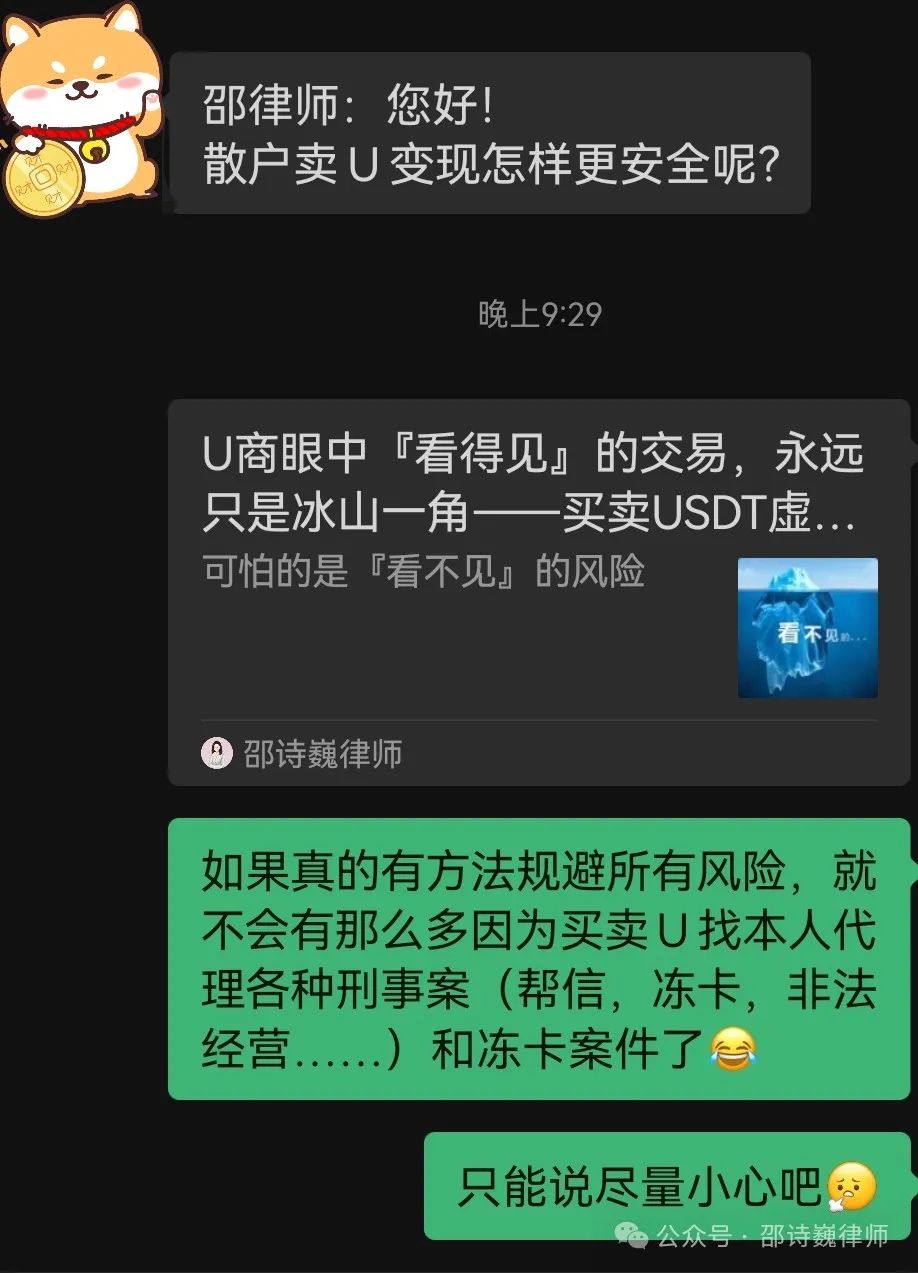
Zhang San works in a certain secret industry and occasionally trades crypto on the side. One day, he added Attorney Shao on WeChat and asked me:How can I sell USDT more safely??And so this diagram came about.
01
Selling USDT and having a card frozen (third party reports to the police)

02
Selling USDT and having a card frozen (reported by a third party)

AOne day, while posting sell orders on an exchange as usual, B contacted A, the two reached an agreement to purchase, and a transaction was completed smoothly. The two also added each other on WeChat, and as they interacted over time they became familiar; B occasionally sought out A to buy USDT, but not frequently, so in the eyes of A, who had a high awareness of risk management, B appeared safe and normal—because each transaction was only a few thousand or tens of thousands, and B had bought only a few times, with no large demand.
One day, B again sought out A to buy USDT, but this time the amount was rather large, 300,000. After A transferred the USDT to B, B said B's card had reached its limit and asked a friend to transfer the money to A; because A had transacted many times before and B had previously also said a friend would transfer to A, and no problem had ever arisen, A fully trusted B. Sure enough, B did not disappoint A, and A received three transfers of 100,000 each from three of B's friends.
Not long afterward, A discovered that A's card had been frozen, and frozen by public security authorities in three localities. When A contacted B, A found that B had deleted A.
The police asked A to return the full 300,000 in USDT received to the victim; A was unwilling, saying that B was behind this and asking the police to arrest B. The police said,You first compensate the victim, and as for the dispute between you and B, you resolve it with B yourself。
Selling USDT and being arrested (reported by the USDT buyer)

As in Case 2 above, A was selling USDT on a certain An exchange; absurdly, the person who reported the matter was B personally. B reported that B had entered an online romantic relationship with a boyfriend, who taught B to buy coins, and B then contacted multiple USDT dealers on a certain An exchange to buy coins. Later B discovered that B had been defrauded by the boyfriend and reported the matter.
Therefore,the police arrested more than twenty USDT dealers, including but not limited to A, all of whom had transacted with B.At present, everyone willing to return the money to B as compensation has been released on bail pending trial,while those unwilling to return the money as compensation continue to sit in the detention center eating plain gruel.
(I had originally intended only to be a quiet listener, but upon hearing this I truly could not hold back, and I remarked to Zhang San with a sigh: the judicial practice across different localities in virtual currency disputes is truly surreal.)
04
Selling USDT and having one's card frozen (the buyer of USDT files a report)

The victim, B, believed that his money had been paid to A, and considered that A must be in league with C! The police therefore froze A's card.
(Zhang San said to me: I could really cry myself to death over this. Whoever defrauded you, go find them. I just sold you some coins; how would I know anything about your dealings with someone else? You never told me about it when you came to me to buy coins in the first place.)
05
Selling USDT and using a third party as a shield, with the third party convicted of the crime of assisting information network criminal activities

After the above four experiences (1, 2, 3 and 4), A was frightened, and keptthinking: how can I sell USDT without having my card frozen and without being arrested?He hit upon a good idea: use someone else's bank card to receive payment!
So A approached his good friend C and said, I have always been a USDT dealer, and I receive so much money every day that it is monitored by the bank's system, and getting it unfrozen each time is very troublesome; lend me your card for a while, and I will give you 200 yuan for every payment received. C did not understand this line of business either and felt a bit afraid. A said, rest assured, for everyone who buys USDT from me, I will have them record a video promising (promising that their funds come from lawful sources and that buying USDT is for legitimate purposes). Hearing this, C thought it was quite reliable and agreed.
In the subsequent cooperation, A did indeed send the buyers' commitment videos to C each time, and A also paid C all the promised kickbacks. After the two parties had cooperated several times, B's bank card was unexpectedly frozen by police in five jurisdictions, and B has been released on bail pending trial by police in two jurisdictions. Over the past few months, B has been,either giving statements at a police station or on the road traveling to police stations across the country to give statements.It has truly been a grueling and exhausting journey.
(Zhang San excitedly said to me: That was close this time! Risk successfully avoided! Aren't I clever? Although I lost several U, which hurts my heart, it's still better than being arrested!)
06
Selling U and finding a third party to serve as a shield, with the third party convicted of concealment

After A had the above experiences 1, 2, 3, 4, and 5, he thought: No! I still need to hide deeper! I want to be behind the scenes!
So he found his good buddy C and asked C to help him sell U. The specific process was: A, through an intermediary's introduction, found buyer B and had C communicate with the intermediary. The intermediary contacted B and had B transfer money to C, after which A released the coins to B.
After the transaction was completed, B reported to the police that he had been defrauded. Because the money was transferred to C, the police have now convicted C of concealment.
(Zhang San said: That was close this time too! I escaped another calamity. Is this intermediary setting me up? I just feel a bit sorry for my buddy C.)
07
Selling U,Unexpectedly, this time he himself became the victim seeking to protect his rights

One day, A's friend said, I have a big order to introduce to you! A said, Great! So, with the friend's matchmaking, A met B, and the two parties agreed to meet at a café and agreed that B would purchase 200,000 U from A (equivalent to approximately RMB 1.4 million). Because the amount was relatively large, A said, why not transfer 1,000 first as a test? B then provided A with his own QR code and had A scan the code to transfer the coins. Afterward, B told A that he had received them. So A scanned the code and transferred the remaining 199,000 coins to B again.
Unexpectedly, this time B said he had not received it?
But A saw that his own account clearly showed the transfer as successful?A confirmed that both times he scanned the same code provided by the other party, and both times the funds were transferred to the same wallet address: Q2i(Only the last 3 characters of the wallet address are listed here; the same applies below)。
B said he had not received the coins and naturally was unwilling to pay A. A panicked: had his 1.4 million just vanished like that? Previously, it had always been A selling USDT that got him involved in cases where others were defrauded; he had never expected that one day he himself would become a victim. So A immediately dragged B to the police station.
The police asked A why B said the second transfer had not succeeded?
A: The address to which he first transferred 1,000 coins was Q2i, but B's account showed that Q2i received them and then transferred them to wallet address 5Hg, yet B said 5Hg was his own address.
A himself could not understand it either. At the coffee shop, the address of B that he scanned was clearly Q2i, but when the two were at the police station, the other party's address indeed showed as 5Hg.
Although A explained for a long time to the police officer taking the statement what U was, what a wallet was, what an address was, and what an exchange was, the police officer still did not understand what USDT or USTD was, and A himself could not explain clearly why he had been defrauded. Therefore, after the statement was completed, the fraud case A reported came to nothing.
(This matter left Zhang San very depressed, and he asked me: Lawyer Shao, why is it so easy for those so-called "victims" to defend their rights? Why is it so difficult for me? The swindler is right in front of me, but the police station just will not file my case!)
Lawyer Shao's note:
How was Zhang San's money stolen by B? In fact, Zhang San overlooked that when he scanned the code to transfer to the other party, Zhang San received a transfer authorization reminder. The page ostensibly displayed a transfer reminder, but in substance, after Zhang San clicked confirm, the other party obtained the authority to transfer away the tokens in Zhang San's wallet. Once Zhang San confirmed the authorization, the other party could transfer the tokens away.
08
After all that, A decided to turn to the dark side.
That's right—Zhang San had been through too much and endured too much. A, still running the USDT-selling business, remained behind the scenes.

One day, he hired a college student, C, for a part-time job. He told C, "A client wants to buy USDT. Help me liaise with the client buying USDT. The address is xxx. When this order is done, I'll transfer you 300." C took the address A gave him and met the client at the entrance of a certain shop. Following his boss A's instructions, C told the client that the RMB had to come first and the USDT after. The client figured that since the person was right there and couldn't run off, he transferred the money to the collection account C provided. After C confirmed it, he messaged A: "Boss, has the client's money arrived? Transfer the USDT." Unexpectedly, this message was rejected.
That's right—when A saw the money had arrived, he deleted C.
Hearing this, I was furious. I said, "How could you do that? He's just a college student looking for a part-time job. Why did you screw him over?"
Zhang San exploded at these words too: "I'm doing business legitimately, just selling some coins—so why is my card frozen every other day? Every time I go to the police station to ask, the police say that if I don't fully refund and compensate the so-called 'victim' the money from selling USDT, they won't unfreeze it for me! Right now I don't have a single card I can use, and on top of that I've got several criminal records against me. Why don't you sympathize with me?"
Hearing this, my silence was deafening.
If selling USDT is not wrong, buying USDT is not wrong, the victim is not wrong, and the police solving the victim's problem are not wrong, then where did things go wrong?
On a side note, college students looking for part-time work should still avoid this kind of job—the crypto world is too deep.

After hearing Zhang San's story, while asking myself in my heart, "Why did Zhang San become like this?", I asked him:"After everything you've been through, why do you keep doing this business?"
Zhang San smiled and said nothing.
Recommended Reading
If a bank card is frozen after selling USDT virtual assets, can it be unfrozen?
What should I do if my bank card is frozen? How can I get it unfrozen as soon as possible?

