Can international U cards fundamentally resolve the issue of frozen bank cards?
Special Disclaimer: This article is an original work by Attorney Shao Shiwei. It reflects only the personal views of the author and does not constitute legal consultation or legal advice on specific matters. For article reprints, legal consultations, or business exchanges, please add WeChat contact: sswls66.
Introduction:
When trading virtual assets, the greatest fear is receiving illicit funds.。
Anyone who has experienced a frozen bank card knows how difficult it is to unfreeze it. Based on our case-handling experience, public security organs across various regions generally hold negative perceptions of parties involved in buying and selling virtual assets. Even if the party whose card is frozen isinnocent,they are often required to “compensate victims for case-related losses” as a precondition for unfreezing their bank cards when communicating with public security authorities. In more severe cases, they may even be accused of crimes such as “aiding information network criminal activities” or “concealing crime-related income” (see this article for details →《[Complaint Post] Some Bizarre Encounters When Buying and Selling USDT》)。
Therefore,how can one avoid having their bank card frozen?This is a common concern among crypto community members, especially those frequently navigating the crypto space.
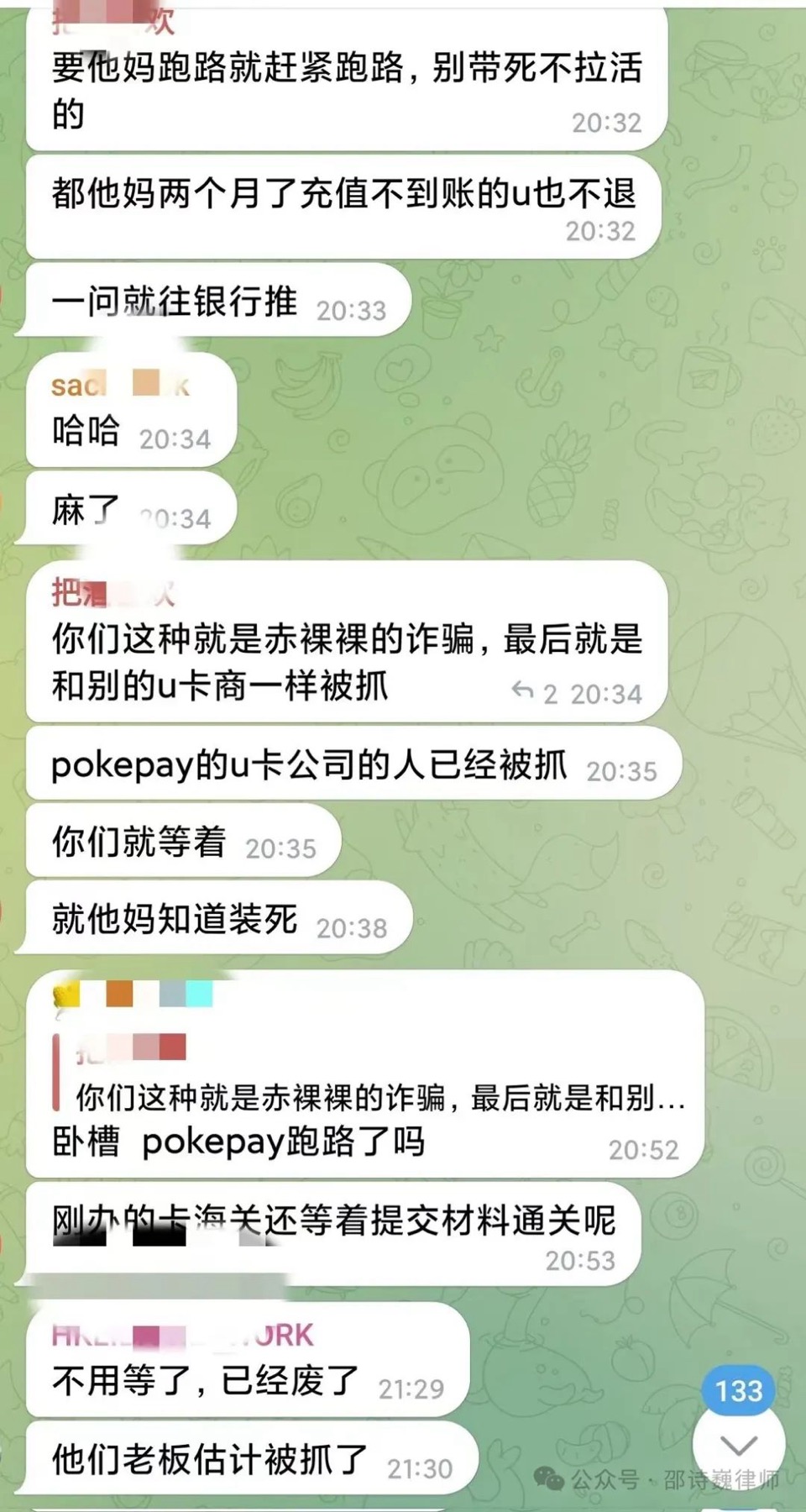
Recently, a client consulted Attorney Shao, sharing some online materials (as shown in the figure) and asking:Many people are using Mastercard U Cards. Are they usable? Does cashing out via U Cards prevent bank card freezes?
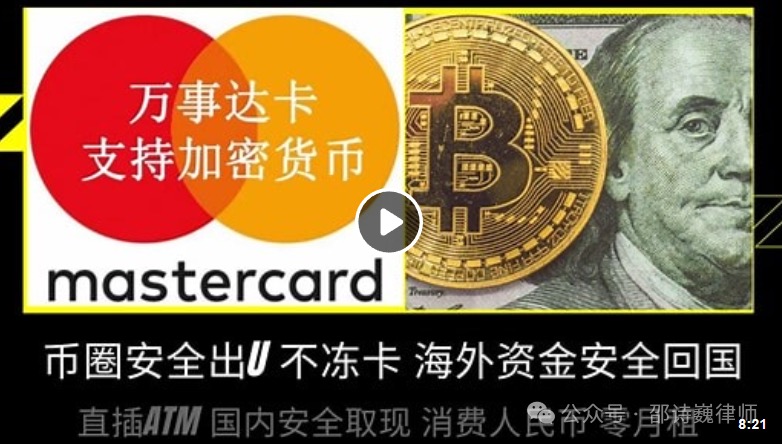
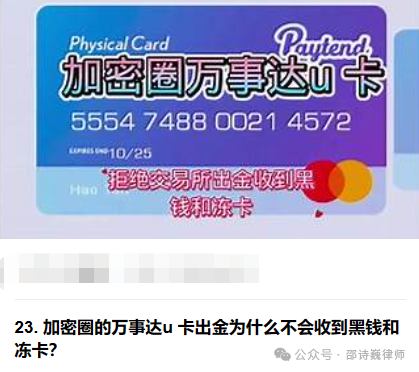
Thus, this article discusses various types of U Cards and their pros and cons, aiming to answer questions for those with similar concerns.
Author: Attorney Shao Shiwei
01
What Is a U Card?
The usage of U Cards can be simply summarized as follows: Users send virtual assets (including but not limited to USDT) from their wallet addresses to the on-chain address associated with the Mastercard. Users can then directly use the card for purchases within China or withdraw RMB from ATMs using the card.
Cardholders can bind the U Card to apps such as Alipay, Meituan, and Ele.me, seamlessly using it as a payment tool for domestic consumption without going through the process of converting virtual assets into fiat currency via OTC trading.
According to relevant policies in China, Bitcoin and other virtual assets are regarded as specific virtual commodities. They do not have legal status equivalent to currency and cannot and should not circulate as currency in the market. However,the payment method using international U Cards seems to magically achieve the function of treating virtual assets as equivalent to fiat currency?
In reality, this is not the case. The virtual assets deposited into the U Card are settled into foreign currencies by the card operator. When users make transactions with the U Card domestically, it is no different from using other bank cards with international payment functions. Due to international settlement agreements, domestic merchants and platforms like Alipay still receive fiat currency.
U Cards can be divided into physical cards and virtual cards. For example, “UnionPay U Cards” and “Mastercard U Cards” are physical U Cards, while “dupay” is a virtual U Card. Fee structures and usage conditions vary slightly among different cards; see the figure below for details.
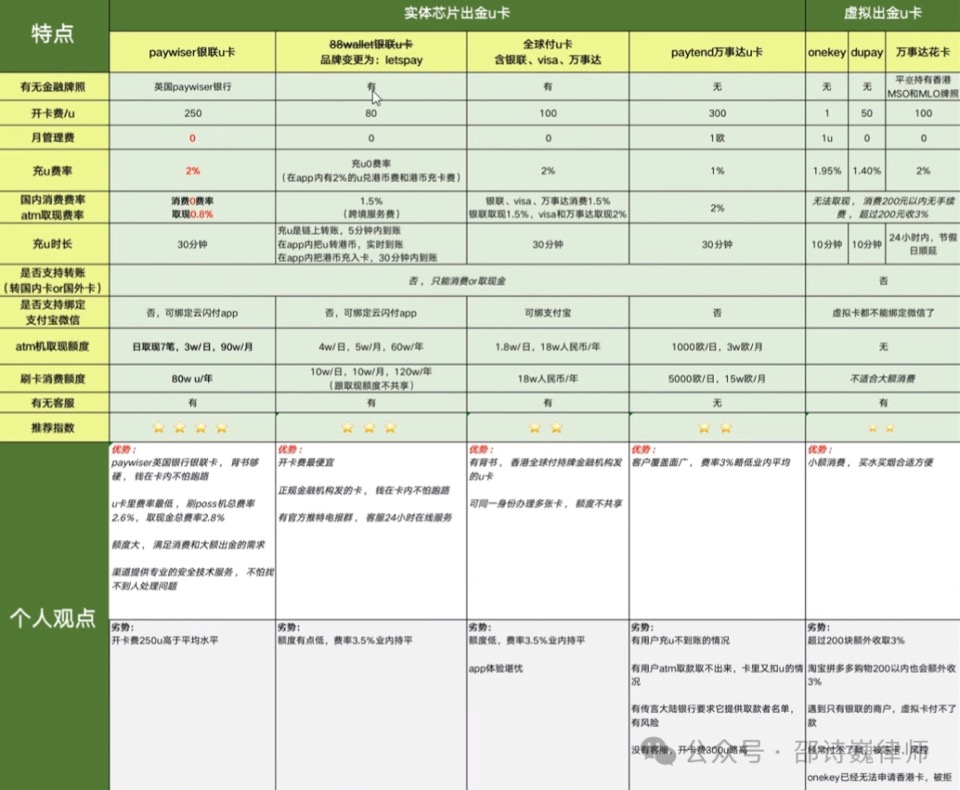
(Source: Up Dahua Xianyou)
02
Pros and Cons of Using U Cards
1. Avoiding the Risk of Frozen Cards
We often state that while buying and selling virtual assets is not prohibited in China, the risks are indeed high, ranging from frozen cards to potential criminal liability. If you sell USDT to someone and the funds they transfer to you are proceeds from their own or upstream illegal or criminal activities (such as fraud from “pig butchering” scams or money laundering from online gambling), the probability of your card being frozen is very high.
Therefore, the reasons for card freezes are: first, you are using a domestic bank card; second, you received abnormal transactions (fiat currency), triggering the bank’s risk control system.
However, U Cards are essentially foreign bank cards. Moreover, the assets received in the card are virtual assets, not fiat currency, and have no direct connection with domestic banks. Thus, they naturally will not be frozen.
Some may ask: What if myMastercard U Card receives “blacklisted USDT”? What are the risks? Will it be frozen?
2. What If the U Card Receives “Blacklisted USDT”?
With a U Card, there is no need to convert USDT into fiat currency via OTC trading, thus avoiding the issue of receiving illicit funds. However, the possibility of receiving “blacklisted USDT” in the card is indeed difficult to completely avoid.
It is important to understand a concept: USDT itself is not marked as “blacklisted”; only the addresses can be blacklisted. In a case where an actor uses USDT for fund transfers, major exchanges such as Binance and OKX will blacklist addresses related to the case. If USDT is received from an address blacklisted by the exchange, the receiving account will be banned by the exchange, and the assets in the account will be restricted to deposits only, with withdrawals blocked.
Receiving USDT via a U Card bypasses exchanges, so it does not trigger the exchange’s risk control mechanisms. Therefore, receiving “blacklisted USDT” does not affect consumption or cash withdrawals. Unless the issuing institutions of these U Cards have relevant KYT risk control measures (Know Your Transaction. KYT is a process used by financial institutions to monitor and track financial transactions for fraud or suspicious activities. It helps financial institutions identify the source and destination of each transaction, assess transaction risks, take appropriate measures, and report suspicious transactions to regulatory authorities.), under which circumstances, receiving “blacklisted USDT” would indeed pose a risk of the card being frozen.
According to online rumors, the People’s Bank of China has requested international U Cards such as Mastercard U Cards to provide lists of customers with abnormal withdrawal activities, but no authoritative official information has been seen to confirm this.
3. Can Using U Cards for Transactions Avoid Criminal Risks Such as Aiding Information Network Criminal Activities or Concealing Crime-Related Income?
The reason for involvement in crimes such as aiding information network criminal activities or concealing crime-related income lies in receiving upstream illicit funds in one’s bank card. Therefore,many believe that since the card receives USDT and does not involve receiving fiat currency into a bank card, there is no criminal risk.However, this is not the case.
Various U Cards do not support transfers; they can only be used for consumption or cash withdrawals. Thus, there is no direct trading with others through the U Card itself involving upstream and downstream transfers, which significantly reduces the possibility of illegal transactions. Nevertheless, some individuals still use U Cards for arbitrage (“brick-moving”) businesses: After agreeing on the price difference between USDT and fiat currency, they use their U Cards to receive USDT on behalf of others, and the difference obtained from ATM cash withdrawals constitutes their profit. If the incoming USDT is proceeds from fraud, and the upstream party converts fraud proceeds from RMB → USDT → deposits into your U Card → cashes out as RMB, this entire chain constitutes concealment of crime-related income.
Furthermore, taking Mastercard U Cards as an example, the card issuance fee is 300 USDT, the monthly management fee is 1 Euro, the USDT deposit fee is 1%, and the ATM withdrawal fee is 2%. Given such high costs, if someone is still willing to give you USDT to cash out for them, doesn’t this clearly indicate a problem? Claiming subjective ignorance of illegality in such a transaction model? No lawyer can save you.
4. Legal Risks of Being Deemed Illegal Foreign Exchange Trading
Regarding the legal risks of illegal business operations involved in buying and selling USDT, Attorney Shao has previously written multiple articles for public education → (See:An Increasing Number of USDT Merchants May Be Convicted of Illegal Business Operations》,《Criminal Risks for OTC Merchants: Illegal Business Operations》《Introducing Others to Trade Foreign Exchange: Beware of Illegal Business Operations!》,《Assisting Others in Currency Exchange Resulting in Conviction for Illegal Business Operations》), so this article will not elaborate further.
In the transaction chain of USDT → Deposited into U Card → Cashed Out as RMB, if the upstream USDT was obtained by exchanging foreign currency, there are two scenarios:
① If the conversion into RMB is for pure personal use and not for business purposes, it constitutes anadministrative violation.If discovered by foreign exchange administration authorities, administrative fines will be imposed.
② If the transactions are high-frequency and involve unspecified counterparties with the aim of earning price differences, and judicial authorities deem it as reselling foreign exchange or disguised foreign exchange trading, it will be characterized asthe crime of illegal business operations.。
5. U Card Scams
Applying for a U Card independently has certain thresholds, so many novices seek agents. However, the agent market is mixed with legitimate and fraudulent operators. If one unfortunately encounters a scammer, seeking remedies is difficult. For instance, a scammer might provide a second-hand U Card. During the guidance process, the recharge link sent to you is actually an authorization request. When you deposit a large amount of USDT into the card, you will find that the USDT in the card has been mysteriously transferred away.
Final Thoughts:
Returning to the initial question of this article: Can U Cards be used? The answer is yes, but strictly for personal use to cash out one’s own USDT. It is more like a prepaid supermarket card: deposit and use immediately. If one intends to use it for arbitrage (“brick-moving”) or as a tool for currency exchange, the resulting legal risks are very high.
The problem never lies with the tool itself, but with the person using it.
The domestic U Card agency industry also faces numerous issues. For example, agents promote that using U Cards prevents card freezes when cashing out USDT. When highlighting the advantages of U Cards, they list that these cards are suitable for online gamblers, individuals under “card-breaking” penalties, and public officials trading crypto assets... Such blatant promotions are practically inviting state intervention.


(Promotional copy from online U Card agents)
Attorney Shao predicts that the lifecycle of U Cards in China will likely not be long. The reasoning is simple:
First,it increases the usage scenarios for virtual assets in China, contradicting the consistent negative stance towards virtual assets in China’s relevant policies.
Second,the state has been cracking down on “two-card” crimes and carrying out “card-breaking” actions for several years. Does the promotion of U Card agencies imply enabling individuals subject to “card-breaking” penalties to use these cards?
Therefore,this tool is easily susceptible to misuse.
According to unofficial rumors, several U Card project teams have been investigated by police in various regions, leading to issues such as failed deposits and inability to withdraw cash from ATMs. Whether these rumors are true remains uncertain.