AI summaryLegal risks associated with group administrators providing escrow services in virtual currency transactions。Legal Risks Associated with Group Administrators Providing Escrow Services in Virtual Currency Transactions Since 2021 , after most virtual currency exchanges exited China, mainland residents have had increasingly fewer channels for investing in virtual currencies.…
Legal Risks Associated with Group Administrators Providing Escrow Services in Virtual Currency Transactions
Since2021, after most virtual currency exchanges exited China, mainland residents have had increasingly fewer channels for investing in virtual currencies. Although laws, regulations, and regulatory policies do not explicitly prohibit virtual currency transactions, policy documents represented by the “9.24Notice” (the Notice on Further Preventing and Disposing of the Risks of Speculation in Virtual Currency Transactions) reflect an attitude that does not encourage, support, or protect virtual currency transactions, leaving the mainland virtual currency market fraught with dangers akin to a primitive jungle.
In an effort to find a viable path, adventurous participants in the crypto community began exploring various avenues: some led to smooth roads, others remained rugged and difficult, and some turned out to be dead ends. Among the methods for safely buying and selling virtual currencies, one approach involves escrow services provided by group administrators. This model, reminiscent of medieval European trade markets, may appear “backward,” yet it has thrived in the emerging field of the crypto community, representing a form of innovation in its own right. However, as aweb3.0lawyer, the author must dampen enthusiasm by stating: group administrator escrow services for virtual currencies carry significant legal risks!
What Is Group Administrator Escrow and Trading in Virtual Currencies?
“9.24Notice,” all mainstream virtual currency exchanges exited the mainland. However, the demand for virtual currency transactions among numerous crypto community participants and traders has not diminished. Some individuals continue to trade on overseas virtual currency exchanges by using tools to bypass internet restrictions. Others, having accumulated substantial networking resources earlier, simply “leveraged their remaining influence” to matchmake for those seeking to buy or sell virtual currencies, thereby earning small commissions. In fact, even on virtual currency exchanges, spot trading of virtual currencies (primarily involving the buying and selling ofUSDT) constitutesC2Ctrading, with relatively higher transaction fees. Consequently, some experienced crypto participants and newcomers (including those unable to bypass internet restrictions) prefer to conduct transactions within online communities, relying on reputable group administrators within the community to provide escrow services, a method that some have come to accept.
In terms of community formats, common groups include WeChat groups,QQgroups, Telegram groups, etc. Group administrators are typically individuals with certain reputations and credibility within the community, such asKOL, majorV, or individuals with substantial financial strength (even so, they still seek to earn small commissions, as every bit helps).
Regarding the transaction process, there are generally two methods. The first method is “crypto first, payment later.” The specific steps are as follows: Step 1: Parties who reach a transaction intention within the community either create their own group or communicate in a group created by the administrator to determine the type of currency, quantity, amount, etc.; Step 2: The seller transfers the virtual currency to the group administrator’s wallet address; Step 3: Upon receiving the virtual currency, the group administrator posts a screenshot in the group for confirmation and notifies the buyer to transfer funds (in RMB) to the seller; Step 4: After receiving the payment, the seller posts a screenshot in the group for confirmation and notifies the group administrator to release the virtual currency to the buyer; Step 5: The buyer confirms receipt of the virtual currency. At this point, the transaction is completed.
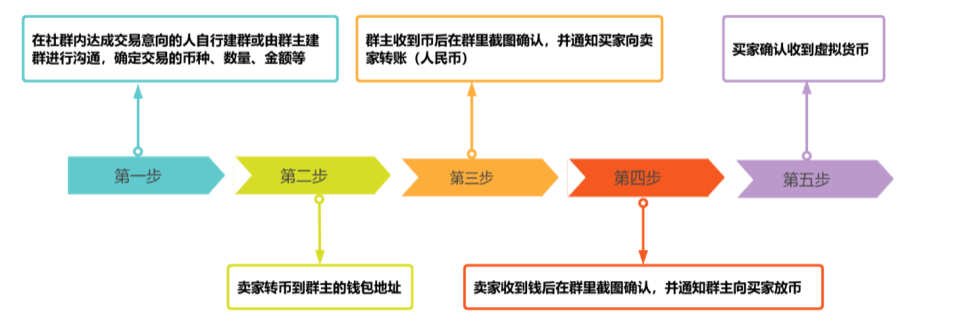 The second method is “payment first, crypto later,” where the buyer first transfers RMB to the group administrator, then the seller transfers the virtual currency to the buyer, and finally the group administrator transfers the funds to the seller. Other steps are identical to the first method.
What Are the Legal Risks of Group Administrator Escrow Transactions?
(I) Violation of the “9.24Notice”
“9.24The Notice stipulates that “conducting exchange businesses between fiat currencies and virtual currencies, exchange businesses between virtual currencies, acting as a central counterparty to buy and sell virtual currencies, providing information intermediary and pricing services for virtual currency transactions, etc.,”constitute illegal financial activities. For group administrators, the escrow transaction model provides direct assistance in the exchange between virtual currencies and fiat currencies, and may even involve acting as a central counterparty to buy and sell virtual currencies (i.e., assuming the roles of seller to the buyer and buyer to the seller), which clearly falls under illegal financial activities. Whether such actions necessarily constitute a crime depends on the scale and manner of the transactions, as well as the degree of infringement upon legal interests (particularly the harm caused to financial order and financial security).
(II) Participation in Direct or Indirect Money Laundering
In a sense, the role of group administrators in escrow transactions is similar to that of virtual currency exchanges. Legitimate virtual currency exchanges possess the strength and capability to conductKYC、AMLreviews of transacting users. However, community group administrators generally lack the ability to perform such reviews on transacting users, and thus cannot ensure that the participants, virtual currencies, and funds involved in the transactions are genuine, lawful, and compliant.
If either the buyer or the seller is involved in money laundering activities, the group administrator, as the escrow party, is highly likely to commit the crime of aiding information network criminal activities or the crime of concealing or disguising the proceeds of crime, and may even directly become an accomplice to upstream or downstream crimes.
(III) Fraud Against Buyers/or Sellers
For buyers or sellers, placing trust solely based on reputation without knowing the group administrator or possessing their identity information does not fully align with basic common sense in contemporary commercial transactions. If the group administrator disappears after receiving the virtual currency, it is difficult to recover losses under current judicial practice. Even if RMB is received, if the group administrator uses another person’s account (such as bank accounts purchased on the black market) to collect funds and then vanishes, it is challenging for the buyer to effectively assert their rights, ultimately resulting in fraud.

In summary, although the group administrator transaction model is concise and efficient, it poses significant legal risks for the group administrator, the buyer, and the seller alike. Attorney Liu does not recommend that any party use this method for investment and trading in virtual currencies.

To submit articles or request permission for reprinting, please add the WeChat ID: MankunLawFirm