

Is crypto media a good business?
Special Disclaimer:
This article is an original work by Mankun Law Firm. It represents only the personal views of the author and does not constitute legal consultation or legal advice on specific matters. For reprinting permissions, please contact Mankun Law Firm staff at: MankunLawFirm
Background
News media serves as an important channel for information dissemination and public opinion influence. For the crypto sector, which is still in a period of vigorous development, news media not only provides all parties with the latest market trends, developments, analyses, and commentary, but also plays a significant role in popularizing and promoting the industry. However, operating crypto news media is no easy task, as evidenced by the transformation of the formerly well-known blockchain news website,8btcwhich has shifted its focus to AIGC (Artificial Intelligence Generated Content) news.
Nevertheless, there is demand for industry news, as well as for information on price trends in the crypto sector. Many investment institutions also include media as part of their investment portfolios to facilitate market promotion and publicity. The prerequisite for doing difficult yet correct things is to guard against potential legal risks. For crypto news media, the following are key compliance points.
Compliance with Operational Qualifications
I. Internet News Information Service License
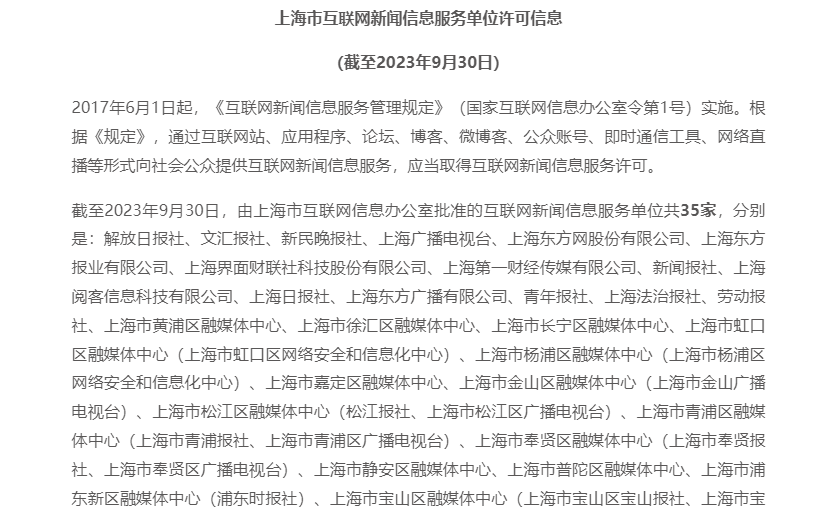
Only those providing news information are required to apply for an Internet News Information Service License.According to China’s Provisions on the Administration of Internet News Information Services (2017), the term “news information” referred to in the aforementioned license includes reports and commentary on social public affairs such as politics, economy, military affairs, and diplomacy, as well as reports and commentary on sudden social events.For crypto news media, the nature of their information does not fall under social public affairs; it merely constitutes reporting and commentary on commercial news within a specific industry. Therefore, there is no need to apply for an Internet News Information Service License.In practice, entities applying for Internet News Information Service Licenses are mostly mainstream media outlets, such as central state media and party-affiliated media.
II. Filing/License for Internet Information Service Providers (ICP Filing/Operating License)
According to the Measures for the Administration of Internet Information Services (2011 Revision), service activities that provide publicly accessible and shareable information to internet users free of charge via the internet constitute non-operational internet information services and require filing as an Internet Information Service Provider. In short,all websites must undergoICPfiling。If information is provided for a fee, or if services such as webpage production, online advertising, or e-commerce are offered, these constitute operational internet information services, requiring an ICP Operating License (also known as the Value-Added Telecommunications Business Operating License for Internet Information Services). This should not be confused with an EDI License, as the two permits are entirely different.For crypto news media, the business model generally involves providing information to internet users free of charge. For instance, PANews, a crypto news media outlet, has only obtained ICP filing.。However, if users are required to pay to access relevant information, adopting a business model similar to Caixin, then the crypto news media must apply for an ICP Operating License.


Compliance in Content Publication
I. Copyright Protection
According to the Copyright Law and the Administrative Measures for the Protection of Copyright on the Internet, Internet Information Service Providers must respect and protect others’ copyrights, rights of communication through information networks, and related rights. They must not use others’ works without authorization or infringe upon others’ copyrights and related rights in other ways. If using others’ works, lawful authorization must be obtained, remuneration must be paid as agreed, and the author’s name and source must be cited. Unauthorized use of others’ works, use beyond the scope of authorization, failure to pay remuneration as agreed, or failure to cite the source will be deemed infringement. This may result in civil liabilities such as cessation of infringement, elimination of impact, apology, and compensation for losses; administrative liabilities such as fines, confiscation of illegal gains, and revocation of licenses; or even criminal liability if a crime is constituted.
Specifically, when translating English industry articles, crypto news media must obtain lawful authorization from the original copyright holder, cite the author’s name and source, promptly declareexemption from liability for infringing content posted by users, and remove relevant content upon receiving notice of infringement from the copyright holder.
II. Regulatory Policies Related to Virtual Currencies
Crypto news media must also comply with mainland China’s regulatory policies regarding virtual currencies.。According to the Notice on Further Preventing and Disposing of Risks Associated with Virtual Currency Trading and Speculation (Yin Fa [2021] No. 237), business activities related to virtual currencies constitute illegal financial activities. Providing information intermediary and pricing services for virtual currency trading, among other virtual currency-related business activities, is suspected of being an illegal financial activity and is strictly prohibited.
When operating websites, crypto news media must avoid involvement in token issuance financing activities and virtual currency trading activities.For example, when publishing content, they must avoid promoting, recommending, evaluating, or predicting content related to token issuance financing and virtual currency trading. When providing services, they must avoid offering platforms, mediums, tools, technologies, or other services for token issuance financing and virtual currency trading. When leasing advertising space, they must avoid cooperating with organizations or individuals engaged in token issuance financing and virtual currency trading activities.
Additionally, user risk warnings and education are required. For instance, relevant policy documents must be prominently displayed on the homepage or in conspicuous positions, with warnings to users about risk prevention. When publishing content, sources must be cited, and users must be reminded to independently verify authenticity. When providing services, users must be advised to exercise caution, and disclaimers must be provided.

Particularly, when operating websites, it is crucial to distinguish between project tokens and project points. Project tokens refer to digital credentials with value attributes issued based on blockchain technology, such as Bitcoin and Ethereum. Project points refer to digital credentials without value attributes issued based on blockchain technology, such as loyalty points and coupons. According to regulatory policies, the issuance and trading of project tokens are prohibited, whereas the issuance and use of project points are permitted. Therefore, when operating a website, if incentives or value-added services are provided to users, the platform may issue its own project points but must not issue its own project tokens.
Data Compliance and Privacy Protection
According to the Cybersecurity Law and the Personal Information Protection Law, network operators shall adhere to the principles of legality, propriety, and necessity. They must clearly specify the purpose, method, and scope of collecting and using personal information, and obtain consent from the personal information subject or disclose such information in accordance with the law.
When collecting and using users’ personal information, crypto news media must clearly inform users and obtain their consent. Simultaneously, they must formulate and publish a privacy policy and protect users’ personal information in accordance with said policy. For example, during user registration, the privacy policy must be presented to users and their consent obtained. During user login, users must be informed and consent obtained for the use of cookies and other technologies to collect user data. When users post content, they must be informed and consent obtained for the use of sensitive word filtering and other technologies to review user content.
When processing users’ personal information, the principle of minimization must be observed, and necessary measures must be taken to ensure data security. For example, user data must be encrypted or desensitized when stored; secure protocols and channels must be used when transmitting user data; risks must be assessed and user consent obtained when sharing or transferring user data; and in the event of data leakage or damage, users must be notified promptly and remedial measures taken.
Particularly, when handling user real-name authentication, a distinction must be made between guests and registered users. Real-name authentication may not be required for guests, but users who post content must undergo real-name authentication. It is important to note that decentralized wallets cannot be equated with real-name authentication, as decentralized wallets are also anonymous. Therefore,if users are required to log in or bind using a decentralized wallet, they must also be required to provide other valid identity proofs, such as mobile phone numbers, email addresses, or ID cards, to fulfill real-name authentication requirements。
Conclusion
Operating media is a task that requires a high sense of responsibility and legal awareness, and crypto news media is no exception. While striving to provide valuable information services to users with an objective, fair, and professional attitude, crypto news media must also fulfill their social responsibilities and legal obligations.
Recommended Reading
zkSync Shanghai Tour: How to Legally and Compliantly Host Web3 Offline Events?
Trump, the Crypto Patriarch of the US: Can He Still Become President After Being Sentenced?
Bitcoin Inscriptions: A Hype Deviating from Satoshi Nakamoto’s Original Intent

{loadmoduleid 245}

To submit articles or request reprint permissions, please add WeChat ID: MankunLawFirm