
Figure’s compliance pathway is not an attempt to circumvent regulation.
Introduction
On October 14, 2025, Figure Certificate Company (FCC), a subsidiary of Figure Technology Solutions (NASDAQ: FIGR), announced that its interest-bearing security token, YLDS, registered with the U.S. Securities and Exchange Commission (SEC), has been natively deployed on the Sui public blockchain. This marks the first time YLDS has expanded beyond its native chain (Provenance) to another mainstream Layer-1 public blockchain, achieving a significant breakthrough in “cross-chain compliance.”
Against the backdrop of tightening crypto asset regulation in the United States and frequent setbacks affecting yield-bearing products,Figure has chosen a nearly opposite route: proactively acknowledging the securities nature of its tokens and implementing a compliant structure for yield distribution.This not only makes YLDS one of the first interest-bearing on-chain assets filed with the SEC, but also provides a replicable legal compliance model for compliant yield generation in the Web3 world.
Deconstructing YLDS: The End-to-End Process from USD Funding to On-Chain Yield
YLDS is essentially a blockchain-based yield-bearing security token. Its core mechanism involves digitizing real-world fixed-income assets (such as short-term notes or treasury bonds) and issuing them on a public blockchain in the form of compliant securities.

Its operational process is as follows:
-
Subscription:Investors subscribe to YLDS in U.S. dollars, with funds transferred into an independent custodial account.
-
Asset Investment:The custodial account invests in underlying assets that generate stable returns.
-
On-chain issuance:Figure mints the corresponding YLDS tokens on the Sui public blockchain, serving as beneficiaries’ certificates for investors’ interests in the asset pool.
-
Distribution of returns:After the underlying assets generate interest, Figure distributes such interest to investors on a pro rata basis.
-
Redemption of principal:Upon maturity or when specified conditions are met, investors may redeem their principal.
This model establishes a closed-loop framework encompassing “USD funding—asset investment—on-chain certificates—distribution of returns—redemption of principal,” balancing traditional financial compliance with on-chain transparency and verifiability, thereby creating a yield-bearing vehicle with a dual-layer structure of “tokenization of real-world assets (RWA) plus securities law compliance.”
Legal characterization: YLDS with a stable face value is not a stablecoin.
Although YLDS resembles“interest-bearing stablecoins”in terms of user experience, there are fundamental differences between the two in their legal characteristics and regulatory logic:
Although specific regulatory rules for stablecoins are still being explored and refined globally, there is a growing consensus and trend across major jurisdictions to classify stablecoins as "payment and store-of-value instruments" and regulate them within the payment system (rather than the capital markets), while requiring"no interest or yield to be paid to holders", which has become the consensus and trend in major global jurisdictions. In contrast, YLDS is built on a compliance foundation of traditional securities registration and disclosure, leveraging public blockchains to achieve 24/7 transferability and programmable yield distribution. The legal essence of YLDS is an investment product, and its yield structure and legal relationships are fundamentally different from those of stablecoins:
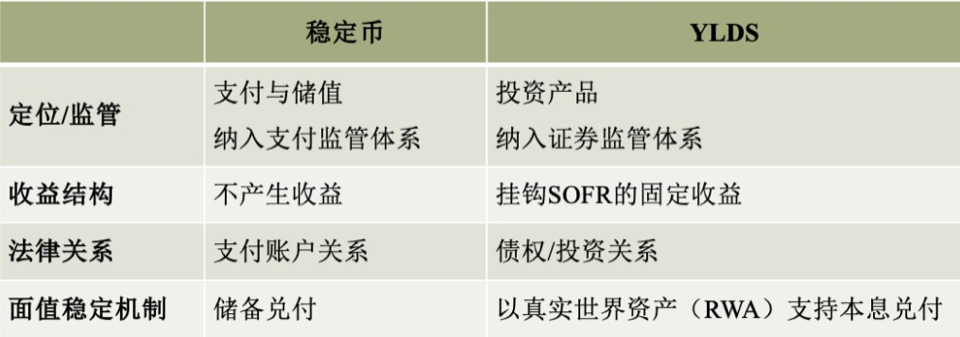
Therefore, YLDS with a stable face value ≠ stablecoin. Although they share similar functions, their attributes are markedly different—both have nominal values pegged to "1 USD," but the core of a stablecoin lies inmaintaining "price stability" for short-term purchasing power and payment functionality, whereas YLDS is dedicated to providing "yield stability" backed by real-world assets (RWA) and "long-term risk control." This represents a new compliance model: achieving stable yields through a securities law framework, rather than pursuing price stability through a payments law framework.
Compliance Logic of the YLDS Yield Mechanism
Within the regulatory context of the U.S. crypto market, yield-bearing crypto products have consistently been a high-risk area for enforcement. The SEC has taken enforcement actions against products such as BlockFi, Celsius, and Gemini Earn, citing reasons including unregistered securities offerings. Under U.S. securities law and payment regulation logic: if yield or interest is paid to token holders, it is highly likely to be deemed an investment contract; if stablecoins or payment-type tokens carry yield, they may lose their status as "payment instruments" and fall under securities regulation and other regimes.
Against this backdrop, Figure adopted the path of "acknowledging securities attributes → avoiding investment contract risks → classifying as debt securities → issuing in compliance with registration requirements," thereby constructing a regulatable yield-bearing securities structure without departing from on-chain innovation.
1. Logical Starting Point: Proactively Acknowledging Securities Attributes
Unlike other Web3 yield products that passively encounter regulatory scrutiny, Figure’s strategy is to proactively acknowledge YLDS as a security and voluntarily subject it to the SEC’s exemption framework. This proactive classification is a self-securitization strategy: by choosing the registration path, YLDS is directly incorporated into the lawful securities issuance system, actively entering the regulatory framework, thereby resolving the controversy over "whether it constitutes a security" and securing compliance space.
2. Core Mechanism: "Downgrading Design" from Howey to Reves
The core of Figureinnovation lies in its downgraded compliance strategy through legal structure design: namely, Figure optimizes its structure so that the risk profile of YLDS more closely resembles traditional bonds, aligning more with the characteristics of a "note" under the Reves Test, rather than an equity-type investment contract.

Within the YLDS structure, returns are defined as interest income, constituting debt payments under contractual obligations, rather than investment profits (i.e., dividends from managed returns). These returns derive from interest on real-world assets (RWA), not from platform reinvestment yields. This design ingeniously avoids the "expectation of profits" and "efforts of others" elements of the Howey Test, thereby legitimizing the interest-bearing mechanism.
3. Issuance Pathways: The Divergence Between Registered Securities and Cross-Border Private Placements
According to public information, the vehicle for YLDS is the Figure Certificates issued by FCC, which are face-amount certificates with debt characteristics, essentially constituting interest-bearing debt securities. FCC filed a Form S-1 registration statement with the U.S. Securities and Exchange Commission (SEC) in 2025 and explicitly stated in its formal prospectus:
Figure Certificates are interest-bearing debt securities, issued by Figure Certificate Company, a face-amount certificate company registered under the Investment Company Act of 1940.—— [SEC Filing, Figure Certificate Company, 2025]
This arrangement implies:The interests represented by YLDS are not issued under private placement exemptions, but are debt securities brought under formal SEC regulation through traditional registration procedures (registered debt securities).This model not only establishes the legal legitimacy of YLDS but also builds a solid securities law foundation for its subsequent on-chain deployment (such as listing on the Sui public blockchain).
Furthermore, FCC indicated in its SEC filings that certain Figure Certificates (such as Transferable Certificates) may be traded secondarily on registered Alternative Trading Systems (ATS) in the future, enabling compliant transfers between holders. This arrangement breaks through the liquidity barrier of traditional securities products being "registered but non-transferable," and provides a crucial pivot for the lifecycle compliance of on-chain securitized assets—ensuring that the entire process, from issuance, holding, and distribution of returns to compliant transfer, remains within the regulatory scope.
Of course, in the actual market operations of crypto financial products, the light-compliance structure of dual exemptions under Regulation D and Regulation S remains an extremely common prevailing mechanism. Many Web3 projects adopt the combined channel of Reg D and Reg S for token issuance during early-stage financing, supplemented by on-chain lock-ups, compliance audits, and trading platform support, to achieve“On-chain compliance + cross-border coverage”dynamic balance.
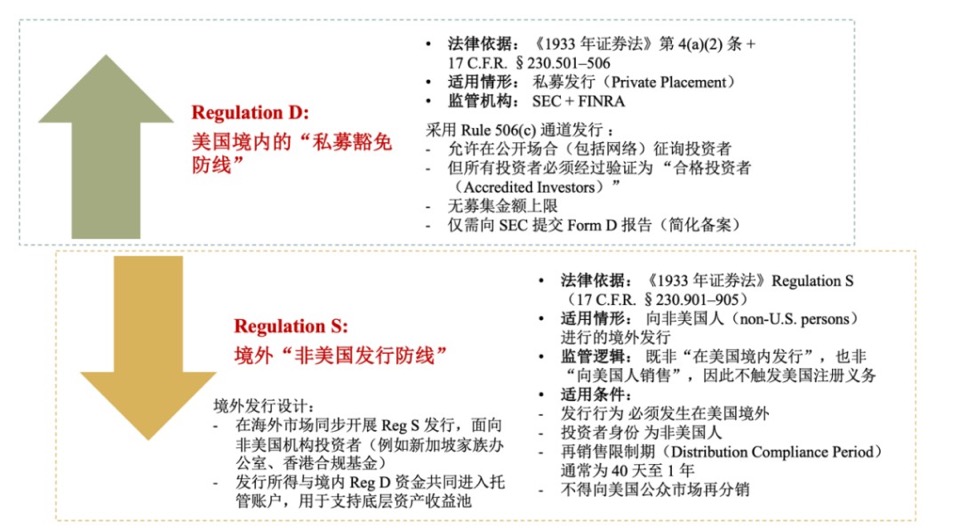
Figure’s compliance pathway can be viewed as an advanced iteration of this traditional dual-exemption architecture: by incorporating into the regulatory framework through registration or registration-type bond mechanisms, the boundaries of compliance are more clearly defined. Of course, the widely adopted Reg D + Reg S combination in the market continues to serve as a highly flexible private placement mechanism, providing an operable alternative pathway for on-chain asset issuance on a global scale.
YLDS’s pathway intersects with and draws lessons from mainstream structures, demonstrating the diversity and future possibilities of on-chain compliance: it can either“adopt registration as the norm”, or“use exemptions as the pathway”, with the key lying in the meticulous construction of legal structures and the adaptive arrangement of issuance pacing.
Conclusion: A Model for Transitioning from Gray-Area Returns to Regulatory Compliance Benefits
Figure’s compliance pathway is not an evasion of regulation, but rather an embedded restructuring achieved through legal structure design: by proactively acknowledging its securities nature, it transforms returns from investment profits into debt interest, and through registered compliant issuance, achieves a safe transition from a “potentially non-compliant investment contract” to a “regulated debt security.”
The Figure pathway demonstrates how to balance on-chain transparency with off-chain legal compliance, and how to achievereturns, trust, and regulatory complianceThe balance among the three provides a replicable model for crypto financial products to transition from "gray-area returns" to"regulatory-compliant returns",and also offers important compliance references for real-world assets (RWA) projects.