

The choice among a not-guilty defense, a defense seeking a lesser sentence, or a defense based on a lesser offense must be determined through case-specific analysis of the particular facts and issues.
Special Disclaimer: This article is an original work by Attorney Shao Shiwei. It reflects only the author’s personal views and does not constitute legal consultation or legal advice on any specific matter. For article reposting, legal consultation, or professional exchanges, please add: sswls66
Whether virtual assets or the digital renminbi are used as instruments to transfer illicit proceeds, or whether the conduct involves ordinary “two-card” offenses, in addition to potential liability as an accomplice to the predicate offense—thereby incurring the same charge as the predicate offense (such as the crime of operating a casino, fraud, etc.)—the crime of aiding information network criminal activities(the “Aiding Offense”)and the crime of concealing or disguising criminal proceeds and the benefits derived therefrom(the “Concealment Offense”) are more common and frequently charged offenses.
Under applicable law, the Aiding Offense carries a maximum sentence of three years’ imprisonment, while the Concealment Offense carries a maximum sentence of seven years’ imprisonment. Accordingly, when a client is charged with the Concealment Offense, one defense strategy available to counsel is to argue for recharacterization as a lesser offense. If the conduct can be recharacterized as the Aiding Offense, given that offense’s higher thresholds for criminal liability, the likelihood of receiving a suspended sentence for the same amount involved is evidently higher; where the conduct merely meets the statutory threshold for initiation of criminal proceedings, there may even be grounds to seek a decision of relative non-prosecution at the procuratorial review stage.
However, whether it is viable to pursue a defense seeking a lesser offense must be assessed by reference to the constituent elements of each offense in light of the specific circumstances of the case. We explore this issue using the case discussed herein. (Note: The modus operandi of the money-laundering syndicate illustrated in this case is commonly encountered in practice; any resemblance to actual cases is purely coincidental.)
Author: Attorney Shao Shiwei
01
Question Posed: In virtual asset transactions, why are USDT dealers charged with the Concealment Offense?
In fact, during numerous detention-center visits with clients, Attorney Shao has gained a profound appreciation that crypto-related criminal cases constitute a relatively niche field. As participants within the transaction chain, clients often have significant blind spots regarding their own conduct. Moreover, if retained counsel lacks experience handling crypto-related matters, clients may remain unaware of why their conduct is alleged to constitute a crime until the case reaches the review-for-prosecution stage, when they are permitted to review the case file.
Consider the following case. From the client’s perspective, the facts are as follows:
A met B on Telegram (TG). B asked A whether he would like to engage in a small business venture that could generate profits from price differentials by buying and selling virtual currencies. A expressed strong interest, and B guided him through the initial steps, starting with an explanation of what a cold wallet is. Because A was new to this activity, B not only sold USDT to A but also introduced clients to him.
B advised A to exercise extreme caution to avoid receiving illicit funds of unknown origin and recommended that A conduct thorough know-your-customer (KYC) checks on clients. A took this advice to heart. In addition, having read numerous articles by Attorney Shao, A understood that there are risks when a counterparty instructs a third party to remit funds to him. Accordingly, A devised a method: he required buyers to personally deposit RMB cash at a bank and remit the funds to him, and he required buyers to record a video showing both the remittance receipt and the original identity card, in which the buyer warranted that the source of funds was lawful and the purpose of the transaction was genuine, and agreed to bear any losses arising therefrom. After receiving the funds, A withdrew them in cash and used the cash to purchase additional USDT from B.
I believe that most individuals with experience in virtual currency transactions, upon reviewing this transaction process, would consider that A had fulfilled no less than 90% of his KYC review obligations, if not 100%.
However, shortly thereafter, A was criminally detained on suspicion of the crime of concealing or disguising the proceeds of crime, and B disappeared after learning of the news.
In relation to this case, we need to consider two questions:
1. Why was A charged with the crime of concealing or disguising the proceeds of crime?
2. Where the amount involved is relatively high, if A’s conduct indeed constitutes a criminal offense, is there a possibility that the charge in this case could be changed to the crime of aiding information network criminal activities?
02
Distinguishing the thresholds for initiating investigations into the crime of aiding information network criminal activities and the crime of concealing or disguising the proceeds of crime is of significant importance.
1. Thresholds for initiating investigations into the crime of aiding information network criminal activities
Article 12(1)(2) of the Interpretation of the Supreme People’s Court and the Supreme People’s Procuratorate on Several Issues Concerning the Application of Law in the Handling of Criminal Cases Involving the Illegal Use of Information Networks, Aiding Information Network Criminal Activities, and Other Matters (hereinafter, the “Interpretation”) provides that “payment and settlement amounts exceeding RMB 200,000” shall be deemed “serious circumstances” for the crime of aiding information network criminal activities;
The 2022 Minutes of the Meeting on Certain Issues Concerning the Application of Law in the “Card-Cutting” Campaign further clarified the applicable standard whereby one-way inflows of funds into bank cards involved in cases exceed RMB 300,000, and at least RMB 3,000 thereof is verified as fraud proceeds.
Interpretation of the Supreme People’s Court and the Supreme People’s Procuratorate on Several Issues Concerning the Application of Law in the Handling of Criminal Cases Involving the Illegal Use of Information Networks, Aiding Information Network Criminal Activities, and Other Matters
Document No.: Fa Shi [2019] No. 15
Article 12 Where a person knowingly provides assistance to another person who commits crimes by means of information networks, and any of the following circumstances exists, such conduct shall be deemed as “serious circumstances” as prescribed in Paragraph 1 of Article 287-2 of the Criminal Law:
(1) providing assistance to three or more persons;
(2) the amount involved in payment and settlement reaches RMB 200,000 or more;
(3) providing funds of RMB 50,000 or more through methods such as placing advertisements;
(4) illegal gains amount to RMB 10,000 or more;
(5) having been subject to administrative penalties for illegally using information networks, assisting in cybercrime activities, or endangering the security of computer information systems within two years prior, and again engaging in assisting in cybercrime activities;
(6) the crimes committed by the assisted persons result in serious consequences;
(7) other circumstances constituting serious circumstances. Where a person commits the acts prescribed in the preceding paragraph, and it is indeed impossible to verify whether the assisted persons’ conduct has reached the threshold for criminal liability due to objective constraints, but the relevant amounts cumulatively reach five times or more of the standards prescribed in Items (2) through (4) of the preceding paragraph, or cause particularly serious consequences, the actor shall be held criminally liable for the crime of assisting in cybercrime activities.
2. Thresholds for Initiating Investigation for the Crime of Concealing or Disguising the Proceeds of Crime
(1) There is no explicit statutory threshold for criminal liability for the crime of concealing or disguising the proceeds of crime.In other words, the existence of a specific amount involved in the case is not a mandatory requirement for determining that an actor constitutes this crime.
In the Interpretation of the Supreme People's Court on Several Issues Concerning the Application of Law in the Trial of Criminal Cases Involving the Concealment or Disguise of Crime-Related Proceeds and the Benefits Derived Therefrom (hereinafter referred to as the "2015 Interpretation") issued in 2015, thresholds for initiating criminal proceedings for the offense of concealing or disguising crime-related proceeds were prescribed as "where the value of the concealed or disguised crime-related proceeds and the benefits derived therefrom amounts to RMB 3,000 to RMB 10,000 or more." However, in April 2021, the Supreme People's Court issued a Decision on Amending the Interpretation of the Supreme People's Court on Several Issues Concerning the Application of Law in the Trial of Criminal Cases Involving the Concealment or Disguise of Crime-Related Proceeds and the Benefits Derived Therefrom, stipulating that the aforementioned thresholds are no longer applicable.
(2) The criteria for determining criminal liability for "serious circumstances" (punishable by imprisonment of three to seven years) for the offense of concealing or disguising crime-related proceeds continue to be governed by the provisions of the 2015 Interpretation. In brief, where the aggregate value involved reaches RMB 100,000 or more, or where there are ten or more instances of deriving benefits, or where there are three or more instances and the aggregate value reaches RMB 50,000 or more, such conduct constitutes "serious circumstances."
2015 Interpretation of the Supreme People's Court on Several Issues Concerning the Application of Law in the Trial of Criminal Cases Involving the Concealment or Disguise of Crime-Related Proceeds and the Benefits Derived Therefrom
Article 3: Where crime-related proceeds and the benefits derived therefrom are concealed or disguised, and any of the following circumstances exists, it shall be deemed as "serious circumstances" as prescribed in Paragraph 1 of Article 312 of the Criminal Law:
(1) The aggregate value of the concealed or disguised crime-related proceeds and the benefits derived therefrom reaches RMB 100,000 or more;
(2) The crime-related proceeds and the benefits derived therefrom are concealed or disguised on ten or more occasions, or on three or more occasions with an aggregate value reaching RMB 50,000 or more;
(3) The concealed or disguised crime-related proceeds consist of electrical power equipment, transportation facilities, radio and television broadcasting facilities, public telecommunications facilities, military facilities, or funds and materials designated for disaster relief, emergency rescue, flood control, preferential treatment and compensation, poverty alleviation, resettlement, or social assistance, with an aggregate value reaching RMB 50,000 or more;
(4) The act of concealment or disguise prevents the timely investigation and handling of the upstream crime, resulting in irretrievable significant losses of public or private property or other serious consequences;
(5) Other acts of concealing or disguising crime-related proceeds and the benefits derived therefrom are committed, which seriously impede judicial organs from pursuing accountability for the upstream crime.
Returning to the case cited at the beginning of this article, if the amount involved is RMB 100,000, it would not meet the threshold for initiating criminal proceedings if characterized as the offense of aiding information network criminal activities. However, if characterized as the offense of concealing or disguising crime-related proceeds, the statutory sentence could include imprisonment of three years (of course, the actual sentence requires comprehensive consideration of factors such as the party's cognitive capacity, illicit gains, whether victim forgiveness has been obtained, and the presence of statutory mitigating or leniency circumstances; as these depend on the specifics of each individual case, they will not be discussed further in this article).
03
The concept of "knowingly" as understood by the general public ≠ the concept of "knowingly" as understood by judicial authorities
Both the offense of concealing or disguising crime-related proceeds under Article 312 of the Criminal Law and the offense of aiding information network criminal activities under Article 287-2 of the Criminal Law require that the perpetrator knowingly provides assistance while aware that the assets constitute crime-related proceeds and benefits, or while aware of another person's criminal conduct.
Attorney Shao also believes that no one would knowingly assist another person suspected of committing a crime by receiving funds on their behalf, merely to earn meager "benefits," while risking criminal conviction. It is a simple principle: human beings are driven by self-interest and the avoidance of harm.Who would engage in activities where the risks are disproportionate to the rewards?
However, from the perspective of legal practice, with respect to such offenses,Attorney Shao rarely pursues a not-guilty defense, for two reasons:
1. With the continuous advancement of the "Card Breaking" campaign over the years, law enforcement officers are highly familiar with both the crime of aiding information network criminal activities and the crime of concealing or disguising the proceeds of crime. The facts of such cases are generally not complex, and the probability of wrongful convictions is extremely low;
2. Similarly, due to the sustained crackdown by judicial authorities on crimes involving bank cards and SIM cards, money laundering methods have long shifted from fiat currencies to virtual assets. Consequently, judicial authorities often hold preconceived negative impressions of USDT merchants or ordinary cryptocurrency traders. As noted in a somewhat emotionally charged comment by an official cited in Attorney Shao's previous article:
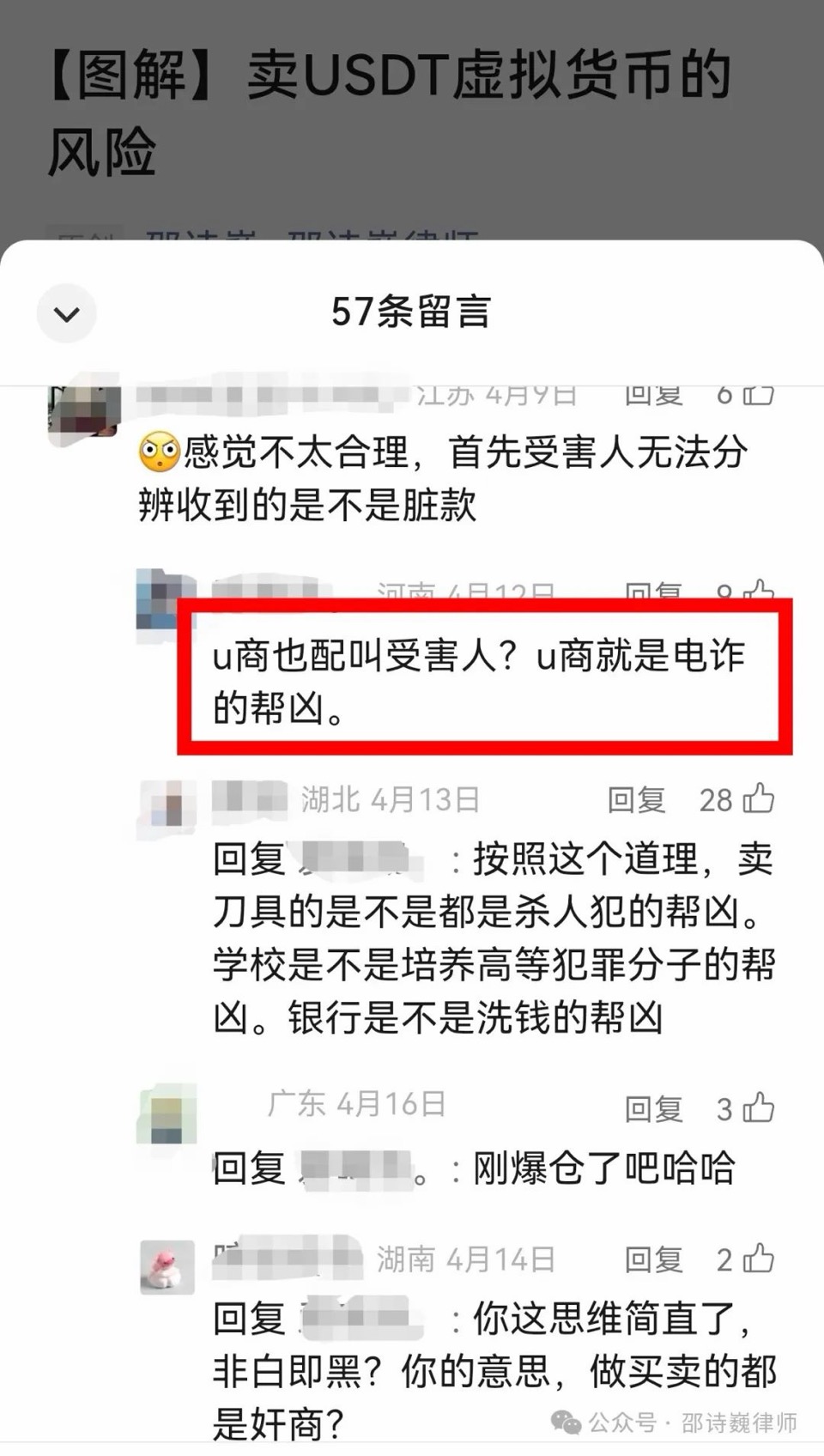
Therefore,the fact we must accept is: from the standpoint of evidentiary standards, judicial authorities are increasingly lowering the threshold for proving whether a party had"subjective knowledge"that the upstream activities were suspected of constituting a crime.
If one insists on a not-guilty defense, or if there is no dispute that the case should be characterized as the crime of concealing or disguising the proceeds of crime but one still argues that it should be characterized as the crime of aiding information network criminal activities, what are the consequences?
Let us revisit the 2023 case in which an Inner Mongolia court convicted a female master’s degree holder of the crime of concealing or disguising the proceeds of crime for selling USDT [Case No. (2023) Nei 0602 Xing Chu 203]. In 2022, Xu, a master’s graduate student, sold Tether (USDT) worth RMB 200,000 (approximately 27,000 USDT) to earn the price difference. She received the payment into her own bank account and immediately withdrew the cash at a bank counter. Upon investigation, it was found that over RMB 99,000 of the funds were proceeds from telecommunications fraud.
In this case, Xuwas released on bail pending trial on the day of her arrest, charged with the crime of concealing or disguising the proceeds of crime.However, possibly due to her personal insistence, her two retained defense counsel adopted different strategies: one argued that Xu was not guilty, while the other argued that Xu should be convicted of the crime of aiding information network criminal activities. The final outcome was that, because Xu received RMB 99,000 in proceeds from telecommunications fraud, she was sentenced to one year of fixed-term imprisonment for the crime of concealing or disguising the proceeds of crime.(actual imprisonment, not suspended sentence)。
Therefore, one should not lightly assert a not-guilty defense. Even when pursuing a defense for a lesser offense, it is necessary to consider whether the case truly warrants characterization as a lesser offense. Otherwise, while the defensive effect of arguing for a lesser offense may be similar to that of arguing for innocence, the consequences are borne by the client. Extreme caution is required.Lawyers handle not only cases, but also the lives of their clients.
04
Legal Analysis: The degree of subjective knowledge determines the distinction between guilt and innocence, and between different offenses.
We now address the two questions raised at the beginning of this article regarding Case A, which involves suspicion of the crime of concealing or disguising the proceeds of crime:
1. Why was A convicted of the crime of concealing or disguising the proceeds of crime?
2. Given the relatively high amount involved, if A’s conduct indeed constitutes a crime, is there a possibility that the charge could be changed to the crime of aiding information network criminal activities?
The offense of concealing or disguising the proceeds of crime presupposes:that a victim has filed a report with the authorities;A confidently believed that his transactions were problem-free, primarily because: the buyer paid in cash in person and provided a video recording of their commitment.
Judicial authorities do not recognize such commitment videos; this is uncontroversial in practice and therefore requires no further discussion. The issue thus lies with “the buyer paying in cash in person.” Were the funds paid by the buyer their own money or someone else’s? If they were the buyer’s own funds, did the buyer truly pay voluntarily to purchase USDT?
A might think, “What does this have to do with me? Someone wants to buy USDT, so I sell it. The counterparty has already represented that the source of funds is lawful. What more verification am I expected to perform? How can I be suspected of committing a crime?”
We may posit three scenarios.
Scenario 1: Under what circumstances can A likely strive for an acquittal?
Perfect KYC must be performed.
But what constitutes perfect KYC? I do not know either. Why say this? One may refer to the following judgment from a Hunan court:[(2022) Xiang 0281 Xing Chu No. 484]。
The basic facts are as follows: After purchasing USDT from a USDT merchant on OKX, the “victim” invested the tokens and was defrauded by others. Although the seller (i.e., the USDT merchant and defendant) stated that he had fulfilled strict review obligations prior to the transaction and was completely unaware that the buyer intended to purchase USDT for investment on a fraudulent platform, the court still convicted the USDT merchant of the crime of aiding information network criminal activities. How did the court infer the defendant’s “subjective knowledge”? The court held:Because the defendant knew that speculative trading in virtual currencies is an illegal financial activity, yet still engaged exclusively in virtual currency transactions on the platform in the form of a studio., and during the course of transactions, his bank cards were frozen on multiple occasions due to suspected involvement in illegal or criminal activities; therefore, it is presumed that the defendant and others had subjective "knowledge" of the criminal conduct of others.
The presumption of "subjective knowledge" in this case is outrageous.I find this difficult to understand and unacceptable.
Scenario 2: Under what circumstances can A seek a lesser charge of aiding information network criminal activities?
If the amount involved is small, for example, less than RMB 50,000, it matters little whether the charge is concealment or aiding information network criminal activities. However, where the amount is substantial, it is highly necessary to consider whether a defense for a lesser offense can be mounted.
For example, if A merely provided his own bank card, occasionally traded virtual assets, and received payments from buyers via online transfers—preferably conducted through an exchange—and fulfilled a certain degree of due diligence obligations, such as verifying the source of the counterparty’s funds, confirming that the transaction was operated by the buyer personally, that the buyer engaged in the transaction voluntarily, and that both parties communicated normally using domestic applications such as WeChat rather than encrypted messaging apps like Telegram, and the transaction price was reasonable, then in the unfortunate event of receiving illicit funds, there is hope in arguing for the charge of aiding information network criminal activities, and it may even be possible to seek a decision by the procuratorate not to prosecute or by the public security organs to withdraw the case.
Scenario 3: Under what circumstances does A indeed constitute the crime of concealment?
Is it possible that the buyer was merely a pawn?
Most people are familiar with the term "pig-butchering scam." To launder money, criminal syndicates will employ various means, such as hiring numerous "romance scammers" or using other methods to gain trust. These laundering syndicates search online for victims who lack discernment but have payment capacity; after gaining their trust, they instruct the victims to invest funds into a specific website or app for wealth management purposes.
Many people have likely seen the film No More Bets. Attorney Shao has previously written related articles (see below), which describe similar modus operandi.

(Click to read ➡️ Can Chinese public security organs make cross-border arrests for telecom fraud committed abroad?)
But what do the above-mentioned scenarios have to do with USDT merchants trading virtual assets?This is the sophistication of fraudsters: after gaining the victim’s trust, they transfer illicit proceeds to the victim and induce the victim to invest those funds on a fraudulent platform. Customer service representatives of the platform, citing various pretexts, instruct the victim to deposit cash at bank counters into designated bank accounts specified by the website.
Coincidentally, the designated account provided by customer service belongs to A. Why such a coincidence? We may reasonably hypothesize as follows: Could B be part of a money-laundering syndicate? Why was B so “generous” in bringing A into the scheme—selling USDT to A and referring clients to A? If there were buyers for USDT, why did B not conduct the transactions personally? B and an associate within the team, B1, had clearly divided roles: B1 contacted victims to establish trust, then transferred illicit proceeds to unwitting victims, who withdrew the funds in cash and deposited them at bank counters into A’s bank account, as directed by the platform’s “customer service.”
A believed he was merely selling USDT, but in reality he was exploited by B to launder illicit proceeds. If, during this process, B required A to purchase the sold virtual currency exclusively with RMB cash, A would need to withdraw cash from the payments received from victims (buyers). From the perspective of judicial authorities, A’s modus operandi closely aligns with the elements of the crime of concealing or disguising the proceeds of crime, leaving A with little room to refute the allegations.
When additional factors are present—such as communications via Telegram, using third-party bank cards to facilitate receipt of funds, and frequent, high-volume transactions over a short period—the threshold for proving subjective knowledge in such offenses is already relatively low. Consequently, conviction for the crime of concealing or disguising the proceeds of crime becomes virtually inevitable, and obtaining a reclassification to the crime of aiding information network criminal activities is highly unlikely.
Nevertheless, depending on the specifics of each case, defense counsel may still advocate for leniency in sentencing by raising mitigating circumstances on behalf of the client.
05
Concluding Remarks
When individuals face charges of concealing or disguising the proceeds of crime arising from USDT transactions, how should defense counsel select their strategy? This article offers an open-ended discussion. In practice, however, there is no one-size-fits-all answer as to which approach best safeguards the client’s interests. Each case requires tailored analysis based on its specific facts to determine the most appropriate defense strategy.

Recommended Reading
Overview: Potential Criminal Charges for Providing Bank Accounts to Facilitate Third-Party Transfers
What Legal Risks Should Be Considered When Establishing a Web3 Airdrop-Hunting Studio?