Navigating the Complexities of Establishment
As an international financial center, Hong Kong possesses a mature asset management system that has been extended to the field of virtual assets. Particularly since 2024, various crypto-friendly policies have attracted Web3 entrepreneurs to attempt establishing operations there. Bai Zhen, Head of Mankun Law Firm’s Hong Kong Office, has observed in past consultations that many Web3 entrepreneurs often encounter confusion when choosing to establish a crypto fund in Hong Kong, such as failing to distinguish between certain fund concepts, and worrying about the complex regulatory environment and cumbersome procedures.
If you share these concerns, rest assured that Mankun lawyers are here to provide answers.
Three Core Concepts
Before establishing a crypto fund, it is essential to clarify three core concepts, which are often the primary causes of confusion for fund founders.
1. Fund Manager
A Fund Manager is the person responsible for making investment decisions.
Unlike in mainland China, Hong Kong allowsprivate funds to be independently managed by a fund management company, without the need to appoint a specific fund manager. However, for public funds investing in virtual assets, such as Bitcoin ETFs, the Securities and Futures Commission (SFC) requires the appointment of at least one Key Investment Personnel (KIP), i.e., a qualified employee with relevant experience, responsible for investment strategy and compliance.
2. Fund Management Company
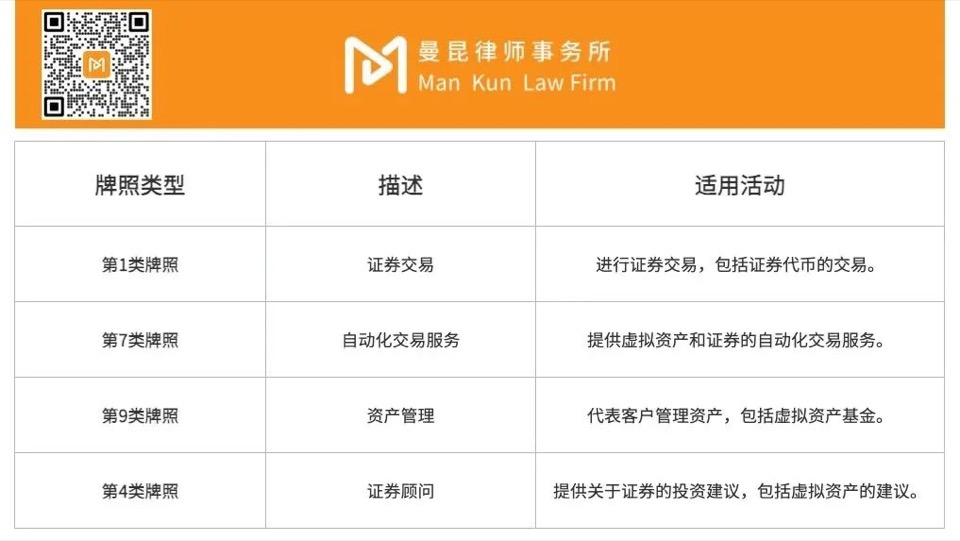
A Fund Management Company is the entity operating the crypto fund and mustobtain a Type 9 license issued by the SFC(Asset Management). This involves the following requirements:
- Capital Requirements. Maintaining a minimum capital level, the specific amount of which depends on the size of the company.
- Compliance Framework. Establishing a robust compliance framework, including anti-money laundering (AML) and counter-terrorist financing (CFT) measures.
- Risk Management. Implementing effective risk management strategies to mitigate risks associated with virtual asset investments.
3. Fund Product Structure
As an investment vehicle, a fund product must ensure that its assets are completely segregated from the personal assets of the fund management company and the fund manager. This segregated Fund Product Structure is designed to reduce the risk of misappropriation of assets and protect investors' interests. The fund product structure typically includes the following key points:
- Asset Segregation. Ensuring that fund assets are independent from those of the fund manager and other related parties, thereby safeguarding the security of investors' property.
- Legal Entity. The fund is usually registered as an independent legal entity to enhance asset protection and management transparency.
- Investors' Rights and Interests. The design of the fund product structure must clearly define investors' rights and interests, including provisions for profit distribution, asset redemption, etc.
After mastering these three key concepts, the next critical issue is "how to structure the fund."
Establishment of Crypto Funds
The following are key steps and elements to consider when establishing a crypto fund:
1. Selecting the Appropriate Fund Type
When establishing a crypto fund in Hong Kong, the first step is to select the appropriate fund type. The two main categories are as follows:
- Private Funds. Targeting individual professional investors, corporate professional investors, or institutional professional investors, these funds have higher investment thresholds and are subject to relatively lighter regulation in certain aspects.
- Public Funds. Geared towards public investors, these are subject to stricter regulation, such as Bitcoin ETFs. For crypto funds targeting the retail market, the following specific requirements must also be considered:
- Investment Scope. Investing only in virtual assets recognized by the SFC to mitigate risks.
- Disclosure Requirements. Providing comprehensive information disclosure to investors, including the nature of investments, risks, and fund structure.
- Ongoing Reporting. Regularly reporting fund performance, compliance status, and changes in management strategies to the SFC.
2. Determining the Fund Structure
The following are several common fund structures:
- Unit Trust. Under this arrangement, investors purchase units in the fund, which represent proportional ownership of the fund's underlying assets. The fund's assets are overseen by a trustee company, which assumes the task of managing and servicing these assets. The unit trust model is particularly adept at pooling resources from multiple investors, which is highly advantageous for the capital-intensive operations typically required to establish and manage crypto funds in Hong Kong.
- Open-Ended Fund Company ("OFC"). An OFC is an investment fund registered in Hong Kong in the form of a company. It differs from a unit trust in that it is a separate legal entity with a board of directors. Directors owe fiduciary duties and statutory duties of care, skill, and diligence to the OFC.
Note: Do not be misled by the term "open-ended." In the SFC's OFC fund structure, although the name refers to "open-ended," an OFC can actually beclosed-ended, provided that the offering documents of the OFC stipulate terms restricting redemption, and the articles of association of the OFC envision it as a closed-ended fund.
- Limited Partnership. Partners include general partners and limited partners, with clear allocation of liabilities and rights. The limited partnership structure is commonly used in private equity projects involving illiquid assets.
The following is an example of the Hong Kong OFC structure. The SPC/SP structure in the Cayman Islands includes a master fund(SPC = Segregated Portfolio Company)and multiple sub-funds(SP = Segregated Portfolio). Hong Kong has a similar OFC framework, which can reduce operational costs as there is no need to establish a new company for each sub-fund.

*Source: SFC Website
In the context of crypto funds, structures such as SPC or OFC offer advantages because they allow fund managers to implement multiple strategies across different portfolios, depending on the virtual assets within each portfolio. In this regard, this is a win-win for both managers and investors, as investors can autonomously choose which portfolio to invest in without worrying about their assets flowing into other portfolios, while managers do not need to separately establish independent portfolios, offering relative convenience.
In addition to establishing the crypto fund, another key component to consider isAsset Custody, to ensure the independence, security, and transparency of fund assets.
Fund Asset Custody
The quality of custody services directly impacts investor confidence and the stable operation of the fund, so particular caution is required when selecting a provider. Hong Kong fund management companies typically adopt the following custody arrangements for different types of assets:
1. Segregated Accounts
A Segregated Account means that each client's assets are held in separate accounts. This arrangement facilitates the accurate calculation of each client's Net Asset Value (NAV) and significantly reduces the risk of asset misappropriation. By managing segregated accounts, asset traceability and transparency are enhanced, complying with the strict requirements of Hong Kong regulators regarding fund asset management.
2. Commingled Funds
A Commingled Account refers to a fund product where the investment manager collects funds from different investors and merges them into a single vehicle. This approach simplifies management processes and reduces operational costs through economies of scale. However, it also requires more complex administrative procedures and higher compliance requirements. To protect the interests of each investor, Hong Kong fund management companies have established strict investment allocation and redemption mechanisms, and conduct regular audits to ensure the safety and fairness of the fund.
Additional custody measures and considerations for Hong Kong crypto fund management include:
- Cryptographic Technology. Custody services typically employ advanced cryptographic technology to ensure the security of virtual assets during storage and transaction processes.
- Cold Storage Solutions. To prevent hacking and theft of assets, cold storage (offline storage) should be used.
- Compliance and Regulation. Custody services in Hong Kong must comply with SFC regulatory requirements, including but not limited to anti-money laundering and counter-terrorist financing requirements.
- Regular Reporting. Custodians are required to provide regular asset reports to the fund management company and investors to ensure timeliness and transparency of information.
- Risk Management. Custody service providers must establish comprehensive risk management systems to address market volatility and potential risk events.
Through these measures, Hong Kong crypto fund management companies can provide investors with a safe and reliable investment environment.
Next, when you formally commence operations of your crypto fund business, you may also wish to pay attention to Hong Kong's Unified Fund Exemption Scheme.
Can Crypto Funds Obtain Profits Tax Exemption in Hong Kong?
Hong Kong's Unified Fund Exemption Scheme(Unified Fund Exemption Scheme)allows funds to be exempt from Hong Kong profits tax under specific conditions, regardless of the fund's place of registration, provided key conditions are met, including:
I. It must constitute a "fund." It is necessary to assess whether the structure you adopt meets the definition of a "collective investment scheme" under the Securities and Futures Ordinance.
II. All transactions of the fund must be conducted through an entity holding a Type 9 SFC license in Hong Kong.
III. The fund's portfolio must include assets classified as "securities" as defined under the Securities and Futures Ordinance.
It is particularly important to note that while conditions (I) and (II) are relatively clear, condition (III) presents uncertainty for crypto funds. Therefore, when determining whether your virtual asset portfolio constitutes "securities" assets as defined under the Securities and Futures Ordinance,you must proceed with caution!
Summary by Mankun Lawyers
Establishing a crypto fund in Hong Kong offers opportunities but also requires careful navigation of a complex regulatory environment. Understanding the roles of the fund manager, fund management company, and fund products is crucial. Fund management companies can successfully operate crypto funds by complying with SFC regulations, selecting appropriate custody institutions, and maintaining transparent communication with investors. As the virtual asset sector continues to evolve, understanding regulatory changes and market trends is vital for long-term success.
As a further note, Mankun Law Firm boasts a team of professional lawyers specializing in assisting Web3 clients in establishing crypto funds globally, including in Hong Kong, and providing additional compliance support. If you encounter difficulties in establishing a fund, feel free to add our customer service for consultation:mankunlawyer。
/ END.
Recommended Reading:
- Mankun Web3 Research: Singapore, a Popular Destination for Going Global – Which Well-Known Crypto Projects Have Already Established Operations There?
- Event Recap | Mankun Law Firm x Conflux Research Institute: Compliance-Driven Financial Innovation Powered by Web3
*This article is an original work by Shanghai Mankun Law Firm and represents only the personal views of the author. It does not constitute legal consultation or legal advice on specific matters. More Web3 practitioners are welcome to contribute articles or provide tips. For reprinting permissions and legal consultation, please add customer service: MankunLawFirm.
Author of this Article