
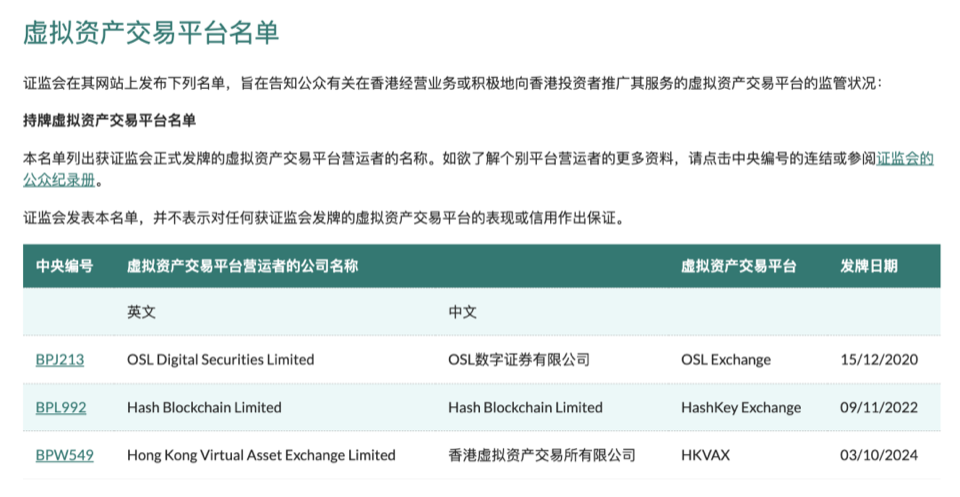
On October 3, 2024, the Securities and Futures Commission (SFC) of Hong Kong updated its list of licensed virtual asset trading platforms on its official website, announcing HKVAX as the latest licensed exchange. This marks the third virtual currency exchange recognized by Hong Kong regulators, following OSL Exchange and HashKey Exchange. According to reports from Ming Pao, a prominent Hong Kong news media outlet, HKVAX already holds Type 1 (Dealing in Securities) and Type 7 (Providing Automated Trading Services) licenses issued by the SFC, offering OTC brokerage services, virtual currency trading, and comprehensive virtual asset custody services to virtual currency investors in Hong Kong.
This may raise a question for some: If I also wish to operate a compliant virtual currency exchange in Hong Kong, should I apply for a license to operate a virtual asset trading platform, or must I obtain Type 1 and Type 7 licenses? Do other virtual currency exchanges follow the same model? Before answering this question, lawyers at Mankun Law Firm will first provide an overview of the licenses held by virtual currency exchanges that have already been licensed or are deemed to be licensed.
Overview of Licensed Virtual Asset Trading Platforms in Hong Kong
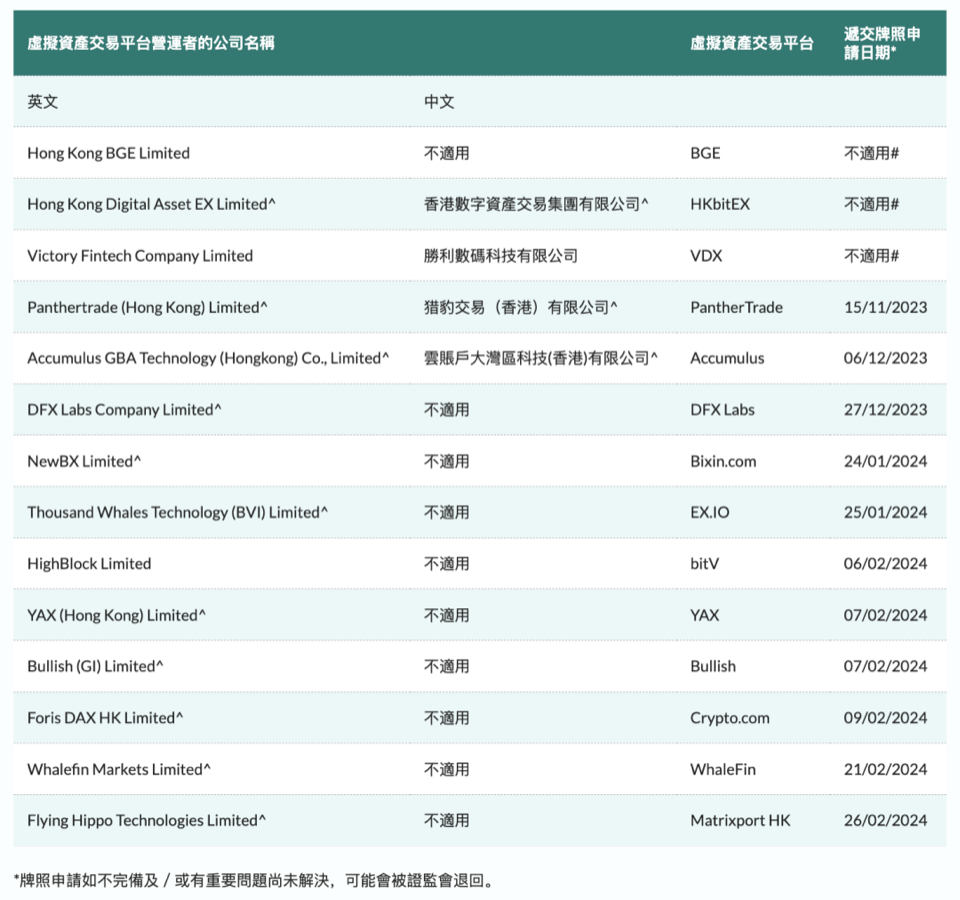
Currently, based on the list of virtual asset trading platforms on the Hong Kong SFC website that have either obtained licenses or are in the process of applying, lawyers at Mankun Law Firm have conducted a brief review of the relevant licenses.
OSL Exchange,Holders of Type 1 and Type 7 Licenses, and License to Operate a Virtual Asset Trading Platform
HashKey Group,Different platforms under the group hold different licenses, including:
Hash Blockchain Limited, i.e., HashKey Exchange, has obtained Type 1 and Type 7 licenses, as well as the license to operate a virtual asset trading platform.
HBS (Hong Kong) Limited holds Type 1 and Type 4 licenses.
HashKey Capital Limited holds Type 4 and Type 9 licenses.
HKVAX,Holders of Type 1 and Type 7 Licenses
BGE,Does not hold any license
HKbitEX,Deemed to have obtained the license to operate a virtual asset trading platform
VDX,Does not hold any license
PantherTrade,Deemed to have obtained the license to operate a virtual asset trading platform
Accumulus,Deemed to have obtained the license to operate a virtual asset trading platform
DFX Labs,Deemed to have obtained the license to operate a virtual asset trading platform
Bixin.com,Deemed to have obtained the license to operate a virtual asset trading platform
EX.IO,Deemed to have obtained the license to operate a virtual asset trading platform
bitV,Does not hold any license
YAX,Deemed to have obtained the license to operate a virtual asset trading platform
Bullish,Deemed to have obtained the license to operate a virtual asset trading platform
Crypto.com,Deemed to have obtained the license to operate a virtual asset trading platform
WhaleFin,Deemed to have obtained the license to operate a virtual asset trading platform
Matrixport HK,Deemed to have obtained the license to operate a virtual asset trading platform
It is worth noting that although most platforms are currently listed as “deemed licensed,” this status indicates that the platforms are still in a temporary licensing phase. They may only provide virtual asset services under specific restrictions, primarily catering toprofessional investors. Under this status, platforms are prohibited from providing services to retail investors, and the scope of services they offer is relatively limited. Specifically, these platforms cannot engage in margin trading, trading of virtual asset derivatives (such as futures contracts), or high-risk financial activities such as asset lending and market making.
It can be observed that the majority of current virtual asset exchanges have not obtained licenses issued by the SFC; instead, they have mostly applied for licenses to operate virtual asset trading platforms. However, the only three exchanges that have obtained licenses to operate virtual asset trading platforms happen to already hold Type 1 and Type 7 licenses.
Therefore, what is the relationship between the license to operate a virtual asset trading platform and virtual asset (VA) licenses? Is it mandatory to hold Type 1 and Type 7 financial licenses to obtain a license to operate a virtual asset trading platform?
License to Operate a Virtual Asset Trading Platform vs. Licenses
In Hong Kong, any centralized virtual asset trading platform that (1) is conducting business; or (2) is actively promoting its services to Hong Kong investors, must obtain licensing and be subject to regulation by the Securities and Futures Commission (SFC) of Hong Kong. This requirement stems from two important financial regulations in Hong Kong:

1. Securities and Futures Ordinance (SFO)
The regulatory regime under the SFO aims to regulate the following centralized platforms, involving licenses such as Type 1 and Type 7:
Providing trading services for security tokens by matching client orders using automated trading engines; and
Providing custody services as ancillary services to trading services.
2. Anti-Money Laundering and Counter-Terrorist Financing Ordinance (AMLO)
The AMLO pertains to licenses for operating virtual asset trading platforms. Its regulatory regime aims to regulate the following centralized platforms:
Providing trading services for non-security tokens by matching client orders using automated trading engines; and
Providing custody services as ancillary services to trading services.
However, given that the nature of virtual assets often changes, a virtual asset may transition from a non-security token to a security token, and vice versa. Therefore, the Hong Kong SFC recommends that companies adopt a prudent approach, namely:Virtual asset trading platforms should simultaneously apply for licenses under both the SFO and AMLO regimesto avoid violating licensing requirements and ensure business continuity.
So, what specific businesses do Type 1 and Type 7 licenses correspond to? Apart from these two licenses, are other licenses required to operate virtual asset-related businesses in Hong Kong? Why does HashKey also hold Type 4 and Type 9 licenses? These questions lead us to an overview of financial licenses in Hong Kong.
Overview of Financial Licenses in Hong Kong
Under Hong Kong’s Securities and Futures Ordinance (SFO), the financial market is divided into multiple categories, and participants in each category must apply for the corresponding license. Below are several common licenses and the businesses to which they apply:
Type 1 License,Allows the licensee to deal in securities, including buying and selling securities and providing securities investment services to clients.
Type 2 License,Authorizes engagement in futures contract trading business.
Type 3 License,Used for leveraged foreign exchange trading platforms.
Type 4 License,Allows the licensee to provide securities-related investment advice to clients.
Type 5 License,Used for advisory services on futures contracts.
Type 6 License,Allows the licensee to provide advisory services related to corporate finance, involving capital market operations, mergers and acquisitions, listings, etc.
Type 7 License,Allows the platform to provide automated trading services to clients.
Type 8 License,Allows the licensee to engage in securities financing activities.
Type 9 License,Is a license that asset management companies must hold.
Type 10 License,Pertains to credit rating services.
Seeing this, a new question arises: With so many licenses, if I wish to conduct virtual currency-related business in Hong Kong, do I need to apply for all of them? The answer from lawyers at Mankun Law Firm is:No!
Apply for the License Corresponding to Your Business Activities
Previously, lawyers at Mankun Law Firm shared an article titled “Applying for Virtual Currency Licenses in Hong Kong: What Is the Difference Between VASP and VATP? | Mankun Web3 Legal Education,” which detailed various virtual currency-related businesses. The article pointed out that Virtual Asset Service Providers (VASPs) cover a variety of entities, including but not limited to:
Virtual asset fund managers;
Virtual asset advisors;
Virtual asset custodians;
Virtual asset wallet providers;
And financial service providers related to the issuance, offering, or sale of virtual assets, such as service providers in ICO projects.
Correspondingly, if conducting virtual asset trading-related business in Hong Kong, it generally involves applying for and holding Type 1, Type 4, Type 7, and Type 9 licenses, depending on the type of services provided:
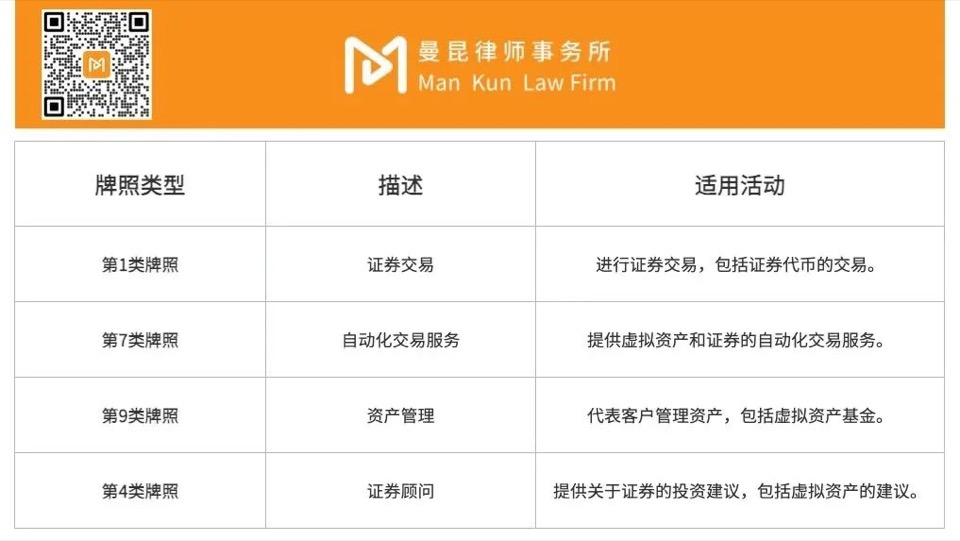
If you only intend to operate a virtual currency exchange in Hong Kong, apart from the license to operate a virtual asset trading platform, you only need to consider Type 1 and Type 7 licenses:
Type 1 license applies to trading platforms involving security-type virtual assets.In the virtual currency sector, some virtual assets may be structurally regarded as securities. Therefore, operating a virtual asset exchange may require a Type 1 license to legally trade these assets.
Type 7 license is required by almost all virtual currency exchanges,because virtual currency exchanges primarily conduct automated virtual asset trading through electronic platforms.
Meanwhile, if you are a traditional financial institution but also wish to explore integration with virtual assets, you may refer to Tiger Brokers and ZA Bank, which have applied for and hold Type 1 licenses that include virtual asset trading.
Of course, engaging in virtual asset-related business does not necessarily mean providing trading services to investors; one may also venture into areas such as providing investment consultation and advice, which would require considering the Type 4 license. Whether for companies or individuals, such as Telegram group admins sharing crypto investment insights or virtual currency investment advisors, holding a Type 4 license is mandatory to “operate”; otherwise, they will face regulatory issues.
Additionally, if you wish to legally manage investment portfolios including virtual assets in Hong Kong and provide related investment services, you must apply forthe Type 9 license for virtual assets (VA). Some investment companies that already hold a Type 9 license only need toupgrade their licenseto invest in various virtual assets, including but not limited to Bitcoin, Ethereum, and other cryptocurrencies and tokens. These investments may include direct holding of virtual assets or indirect investment through derivatives and other financial instruments.
It is worth noting thatfund managers holding a Type 9 license can conduct securities trading and provide advisory activities without additionally applying for Type 1 and Type 4 licenses.This seems to imply that if you wish to operate a company in Hong Kong similar to HashKey Group, with a business scope covering trading platforms, investment management, and consulting, the most convenient approach would be to directly apply for Type 7 and Type 9 licenses, as well as the license to operate a virtual asset trading platform.
Currently, the Hong Kong office of Mankun Law Firm has launched compliance services for applying for Hong Kong financial licenses, covering Type 1–10 financial licenses and licenses to operate virtual asset trading platforms. The service covers the entire process from establishing a Hong Kong company, assisting with license applications, to handling subsequent inquiries from the SFC, helping Web3 entrepreneurs relocating to Hong Kong obtain the “passport” for Hong Kong virtual asset enterprises “painlessly” and quickly, allowing them to compliantly participate in the dividends of Hong Kong’s virtual asset industry ahead of others. If needed, please contact customer service at: mankunlawyer.
Summary by Mankun Lawyers
As of early October, only three entities are truly able to directly provide compliant trading services to Hong Kong virtual asset investors. Traditional brokerages and other financial institutions in the market typically cooperate with these licensed virtual asset trading platforms to provide indirect virtual asset trading services to their users. This also means that whoever obtains compliant licenses first will occupy more influence in Hong Kong’s virtual asset trading market.
/ END.
Recommended Reading:
1. Where Is the Best Location for Web3 Startups? 2024 Global Ranking of Crypto-Friendly Countries Released
2. Why Do Exchanges Like OKX and Bybit Choose to Incorporate in Dubai? | Mankun Web3 Research
*This article is an original work of Mankun Law Firm. It represents only the personal views of the author and does not constitute legal consultation or legal advice on specific matters. More Web3 practitioners are welcome to contribute articles or share insights. For reprinting permissions and legal consultation, please contact customer service at: MankunLawFirm.
Author of this Article