

Against the backdrop of the evolving virtual assets landscape, it is essential for industry participants to understand the relevant terminology and regulatory frameworks. In Hong Kong, two key terms frequently arise in this context—“Virtual Asset Service Provider” (VASP = Virtual Asset Service Provider) and “Virtual Asset Trading Platform” (VATP = Virtual Asset Trading Platform). Although these terms are related, they are not identical. VASP is a broad concept that encompasses various entities engaged in virtual asset activities, whereas VATP specifically refers to platforms that facilitate the trading of virtual assets.
Distinguishing between these two concepts is important because it directly affects how different entities are regulated under Hong Kong law. The Securities and Futures Commission (SFC) of Hong Kong has issued specific regulatory guidelines for VATPs and other VASPs. Because VATPs are directly involved in the trading and custody of virtual assets, they are subject to stricter regulation, particularly with respect to security measures, anti-money laundering and counter-terrorist financing compliance, and investor protection. On the other hand, VASPs such as virtual asset fund managers and advisors are also regulated, but the regulatory focus for them is more on risk management, client disclosures, and the integrity of their operations.
Before delving into the differences between VASPs and VATPs,let us first review the definition of “virtual assets” in Hong Kong:
Under the Anti-Money Laundering and Counter-Terrorist Financing (Amendment) Ordinance 2022 (AMLAO) , virtual assets are defined as:
- a cryptographically secured digital representation of value that can be transferred, stored, or traded electronically and used for payment or investment purposes, such as cryptocurrencies and other asset classes in virtual worlds;
- a digital representation of rights, entitlements, or access privileges that are cryptographically secured and may confer management authority, governance rights, or applicability to any cryptographically secured digital representation of value, such as governance tokens;
Note: Under the AMLAO, the following do not fall within the definition of virtual assets:
- digital representations of value issued by central banks or governments
- Digital tokens with limited utility
- Securities or futures contracts
- Any floating funds or deposits associated with stored value facilities
Why, then, is the foregoing definition so important? Its significance lies in the fact that the Anti-Money Laundering and Counter-Terrorist Financing (Amendment) Ordinance 2022 (AMLAO) strictly confines the definition of virtual assets to “non-securities,” excluding virtual assets defined under the Securities and Futures Ordinance (SFOvirtual assets as defined).
Typically, when we consider the Securities and Futures Commission’s (SFC) Type 1 licence, we understand that it pertains to activities related to“dealing in securities”. Accordingly, the aforementioned definition of “virtual assets” would originally have fallen outside the SFC’s regulatory scope. However, under Hong Kong’s new virtual asset regulatory regime, if you hold an SFC licence and your business involves virtual assets, you will be required to comply simultaneously with the relevant regulations applicable to both securities and non-securities. This means that you must concurrently comply with the Securities and Futures Ordinance and the Anti-Money Laundering and Counter-Terrorist Financing (Amendment) Ordinance 2022 (AMLAO), as well as other applicable laws, regulations, and guidelines.
In Hong Kong, you may encounter the term“dual regulation”(dual regulation), and the regulations mentioned above are precisely what “dual regulation” refers to. In other words, the SFC has adopted a dual-regulatory approach toward virtual asset service providers to ensure:
- the regulation of virtual assets classified as securities (through the Securities and Futures Ordinance); and
- Regulation of virtual assets that are not securities (through AMLAO).
Subcategories under the broad umbrella: Virtual Asset Service Providers (VASPs)
The concept of a VASP is defined by the Financial Action Task Force (FATF) in its guidance, which Hong Kong also follows. According to the FATF guidance, a VASP includes any natural or legal person who, as a business, conducts one or more of the following activities or operations for or on behalf of another natural or legal person:
- Exchange between virtual assets and fiat currencies;
- Exchange between one or more forms of virtual assets;
- Transfer of virtual assets (in this context, “transfer” refers to transactions conducted on behalf of another natural or legal person, moving virtual assets from one virtual asset address or account to another);
- Safekeeping or administration of virtual assets, or instruments enabling control over virtual assets;
- Participation in and provision of financial services related to an issuer’s offer or sale of virtual assets.
From this broad definition, it can be seen that it covers a variety of entities, including but not limited to:
- Virtual asset fund managers;
- Virtual asset advisors;
- Virtual asset custodians;
- virtual asset wallet providers; and
- financial services providers involved in the issuance, offering, or sale of virtual assets, such as service providers in initial coin offering (ICO) projects.
Each type of entity plays a distinct role in the virtual asset ecosystem and is subject to different regulatory requirements depending on its specific activities.
For example, virtual asset fund managers managing portfolios containing virtual assets are required to implement robust risk management frameworks to protect investors. They must also provide clear and accurate disclosures regarding the risks associated with virtual assets to their clients. Similarly, virtual asset advisors providing investment advice on virtual assets are expected to maintain high standards of conduct and ensure that their recommendations are suitable for their clients’ needs. Custodians, who hold virtual assets on behalf of others, must implement stringent security measures to prevent theft or loss of such assets.
In addition, the definition of a virtual asset service provider (VASP) encompasses the following two types of transactions and operations:
- virtual-to-virtual transactions; and
- virtual-to-fiat currency transactions.
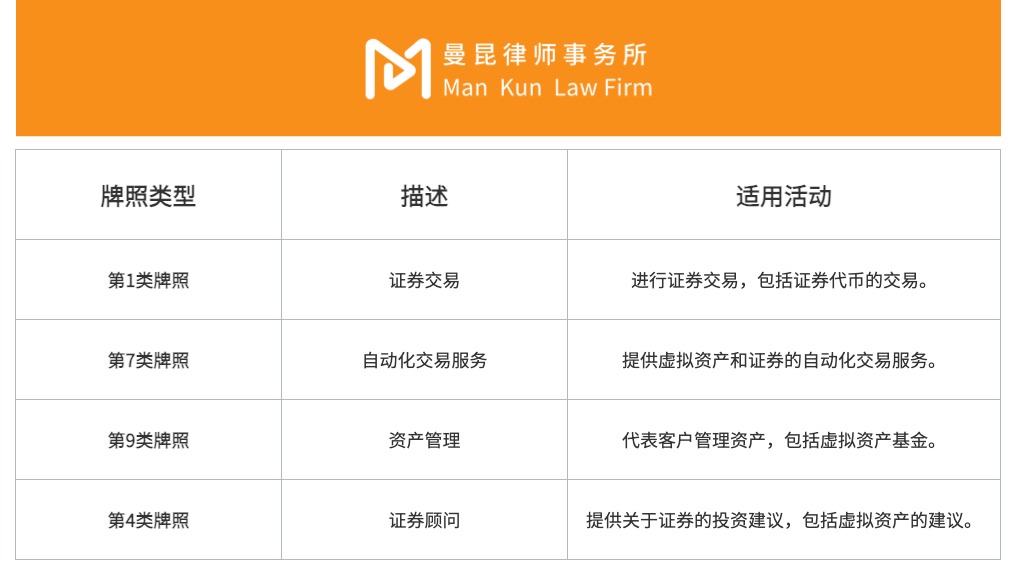
Other licenses may also be required depending on the nature of the business activities. For instance, entities engaging in futures contract trading must apply for a Type 2 license, while entities providing corporate finance advice must apply for a Type 6 license.
Focus under the Umbrella: Virtual Asset Trading Platforms (VATPs)
Having clarified what constitutes a VASP, what exactly is a VATP?
A VATP can be described as a type of VASP that specializes in facilitating the trading, exchange, and typically the custody of virtual assets. Acting as an intermediary, a VATP connects buyers and sellers of virtual assets, enabling them to conduct transactions in a secure and regulated environment.
VATPs play a critical role in the virtual asset ecosystem by providing liquidity and facilitating price discovery for various virtual assets. In Hong Kong, VATPs are subject to specific regulations prescribed by the Securities and Futures Commission (SFC). If a VATP engages in transactions involving at least one virtual asset deemed to be a security, it must hold a license in Hong Kong. This means that once a VATP offers trading in security tokens, the platform operator will need to obtain the following licenses in Hong Kong:
- Type 1 licence (dealing in securities); and
- Type 7 licence (automated trading services).
If a virtual asset trading platform (VATP) does not engage in any transactions involving virtual assets classified as securities, it must still comply with other applicable requirements (such as anti-money laundering and counter-terrorist financing (AML/CFT) obligations), but it is not required to obtain a licence from the Securities and Futures Commission (SFC) under the current regulatory framework.
In regulating VATPs in Hong Kong, the SFC primarily focuses on overseeing centralized virtual asset trading platforms, rather than peer-to-peer trading markets where investors typically retain control over their fiat currency assets or virtual assets.
If an entity applies for an SFC VATP licence but merely provides routing services instead of genuinely providing automated trading services related to virtual assets, the SFC will not accept its licence application.
Mankun Lawyers’ Summary
Understanding the distinction between virtual asset service providers (VASPs) and virtual asset trading platforms (VATPs) is crucial for anyone participating in the virtual assets industry. VASP is a broad term that encompasses a wide range of entities, including virtual asset fund managers, advisors, and custodians. In contrast, a VATP is a specific subcategory of VASP that focuses on facilitating the trading of virtual assets.
This distinction is significant because it affects how different entities are regulated under Hong Kong law. Due to the high risks associated with virtual asset trading and custody, VATPs are subject to stringent regulatory requirements. Other VASPs are also regulated, but the regulatory focus is on risk management, client disclosures, and ensuring operational integrity. Therefore, operating entities in Hong Kong need to develop tailored compliance strategies based on the specific services provided by the VASP, which helps ensure their safe and sound operations.
This article is an original work of Mankun Law Firm. It reflects only the personal views of the author and does not constitute legal advice or a legal opinion on any specific matter.
Recommended Reading
Summary of Global Crypto Industry Regulatory Policies (August 26–September 1, 2024)

{loadmoduleid 245}