

Web3 key opinion leaders (KOLs) are also required to fulfill compliance obligations.
Case Summary
On November 7, 2025, the Eastern Magistrates’ Courts of Hong Kong ruled that financial influencer Zhou Boxian (formerly known as Zhou Jianxi) was guilty of providing investment advice in a paid Telegram group without holding the requisite license. He was sentenced to six weeks’ imprisonment and ordered to bear the investigation costs incurred by the Securities and Futures Commission (SFC). This case has becomethe first criminal prosecution in Hong Kong against an unlicensed financial influencer, marking the end of the era of “unregulated growth” in social media investment consulting.
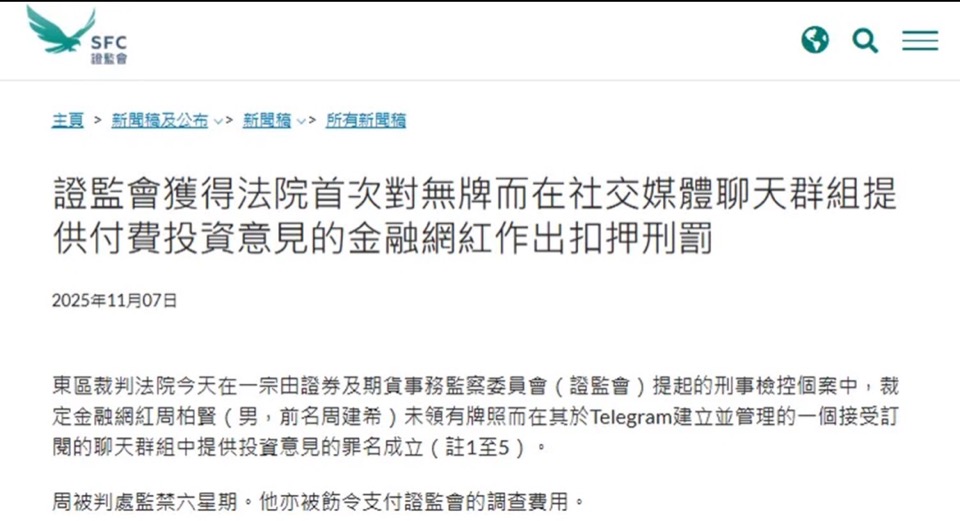
The judgment in this case was based on the Hong Kong Securities and Futures Ordinance. Zhou Boxian’s conduct of“providing advice on securities”constitutes a Type 4 regulated activity, which requires prior licensing from the SFC. The determination of such conduct involves three key elements:
- Profitability:The activity is conducted for profit, with fee structures (such as subscription fees) directly constituting commercial conduct;
- Continuity:Regular publication of analyses and responses to specific questions;
- Specificity:Providing specific recommendations on particular securities (such as Nasdaq-listed stocks) goes beyond the mere "sharing of general views."
Zhou Boxian operated a Telegram subscription group named "Futu Zhen. Cai Zi Private Group" under the guise of being a "major shareholder of Futu." Without obtaining a license from the Securities and Futures Commission, he provided Hong Kong subscribers with specific securities commentary, target prices, and Q&A services. By charging monthly fees (USD 200 or HKD 1,560), he illegally profited HKD 43,600.This conduct meets the criteria for being deemed as "providing advice on securities."
This case also reflects two aspects of compliance requirements imposed by Hong Kong on unlicensed financial influencers:First, the platform is no excuse, regardless of whether Telegram, Discord, or emerging social media platforms are used; as long as the activity constitutes investment advice, a license is required;Second, the audience determines jurisdiction, even if the servers are located overseas, as long as the target audience consists of Hong Kong investors, the activity is subject to regulation.
In previous similar cases involving Hong Kong financial influencers, Huang Mouzhong, a licensed representative, had his license temporarily suspended for 16 months for operating a paid group in his personal capacity.However, this case marks the first instance where criminal penalties were imposed, highlighting the escalation of regulatory oversight in Hong Kong regarding unlicensed financial influencers issuing investment advice.

The penalty in this case aligns with the global trend of strengthening regulation over "financial influencers." With the development of financial markets,regulators in various jurisdictions are increasingly focusing on investor protection and maintaining market integrity, while becoming more vigilant about the risks of misleading investors through harmful content on social media.
The UK Financial Conduct Authority (FCA)has established a clear regulatory framework for financial promotions, particularly those targeting crypto assets and financial influencers, requiringthat all investment promotions conducted on social media platforms be approved in advance, prohibiting financial institutions from promoting "improper" investment behaviors, and emphasizing that financial promotional activities must ensure they are "fair, clear, and not misleading." Violations may result in criminal penalties and fines.
The U.S. Securities and Exchange Commission (SEC) has cracked down severely on unauthorized financial promotion activities, imposing fines on companies and individual influencers who violate rules or engage in other types of market manipulation, with penalties reaching up to millions of dollars. The SEC once imposed a $1.75 million fine on an investment management company for failing to disclose the promotional role of a social media influencer under its umbrella and the fee structure linking the influencer’s compensation to the fund’s growth during the launch of its exchange-traded fund (ETF).
Regulatory authorities in mainland China, such as the Cyberspace Administration of China,have also beencontinuously rectifying chaotic financial information practices online, including illegal stock recommendations,and have lawfully dealt with accounts and websites disseminating false information about capital markets, engaging in illegal stock recommendations, and speculating on virtual currency trading.
Thus, it is evident that financial influencers and their promotional activities are being comprehensively brought under stricter and more internationalized regulatory scrutiny, and relevant participants need to pay greater attention to compliance risks.
Implications of this case for crypto asset KOLs
Although this case directly involves only traditional securities investment advice,the regulatory signals it conveys will also have an impact on the crypto assets sector.
On the one hand, the adjudicatory philosophy of this case is rooted in the principle of investor protection, which is equally important in the virtual assets market, where risk characteristics are more complex.
In recent years, issues concerning investor protection in the crypto assets sector have gradually come to light. A 2025 VISTA study found that 58% of Generation Z (born between 1995 and 2009) and Millennials (who came of age in the 21st century) prioritize self-directed investing, butmany lack the expertise to assess the risks associated with unregulated investment opinions and are easily attracted by aggressive and misleading promotional campaigns,leading to a surge in speculative trading in the crypto markets. Some investors have even lost their life savings due to the use of contracts for difference or investments in volatile assets such as unregistered crypto tokens. In multiple incidents, including the Hong Kong JPEX case, investors reported suffering losses due to the influence of online publicity and social media investment opinions.
The JPEX virtual asset platform fraud case is the largest cryptocurrency fraud case in Hong Kong in recent years, involving amounts exceeding HK$1.6 billion and affecting more than 2,700 victims.JPEX personnel attracted a large number of investors by advertising through advertisements, social media, over-the-counter exchanges, and internet celebrities/key opinion leaders (KOLs), promoting the platform as “legally compliant, endorsed by celebrities, low-risk, and high-return,”and ultimately transferred customer funds into cryptocurrency wallets for money laundering and misappropriation. In this case, the police also invoked for the first time the provision under the Anti-Money Laundering and Counter-Terrorist Financing Ordinance, which came into effect in 2023, regarding “fraudulently or recklessly inducing another person to invest in virtual assets,” to prosecute several internet celebrities involved in the case. This case reflects, on the one hand,the susceptibility of investors to the influence of online publicity and social media opinion leaders,leading to blind investment; on the other hand, it also reflectsthe state’s emphasis on regulating the adverse promotional practices in the virtual assets sector.。
On the other hand, Hong Kong is steadily advancing efforts to refine its regulatory framework for virtual assets,emphasizing compliance for tokenized assets and continuously establishing a licensing regime to regulate virtual asset-related services.In the future, Hong Kong may refer to the regulatory standards applied to securities analysts in the traditional financial sector, requiring key opinion leaders (KOLs) in the virtual asset space to adhere to higher professional and disclosure requirements when issuing investment recommendations. This aims to prevent disorderly promotion and misleading information in the virtual asset market, maintain market order, and protect investor interests.
Given current regulatory trends, financial influencers and content creators in the virtual asset sector must pay particular attention to potential legal and compliance risks associated with KOL activities. As the Securities and Futures Commission of Hong Kong proposes to require brokers to conduct due diligence on KOL collaborators and continuously monitor their content, the operating costs and compliance thresholds for the entire KOL industry are likely to rise significantly.
In this context, market participants may face two primary options:
First, participants can adjust their wording to carefully avoid having their content characterized as investment advice.For instance, participants may shift towards educational content such as blockchain technology analysis, macroeconomic trend interpretation, and risk management, while avoiding references to specific buy/sell points or target prices for particular tokens. By more prudently defining the boundaries of content creation and clearly disclosing risks and conflicts of interest, participants can avoid crossing the regulatory red line of "investment advice."
Second, participants can proactively seek compliance pathways by establishing cooperative relationships with licensed institutions.For example, participants may collaborate with licensed virtual asset trading platforms such as HashKey and OSL, or with traditional licensed institutions, thereby integrating their content creation into a compliant framework.
While these industry adjustments will enhance overall compliance levels, they may also bring about certain structural changes.For instance, channels for investors to access investment advice may become restricted, and the cost of professional advisory services may correspondingly increase. Some market participants, unable to bear the compliance costs, may have to scale down their operations or relocate to jurisdictions with relatively more lenient regulatory environments.However, in the long term, establishing a clear regulatory framework will contribute to the standardized development of the virtual asset market. On one hand,, which can enhance market transparency in the crypto assets sector, further prevent retail investors from falling victim to "pump-and-dump" schemes, and bolster the confidence of compliant institutional investors in participating;On the other hand,, it may drive the transformation of industry content creation toward professionalism and value orientation, thereby achieving a more balanced development path between protecting investor interests and promoting industry growth.
Conclusion
The Zhou Boxian case serves as a mirror, reflecting Hong Kong’s efforts to safeguard financial security and protect ordinary investors. For key opinion leaders (KOLs) in the crypto sector, this also sends a clear warning signal—Web3 KOLs are also required to fulfill compliance obligations.
“Decentralization” does not mean “unregulated”; technological innovation must go hand in hand with investor protection.As Hong Kong’s regulatory framework for virtual assets continues to improve, only those participants who can both grasp market dynamics and adhere to compliance baselines will stand out in the new era.
Whether Hong Kong can strike a balance between fostering Web3 innovation and maintaining market integrity in the future will depend on the joint efforts of regulatory wisdom and industry self-discipline, and this judgment is undoubtedly an important milestone in this process.