

From Token-Only Issuance to a Dual-Engine Model of “Equity + Tokens”
Introduction
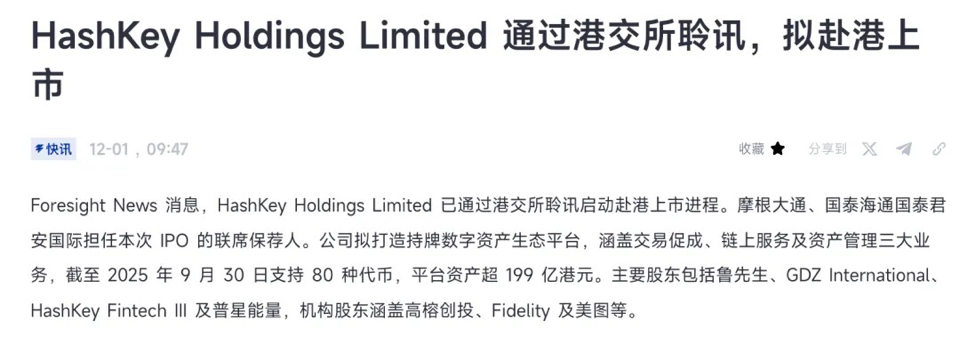
On December 1, 2025, HashKey Holdings Limited officially passed the listing hearing for the Main Board of the Hong Kong Stock Exchange, with J.P. Morgan, Guotai Junan International, and Haitong International serving as joint sponsors. As a leading platform holding a Hong Kong virtual asset trading platform license, with business activities covering digital asset trading matching, on-chain services, and asset management, HashKey is also poised to become Hong Kong’s “first crypto assets stock.”
For the industry, this is not merely a milestone for one company, but a landmark event:
The first batch of regulated crypto assets platforms in Asia is entering the mainstream capital markets.
The signal behind this is very clear:
The crypto assets industry is undergoing a structural transformation, and the narrative that “token issuance equals going public” has become outdated. An increasing number of projects have realized that relying solely on tokens, without establishing a corporate entity, issuing equity, or considering the capital markets, can no longer sustain the next round of growth. The HashKey case serves as the strongest real-world proof of this shift.
Thus, a new question faces all projects:
Why are an increasing number of Web3 projects beginning to consider initial public offerings (IPOs)? Why is the three-track parallel model of “corporatization + equity financing + tokens” becoming the new normal?
Next, we will begin by discussing the changes currently taking place in the industry.
The Golden Age of Financing Solely Through Token Issuance Has Truly Passed
If you are still following the old playbook from the previous cycle over the past two years—
- whitepaper + private placement + exchange listing
- DAO/foundation structure, with a shell company added as a last resort
- everything revolves around tokens, while equity interests serve merely as a “shell”
you have most likely already discovered that:
primary-market funding has become harder to secure, secondary-market valuations are unsustainable, and regulatory scrutiny is intensifying.
Conversely, you will observe another category of projects quietly shifting tracks:
- first establishing a proper corporate entity and conducting regulated equity financing;
- tokens continue to be issued, but primarily for ecosystem incentives and liquidity purposes;
- the long-term objective is no longer limited to “listing on a centralized exchange (CEX),” but rather building a company capable of going public, being acquired, and sustaining long-term operations.
Projects adopting this approach are progressing more steadily and are better positioned to secure substantial capital. This is not merely a matter of changing trends; the structural dynamics of the market cycle have shifted.
Why did market participants previously dismiss equity interests and initial public offerings (IPOs) during the last cycle?
A retrospective glance makes it evident how compelling the prevailing logic was at the time:
1. Token issuance offered rapid capital formation
There was no need for a prospectus, no requirement to pitch to institutional investors through roadshows, and no necessity for several years of audited financial statements. A whitepaper accompanied by the logos of a few leading venture capital firms was sufficient to attract capital.
2. Regulatory ambiguity allowed for an iterative approach
Many jurisdictions initially failed to clearly define the legal nature of tokens. Project sponsors leveraged the shields of "innovation" and "technological experimentation" to press ahead.
3. The appeal of DAO/foundation structures
There were no shareholders, only communities; no boards of directors, only governance voting. This structure provided ample room for narrative construction.
4. The illusion that "tokens are an upgraded form of equity"
Many founders genuinely believed that tokens were superior to equity, offering greater liquidity, the ability to serve as collateral in over-the-counter transactions, and faster market price discovery.
In such an environment, those who adhered to traditional equity financing or even contemplated an initial public offering (IPO) were often perceived as lacking sophistication.
Why are an increasing number of projects now actively considering equity structures and IPOs?
The context of this current cycle is different. Adhering to the old logic will only lead to increasing passivity and disadvantage.
1. Regulators are beginning to "speak plainly"
- In jurisdictions such as the United States, the European Union, Singapore, and Hong Kong, certain tokens are being directly subjected to securities or regulated-asset frameworks, requiring classification and oversight as securities, payment instruments, electronic money, and the like.
- Regulators are increasingly unsympathetic toward models that lack a corporate entity and rely solely on a foundation plus token-based fundraising. This does not amount to a blanket prohibition; rather, regulators are making clear that:
If you are engaged in financial services, payment services, or asset issuance, you cannot hide behind the claim that you are merely conducting technology research and development.
2. Capital is returning, but this time it is "capital that understands finance"
The capital entering the market in this cycle differs from the waves seen in 2017 and 2021:
- Much of it comes from traditional venture capital and private equity firms, as well as mainstream institutional investors.
- These investors are accustomed to equity valuations, board seats, exit pathways (such as mergers and acquisitions or initial public offerings), information disclosure, and compliance.
If you cannot present a credible equity structure, corporate entity, and audited financial statements, and instead merely provide a tokenomics model, investors will either offer only nominal amounts or decline to engage altogether.
3. Your project may no longer be a "purely on-chain toy"
Consider the currently popular sectors:
- Stablecoins, PayFi, and cross-border settlement
- Real-world assets (RWA): tokenization of bonds, funds, equipment, real estate, and accounts receivable
- DeFi infrastructure, clearing and settlement, custody, and compliance components
- AI plus computing power, data elements, privacy-preserving computation, and more
A common feature of these businesses is that they are tied to “real assets,” “real revenue,” and “real regulatory obligations.”
In such circumstances, if you still seek to rely on the ultra-light “pure Token + foundation” structure from the previous cycle, fundraisers, regulators, and partners will become increasingly hesitant.
4. Relying solely on secondary-market Token exits provides insufficient certainty
- Secondary-market sentiment is highly volatile
- Any regulatory action or exchange rule adjustment can passively erode the project’s valuation
- Many institutions are unwilling to stake their entire exit strategy on a secondary market beyond their control
Equity combined with an IPO or M&A at least provides large investors with a predictable, negotiable, and operable exit route.
Trend signal: an increasing number of projects are adopting a “corporatization + equity structuring + capital-market orientation” approach
This does not mean that every project must go public; rather, several real-world cases this year have already demonstrated that:
The crypto industry is transitioning froma “token-only” model to a multi-track model of “token issuance + corporate establishment + access to capital markets”multi-track model.
The following trends are particularly illustrative:
1. High-profile cases directly entering mainstream markets
- Circle: Completed its U.S. initial public offering (IPO) this year, demonstrating that “compliance + blockchain infrastructure” can gain access to mainstream capital markets.
- TRON (Sun Yuchen): Listed on NASDAQ through a reverse merger, illustrating that a “token ecosystem + corporate entity” can also pursue a path to capitalization.
2. Continued listings of infrastructure companies
- Bitdeer, Core Scientific, Marathon, and Iris Energy—these mining and computing power companies have long been traded on public markets, indicating that crypto infrastructure is inherently compatible with traditional capital markets.
3. Accelerated “corporatization + equity financing” by large Web3 projects
- Projects such as Animoca Brands, ConsenSys, LayerZero, and EigenLayer:
Although not yet listed, they are strengthening their corporate entities, equity structures, audits, and governance, clearly preparing for future capital market options.
4. “Lightweight listing” pathways such as SPACs and RTOs are drawing increased attention from more projects
- Certain blockchain gaming, NFT, and Web3 tooling companies are exploring pathways such as special purpose acquisition company (SPAC) mergers and reverse takeovers (RTOs), indicating that listing routes are becoming increasingly diversified.
The crypto industry is no longer equating “token issuance” with “going public”; instead, it is moving toward a multi-track parallel model comprising the corporate entity, equity, tokens, and capital markets.
Only projects that can effectively integrate this structure will have the opportunity to advance to the next stage.
Why has “managing both equity and tokens” become the new normal?
For projects, this is not merely “an additional pathway,” but rather involves “two entirely distinct objects”:
1. Whose issues does equity address?
- It addresses the concerns of institutional investors: valuation logic, exit channels, and governance rights.
- It addresses regulatory requirements: the corporate entity, the party bearing liability, and audit and disclosure obligations.
- It addresses prospective acquirers: whether they are acquiring the “project” itself, or the “company plus licenses, assets, and team.”
2. Whose issues do tokens address?
- They address the needs of users and the community: use cases, incentives, participation in governance, and network effects.
- Addressing business growth: marketing, ecosystem development, developer acquisition, and alliance building
- Addressing liquidity: circulation, market making, collateralization, and on- and off-exchange settlement
Accordingly, you will observe an increasing number of projects adopting a “Dual-Asset Model”:
Equity constitutes the corporate backbone, while tokens serve as the lifeblood of the ecosystem; their roles are clearly delineated rather than mutually substitutive.
As a project sponsor, you should first ask yourself three questions:
Question 1: I currently have only tokens and no corporate entity or equity structure. Is it still feasible to rectify this gap?
It is feasible, but be prepared for what amounts to a “surgical-level” restructuring:
- First, establish the requisite corporate entities: determine the jurisdictions for incorporating the parent company and operating entities, and assess whether a foundation is necessary.
- Consolidate ownership of intellectual property, code, data, and smart contract revenues from personal wallets or informal arrangements into the corporate entity or foundation.
- Convert early investors’, team members’, and advisors’ “oral agreements” and “Excel-based records” into formal equity agreements and token allocation agreements.
Question 2: If I introduce an equity structure, will the community criticize me for “betraying Web3 ideals”?
The core issue is not whether you have equity, but rather:
- Have you clearly stated from the outset:
- which portion of the value belongs to equity holders
- which portion of the value belongs to token holders
- Have you avoided “double extraction”:
- the same cash flow is neither distributed to shareholders nor flowed back to tokens;
- everything is solely for “market manipulation” and “cashing out”
To put it bluntly: whether the community criticizes you depends on whether you have “clearly stated in black and white what you are taking.”
Question 3: Is an IPO absolutely necessary? Or is it merely “icing on the cake”?
Not all projects are suitable for an IPO.
- If your project is essentially a utility protocol or protocol-layer infrastructure, the most realistic path is instead:
- to become an acquisition target for leading technology companies or financial institutions
- or to become a “standard component” within the ecosystem of a major upstream or downstream player
- If your core business is financial infrastructure (stablecoins, issuance of real-world assets (RWA), custody, clearing and settlement, compliance services), then pursuing an initial public offering (IPO) is a path worth planning well in advance—though it is also a high-barrier, long-cycle route.
What is truly needed is to start positioning yourself, from today, as an asset that is “regulatorily intelligible, investable by institutional investors, and suitable for M&A or an IPO.”
If you wish to keep the IPO option open, here are several steps you should take now
1. Transform the “project” into a “group of companies”
- Select the jurisdiction for the parent company (Hong Kong, Singapore, Cayman Islands, British Virgin Islands, European Union, etc., depending on the business scenario and target markets)
- Streamline the operating entities, technology teams, and license-application entities, rather than having them haphazardly registered under different individuals’ names
- Clarify which business lines belong to which company and which belong to the foundation
2. Restructure your cap table: plan equity and tokens together
- Who receives equity? Who receives tokens? Who receives both?
- When future VC/PE investors come in, will they receive equity, or token allocations subject to conditions?
- If an IPO becomes necessary at some point, will the existing token structure create obstacles at the regulatory review and prospectus disclosure stages?
3. Establish a “regulatorily readable” compliance framework in advance
- Are you engaged in payment services? Are you accepting funds from the public? Are you offering investment products?
- What you actually need is either a registration-based license (such as MSB/VASP, etc.) or a permit-based license (such as certain CASP/VA/DPT types)?
- Can your AML/KYC procedures, sanctions screening, and information disclosure withstand the heightened scrutiny of future regulatory oversight and audits?
4. Maintain a trail that can be included in a prospectus
- Financial data:Revenue structure, cost structure, reserves, and exposures
- Compliance record:Presence or absence of penalties, and status of remediation
- Governance record:What procedures were followed for major decisions, and whether there have been disputes regarding governance failures
These matters are not to be prepared only in the year you decide to pursue an IPO; rather, they accumulate from every version of your financial statements and every material contract starting now.
A blunt statement to project sponsors
If your project:
- has already issued tokens,
- is currently undergoing or preparing for another round of equity financing,
- and venture capitalists are already asking you, “What is your long-term path—an IPO or a trade sale?”
then it can basically be concluded that you are standing at a new crossroads:
either promptly complete“the integrated framework of equity + tokens + compliance + licenses + exit path,”or continue to rely on the previous round’s “pure token-issuance logic” until liquidity issues and regulatory scrutiny converge.
Either continue to rely on the “pure token issuance logic” from the previous cycle, until liquidity dries up and regulatory scrutiny arrives.
This article is not intended to disparage tokens; on the contrary—the token mechanism remains a key tool for Web3 to break through the boundaries of traditional internet and finance.
However, the next generation of truly significant projects will certainly not rely solely on tokens.
What you need to do is to promptly upgrade your project from “merely issuing tokens” to “a company driven by both equity and tokens.”
In this way, regardless of whether the future path involves an initial public offering (IPO), a merger or acquisition, or building a company that generates sustained profitable cash flow, you will retain strategic options.
If you genuinely intend to pursue the "equity + token" route, what can Mankun Law Firm do?
With long-term expertise in Web3 and on-chain finance, we can help you clarify:
- The boundaries of rights among the corporate entity, the foundation, and the token
- Compliance milestones for equity financing and token financing
- Licenses and regulatory requirements necessary for business implementation
- The feasibility of future mergers and acquisitions, public listings, and expansion
We will clearly explain, design, and document these key issues in a comprehensive manner, equipping your project with the capacity to "operate successfully with token issuance while ensuring the long-term viability of the corporate entity."
If you seek to elevate your project from a "team" to a "company" and bridge tokens to the capital markets, Mankun Law Firm can help pave the way.