

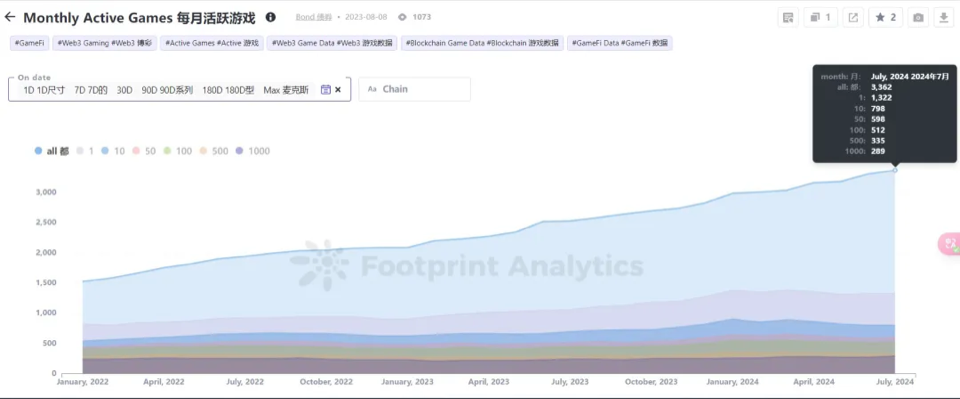
The development of overseas Web3 games also faces obstacles arising from various complex circumstances. According to Footprint Analytics’ July report on Web3 games, there were a total of 3,362 Web3 games in July, with only about one-third remaining active. Among these, only 289 games attracted more than 1,000 monthly active on-chain users (MAU). This has sparked market discussions regarding the sustainable development of Web3 games.
Active users are the foundation of sustained revenue for Web3 games. Therefore, in addition to generating revenue by directly selling in-game items through primary markets, project teams employ various methods to enhance the sustainability of their revenue. For instance, some project teams design dual-token systems during development to stabilize the game’s economic system. Furthermore, to enhance liquidity within the in-game economy, establishing secondary markets has become one of the significant factors influencing the operation and development of blockchain games.
Recently, Mankun Law Firm organized its76th Mankun Afternoon Tea, inviting seasoned practitioners in the Web3 gaming industry to discuss compliance issues faced at various stages of Web3 game development, including discussions on secondary markets.
Currently, the prevailing approach in the industry for building secondary markets is through cooperation with third-party platforms. However, Mankun lawyers have received numerous inquiries regarding the establishment of self-built secondary markets. In light of this, Mankun lawyers have authored this article to explore different strategies for self-built versus third-party cooperative secondary markets and to provide corresponding compliance recommendations.
Why Establish a Secondary Market
A secondary market is a platform that allows players to freely trade in-game assets (such as NFTs and virtual items), providing players with opportunities to derive value from rare items or virtual assets.
The roles of secondary markets in Web3 games mainly include the following four aspects:
-
Enhancing Asset Liquidity.Secondary markets provide players with a platform to trade NFTs, in-game items, and other virtual assets, allowing them to buy, sell, or exchange freely. This functionality not only enhances asset liquidity but also increases player engagement and stickiness within the game ecosystem.
-
Increasing User Engagement and Revenue Potential.Through secondary markets, players can create value within the game, such as by trading rare items or selling upgraded assets for profit. This sense of participation and opportunity for profit attracts more users to join blockchain games and promotes the development of the game community.
-
Ensuring Market Pricing and Value Discovery.Secondary markets regulate the prices of blockchain game assets through supply and demand dynamics, allowing the market value of assets to be reflected more accurately. This benefits both project teams and players, as transparent market pricing helps enhance trust throughout the entire ecosystem.
-
Promoting Sustainable Circulation of the In-Game Economy.The existence of secondary markets makes the in-game economic system healthier and more sustainable. Players can recover funds and reinvest through continuous trading, thereby maintaining the vitality of the in-game economy.
Comparison of Advantages and Disadvantages: Self-Built vs. Third-Party Solutions
Secondary markets are crucial for the sustainability of Web3 games. So, how should project teams choose the appropriate method for building secondary markets between self-built and third-party pathways?
A complete Web3 game secondary market primarily comprises four dimensions: the front-end user interface, the back-end management system, the smart contract layer, and the blockchain network. We can intuitively compare the two approaches using the table below.

As can be seen,the core advantage of a self-built secondary market lies in the project team’s complete control over the platform.From market rules and fee structures to user experience, project teams can customize designs according to their specific needs. This flexibility allows project teams to deeply integrate with brand-building strategies, enhancing user loyalty and market stickiness. For example, Starshark, which was previously very popular, utilized a self-built secondary market to help the project team build its brand image, provide a user experience highly consistent with the main brand, and increase users’ sense of belonging and interaction frequency.

However, the complex compliance requirements associated with self-built secondary markets, such as formulating trading rules and conducting fund reviews, lead to a sharp increase in technical and resource costs for project teams. Under the addition of multi-layer contracts, market liquidity may be correspondingly restricted. Without stable buyers and sellers, asset prices may fluctuate significantly, affecting user trust and leading to an increase in customer complaints. Furthermore, project teams building their own secondary markets need to address asset and information transmission between the underlying blockchain and external systems by creating cross-chain bridges, which further increases technical costs.
In comparison, cooperating with third-party secondary markets can significantly reduce legal and compliance risks. Isolating the project team’s core business from the secondary market can avoid direct involvement in currency transactions. In this way, if price fluctuations or losses occur, users are more likely to view them as market behaviors rather than the responsibility of the project team, thereby reducing the risk of rights protection claims. This approach keeps the project team at a certain legal distance from secondary market trading activities, particularly reducing the likelihood of being held liable in terms of potential criminal liability. Meanwhile, market isolation can also prevent future legal issues, especially those involving virtual currency transactions and regulatory risks. Large platforms such as OpenSea and Magic Eden have already established mature KYC (Know Your Customer) and AML (Anti-Money Laundering) compliance systems and assume most of the regulatory responsibilities. Additionally, large platforms typically possess robust copyright protection mechanisms capable of rapidly handling potential infringement disputes, thereby lowering the risk for project teams of directly facing copyright issues.
Although cooperation with third parties implies certain limitations on market rules, fee structures, and user interfaces, making it difficult to fully customize according to specific needs, large third-party platforms possess extensive user bases and well-developed trading ecosystems. At the same time, these platforms generally support multiple public blockchains. By cooperating with these platforms, project teams can quickly obtain market liquidity and leverage existing user groups to expand market coverage. This cooperation model is particularly beneficial for projects in their early stages of development, enabling rapid market entry without the need to independently build a liquidity foundation.
Mankun Lawyers’ Commentary
Projects Suitable for Self-Built Secondary Markets
Self-built secondary markets are suitable for projects with strong technical teams, abundant resources, and a desire for deep control over brand and user experience. For projects that already have a large user base and the capacity to bear compliance and operational pressures, building a secondary market is a choice worth considering. However, it is important to note that during the customization of transactions, involvement in RMB exchange should be avoided. Whether providing official cash-out channels for game points or tokens, or allowing cash transactions between users, both scenarios involve extremely high risks of criminal liability.
Projects Suitable for Cooperation with Third Parties
For projects in the early stages of development, prioritizing the reduction of compliance risks and the rapid acquisition of market liquidity, cooperating with third-party platforms is a more prudent choice, which is also the practice adopted by most blockchain game project teams currently. This model not only enables rapid market entry but also reduces technical and operational burdens, lowering initial investment costs. However, it is worth noting that when operating blockchain game projects on third-party platforms, users may perceive an association between the project team and the platform. Project teams can clearly define the independence of both parties through clear user agreements and cooperation statements, thereby reducing misunderstandings.
Possibility of a Hybrid Model
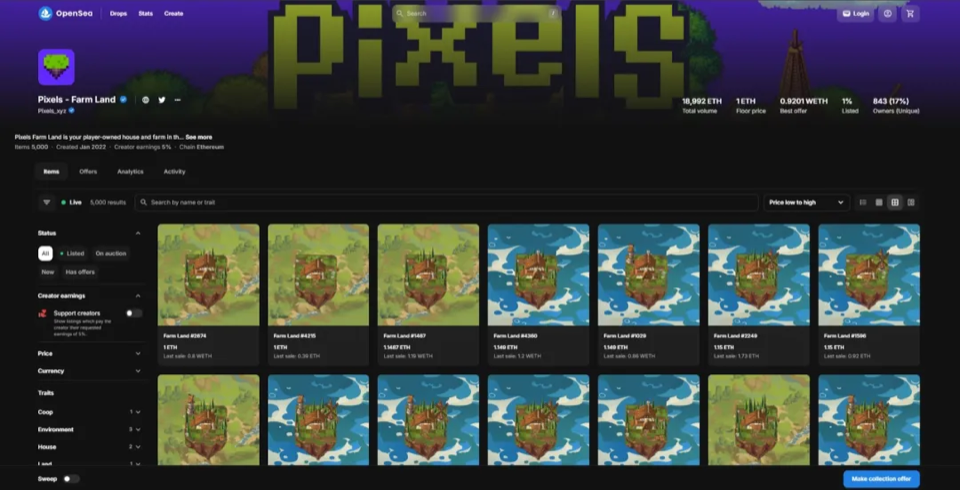
Some projects may consider cooperating with third-party platforms in the initial stage and gradually transitioning to a self-built secondary market as the business matures. For example, Pixeis, currently ranking first among popular blockchain games, adopts such a model.
This approach helps project teams gradually accumulate technical and market resources while ensuring liquidity and compliance, ultimately achieving a smooth transition. However, it must be clarified that project teams should avoid integrating in-game points into third-party secondary markets for trading. Even if such points are not on-chain, they possess certain token-like attributes, and the project team would still need to bear responsibilities related to data synchronization, privacy, security issues, and potential additional customer complaints arising therefrom. Therefore, restricting cash-out interfaces and ensuring that off-chain tokens are used solely for purchasing in-game items can prevent such tokens from being deemed as cash-out tools, thereby reducing compliance risks.
Mankun Lawyers’ Summary
Overall, when choosing a secondary market model, blockchain game project teams need to make decisions based on their own resources, technical capabilities, and compliance needs. For projects seeking rapid market entry and reduced compliance risks, cooperating with third-party platforms is the optimal solution; whereas for projects pursuing brand independence and deep user control, self-built secondary markets offer greater advantages. Regardless of the chosen model, project teams must align with long-term development goals, formulate flexible secondary market strategies, and manage corresponding compliance issues to cope with the ever-changing market and regulatory environment.
This article is an original work of Mankun Law Firm. It represents only the personal views of the author and does not constitute legal consultation or legal advice on specific matters.
Recommended Reading
Summary of Global Crypto Industry Regulatory Policies (September 2–8, 2024)
It’s Already 2024: Is There Still Viability for NFT Digital Collectible Startups?
How Are Well-Known Web3 Projects Established in Hong Kong Handling Compliance?

{loadmoduleid 245}