

"Anti-money laundering" has never been a set of restrictive rules; rather, it is an opportunity to rebuild the trust system.
Introduction
As the global digital economy accelerates its integration, cross-border payment methods are rapidly transitioning from traditional bank card systems to blockchain networks. Today, an increasing number of merchants are accepting crypto assets as a means of payment, ranging from NFT artworks and metaverse real estate to cross-border e-commerce and freelance services.
While this shift significantly enhances payment efficiency and expands transaction boundaries, it also brings dual implications: it pushes cross-border acquiring to the forefront of financial innovation while providing new concealment spaces for illegal activities such as money laundering. In light of this trend, how should Web3 cross-border traders effectively identify and mitigate money laundering risks in their operations? This article provides a systematic analysis of this issue.
Evolution of Payment Systems: From Account-Based to Address-Based Models
To understand the new challenges faced by Web3 cross-border acquiring in the field of anti-money laundering (AML), it is first necessary to clarify the fundamental differences between its underlying operational logic and traditional models.
As illustrated below, the traditional Web2 acquiring process is tightly built around centralized financial institutions such as card schemes, acquiring banks, and clearing banks, known as the "account-based model." In contrast, this process is completely overturned in the Web3 world:
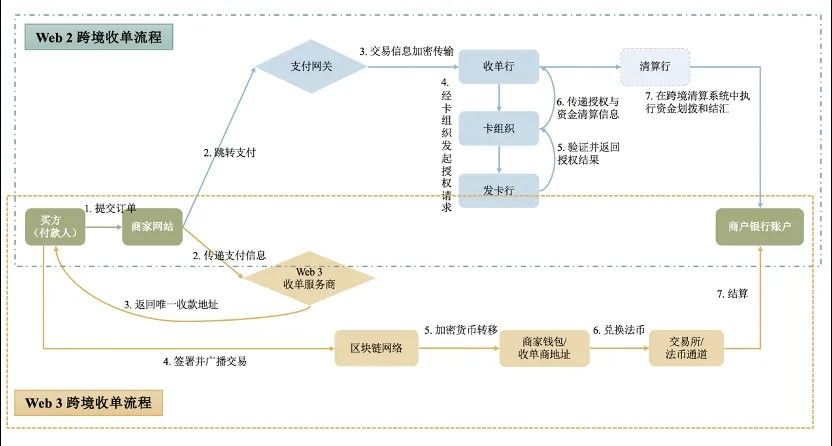
In the traditional Web2 system, cross-border payments are constructed around identity: all transactions must rely on trusted intermediaries such as banks and payment institutions, which record and clear transactions in their private ledgers, thereby forming a closed system.
In comparison, Web3 constructs an open payment system. Here, a payment request involves not just an account, but an "anonymous digital address" generated through technology. During payment, there is no need for deduction and clearing through banks or payment platforms; users can complete transactions directly on a peer-to-peer basis. This mechanism relies on algorithms and networks rather than the credit of any centralized institution.
From Web2"Account-Based Model"to Web3"Decentralized Settlement + Address-Based Model", this represents not only a technological upgrade but also a fundamental shift in the underlying financial paradigm.
The payment structure of Web3 makes cross-border payments faster and lowers barriers, breaking through national and traditional banking restrictions. However, it is precisely these characteristics of openness and anonymity thathave escalated money laundering risks from "offline concealment" to "on-chain invisibility."Under the cover of anonymous addresses and smart contracts, illicit funds can be infinitely split and mixed, merging like water droplets into a vast data torrent.
On-Chain Acquiring: Common Money Laundering Schemes in Cross-Border Payments
In Web3 cross-border payments, money laundering activities exhibit a high degree of technical sophistication and concealment. The following summarizes several typical money laundering schemes:
Scheme 1: Money Laundering Using Anonymous Coin Mixing
Money launderers use "mixers" to commingle illicit funds with other transactions, thereby severing the source and hiding traces. Subsequently, these "cleaned" funds can be used to purchase physical goods in cross-border payments or exchanged for fiat currency, completing the legalization of illicit funds. The purpose of mixing is to disrupt on-chain tracking, obscure transaction paths, and make it difficult for acquirers to trace the source of funds.
Core of the Scheme: Achieving anonymity through "mixing," making funds untraceable.
Scheme 2: On-Chain Money Laundering Through DeFi Protocols
Money launderers leverage the openness and composability of decentralized finance (DeFi) protocols to execute rapid and complex fund transfers. By engaging in cross-chain transfers, swaps, and yield-generating activities, they complicate fund paths to a degree that is difficult for manual analysis to decipher, causing tracking efforts to become lost in the maze of extensive on-chain data.
Typical operations include:
- Cross-Chain Bridge Transfers – Moving illicit funds across different blockchain networks via cross-chain bridges to increase tracking difficulty;
- Asset Swaps – Exchanging one asset (e.g., stolen ETH) for another (e.g., USDT) on decentralized exchanges;
- Staking and Lending – Depositing illicit funds into DeFi staking pools to earn interest, or using them as collateral to borrow other "clean" assets for payment.
Core of the Scheme: Creating complex fund flow paths to increase tracking difficulty.
Scheme 3: Money Laundering Through Fake Trade Confusion
Money launderers conduct fake transactions on cross-border e-commerce websites they control, using illicit funds to purchase their own goods. After the website converts the received crypto assets into fiat currency, the illicit money becomes legitimate sales revenue.
Core of the Scheme: Using fake cross-border trade as a cover for money laundering activities.
Scheme 4: High-Value Money Laundering via NFT Markets
Money launderers stage a "one-man show" to launder money: they first create an NFT and then purchase it at an exorbitant price using another wallet they control. The funds move from one pocket to another, transforming into "clean" money from "art sales," which can then be used normally.
Core of the Scheme: Exploiting the lack of standard pricing for NFTs to fabricate non-existent commercial transactions through self-buying and self-selling, thereby laundering money.
Core Challenges in Risk Control: Multiple Dilemmas in Anti-Money Laundering
Anti-money laundering work for Web3 cross-border acquiring is no longer a simple compliance issue but a systemic challenge involving technology, law, operations, and international cooperation. The fundamental contradiction lies in the fact that while a new decentralized financial system has formed, traditional regulatory logic has not kept pace, resulting in structural regulatory gaps.
1. Technological Level: Identification Blind Spots on Transparent Ledgers
The transparency of blockchain is far from sufficient for anti-money laundering purposes. We can see transactions, but we cannot identify "who is transacting" and "why they are transacting." This fundamental contradiction manifests in four specific technological dilemmas:
- Dilemma 1: Protocol Ownership Absence, Accountability Vacuum
DeFi protocols like Uniswap lack clear responsible parties, leading to a situation where no one is held accountable when risks arise, leaving regulators with no clear target for enforcement.
- Dilemma 2: Smart Contract Black Boxes, Ambiguous Intent
Money launderers can bundle multiple steps into a single smart contract call, making it difficult for risk control systems to parse the underlying true business logic.
- Dilemma 3: Cross-Chain Interactions, Broken Tracking Chains
When funds transfer between different blockchains, their original risk identities cannot be carried over, causing the tracking chain to break.
- Dilemma 4: Privacy Tools, Data Contamination
Technologies such as mixers can thoroughly disrupt fund flows, rendering traditional risk control models that rely on path analysis completely ineffective.
2. Legal and Regulatory Level: Ambiguity in Responsibility and Boundaries
If technological dilemmas represent "seeing but not recognizing," then legal and regulatory challenges represent "knowing the problem exists but being unable to find the responsible party."
Traditional regulation centers on clear territorial jurisdiction and responsible entities, but the decentralized structure of Web3 is exactly the opposite. When issues arise on "ownerless protocols" like Uniswap, regulators face a fundamental dilemma: among the many roles such as development teams, governance participants, and users, no clear bearer of responsibility can be identified.
The Tornado Cash case further provokes reflection: Does publishing neutral open-source code equate to assisting in money laundering?
The cross-border nature of Web3 acquiring leads to blurred regulatory boundaries. A single transaction may face jurisdiction from multiple countries, or may fall under no jurisdiction due to enforcement difficulties, forcing practitioners to survive in the cracks between compliance overload and regulatory vacuums.
3. Operational and Risk Control Level: Challenges of Second-Level Decision-Making and Irreversible Settlement
The "transaction equals settlement" characteristic of Web3 compresses risk control to the minimum. Acquirers must complete risk assessments within an extremely short timeframe, falling into a dilemma between "wrongfully blocking legitimate users" and "allowing illicit funds to pass."
Furthermore, the industry generally relies on lagging black-box risk control models and lacks a unified definition of "suspicious transactions," leading to inconsistent risk judgment standards. Once an error occurs, funds are completely lost due to the inability to reverse transactions.
4. International Cooperation Level: Disconnection Between Globalized Transactions and Fragmented Regulation
Web3 acquiring can be completed in minutes, whereas judicial assistance investigations and regulatory responses take months. This has spawned a phenomenon where institutions use offshore lenient licenses to undertake high-risk businesses at the lowest cost, creating a vicious cycle where bad money drives out good.
Simultaneously, there is a fundamental conflict between the public nature of on-chain data and privacy protection regulations for off-chain identity information, further exacerbating regulatory lag.
Constructing Future Paths: Designing Systematic Compliance Architectures
Anti-money laundering for Web3 cross-border acquiring is a systemic puzzle with interlocking components. It involves multiple levels including technology, law, risk control, and global collaboration, mainly comprising:
- Technological Decentralization:Leads to the inability to identify clear legal responsible parties;
- Ambiguous Legal Provisions:Makes it difficult for traditional risk control measures to intervene in advance;
- Inconsistent Regulatory Standards Across Countries:Ultimately greatly weakens enforcement efforts.
These levels produce chain reactions like dominoes. Therefore, acquiring service providers can no longer focus on a single aspect but must construct a systematic compliance architecture, building a sturdy bridge between the "decentralized" technological world and "centralized" regulatory requirements.

Conclusion
"Anti-money laundering" has never been a set of restrictive rules; rather, it is an opportunity to rebuild the trust system. When money can flow easily across borders, when code contracts replace banks, and when algorithms automatically execute transactions, the ultimate competition among enterprises is no longer just about who is faster, but about who is more trustworthy.
For companies providing payment collection services, investing effort to build a comprehensive compliance system is not only a necessary security measure but also a way to construct competitive advantage. It allows you to clearly demonstrate to regulators, partners, users, and investors that your business is standardized and transparent. In this way, compliance investments, originally viewed as costs, transform into valuable trust capital.
Web3 cross-border payments are undergoing a critical transition: moving from retrospectively "patching" problems after they occur to proactive planning and system establishment. If you require professional legal advice or compliance scheme design while exploring Web3 cross-border payment businesses, Mankun Law Firm possesses extensive experience in this field and welcomes you to contact us at any time.