

Dubai Ranks First
Author: Sudhir Khatwani
Article Title: "World’s Most Crypto Business Friendly Countries in 2024"
Source: Social Capital Markets
This article is translated and published with the author's authorization.
With its disruptive power, cryptocurrency has transformed the landscape of investment and digital assets, injecting new momentum into economic development across multiple regions worldwide. Recognizing the immense potential behind this trend, many countries have adjusted their regulatory strategies and enacted relevant laws to attract crypto enterprises and innovative startups. As of 2024, the global landscape of countries open to crypto business is rapidly evolving, with some nations standing out for their proactive measures to promote the development of the crypto industry.
In this report, the Social Capital Markets team evaluated and scored numerous countries worldwide based on five key indicators: regulatory transparency, capital gains tax rate, corporate income tax rate, the number of registered crypto companies, and the number of businesses accepting cryptocurrency payments. Each indicator was scored out of a maximum of 20 points, for a total possible score of 100 points.
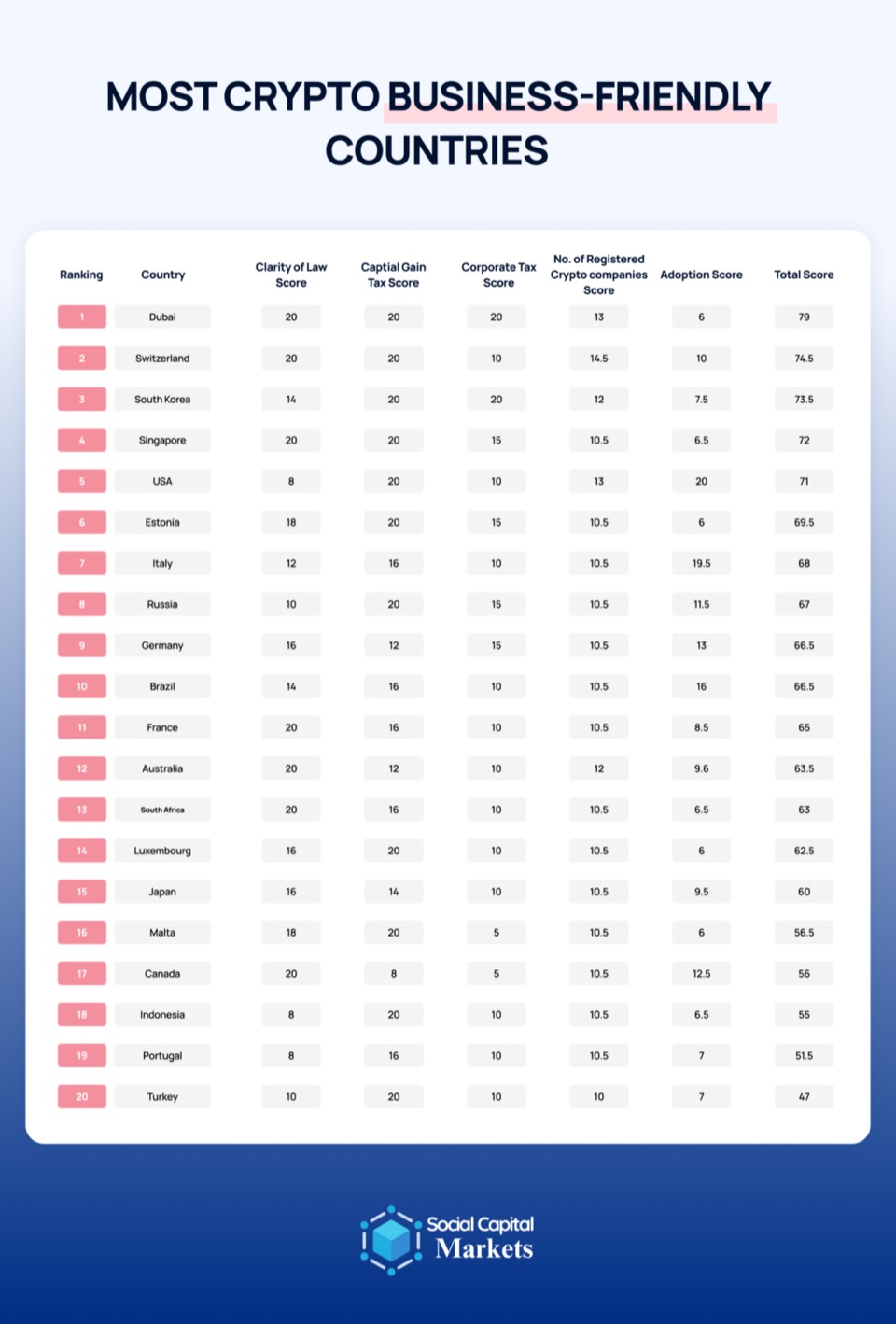
The data analysis reveals that countries such as Switzerland and Singapore have long been recognized as crypto-friendly jurisdictions, while Estonia, Malta, and the United Arab Emirates have also made significant progress in this field. Through an in-depth analysis of each country's regulatory policies, tax systems, and business environments, we have identified the top ten countries poised to lead the future development of crypto business.
Top 10 Crypto-Friendly Countries
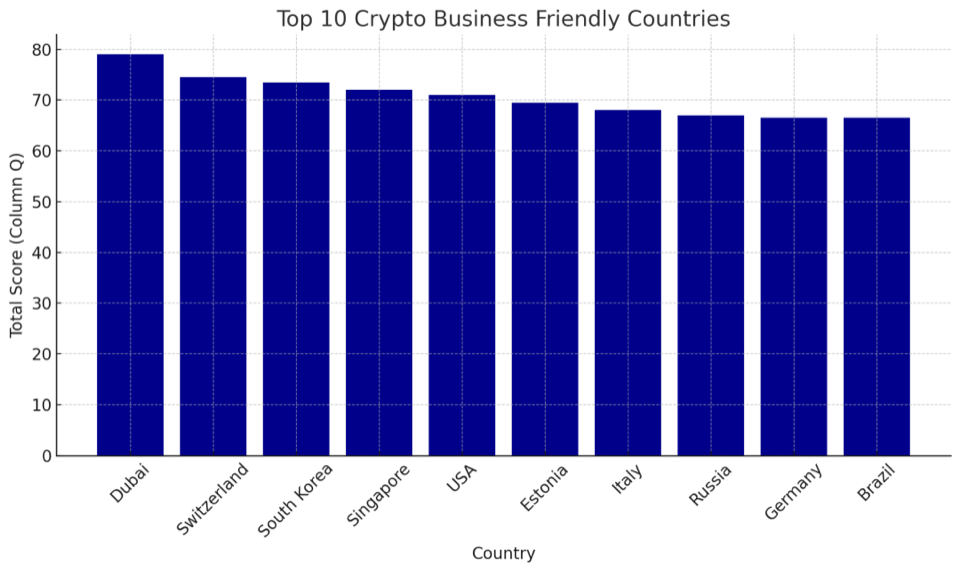
1. Dubai, UAE – Score: 79
G20 Country:Yes
Regulatory Framework:Dubai Multi Commodities Centre (DMCC), Dubai Financial Services Authority (DFSA)
Legal Clarity:Clear and Supportive
Capital Gains Tax:None
Corporate Tax:9% corporate tax on taxable income exceeding AED 375,000
Registered Crypto Companies:Over 550
In recent years, Dubai has gradually emerged as a pioneer city in the cryptocurrency sector due to its open stance. The Dubai Multi Commodities Centre (DMCC) has even established a dedicated Crypto Centre, providing a supportive launch platform for companies in the crypto and blockchain technology sectors. As a member of the G20, Dubai boasts regulatory bodies such as the Virtual Assets Regulatory Authority (VARA) and the Dubai Financial Services Authority (DFSA), which provide a standardized regulatory environment for cryptocurrency businesses.
Companies conducting crypto business in Dubai must register with the DFSA and DMCC. The Dubai government does not impose capital gains tax on the income of crypto companies, a feature that is highly attractive to crypto enterprises. Furthermore, Dubai imposes a relatively low corporate tax rate of only 9% on company income exceeding AED 375,000. Currently, there are over 550 registered crypto companies in Dubai.
2. Switzerland – Score: 74.5
G20 Country:No
Regulatory Framework:Swiss Financial Market Supervisory Authority (FINMA)
Legal Clarity:Clear and supportive, particularly in the Canton of Zug
Capital Gains Tax:7.8%
Corporate Tax:12%-21%
Registered Crypto Companies:Over 900
Switzerland's development in the cryptocurrency field is remarkable, with the city of Zug becoming a globally recognized crypto hub. In 2018, Johann Schneider-Ammann, the Swiss Minister of Economic Affairs, proposed the ambitious goal of building Switzerland into a "Crypto Nation."
The Swiss Financial Market Supervisory Authority (FINMA) provides clear and supportive regulatory provisions, especially in the crypto-friendly Canton of Zug. Companies conducting crypto business in Switzerland must register with FINMA. Thanks to legal clarity, Switzerland has become the preferred location for over 900 registered crypto enterprises.
Switzerland sets reasonable tax rates for crypto service providers, with a capital gains tax of 7.8% and corporate tax rates ranging between 12% and 21%. Additionally, more than 400 companies in Switzerland accept cryptocurrency as a payment method, demonstrating its open attitude towards cryptocurrencies.
3. South Korea – Score: 73.5
G20 Country:Yes
Regulatory Framework:Korea Financial Intelligence Unit (KoFIU), under the Financial Services Commission (FSC)
Legal Clarity:Gradually improving
Capital Gains Tax:Deferred collection (0%)
Corporate Tax:Implementation deferred until 2025
Registered Crypto Companies:Over 376
As a G20 member, South Korea is gradually emerging as a hotspot for crypto business. Digital asset trading and services are regulated by the Korea Financial Intelligence Unit (KoFIU), an important component of the Financial Services Commission (FSC). Although South Korea's cryptocurrency regulations are still being refined, its commitment to creating a business environment friendly to crypto technology is evident.
In South Korea, companies operating crypto services must register with the FSC and strictly comply with its legal requirements. Despite the ongoing development of the regulatory framework, South Korea has demonstrated its support for cryptocurrency business. Currently, South Korea has implemented a deferral policy on capital gains tax, and the implementation of corporate tax has been postponed until after 2025. These tax incentives, combined with over 376 registered crypto companies, have positioned South Korea strongly within Asia's crypto industry, steadily developing into a regional powerhouse in the sector.
4. Singapore – Score: 72
G20 Country:No
Regulatory Framework:Monetary Authority of Singapore (MAS)
Legal Clarity:Clear and Supportive
Capital Gains Tax:No capital gains tax
Corporate Tax:17%
Registered Crypto Companies:Over 100
As a major commercial hub in Asia, Singapore has shown great friendliness towards cryptocurrency companies. In Singapore, enterprises conducting crypto business must obtain licensing from the Monetary Authority of Singapore (MAS). Through the Payment Services Act (PSA), Singapore provides a forward-looking and flexible regulatory framework for industry participants, ensuring appropriate due diligence, solicitation, and risk disclosure.
Singapore does not levy tax on capital gains, which is a significant advantage for investors and businesses. The corporate income tax is uniformly set at 17%, providing a stable tax environment for the development of crypto enterprises. Currently, there are over 100 registered crypto companies in Singapore, which dominates the crypto business sector in Southeast Asia.
The Singaporean government has also allocated substantial funds for research and development in blockchain technology, demonstrating active support for cryptocurrency and blockchain technologies. Furthermore, Singapore's tax policies regarding cryptocurrency are relatively clear, providing explicit guidance for businesses, which further enhances Singapore's attractiveness as a center for crypto business.
5. United States – Score: 71
G20 Country:Yes
Regulatory Framework:Securities and Exchange Commission (SEC), Financial Crimes Enforcement Network (FinCEN)
Legal Clarity:Varies by state; complex
Capital Gains Tax:Varies by state (most states do not levy it)
Corporate Tax:21%
Registered Crypto Companies:Over 474
As a G20 country, the United States has a high level of acceptance for cryptocurrency, with over 5,000 businesses accepting cryptocurrency as a payment method, demonstrating the widespread application and significant status of cryptocurrency in the US. However, due to differences in laws across states, the regulatory environment in the US is relatively complex.
Despite the complex legal environment, the US remains quite active in the cryptocurrency field, with many states introducing supportive laws and programs. For example, Colorado has launched a sandbox program for blockchain enterprises to test new products and services.
Regarding tax policy, the US is relatively lenient towards crypto enterprises. Currently, most states do not impose capital gains tax on cryptocurrency, and the federal corporate income tax rate is 21%. Although license fees may be high, the vast market and innovative spirit of the US continue to make it a major player in the crypto industry. Currently, over 474 registered crypto companies operate in the US, further consolidating its leading position in the industry.
6. Estonia – Score: 69.5
G20 Country:No
Regulatory Framework:Financial Supervision Authority (EFSA)
Legal Clarity:Clear and Supportive
Capital Gains Tax:20%
Corporate Tax:20%
Registered Crypto Companies:Over 1,200
In Estonia, the strict "Anti-Money Laundering (AML) and Terrorist Financing Prevention Act" implemented during 2021–2022 reshaped the landscape of its crypto service provider market. These new laws prompted numerous enterprises to reassess their operational strategies, leading some to abandon license applications. In 2022, the Financial Intelligence Unit (FIU) revoked the licenses of nearly 482 crypto enterprises, reflecting Estonia's firm commitment to financial transparency.
Despite facing a strict regulatory environment, Estonia continues to attract industry pioneers through its favorable tax policies for crypto enterprises. Currently, approximately 100 crypto companies have obtained valuable licenses to operate in Estonia. Estonia does not levy capital gains tax and implements a 20% withholding tax on income tax, providing a relatively lenient tax environment for crypto enterprises. These measures, combined with its clear legal support, have secured Estonia a place in the global crypto business landscape.
7. Italy – Score: 68
G20 Country:Yes
Regulatory Framework:Ministry of Economy and Finance (MEF), Italian Securities and Exchange Commission (CONSOB)
Legal Clarity:Clear but still developing
Capital Gains Tax:26%
Corporate Tax:24%
Registered Crypto Companies:Over 73
Italy's attitude towards the cryptocurrency industry has gradually shifted from welcoming to strengthening regulation. Nevertheless, Italy remains one of the hotspots for crypto business. The introduction of the EU's Markets in Crypto-Assets Regulation (MiCA) has influenced the regulatory approach towards crypto service providers in Italy. Currently, over 73 approved crypto service providers are actively operating in the Italian market.
Italy's tax system is relatively unique, with strict tax laws. For capital gains tax, Italy implements a flat rate of 26%, while the corporate income tax is 24%. Although these rates are higher compared to other countries such as Australia or Japan, they remain somewhat competitive. As Italy continues to develop its regulatory framework and tax policies, the country is expected to become an important center for crypto business.
8. Russia – Score: 67
G20 Country:Yes
Regulatory Framework:Central Bank of Russia (CBR)
Legal Clarity:Clear but restrictive
Capital Gains Tax:No capital gains tax
Corporate Tax:20%
Registered Crypto Companies:Over 70
As a global superpower, Russia has attracted numerous crypto companies through its favorable tax policies. Russia does not levy capital gains tax, and the corporate income tax is 20%, providing a relatively lenient tax environment for businesses. The country recognizes cryptocurrency as legal tender, with over 500 enterprises across various industries accepting cryptocurrency as a payment method. This not only accelerates transaction processes but also ensures the security of payment data and simplifies operations for crypto companies in the Russian market.
9. Germany – Score: 66.5
G20 Country:Yes
Regulatory Framework:Federal Financial Supervisory Authority (BaFin)
Legal Clarity:Clear and supportive for licensed enterprises
Capital Gains Tax:25%
Corporate Tax:15%-30%
Registered Crypto Companies:Over 300
Germany was one of the earliest countries to recognize the potential of blockchain technology and apply it to digital transformation. The German Savings Banks Association, a network of 400 savings banks, has even developed fintech blockchain applications to facilitate cryptocurrency transactions. Germany maintains an open attitude towards cryptocurrency and extends this support to the entire crypto business sector. Regarding taxation, Germany exempts income from long-held cryptocurrencies from capital gains tax, while short-term capital gains tax ranges from 0% to 45% depending on the gains. The corporate income tax rate is 15%.
Although Germany's tax rates are slightly higher compared to some other countries, its transparent and mature crypto regulations provide an ideal environment for the development of crypto enterprises. Germany recognizes the legal status of cryptocurrency, and more than 700 enterprises accept cryptocurrency as a payment method, significantly enhancing the convenience of business operations.
10. Brazil – Score: 66.5
G20 Country:Yes
Regulatory Framework:Central Bank of Brazil
Legal Clarity:Gradually improving
Capital Gains Tax:15.0% – 22.5%
Corporate Tax::0% – 27.5%
Registered Crypto Companies:Over 19
Brazil's development in the cryptocurrency field is ongoing, with its regulatory framework gradually becoming clearer. In 2022, Brazil established a framework for the crypto industry and designated the Central Bank of Brazil as the regulatory authority. However, relevant laws and regulations have not yet been fully established, providing a relatively lenient environment for businesses.
Although Brazil's tax rates may make it relatively less attractive for crypto business—with corporate income tax reaching up to 27.5% and short-term capital gains tax ranging between 15% and 22.5%—the country's friendly attitude towards cryptocurrency is gradually improving. Brazilian residents will not be able to use cryptocurrencies such as Bitcoin as the country's legal tender, but newly enacted laws include many digital currencies under the definition of legal payment methods in Brazil and establish a licensing regime for virtual asset service providers.
Conclusion
The rise of cryptocurrency has opened a new chapter in the global investment landscape, attracting worldwide attention with its potential for substantial profits. Numerous countries are actively formulating laws and regulations to support and regulate the development of crypto business while ensuring the protection of citizens' interests, aiming to seize this wave of digital investment. In this global cryptocurrency race, G20 countries are leading the formulation of regulatory policies with their pioneering stance, while non-G20 members are catching up rapidly, injecting vigorous competition into the cryptocurrency sector. By providing clear legal support, favorable tax policies, and open business environments, these countries have not only promoted the legalization of cryptocurrency but also laid a solid foundation for the prosperous development of crypto business.
/ END.
Recommended Reading:
- Why Do Exchanges Like OKX and Bybit Choose to Incorporate in Dubai? | Mankun Web3 Research
2. Mankun Web3 Research | Analysis of Key Legal Compliance Points for Real-World Assets (RWA) in Hong Kong
*This article represents only the personal views of the author and does not constitute legal consultation or legal advice on specific matters. For legal consultation, please contact customer service: MankunLawFirm.
About the Author

Sudhir Khatwani holds a bachelor's degree from Vellore Institute of Technology. During his tenure as a Program Analyst at Cognizant, he made significant contributions to key projects for financial giants such as Mitsubishi UFJ Financial Group (MUFG) and Citibank. Leveraging his professional technical expertise and keen analytical skills, he successfully implemented multiple high-impact solutions in the financial sector. Additionally, as a Content Strategist at the CoinSwitch cryptocurrency exchange, Sudhir further deepened his professional capabilities in digital assets and blockchain technology.