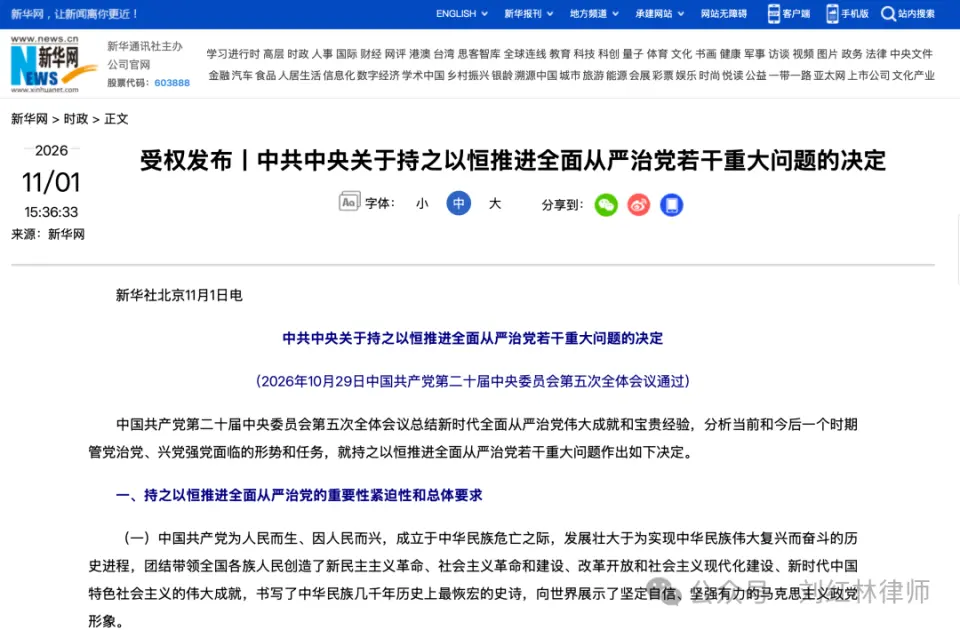
On November 1, Xinhua News Agency, authorized to do so, released the Decision of the Central Committee of the Communist Party of China on Several Major Issues Concerning Persevering in Advancing Full and Rigorous Party Governance. When addressing the punishment of corruption, the document specifically included the following sentence:
“Resolutely combat corrupt acts carried out through the internet, virtual assets, cross-border funds, blockchain, and other means.”
Virtual assets and blockchain—topics usually discussed at industry conferences and in project introductions—have now been written directly into the central authorities' anti-corruption arrangements.
Reading this, I was reminded of the 2024 case in which Yao Qian was expelled from both the Party and public office.
At that time, Yao Qian, former Director of the Science and Technology Supervision Department and former Director of the Information Center of the China Securities Regulatory Commission, was expelled from both the Party and public office, and the notice contained a detail that drew considerable attention: using virtual assets and other means to engage in power-for-money transactions.
For someone who had long studied fintech and was familiar with digital currency, the appearance of such content in the notice indeed left the industry sighing for a while.
Two years on, from the notice in a specific case to the explicit naming in a central document, one question is still worth discussing: is bribery using virtual assets really safer than cash or bank card transfers?
The conclusion first: using virtual assets can indeed provide an alternative path for transferring money and may also make investigation more laborious. But to conclude from this that one cannot be traced would be to oversimplify the matter.
Why some people think it is safer
It is not hard to understand why some people think bribery using virtual assets is safer. Looking only at the delivery step, it does indeed involve fewer complications than cash and bank transfers.
With bank transfers, accounts are under real names, and banks keep records showing where the money came from and to whom it was transferred. Cash does not have the same account transaction records, but large amounts are also difficult to handle: someone has to arrange for withdrawing it, where to keep it, and how to deliver it to the other party, and this may also leave clues such as surveillance and the people involved.
With virtual assets, wallet addresses do not directly bear names, transfers do not go through banks, no meeting is required, and cross-border transfers are convenient… Given all these conveniences, some people come to feel that the matter is much safer.
But if you focus only on the fact that no real-name verification was performed at the time of transfer, it is easy to oversimplify the matter.
Bribery and the acceptance of bribes ultimately occur between people. Project approvals, procurement orders, business access, and personnel arrangements—these real-world matters do not simply disappear because the final delivery is made in virtual currency.
The most common misunderstanding about virtual currency is equating the absence of real-name labels on addresses with the absence of records for transactions in the real world.
Take Bitcoin as an example. On-chain transfers are indeed purely anonymous, and at the time a transaction occurs, others may not yet know who is behind the address. But if new identity clues emerge later, it may be possible to trace the address and re-examine past transactions.
For example, when coins enter a trading platform, the platform is centralized and retains all user information. With a single email from the judicial authorities of any country or region, the vast majority of exchanges will cooperate obediently.
Once an address and a person are linked through reliable evidence, the records left on the chain in the past become useful. Some cash deliveries leave no direct transaction trail, whereas on-chain transactions instead leave a record that can be checked later.
Some friends may ask: don't privacy technologies and coin-mixing tools make tracking more difficult?
These technologies do indeed make analysis harder, but investigations do not necessarily have to start from the chain. The Yao Qian case already provides a very intuitive reminder: familiarity with financial technology did not allow the relevant money-for-power transactions to escape investigation. Moreover, for people who have had little contact with cryptocurrencies in the first place, how much reason is there to believe they can conceal every link in the process?
Why I advise everyone not to engage in large-amount OTC
This is also why Lawyer Honglin has consistently advised everyone not to engage in large-amount OTC in mainland China. It does look profitable: do one transaction, collect a small fee or earn a small spread, and once the volume grows, the income becomes considerable. But you need to think one step further: why is this money willing to come to you for exchange, and what problem is the other party actually trying to solve?
Large-amount cash-outs in mainland China generally fall into these two categories of demand.
One category is money within the mainland that wants to go abroad but does not want to use formal channels to account for the source and use of funds, so it seeks to circumvent this through currency exchange. The other category is money that is itself derived from embezzlement or bribery; the person seeks someone to exchange it into coins and move it around in order to conceal its original source. If you encounter funds of this kind, you may become a link used by others in transferring and laundering assets.
What you see is the other party being willing to pay the transaction fee; what the other party has its eye on may be precisely your ability to help it convert the money into another form and move it to another place. When the corruption problem at the front end is investigated, and the case handlers follow the funds forward, these several conversions you handled will also have to be explained one by one. By that time, a statement that "I didn't participate in the corruption, I just helped exchange some coins" may not be enough to extricate yourself.
This is not something that only needs to be considered after seeing the news today.
The judicial interpretation on money laundering issued by the Supreme People's Court and the Supreme People's Procuratorate, effective from August 20, 2024, has expressly listed the transfer and conversion of criminal proceeds and the proceeds thereof through virtual asset transactions as a corresponding method of money laundering. Corruption and bribery have always fallen within the scope of predicate offenses for the crime of money laundering; the money being exchanged into coins will not thereby become clean money.
If you cannot even explain the source of the funds, yet are first busy calculating how much this transaction can earn, I really would not recommend touching it. Moreover, the mainland already has clear regulatory prohibitions on businesses such as operating exchanges between legal tender and virtual currency.
Summary
In this central document, expected returns, agreed nominee holdings, "white gloves," and the use of virtual currency, cross-border funds, and blockchain to carry out corruption are placed in the same paragraph. I think this is more worth pondering than seeing the words "virtual currency" alone.
Two years ago, the Yao Qian case drew many people's attention to the connection between virtual currency and the trading of power for money. Today, the central document has once again placed this issue explicitly on the table. For those who still believe that "changing to another wallet can wash the relationship clean," what most needs reconsideration is probably their own understanding of safety.