
"Without using a domestic bank card, you can top up USDT directly onto a U card and spend globally, and cashing out won't result in your card being frozen."
For Web3 practitioners who worry about bank card freezes, frequently travel across borders, or receive their salaries in USDT, this kind of marketing is very appealing. It appears to solve the most anxiety-inducing problem of traditional OTC cash-out: users do not need to first sell USDT to strangers, nor do they need to let third-party RMB enter their domestic bank cards directly.
But a U card is not a "safe channel" that bypasses all risk management and regulation. It merely shifts risks that were originally concentrated in domestic bank cards andOTC transactionsto other links such as overseas card issuers, virtual asset platforms, on-chain fund screening, fiat currency exchange, and cross-border card networks.
More importantly, using USDT from lawful sources to pay for daily consumption oneself is a completely different business scenario from receiving USDT from strangers, swiping cards and withdrawing cash on their behalf, and earning handling fees. The former mainly faces review of products, accounts, and sources of funds; the latter may transform from personal consumption into providing fund conversion and payment channels to others.
I. "U cards" on the market are not a uniform product
"U card" is usually just a collective market term for payment cards linked to crypto assets, and different products may differ greatly in card issuance, custody, and exchange structures.
Some cards are issued by overseas banks, electronic money institutions, or licensed card issuers, where users deposit digital assets onto a partner platform and the platform completes the conversion between crypto assets and fiat currency at the time of card payment; some cards are essentially prepaid cards, where users first sell USDT to form a fiat currency balance and then spend the balance; and some products connect to self-custody wallets, where digital assets remain under the user's control before a transaction occurs, but what ultimately enters the bank card network is still fiat currency after conversion.
The crypto card program publicly described by Mastercard shows that crypto asset payments are converted into fiat currency before entering the Mastercard network, and relevant projects need to perform KYC, anti-money laundering, sanctions screening, fraud monitoring, and ongoing transaction monitoring; the specific supported assets, functions, and service regions also vary depending on partners and markets.
Therefore, the so-called "swiping U directly" is more of a user-end experience and does not mean that merchants directly receive USDT. In the actual chain, there are usually still crypto asset platforms, exchange service providers, project managers, card issuers, card networks, and acquirers.
The Visa or Mastercard logo printed on the card can only indicate that the card may be connected to the corresponding payment network; it cannot prove that the project party selling the U card is itself a card issuer, nor can it prove that the USDT topped up by users is held in custody by the card network, and it certainly does not mean that the card network will backstop platform operational failures or user asset losses.
II. "Card freezing" is not a uniform outcome
The most common conceptual confusion in U-card promotion is labeling all of the following as "card freezing": the freezing of domestic bank cards by public security authorities, account reviews by overseas card issuers, platform restrictions, and individual payment refusals.
In reality, the "inability to use" that users encounter may correspond to at least the following situations:
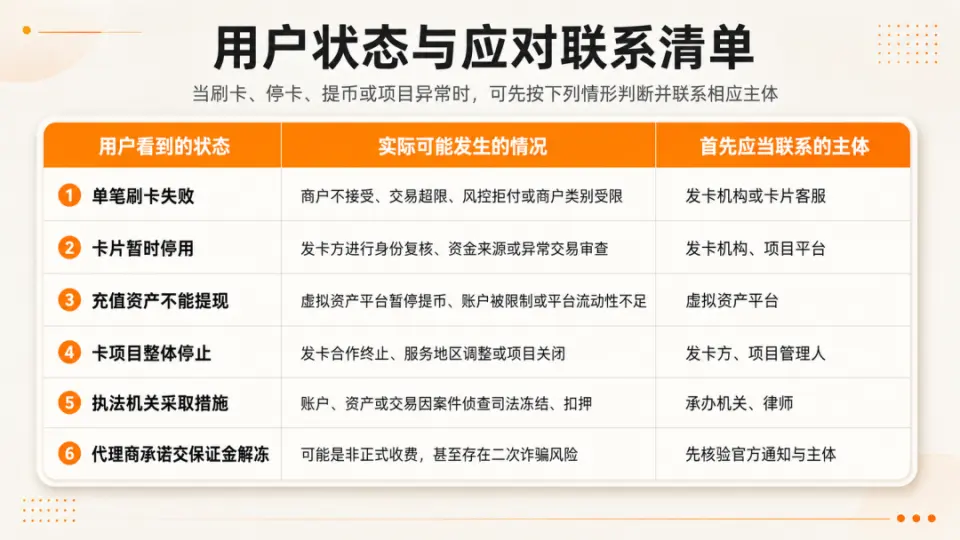
Therefore, the promotional claim that "U-cards will not be frozen" substitutes one issue for another. A user who does not receive unfamiliar RMB through domestic bank cards may avoid one particular path of fund association, but may still face issuer reviews, platform asset restrictions, on-chain address risks, and cross-border law enforcement coordination.
What a U-card changes is the path through which funds pass, not the legal nature of the funds themselves.
III. Why are the risks of personal use and withdrawing funds on behalf of others completely different?
When a user tops up USDT obtained through salary, project dividends, or normal investments onto a card provided by a genuine card issuer and uses it for hotels, air tickets, dining, and daily consumption, the conduct first presents as an individual using their own assets.
However, if a user begins to collect USDT from others and then uses their own U-card to make purchases for those others, buy goods, withdraw cash from ATMs, or complete cash-outs, and charges a fee based on the amount, their role has changed from cardholder to provider of fund services.
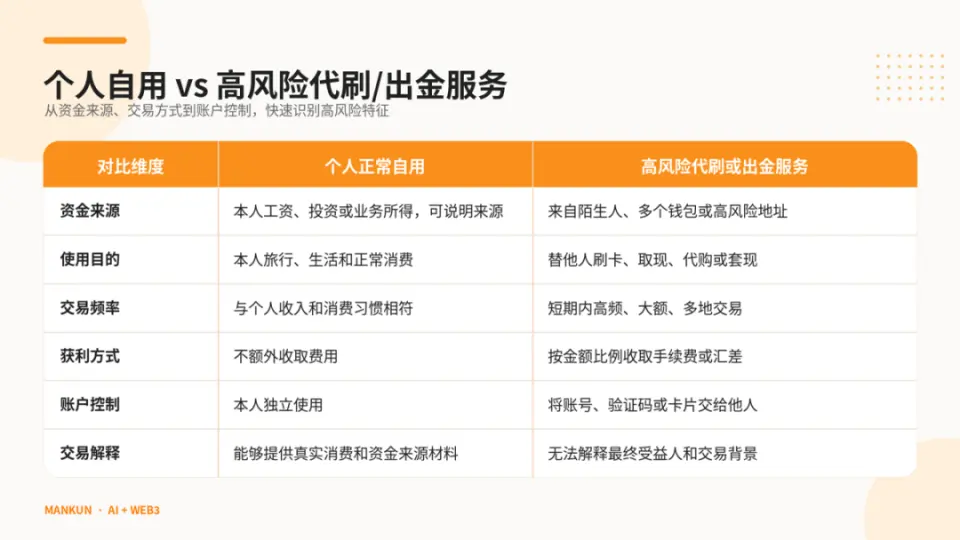
This distinction cannot be made based on amount alone. Occasionally buying an air ticket for a family member is clearly different in legal nature from long-term posting in community groups of "U-card proxy payments, low-fee cash-outs" and providing services to unspecified customers.
When the relevant conduct is continuous, commercial in nature, and actually performs fund exchange or payment settlement functions, it may give rise to risks such as illegal business operations; if the assets handled originate from criminal activity and the actor knows the relevant source is abnormal yet still assists in converting, transferring, or concealing them, it may also trigger review for money laundering or for the crime of concealing or disguising criminal proceeds or the proceeds of criminal proceeds. The Criminal Law expressly brings within the scope of relevant criminal assessment conduct such as providing fund accounts, transferring funds through payment settlement, cross-border transfer of assets, and, with knowledge of criminal proceeds, still transferring them, selling them on behalf of others, or concealing or disguising them.
It must be emphasized that having used a U-card or having paid a fee once on behalf of relatives or friends does not directly lead to a finding of crime. Whether criminal liability is borne still depends on the service recipients, business scale, source of funds, fee method, subjective knowledge, and the consequences actually caused.
IV. Which uses of U-cards are no longer ordinary consumption?
At present, the scenarios most likely to come within the scope of a criminal investigation are concentrated in three areas: account rental, professional proxy swiping and abnormal promotion.
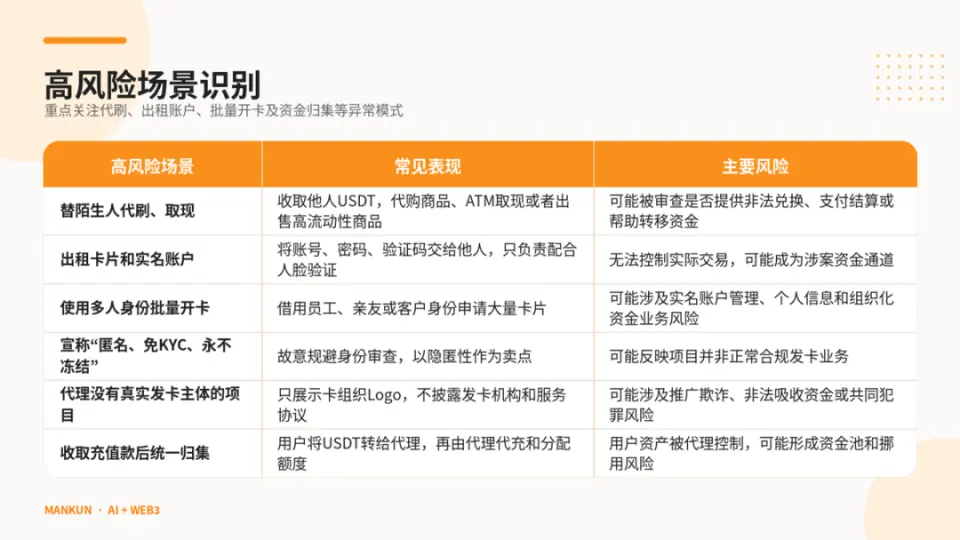
Particular caution is required because "no KYC" and "complete anonymity" are not necessarily product advantages. Legitimate crypto card projects generally need to conduct identity verification, anti-money laundering,sanctions screeningand ongoing transaction monitoring.
If a project claims, on the one hand, to be connected to an international bank card network and, on the other hand, promises not to conduct any identity review, verification of the source of funds or transaction monitoring, these two statements may themselves be contradictory.
V. Before obtaining a U card, do not look only at the logo on the card; at a minimum, clarify five entities
To determine whether a U card is reliable, users should not rely solely on card screenshots displayed by the promoter, but should reconstruct the complete business chain.
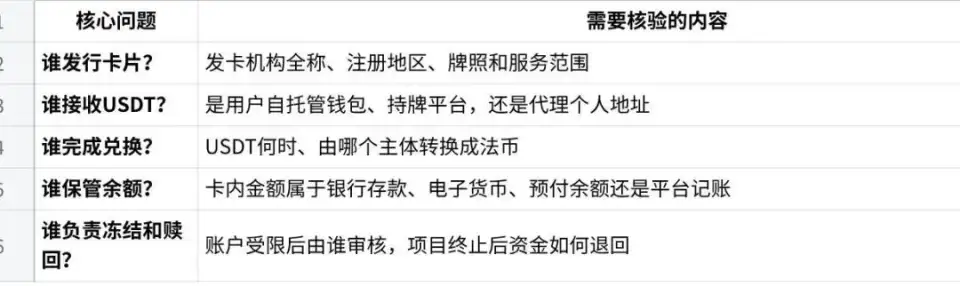
In addition, users should also confirm whether mainland Chinese residents are among the permitted service recipients, and should not circumvent regional restrictions by forging overseas addresses, borrowing another person's identity or using false proof of residence. Even if a card can be successfully opened, subsequent identity re-verification may still result in account closure and difficulties in dealing with the balance.
Materials on the source of funds should also be retained starting from the time the assets were initially acquired, including employment contracts, salary statements, project dividend documents, transaction orders, original wallet addresses andon-chain hashes, rather than retaining only the screenshot of the last top-up to the U card platform.
VI. What should be done first if an account has already been restricted?
After discovering that the card cannot be used, the first step is not to immediately seek an agent for 'paid unfreezing,' but rather to first ascertain which entity imposed the restriction and what nature it has.
The account-opening agreement, the name of the card issuer, KYC materials, top-up hashes, wallet addresses, card statements, platform notices and customer-service communications should be preserved in full. If the platform requires supplementary proof of the source of funds, an explanation should be provided covering how the assets were obtained, which addresses they passed through, why the top-up was made and how the funds were used.
It is not advisable, in order to circumvent restrictions, to immediately change identity, re-apply for a card, transfer assets into another person's account, or continue splitting top-ups across multiple wallets. Such operations may make what could originally be explained as personal consumption appear closer to circumventing risk controls and concealing the path of funds.
If a platform, under the names of 'tax payment,' 'regulatory deposit' or 'secondary activation fee,' requires continuous transfers of new USDT while being unable to provide formal documents, a genuine card issuer and clear refund conditions, one should be alert to secondary fraud.
Where the amount is relatively large, the platform entity is unclear, or law-enforcement coordination has already been involved, it is necessary to determine separately whether the matter is a contractual dispute, recovery of platform assets, a regulatory complaint or a criminal case; the same 'unfreezing tutorial' cannot be used to handle all of them.
Lawyer's Observations
U cards are not inherently illegal products, nor are they inherently safe products. They are merely a business tool connecting digital assets, fiat-currency exchange and bank-card payments.
There is a clear risk boundary between an individual using USDT of lawful origin for normal consumption and accepting others' assets, providing proxy card-swiping cash-out services and charging fees. What truly determines the legal nature is not the name of the card, but for whom the user provides services, where the funds come from, how the exchange is completed, and whether the person can explain the transaction background.
For ordinary users, the most important thing is not to find a card that promises 'never frozen,' but to ascertain clearly who issues the card, who holds it in custody, who exchanges the currency, who conducts the review and who provides refunds. For practitioners, once a business begins to rely on funds from strangers, high-frequency proxy card-swiping, multiple persons' identities and commissions based on transaction volume, they can no longer understand their role as 'I am merely helping with consumption.'
Not using domestic bank cards may avoid one risk pathway; but when a U card becomes a channel for converting and transferring funds on behalf of others, the risk does not disappear—it merely enters through a different gateway.
/ END.
*This article is an original article of Mankun Law Firm and represents only the personal views of the author. It does not constitute legal consultation or legal advice on any specific matter. For reprinting and legal consultation, please add our customer service: mankunlawyer

