
Some money, once it passes through your hands, can never be washed clean again.
I. The First Lesson in a County-Town Internet Café
In 2008, when I was twelve, I first heard the term "money laundering" at the "Feiyu Internet Café" in my hometown county town.
Back then, the internet café still charged two yuan an hour, and the air was thick with the smell of instant noodles and cheap cigarettes. Sitting next to me was my childhood friend Chen Lei, a guy who was always at the bottom of the class academically but whose mind was extraordinarily quick. Pointing at a colorful page on the screen, he lowered his voice and said to me: "Hui, look at this—help people move money around, and you can make over a hundred a day."
I ignored him. At that time, my monthly living allowance was only three hundred yuan, but my father had once said something—"Money that isn't yours burns your hand if you touch it."
Fifteen years have passed. In 2023, Chen Lei was taken away by the police for helping others run USDT, and the amount involved wasover 3.8 million yuanWhen he called me, his voice trembled like leaves in late autumn: "Ahui, I thought I was just helping people trade virtual currency back and forth—how did it become money laundering?"
How did it become money laundering?
I have heard this question no fewer than fifty times in detention-center meeting rooms over the past two years. The people who ask it include recent college graduates, small owners of milk-tea shops, and factory workers tightening screws on assembly lines. They all share one thing in common—they all believed they were merely "moving their fingers," with money passing from the left hand to the right, earning a hard-earned fee, as natural as could be.
But the law does not see it that way. The police do not see it that way. Prosecutors do not see it that way. And judges certainly do not see it that way.
In this article, I want to dismantle the underground industry chain of USDT illegal payment-settlement schemes and money laundering from beginning to end, from top to bottom, and lay it all out cleanly for you. Not to teach you how to do it, but to make you see clearly—the end of this road is not the beautiful dream of earning over a thousand a day, but iron doors behind high walls and a criminal record that can never be washed away.
II. What Are USDT Illegal Payment-Settlement Schemes? Starting with "Traditional Illegal Payment-Settlement Schemes"
To understand USDT illegal payment-settlement schemes, one must first grasp a term—illegal payment-settlement schemes。
Illegal payment-settlement schemes, put plainly, means helping others "pass money through accounts": you lend out your bank card, Alipay or WeChat payment QR code, help others receive money, then transfer the money to a designated account, and take a commission from it. In the trade, this commission is called"points", generally between1.5% and 3%. For every ten thousand yuan processed, you earn one hundred fifty to three hundred.
Does it sound like a courier errand? But the source of this money is, nine times out of ten, unclean—gambling funds from online gambling, illicit proceeds from telecom fraud, black money from underground banks. Your bank card is the conduit for these dirty funds to be "laundered through."
Traditional illegal payment-settlement schemes use bank cards and third-party payments, and have one fatal weakness:bank cards will be frozen.When law enforcement traces the flow of funds, the bank card involved is immediately subject to judicial freeze—at best frozen for six months, at worst officers come directly to make an arrest. In the trade, this is called"Card freeze", people whose cards have been frozen call each other "freeze friends"
Around 2019, the underground and gray-market circles discovered a better tool—USDT。
USDT, short for Tether, known in Chinese as Tether coin, is a stablecoin pegged to the US dollar,1 USDT is approximately equal to 1 US dollarIt runs on the blockchain; transfers do not require a bank, do not require real-name identification, are not subject to national border restrictions, and can arrive within minutes. More critically—the authorities cannot freeze wallets on the blockchain.
Thus, USDT illegal payment-settlement schemes emerged.
III. A complete USDT illegal payment-settlement industry chain
Let me draw you a picture.
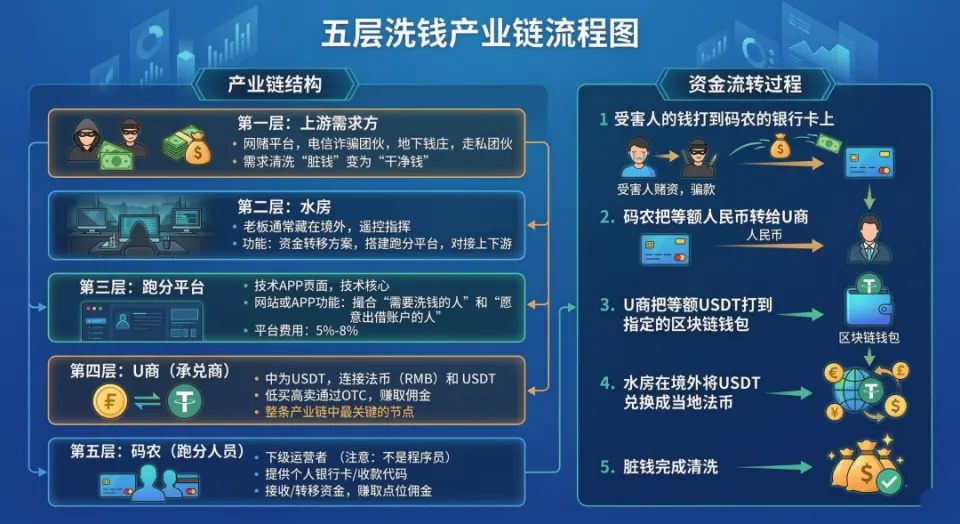
This industry chain, from top to bottom, is roughly divided intofive layers:
Layer one: upstream demand-side parties. Who needs money laundering? Online gambling platforms, telecom fraud rings, underground banks and smuggling rings. They hold large amounts of "dirty money" — gambling funds that victims pay into platforms, and the hard-earned money that defrauded individuals transfer out. This money must be "cleaned" before it can become "clean money" that can be used normally.
Layer two: the water house. This is the term used in the industry for a professional money-laundering ring or venue. The water house is responsible for designing the entire fund-transfer scheme, building the illegal payment-settlement platform, and connecting upstream and downstream parties. The owner of the water house is usually hidden overseas, directing operations remotely.
Layer three: the illegal payment-settlement platform. This is the technical core of the entire chain. The platform developer builds a website or App with a simple function — matching "people who need money laundering" with "people willing to lend their accounts." The platform takes a service fee, generally a percentage of the transaction amount.5% to 8%。
Layer four: U merchants (acceptance merchants). U merchants are middlemen who buy and sell USDT, bridging fiat currency (RMB) and USDT. Through OTC (over-the-counter) trading, they buy USDT low and sell high, earning the spread and commissions. U merchants are the most critical node in the entire industrial chain — without U merchants, dirty money could not return from the blockchain world to the real world.
Layer five: code farmers (payment-settlement personnel). Note that "code farmer" here does not mean a programmer; it is the term used in the black and gray industry for low-level payment-settlement personnel. They provide their own bank cards or payment collection codes, collect and transfer funds according to platform instructions, and earn commission based on points.
The entire process works as follows:
The victim's money was transferred to the card of a money mule → the money mule transferred an equivalent amount of RMB to a USDT dealer → the USDT dealer transferred an equivalent amount of USDT to a designated blockchain wallet → the cash-out operation exchanged the USDT into local fiat currency overseas → the dirty money completed the laundering process.
With USDT in the middle acting as a "blocking layer," the flow of funds on the blockchain becomes a string of anonymous wallet addresses, and the difficulty for law enforcement to trace it increases more than tenfold.
This is why the Criminal Investigation Bureau of the Ministry of Public Security once stated explicitly at a press conference of the State Council Information Office:There is extensive use of illegal payment-settlement platforms combined with virtual assets for money laundering, especially the use of USDT, and the harm is the most serious.
IV. A-Lei's Story: From "Moving Bricks" to Behind Bars
I took on Chen Lei's case in the autumn of 2023.
In the meeting room, across the thick glass, Chen Lei had lost at least twenty jin. He wore a detention center vest, his hands crossed on the table, and there was still uncleaned mud under his fingernails—before he was taken in, he had been building a house in his hometown, and the rebar was only half tied.
"A-Hui, what crime do you think this counts as for me?"
I flipped through the case file and did not rush to answer. The facts in the file were clear: from June 2022 to March 2023, Chen Lei, through an illegal payment-settlement platform called "Jubao," used his own and his family'sfive bank cards, and cumulatively helped others process transactionsof more than 3.8 million yuan,earn commissions47,000 yuanHis upline is a person with the online alias "Brother Dafei," whom he contacted on Telegram and has never met in person.
"What did Brother Dafei tell you?"
Chen Lei's eyes turned red: "He said this was moving-brick arbitrage—buying USDT low and selling it high—and that it was lawful and compliant. He said everyone in the crypto world does this and it isn't illegal."
Moving bricks, industry jargon whose original meaning is arbitrage based on price differences in virtual assets across different platforms. But in the context of USDT illegal payment-settlement schemes, "moving bricks" long ago took on a different meaning—it became a byword for money laundering.
I asked him: "Have you ever thought about where the money that was deposited into your bank card came from?"
Chen Lei was silent for a long time. Finally he said something I still remember to this day: "I have thought about it. But I didn't dare think too deeply."
Didn't dare think too deeply.These six words precisely sum up the psychological state of the vast majority of participants in illegal payment-settlement schemes. It is not that they do not know the money is problematic; rather, they choose to cover their eyes. A commission of four to five thousand yuan a month is all too tempting for a young person in a county town getting by on odd jobs.
But the law will not let you off just because you "didn't dare think too deeply."
Chen Lei was ultimately prosecuted forconcealment or disguise of criminal proceedsThis offense is set out in Article 312 of the Criminal Law and carries a maximum penalty ofseven years' imprisonment。
V. Commercial Logic: Why USDT illegal payment-settlement schemes can become a "business"
If we set aside moral judgment and analyze purely from a commercial perspective, the reason USDT illegal payment-settlement schemes can form a complete industry chain is that they perfectly solve three core problems:
First, the capital turnover rate is extremely high.
Traditional money-laundering methods—such as through underground banks or trade offsetting—often require several days or even weeks to complete the laundering of a single sum of funds. But USDT illegal payment-settlement schemes can, withina few minutes,complete the entire process from fiat currency to virtual currency and back to fiat currency. An active illegal payment-settlement platform can processhundreds oftransactions in a single day. A high turnover rate means high returns; even if the profit per transaction is only a few percentage points, multiplied by a huge transaction volume, the profit is extremely substantial.
Second, the "anti-freeze" advantage brought by decentralization.
Bank cards being frozen is the biggest pain point of traditional illegal payment-settlement schemes. But USDT runs on the blockchain,with no centralized "freeze button."The authorities can freeze your bank card, but they cannot freeze your blockchain wallet—unless they know your private key. This substantially enhances the risk resistance of the entire industrial chain.
Operators of illegal payment-settlement platforms have boasted on dark web forums: "All transactions occur between customers and our acceptance merchants, with no pooled fund account in between, effectively preventing funds from being frozen on a large scale. Moreover, USDT serves as an intermediary barrier, and the entire process consists of untraceable transactions that cannot be traced to their destination."
Third, information asymmetry and the trust economy.
USDT-based illegal payment settlement is essentially a form ofarbitrage on information asymmetry.The upstream does not know who holds clean bank cards, and the downstream does not know who needs money laundering; the platform matches them in the middle and charges an information intermediary fee. At the same time, this industrial chain relies heavily on "trust"—the money mules trust that the platform will not swallow their deposits, the platform trusts that the USDT merchants can complete USDT exchange in a timely manner, and the USDT merchants trust that the upstream will not abscond with the funds.
But this "trust" is extremely fragile. In fact, a large number of so-called "USDT illegal payment-settlement platforms" are themselvesPonzi schemes.According to a developer of an illegal payment-settlement platform system, the USDT illegal payment-settlement platforms they developed for clients are in fact Ponzi platforms and not genuine payment settlement at all. The platform can abscond with the deposits (usually USDT) paid by participants at any time.
You thought you were laundering other people's money, but it turned out that your own money was laundered by others.
This is the cruel reality of thieves preying on thieves.
VI. How do the police apprehend people? From on-chain tracing to off-chain manhunts
Many people believe that using USDT makes them safe and that the police cannot trace them.
That was the understanding in 2019. Applied to today,it is completely wrong.
Let me describe several actual investigative methods:
Method one: monitoring of abnormal funds at the bank card level.
Even if USDT illegal payment-settlement schemes are anonymous at the virtual currency stage, at the fiat currency stage—that is, at the stages of receiving and making payments—bank cards remain indispensable. The police now have a very matureanti-money-laundering funds monitoring system, which can automatically identify abnormal transaction patterns on bank cards: receiving frequent transfers from different people within a short period, transferring funds out immediately after receipt, transactions concentrated in the late night, and so on. Once an alert is triggered, the bank card is immediately frozen, and the police visit to verify.
Chen Lei was discovered in exactly this way. One of his bank cards, within two months, received127 transfers from different accounts, each in an amount between5,000 yuan and 20,000 yuan, and after receipt, on average within8 minutesthe funds were transferred out. In the eyes of law enforcement, this transaction pattern is the "fingerprint" of illegal payment-settlement schemes
Method two: on-chain tracing technology.
Although the blockchain is anonymous, it has one characteristic—all transaction records are permanently public and searchable.Law enforcement now has professional blockchain analysis tools and can, through the correlations between wallet addresses, map out a complete fund-flow chart.
The major case in Qinshui County in 2023 is a typical example. Through the login IPs of the USDT wallet addresses involved in the case, law enforcement found that although most of the login IPs were overseas, among themtwo login IPs pointed to a specific domestic address—That was precisely the residential address of a U merchant's family member. Following the trail,all 21 criminal suspects were apprehended, with the amount involved exceeding RMB 380 million.
Method three: extraction of encrypted chat records from Telegram, BatChat and similar applications.
Illegal payment-settlement schemes typically use encrypted communication tools such as Telegram, BatChat and Paper Plane to communicate. However, after apprehending criminal suspects, the police can conduct electronic forensics on their mobile phones and extract key evidence such as chat records, transaction screenshots and wallet addresses. Many people believe that Telegram's self-destructing messages make them safe, but they forget that the phones of the parties they chat with also store the same records.
As long as one person in the chain is caught, the entire chain will be pulled out.
VII. The Legal Maze: What Crime Have You Actually Committed?
This is the question I am asked most often in the interview room.
The charges involved in USDT illegal payment-settlement money laundering may, depending on the specific circumstances, befour:
- Crime of assisting information network criminal activities ("assisting information network crimes," Article 287-2 of the Criminal Law)
If you merely provided a bank card or payment collection code to assist others in payment settlement, but did not clearly know the specific upstream criminal conduct, you may be found to have committed the crime of assisting information network criminal activities. This charge was added by the 2015 Amendment (IX) to the Criminal Law, and the sentencing is relatively lenient—fixed-term imprisonment of not more than three years or criminal detention, and concurrently or independently a fine.
However, the crime of assisting information network criminal activities has a threshold: it requires that you"know that others are using information networks to commit crimes"In practice, police officers and prosecutors will infer your "knowledge" from your transaction patterns, commission rates, chat records and other evidence. If the commission you charge is clearly higher than normal levels, your counterparties are all strangers, and your transactions are concentrated late at night—basically, the defense of "I didn't know" is very difficult to sustain.
- Crime of concealing or disguising criminal proceeds ("concealment crime", Article 312 of the Criminal Law)
If you know or should know that the funds you handle are criminal proceeds and still assist in transferring them, you may be found to have committed the concealment crime. The sentencing for this crime is heavier than for the crime of assisting information network criminal activities—fixed-term imprisonment of not more than three years; where the circumstances are serious, fixed-term imprisonment of not less than three years but not more than seven years.
Chen Lei was ultimately prosecuted for the concealment crime. The prosecutor's reasoning was: you clearly knew that these funds came from unknown sources, yet you still used multiple bank cards to process transfers for others and charged commissions; subjectively, this at least constitutes "should have known".
- Money laundering crime (Article 191 of the Criminal Law)
On August 20, 2024, the latest judicial interpretation issued by the "Two Supreme Courts" officially came into effect,for the first time expressly listing transactions through "virtual assets" as one of the methods of money laundering.At the same time, this judicial interpretation clarifies"self-laundering"It also constitutes a crime—that is, where a person involved in the predicate offense launders their own money, this likewise constitutes the crime of money laundering.
The penalties for money laundering are more severe:fixed-term imprisonment of not more than five years or criminal detention, in addition to or in lieu of a fine; where the circumstances are serious, fixed-term imprisonment of not less than five years but not more than ten years, in addition to a fine.Moreover, the crime of money laundering requires that the predicate offense be one of seven specified categories of crime—drug-related crime, organized crime of a mafia-like nature, terrorist activity crime, smuggling crime, corruption and bribery crime, crime of disrupting the order of financial administration, and financial fraud crime.
- Crime of illegal business operations (Article 225 of the Criminal Law)
If you engage in foreign exchange trading using USDT as the medium—for example, a client gives you RMB and you convert it into USDT on their behalf, and then a person overseas converts the USDT into US dollars or other foreign currencies—this constitutesdisguised foreign exchange trading, and is suspected of the crime of illegal business operations.
At the end of 2024, a case in which three "post-95s" used USDT for disguised foreign exchange conversion attracted widespread attention. The three completed transactions within just a few monthsmore than 650 times, converting foreign exchange amounting to nearlyRMB 30 million, and was ultimately convicted and sentenced for the crime of illegal business operationsfixed-term imprisonment ranging from one year and six months to five years。
VIII. Confrontation in the Visiting Room: Defending A-Lei
After Chen Lei's case was transferred to the procuratorate, the prosecutor handling it was surnamed Zhao, a female prosecutor in her early forties with strong professional competence and a firm attitude.
In their first conversation, Prosecutor Zhao got straight to the point: "Lawyer Lü, your client helped transfer over 3.8 million yuan for others and earned a 47,000 yuan commission. The evidence chain is complete—bank records, chat logs, and witness testimony are all there. How do you plan to argue the defense?"
I said: "Prosecutor Zhao, I do not deny the facts, but I would like to discuss three issues."
First question: characterization of the offense.
The procuratorate prosecuted on the charge of concealment and disguise of criminal proceeds, but I believe Chen Lei's conduct better fits the constitutive elements of the crime of assisting information network criminal activities. Where is the difference? It lies in the degree of "knowledge." The crime of concealment and disguise requires the actor to "know that the property is criminal proceeds and the income derived therefrom," whereas the crime of assisting information network criminal activities requires only that the actor "know that another person is using the information network to commit a crime." Chen Lei never knew the specific upstream criminal conduct; he knew only that someone asked him to use his bank card to receive and transfer money and would give him a commission. His "knowledge" is closer to a vague, generalized awareness rather than a clear cognition that the property was criminal proceeds.
After hearing this, Prosecutor Zhao paused in thought for a moment: "Determining subjective knowledge is indeed the core point of dispute in this type of case. But look at his chat records—'Brother Dafei' explicitly told him 'don't ask where the money comes from,' which in itself shows that he knew there was a problem."
I nodded: "But there is still a gap between 'knowing there is a problem' and 'knowing it is proceeds of crime.'"
Second issue: the amount involved in the case.
The more than 3.8 million is the total amount passed through the bank card, but how much of it is actually criminal proceeds? In the case file, the police only verified part of it.RMB 760,000was linked to an upstream telecommunications fraud case, and the source of the remaining funds was not ascertained. In my view, the verified RMB 760,000 should be used as the base for sentencing rather than calculating broadly on the basis of RMB 3.8 million.
Third issue: leniency for pleading guilty and accepting punishment.
After Chen Lei was brought in, he truthfully confessed, voluntarily returned and surrendered all RMB 47,000 in illegal gains, and showed a good attitude in admitting guilt. He is also a first-time offender with no prior record. I recommend that the procuratorate give lenient consideration in its sentencing recommendation.
Ultimately, after three rounds of communication, Prosecutor Zhao agreed to adjust the charge tothe crime of assisting information network criminal activities, with a sentencing recommendation ofone year of fixed-term imprisonment and a fine of RMB 10,000。
In court, I made my final defense statement.
I said: "Your Honor, my client Chen Lei is not some vicious criminal. He is a rural child who went out to work right after graduating from high school, stood on an assembly line for eight years, and saved all his earnings to build a house for his family. He did make a mistake, but he is not the designer of this industrial chain, nor a beneficiary; he is merely a tool exploited at the end of the chain. He has already paid the price—he has been in custody for five months, the house construction has stopped, and his wife has taken the child back to her parents' home. I request that the court, within the scope permitted by law, give him a chance to turn over a new leaf."
The judge ultimately sentenced him to one year of fixed-term imprisonment and a fine of RMB 10,000.
Chen Lei did not appeal.
On the day of the verdict, he looked at me through the railing of the courtroom, his lips moved, but no sound came out. But I understood—what he said was "Thank you, Ahui"
IX. Beneath the Undercurrent: Those Unseen Victims
In articles about USDT illegal payment-settlement schemes, many people focus only on whether those running the schemes will go to prison and how much the USDT merchants can earn. But few stop to think—to whom did the money that flowed through these illegal payment-settlement channels originally belong?
I handled a related case. A retired aunt in her sixties was defrauded ofa lifetime of savings—870,000 yuanThis money was deposited into the bank card of a coder involved in an illegal payment-settlement scheme. Eight minutes later, it was split into three transfers and sent out; two hours later, it became USDT and drifted across the ocean into the wallet of a casino boss somewhere in Southeast Asia.
When the aunt reported the case, the police officer told her: the money has already become virtual assets, and recovery is extremely difficult.
She sat on a plastic chair at the police station and cried for an entire afternoon.
This is the other side of USDT illegal payment-settlement schemes. Behind every "commission" lies a family's disaster. The 150 yuan "commission rate" you earn could be a child's tuition, an elderly person's retirement savings, or a family's life-saving money.
Those few seconds when your finger slides across the screen mean you have participated in this plunder of innocent people.
X. The New Storm of 2024: The "Two Supreme" Judicial Interpretation and Regulatory Upgrading
On August 20, 2024, the Interpretation of the Supreme People's Court and the Supreme People's Procuratorate on Several Issues Concerning the Application of Law in the Handling of Criminal Cases of Money Laundering, jointly issued by the two bodies, officially came into effect.
This judicial interpretation introduces three core changes:
First, virtual asset transactions are expressly listed as a money laundering method. In the past, police officers and prosecutors handling USDT money laundering cases frequently faced confusion over the application of law—do virtual currencies count as "property," and what crime should be charged for laundering money through USDT? The new judicial interpretation settles the matter definitively:transactions through virtual assets constitute money laundering.
Second, "self-laundering" is criminalized. In the past, the crime of money laundering punished only those who "launder money for others" ("laundering by others"); persons who committed predicate offenses and cleaned their own illicit proceeds did not separately constitute the crime of money laundering. The new judicial interpretation clarifies thatself-laundering also constitutes a crimeThis means that the ringleaders of telecom fraud groups who launder money through USDT themselves will now face cumulative punishment for multiple crimes.
Third, the subjective knowledge standard changes from "knowingly" to "knew or should have known" This is the most critical change. In the past, the crime of "laundering by others" required the perpetrator to "knowingly" know that the upstream funds were proceeds of crime. The new interpretation changes this to"knew or should have known"—that is, even if you claim you "did not know," but based on objective circumstances such as your pattern of conduct, commission levels, and counterparties to transactions, if a reasonable person "should have known" that the money was problematic, you cannot escape liability.
The criteria for serious circumstances are also clearly defined: where the amount of money laundered is RMB 5 million or more, the penalty is fixed-term imprisonment of not less than five years but not more than ten years.
This means that the legal risks of USDT illegal payment-settlement money laundering have been substantially raised since 2024.
XI. Who Sits at the Top of the Food Chain in USDT Illegal Payment-Settlement Schemes?
I have encountered all kinds of parties, but I have never seen the people who truly sit at the top of the food chain in a detention center.
The lowest-level "code farmers" are arrested and sentenced to one or two years. USDT merchants are arrested and sentenced to three to five years. The operators of illegal payment-settlement platforms, if they are in China and can be caught, are sentenced to five years or more.
But what about the real masterminds behind the scenes? Those bosses of underground money-settlement operations hiding in Cambodia, northern Myanmar and the Philippines hide in lawless places, remotely control the entire network, take the largest profits and bear the smallest risks.
The cruelty of this industrial chain lies in the following:Risk and return are inversely related.The lower a participant is in the chain, the smaller the commission they earn and the greater the legal risk they bear. A "code farmer" earns a few thousand yuan a month, but once the matter comes to light, they face real imprisonment. The masterminds at the top, by contrast, make millions or tens of millions a month, yet because they are abroad and their identities are anonymous, they are very difficult to prosecute.
In economic terms, this is amarket in which risk and return are severely mismatched. Precisely because of this, this industrial chain never lacks low-level "cannon fodder"—they are attracted by high commissions, blinded by the rhetoric of "lawful and compliant," and ultimately become the first pawns to be sacrificed in the entire chain.
In the illegal payment-settlement schemes, there is a cruel but precise metaphor: the coders are the "chicken" in the hands of the "card bosses""compromised hosts"—"Bots" (literally "meat chickens") is the term used in the underground economy for puppet computers under remote control. The coders think they are making money, but in reality they themselves are tools under control, ready to be discarded and replaced at any time.
XII. What I Want to Say
On the day Chen Lei was released, I went to the gate of the detention center to pick him up.
In the north in November, the wind was as hard as a knife. He was wearing the same blue cotton-padded jacket he had on when he went in, but the cuffs had already frayed. He stood at the gate in a daze for a while, then squatted down and lit a cigarette.
"Ahui, it's too cold inside." He was not talking about the weather.
I squatted down too and smoked one with him.
"What do you plan to do from now on?"
"Go back and finish building the house. Then find a proper job in the city. Never touch this stuff again."
I patted him on the shoulder and said nothing. But what I was thinking was—someone like Chen Lei who can get out is already considered lucky. How many people, after going in, have their houses left unfinished, their marriages broken, and their credit records ruined, and when they get out they find that there is no place for them in the outside world anymore.
Among the USDT illegal payment-settlement cases I have handled, the youngest client was only19 years old, dropped out after just one year of junior college and became involved in illegal payment-settlement schemes. The largest amount involved exceededRMB 50 million, and the principal offender was sentenced tosix and a half yearsWhat pained me most was a young mother who had just given birth; during her maternity leave she used her phone at home to engage in illegal payment-settlement schemes. Her child was still in the first month after birth when she was taken away by the police.
None of these people were born criminals. They simply made the wrong choices at the wrong time and touched money they should never have touched.
Lyu, a lawyer, talks it over
As I finish writing, I want to step outside the case itself and say a few words from the heart.
The reason USDT-based money laundering through illegal payment-settlement schemes persists despite repeated prohibitions is not that the techniques are so sophisticated, but that they strike precisely at a group of people's soft spots—lack of money, lack of opportunities, and lack of reverence for the law.
In the county town where I grew up, if a young person has no education, no skills and no connections, most of the jobs they can find pay monthly wages of around three to four thousand yuan. But the overwhelming consumerist advertising on their phones tells them they should wear designer brands, drive a nice car and live in a big house. When lawful income cannot support their desires, and someone offers them a chance to "earn a thousand yuan a day," how many people can resist the temptation?
This is not to excuse them. Breaking the law is breaking the law, and the responsibility that must be borne cannot be reduced by even a fraction. But as a criminal defense lawyer, I have always believed that relying on "cracking down" alone cannot solve the fundamental problem. We need to make more people clearly understand, before they take that step—what lies at the end of this road.
The issuance of the 2024 judicial interpretation by the "Two Supreme Courts" sent a very clear signal: the state's crackdown on virtual currency money laundering crimes will only grow stronger, and the legal net will only be woven tighter. The old wishful thinking that "if you use USDT, the authorities won't be able to trace you" no longer holds at all today. On-chain tracing technology is becoming more mature, fund monitoring on the banking side is becoming more intelligent, and cross-border judicial assistance is becoming more efficient.
The law does not protect those who sleep on their rights, still less does it protect souls lost in greed.
If you are hesitating about whether to "give illegal payment-settlement schemes a try," my advice is just two words—Don't touch it.
If you are already deeply involved, my advice is—Stop as early as possible and confess voluntarily.Under the provisions of the Criminal Law, voluntary surrender may result in a lighter or mitigated punishment, and those who voluntarily plead guilty and accept punishment may be treated leniently in accordance with the law. Stopping one day earlier means one less day of case-related amounts and one less year of imprisonment risk.
If you have already been arrested—find a lawyer who understands this field. The characterization of the charge, the determination of the case-related amount, the determination of voluntary surrender, and the determination of accessory status—each of these links may affect the final sentencing. Professional defense may not necessarily secure your acquittal, but it can secure for youa correct legal assessment。
The Criminal Law is the Magna Carta of the offender; without the Criminal Law, the offender would become the object of litigation. I am Lawyer Lü Yinghui, and criminal defense is my specialty, but I can only help you obtain a correct legal assessment; everything inside and outside the high walls is determined by the facts of your case.
This article is based on fictionalized facts; all names are pseudonyms, and any resemblance to actual persons or events is purely coincidental.

