
Special Note:This article discusses current publicly available rules and general practical scenarios. It does not constitute an endorsement of the legality of any specific transaction path or legal advice for any specific individual or institution. Where large-value digital assets, cross-border currency exchange, overseas bank KYC, or explanations of source of funds are involved, a separate assessment should be made in light of the place where the transaction occurs, tax residency status, and the specific chain of funds. All conduct should comply with the laws of the place where it occurs and be carried out in compliance.
"If I use RMB to purchase USDT through C2C, then transfer the USDT to an overseas exchange and convert it into US dollars, and finally transfer approximately USD 1 million into a U.S. bank account for long-term deposit, what real-world risks would this path involve?"This is a typical type of inquiry we have recently received.
To digital asset holders, this appears to be merely a continuous conversion of asset form from RMB into USDT and then into US dollars. However, from the perspective of law and financial institutions, it is not a single "coin purchase" issue, but a cross-system chain of funds that simultaneously passes through China's domestic virtual currency regulation, individual foreign exchange administration, the AML/KYC of overseas trading platforms, and bank review of source of funds.
Such inquiries are most easily framed as "can it be done," but the truly valuable judgment does not lie in whether any single step can technically be completed; rather, it lies in whether the entire path can be clearly explained under different rule systems: where the RMB originally came from, who the C2C counterparty is, which wallets and platforms the USDT passed through, why the US dollars are to be exchanged overseas, and whether, after the US dollars enter the bank account, complete materials can explain their source, the process by which they were formed, and their ultimate use. The larger the amount, the more important it often is whether the evidence before and after is consistent and whether the chain of funds is traceable, rather than any single screenshot of a balance.
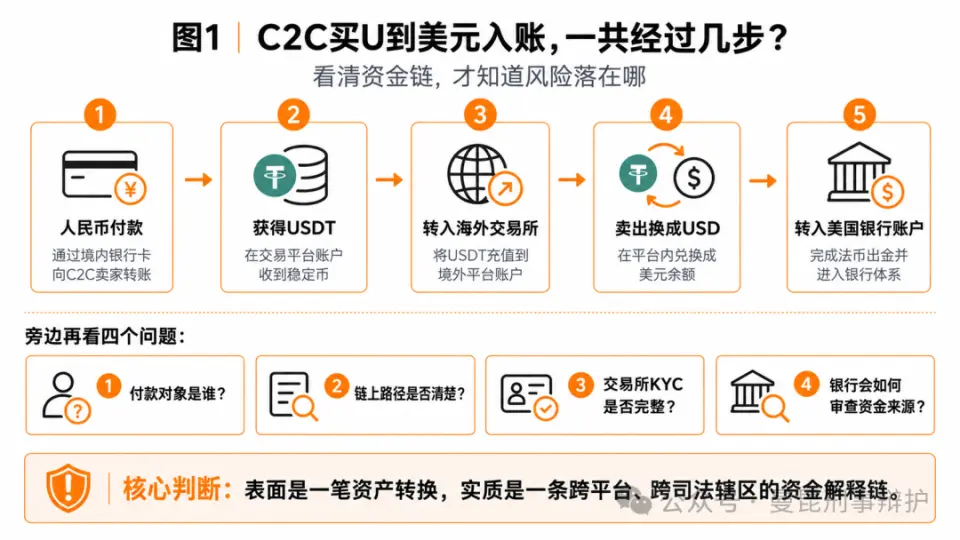
Figure 1 | The complete path from C2C purchase of USDT to receipt of US dollars (prepared by Mankun)
This is not a simple asset conversion, but four sets of rules meeting on the same chain of funds
First, the domestic side. On February 6, 2026, the People's Bank of China and seven other departments issued Yinfa [2026] No. 42, the Notice on Further Preventing and Handling Risks Relating to Virtual Currency and Other Matters, which continues to make clear that virtual currencies, including Tether, do not have the same legal status as legal tender, and brings within the scope of regulation of illegal financial activities the exchange between domestic legal tender and virtual currency, exchange between virtual currencies, and business activities such as providing information intermediation and pricing for related transactions. The Notice also provides that where an individual invests in virtual currency and related financial products, if the relevant civil juristic act violates public order and good morals, the individual may face consequences such as the civil juristic act being invalid and bearing losses personally; if the conduct further is suspected of disrupting financial order or endangering financial security, the relevant authorities shall investigate and handle it in accordance with law.
Therefore, "an individual using their own money to buy USDT" cannot simply be packaged as a normal investment channel recognized by regulators, nor can any single instance of individual holding or trading be directly equated with a criminal offense. For a specific individual, it remains necessary to distinguish four levels: the risk to civil validity, regulation of illegal financial activities relating to virtual currency, foreign exchange administration, and criminal liability. Criminal risk in particular depends on whether the conduct has developed from managing one's own assets into continuously providing exchange, settlement, or fund transfer services for others, or into an assistance relationship, with a subjective knowledge basis, with criminal funds such as those from fraud or gambling.
Next, the foreign exchange side. Article 30 of the Measures for the Administration of Individual Foreign Exchange makes clear that where a domestic individual engages in foreign exchange trading and other transactions, it shall be handled through a domestic financial institution that has obtained the corresponding business qualification in accordance with law. In other words, if a domestic individual does not obtain US dollars through compliant foreign exchange purchase channels such as banks, but first uses RMB to purchase USDT and then exchanges the USDT for US dollars overseas, ultimately entering an overseas bank account, this path itself cannot be understood merely as "digital asset investment"; rather, it is necessary to assess whether it circumvents the current individual foreign exchange administration framework, and whether the scale, frequency, purpose, and fund arrangements of the transactions further give rise to foreign exchange violation risks.
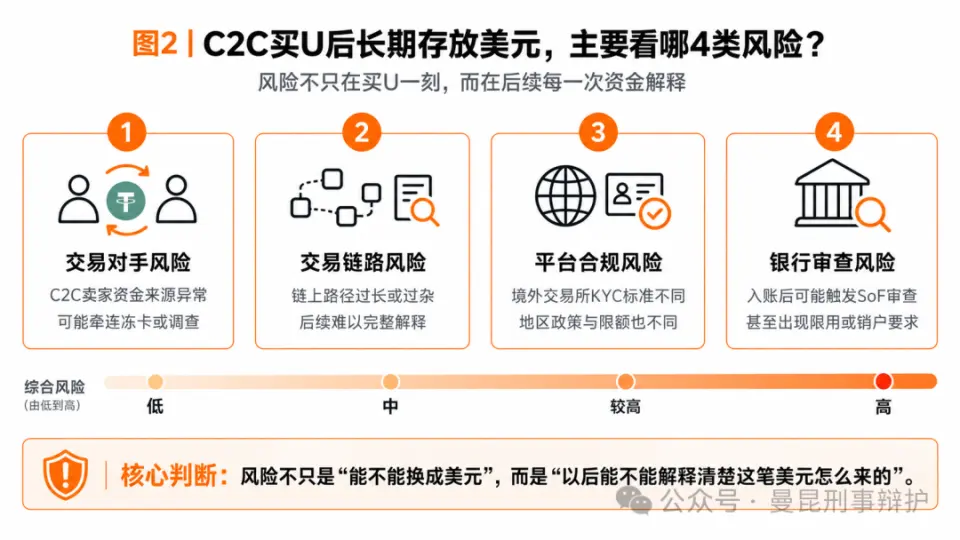
Figure 2 | Four main categories of risk in long-term deposit of US dollars after C2C purchase of USDT (prepared by Mankun)
"Bypassing banks to purchase foreign exchange" and "constituting the crime of illegal business operations" cannot be directly equated
This point especially needs to be made clear, because many discussions easily jump from "not using formal foreign exchange purchase channels" directly to "the crime of illegal business operations." From the perspective of current foreign exchange regulation and publicly reported typical cases, the two are not at the same level. The State Administration of Foreign Exchange has publicly disclosed multiple cases in which individuals were subject to administrative penalties for illegally buying and selling foreign exchange through underground banks, indicating that foreign exchange violations at the individual level may themselves enter foreign exchange administrative enforcement; whereas in the typical illegal business operation case of Zhao and others published by the Supreme People's Procuratorate and the State Administration of Foreign Exchange, the reason it entered criminal evaluation was that the perpetrators had long provided exchange and payment services between dirhams and RMB domestically and abroad, connected domestic and overseas capital circulation through USDT, and continuously profited from exchange rate spreads. Its core was no longer personal asset conversion, but an illegal foreign exchange business provided to others.
Therefore, for the personal scenario of "buying U with RMB and exchanging it for USD overseas," the assessment of criminal risk cannot look only at the name of the asset, but must look at the function the actor performs in the fund chain. If transactions are entirely centered on one's own assets, the responsibility assessment is clearly different from a business model that long solicits clients, collects RMB on behalf of others, arranges overseas payments, and charges fees or exchange spreads based on amount; however, if a personal account gradually takes on the functions of third-party fund transit, collection and payment on behalf of others, matching by crypto traders, or cross-border foreign exchange, even if each transaction superficially appears to be a C2C purchase and sale of USDT, judicial authorities may still look through the form of the transaction to observe whether it substantively provided unlicensed fund exchange or payment settlement services.
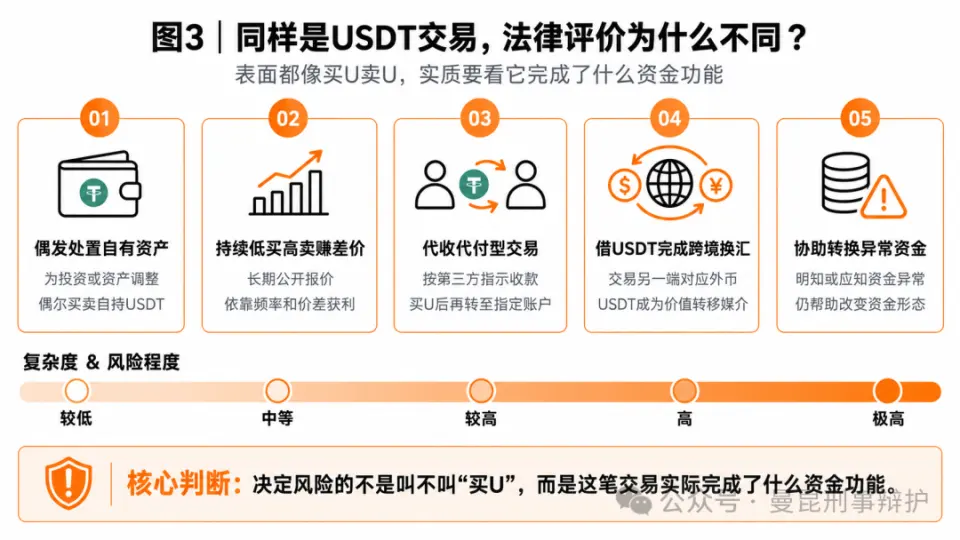
Figure 3 | Even for the same USDT transactions, different fund functions may correspond to different legal assessments (chart by Mankun)
What is truly easy to overlook is that the C2C counterparty and on-chain history will follow the assets to the next stop
If an investor merely pays RMB from their own bank account to a C2C seller, they often focus only on whether USDT is received in a timely manner; but from the perspective of subsequent compliance review, the counterparty's fund background and on-chain history do not automatically disappear once the transaction is completed. C2C transactions inherently involve incomplete information symmetry between the parties, and the buyer usually cannot conduct full customer due diligence on the seller as a bank would. Once the counterparty's account is connected to fraud, gambling, underground banks, or other abnormal fund chains, risks such as subsequent bank account freezes, platform risk controls, and judicial investigations may be transmitted along the fund path to transaction participants.
Once on-chain, risk identification switches to another language. Exchanges and on-chain analytics firms typically focus on whether funds come directly or indirectly from known high-risk addresses, whether they have passed through mixing services or unusually frequent cross-chain or multi-layer address transfers, whether transaction amounts and frequencies match the account profile, and whether the ultimate flow of assets has a reasonable economic explanation. Public FATF materials on virtual asset money laundering risks also list P2P transactions, anonymity-enhancing technologies, abnormal transaction patterns, transaction sizes and frequencies lacking reasonable explanation, and opaque sources of funds or wealth as risk indicators requiring priority attention. It should be emphasized that these indicators are essentially risk signals and are not equivalent to conclusions of criminality, but they will directly affect whether trading platforms and financial institutions initiate enhanced due diligence.
Therefore, whether "U is clean" is not a label that can be answered on its own; the more realistic questions are where this batch of USDT came from, through which addresses it passed, at what time it entered your account, and whether you have sufficient materials to explain the counterparty, price, order, and subsequent use. If an asset lacks a clear transaction background from the RMB end, passes through multiple unexplainable addresses and platforms in the middle, and finally enters a bank in the form of a large amount of USD, then what the bank faces is not a screenshot saying "I hold USDT," but a fund chain that needs to be reconstructed.
After USD 1 million enters a bank, the bank examines "how the wealth was formed," not merely "where the money is now"
Overseas banks' review of digital-asset-related funds is usually built on a risk-based AML/KYC framework, and the specific requirements vary by bank, customer location, account type, and transaction history. Therefore, "USD 1 million" cannot be understood as a uniform statutory threshold that triggers review; however, when the amount credited is significantly higher than the ordinary level of account use, the funds come from a digital asset trading platform, or the transaction path differs materially from the customer's existing occupation, income, and wealth profile, the probability that the bank will require an explanation of Source of Funds and Source of Wealth usually rises markedly.
The two focus on different questions. Source of Funds emphasizes where the specific funds entering the account this time came from, for example whether a certain USD amount was withdrawn from the person's overseas exchange account, how much USDT sold corresponds to it, and how the USDT was obtained previously; Source of Wealth focuses more on whether the customer's overall wealth formation matches their long-term income, investment experience, and asset accumulation. An investor who already held BTC or ETH early on, can retain the initial deposit records, and can continuously prove ownership of wallets and exchange accounts has a completely different level of explainability in compliance review from a person who cannot explain the early principal and provides only a screenshot of the current balance.
In practice, we prefer to organize the source of digital asset funds through a "four-ledger reconciliation" approach, that is, placing RMB bank statements, C2C orders and payment records, on-chain wallet transactions, overseas exchange accounts, and the final USD bank credit on the same timeline for verification, checking whether each segment corresponds in time, amount, currency, and subject. What truly improves explainability is not that the more materials the better, but that every key asset change can be traced to its previous source and next destination, so that the bank or other reviewing entities can independently verify it.
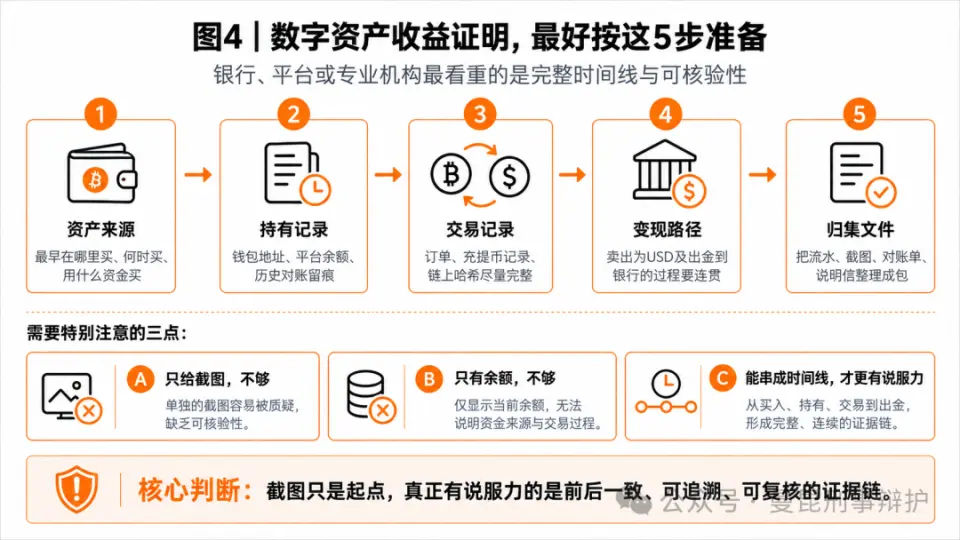
Figure 4 | Five-step preparation path for proof of digital asset income or source of funds (prepared by Mankun Law Firm)
A screenshot can prove "how much money there is now," but it usually cannot prove "why this money belongs to you"
One of the most common mistakes made by digital asset holders is to begin organizing materials only when they actually need to undergo bank review, by which time transaction records from the past several years have already been scattered across different exchanges, old phones, wallet addresses, emails and bank accounts. Some people can produce an asset balance page but cannot find the original purchase records; some have saved on-chain transaction hashes but cannot prove that the relevant wallets are controlled by them; and others can explain that the coins are investment returns but cannot connect the early RMB principal, C2C orders, wallet flows and the final USD withdrawal. The materials are not few, but without a coherent relationship among them, it remains difficult to form a persuasive Source of Funds explanation.
For individuals preparing to convert relatively large-scale digital assets into fiat currency and bring them into the banking system, the more prudent approach is not to hastily produce a "statement of circumstances," but to establish in advance a digital asset file that can be continuously updated: first, confirm the lawful source of the initial principal and retain the corresponding bank vouchers; second, compile exchange trade, deposit and withdrawal records; third, sort out address attribution and key on-chain transactions according to the main wallets; fourth, arrange the path of asset liquidation and entry into bank accounts in chronological order; and finally, use a concise statement to correlate the purpose of the transactions, the source of funds, the process of asset formation and the index of attachments. Where necessary, materials should also be supplemented in light of tax residency status, local tax rules and specific bank requirements, because passing bank KYC does not automatically mean that tax or other legal obligations have all been fulfilled.
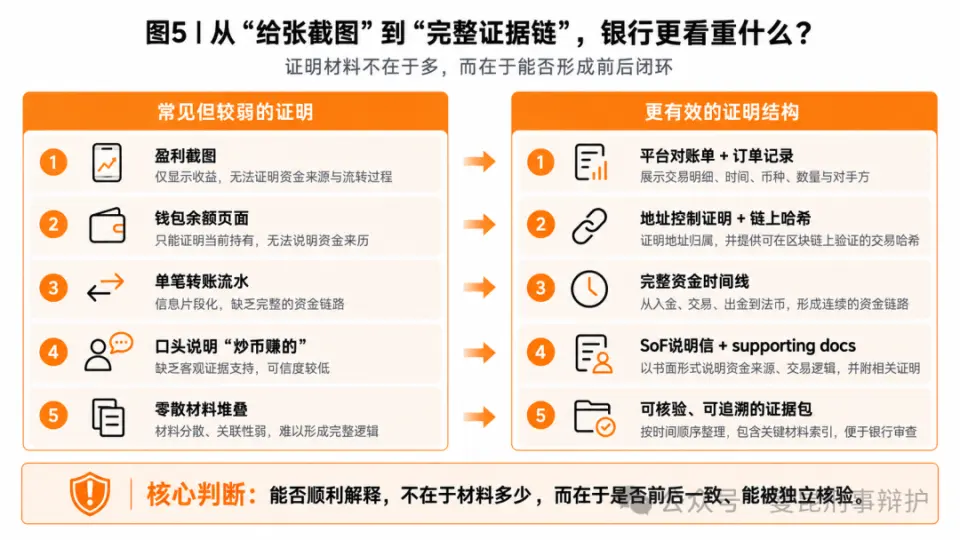
Figure 5 | From a single screenshot to a complete chain of evidence: banks place greater weight on the verifiable relationships among materials (prepared by Mankun Law Firm)
For individuals, what truly needs to be managed is the future "cost of explanation"
Returning to the path described at the outset—"buying USDT through RMB C2C, converting it into USD overseas, and depositing it into a U.S. bank"—the real question is no longer whether a particular platform can complete a transaction, but whether the entire fund chain can simultaneously withstand the different reviews of domestic regulators, foreign exchange administration, trading platforms and banks. For individuals purely managing their own assets, it is necessary to focus on assessing how funds enter the digital asset market from the RMB side, whether there are foreign exchange administration and virtual currency regulatory risks, and how to prove in the future the continuous relationship among wallets, platforms and bank accounts; if transactions begin to involve other people's funds, fixed clients, fee-based exchange, cross-border payment on behalf of others or fund pools, the risk will rapidly shift from personal asset management to the assessment of financial business and criminal liability.
Once digital assets truly enter the high-value stage, "whether they can be transferred" is often no longer the most difficult question. What matters more is whether, when a trading platform, bank, tax authority or judicial organ requests an explanation, one can use a set of consistent, traceable and verifiable materials to explain the money from its initial source all the way to the final account. Technically, completing a cross-border asset conversion requires only a few steps, but enabling that asset to remain usable, provable and manageable within the traditional financial system over the long term requires incorporating law and compliance into the design of the fund path from the very beginning.
Core judgment: the larger the amount, the truly important question is not whether a particular step "can be operated," but whether the RMB source, C2C transactions, on-chain path, exchange conversion and final bank deposit can form a continuous, explainable and verifiable chain of evidence.

