

On September 9, 2026, the Hong Kong Independent Commission Against Corruption announced a commercial bribery case involving virtual assets: a former bank client manager pleaded guilty in the District Court to one count of conspiracy to accept an advantage as an agent, admitting that he had conspired with an employee of a fintech company and other persons to acceptTether (USDT) with a total value of more than USD 470,000, as remuneration for certifying multiple false standby letters of credit and related documents without the bank's authorization. Sentencing has been adjourned to September 18, so as of the time of writing this article, no final sentence can be determined on this basis.
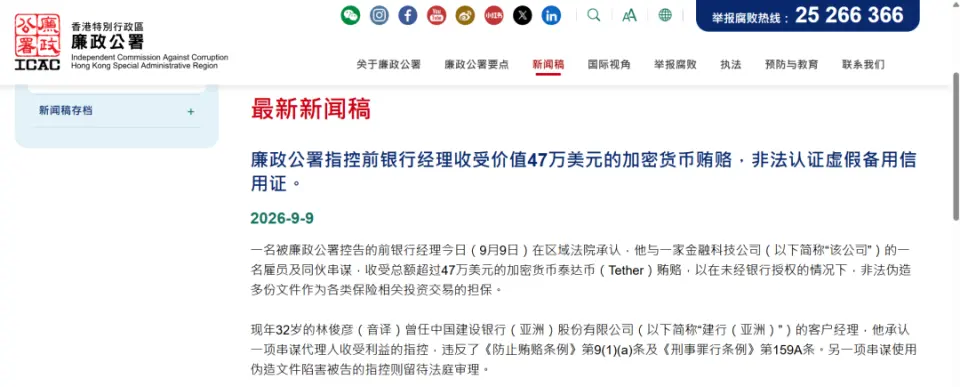
What makes this case worth the attention of Web3 practitioners is not that USDT has become bribe money for the first time, nor that virtual currencies have some special anti-bribery attribute in Hong Kong, but that it brings to the fore a question that is increasingly common in project cooperation: where project introduction fees, channel commissions, business rebates, consulting fees, or even thank-you red packets after a deal is completed are not paid by bank transfer but are sent directly to the wallet of an employee or counterparty individual, how should their legal nature be determined?
The real dividing line has never beenUSDT, but rather why the benefit was given, to whom it was given, and what the recipient did in return.
I. Commercial bribery in Hong Kong does not occur only in government and public bodies
When many mainland Web3 teams first encounter Hong Kong's anti-bribery rules, they tend to understand bribery as giving gifts to government officials, but section 9 of Hong Kong'sPrevention of Bribery OrdinanceArticle 9precisely coversthe transfer of advantages in private-sector organizationsAccording to the official explanation of the Independent Commission Against Corruption, a company employee may generally fall within the term "agent" as referred to in the Ordinance, and their employer may fall within the term "principal"; where an agent, in dealing with the business or affairs of the principal, without lawful authority or reasonable excuse, solicits or accepts an advantage in connection with the relevant act, the party offering the advantage may likewise face legal liability.
This means that in Web3 project cooperation, whether the recipient is a bank relationship manager, an exchange BD, a fund employee, a project procurement officer, or other personnel handling commercial affairs externally on behalf of a company, as long as they are in essence acting on behalf of a principal, one cannot look only at what the two parties privately call the money. A contract describing it as a "consulting fee," a transfer note describing it as a "commission," or a chat referring to it as a "thank-you fee" are merely surface labels; what truly needs to be further verified is the agency relationship between the recipient and their employer, whether there is a connection between the payment and their official conduct, and whether their employer had knowledge and effectively authorized it.
The definition of "advantage" under the Prevention of Bribery Ordinance is itself very broad, covering not only cash but also gifts, loans, fees, rewards, commissions, positions, contracts, services and other advantages; thereforeconverting the payment asset from Hong Kong dollars to USDTwill not automatically remove an advantage that might otherwise be subject to anti-bribery rules from scrutiny under section 9.
II. Whether a USDT payment is a normal commission or commercial bribery can first be examined through four matters
For enterprises, rather than starting the analysis from "can USDT be used to pay," it is better to set the asset form aside and answer four questions in sequence:
1. On whose behalf does the recipient handle the affairs?
2. Why is the payer giving this money?
3. What conduct of the recipient does this advantage correspond to?
4. Did the recipient's principal have effective knowledge and authorization of it?
ThisFour QuestionsThese four questions essentially determine the direction in which a payment should be evaluated.
For example, where a genuinely independent project intermediary enters into a service agreement with a project party in advance, finds clients, arranges meetings and advances cooperation on its behalf, and receives the agreed commission after the project is completed, if the intermediary is not an employee of the other party to the transaction and has not used a fiduciary position to secretly influence the other party's internal decision-making, then even if the commission is paid in USDT, a normal commercial remuneration cannot be characterized as a bribe merely because it takes the form of a digital asset.
In a different scenario, however, if a project party is competing for supplier qualification with a company and the business manager responsible for selecting suppliers privately proposes that, provided the project is ultimately brought to completion through his efforts, a sum of USDT must be paid to his personal wallet, then the nature of the issue is entirely different. What must be examined at this point is not the price of USDT, nor whether the parties can later supplement a "consulting contract," but whether this private benefit has entered into an exchange relationship with the power held by that employee, and whether his employer truly knew of and permitted such an arrangement.
Likewise, a "thank-you red packet" sent after the business is completed cannot simply be excluded from section 9 on the ground that the money was given after the event. Section 9 of the Prevention of Bribery Ordinance addresses not only advantages that serve as an "inducement" to the relevant act, but also advantages that serve as a "reward" for an act already performed. Therefore, where a sum of USDT is given after the project is signed, it is still necessary to assess whether there was a prior expectation of advantage, whether the payment was related to the employee's handling of the employer's affairs, and whether the principal permitted it, rather than mechanically judging by the timing of payment.
Three scenarios that appear very similar, and that may equally involve a sum of USDT moving from one wallet to another, may nonetheless receive completely different legal evaluations. What truly determines the nature is not the asset, but the relationship between the advantage and the performance of official duties.
III. "The Boss Knew" Does Not Equal Effective Permission Obtained
In practice, whenever commercial commissions or employees receiving external advantages are discussed, one of the most commonly heard explanations is: "The boss knew about this."
However, from the structure of section 9 of the Hong Kong Ordinance,"knowing" and permission in the legal sense cannot simply be equated。
Sections 9(4) to (5) of the Prevention of Bribery Ordinance permit a principal to give permission for an agent to accept advantages, in principle before the advantage is offered, solicited or accepted; if there was no prior permission, then, where the conditions are met, permission may also be applied for and obtained as soon as possible after the relevant advantage has been offered or accepted, but the principal must consider the relevant specific circumstances before granting permission.
Therefore, what truly needs to be confirmed is what exactly the company knew and what exactly it agreed to.
It is not the same thing for a company to know that an employee provides industry consulting in their spare time as it is for the company to know that the employee will take a 5% commission based on the project amount from their own counterparty; nor does the company's knowledge that an employee has received a gift once mean that it has agreed to the employee continuously receiving kickbacks based on transaction volume thereafter. If the so-called "permission" rests only on a statement that "the boss probably knows," and cannot be tied to a specific payee, amount, calculation method and business matter, such an explanation may itself be very fragile when a dispute later arises.
For the project party, likewise, its own internal approval cannot be treated as meaning that the payee has already obtained permission. If the paying enterprise's board of directors approves this "marketing expense," it does not mean that the counterparty's employee has thereby obtained authorization from their own employer; anti-bribery review still focuses on the relationship between the receiving agent and their principal.
IV. A small amount, or "the industry has always done it this way," is also not a reliable safe line
In Web3 industry cooperation there is another fairly typical mindset: a few dozen or a few hundred USDT is just a small business red packet, everyone in the industry does this, and there is no need to elevate it to commercial bribery.
This judgment likewise requires caution.
The Hong Kong anti-bribery rules donot set a uniform "small-amount safe line" for all private-sector advantages, and the ICAC's relevant educational materials also clearly emphasize that the concept of an "advantage" does not depend on the amount; at the same time, section 19 of the Prevention of Bribery Ordinance expressly provides that the fact that a certain advantage is customary in a certain industry, profession or businesscannot thereby become a defense to an anti-bribery charge。
Therefore, a company's internal policy permitting employees to accept gifts of a certain amount is first and foremost an internal risk management mechanism, and cannot be mechanically understood as Hong Kong law granting a uniform exemption for advantages below that amount. What truly needs to be returned to is still the purpose of payment and its business connection: a very small amount of USDT, if it is merely a private gift unrelated to the office, is entirely different in legal nature from an advantage paid clearly in order to obtain supplier qualification, account-opening convenience, project approval or other favorable treatment in connection with the office.
"Everyone does this" is even less capable of resolving this problem.
For an industry already accustomed to on-chain transfers, USDT may instead cause many people to underestimate the formality of the transaction, because an on-chain payment has no bank memo, does not require filling out a traditional reimbursement form, and may not pass through the company's finance department; but such convenience does not reduce the legal significance of the payment act itself.
V. The payer must likewise assess: are you paying a service fee, or purchasing the official acts of the other party's employee?
The risk of commercial bribery does not exist only on the receiving side.
Section 9(2) of the Prevention of Bribery Ordinance also regulates the offering of advantages to agents. If a project party knows that the other party is an employee or agent of a company but bypasses that employer to pay an advantage to the individual's wallet, hoping that the individual will provide facilitation in the company's procurement, project selection, account opening, financing approval or arrangement of cooperation resources, the payer itself may also come within anti-bribery scrutiny.
This is also why Web3 enterprises, when handling channel commissions, cannot be satisfied merely with "the other party gave a wallet address".
If the entity actually providing the services is a consultancy, in principle the contracting party, the scope of services, the fee calculation and the receiving entity should be clearly specified; if the recipient is itself an employee of a client, supplier or cooperating institution, it is necessary to further confirm whether it has the authority to receive the relevant advantage personally, and whether the commission may affect the business judgment it makes on behalf of its employer.
Particularly worthy of vigilance is the structure of "the contract is with the company, but the commission goes to an individual".
On the surface the business takes place between two companies, but the person who actually decides the project privately demands an additional payment of a sum of USDT to a personal wallet. Such a structure itself warrants further review by the enterprise's compliance department, because once the payment forms a direct exchange relationship with the official acts of the other party's employee, a subsequently added vague "consultancy agreement" may not necessarily change the true nature of the transaction.
VI. For Web3 enterprises, USDT commissions need to be brought into a formal compliance system
The most practical reminder that the Hong Kong bank manager case gives to project parties is in fact not "do not use USDT to pay commissions in future", but that virtual assets cannot be placed outside an enterprise's traditional systems for commissions, gifts and conflicts of interest.
In the past, corporate anti-bribery systems often referred to cash, gift cards, travel, gifts and hospitality, but today a sum of USDT, a high-value Token, a project whitelist allocation, an airdrop share or even other on-chain rights and interests may all have clear economic value. Therefore, when designing commission and gift policies, enterprises need to consider whether these new types of assets and rights and interests can be covered by existing systems.
In actual implementation, what matters more is that every outward commission can answer several very specific questions: what real service the payment corresponds to, who provides the service, who the receiving entity is, whether the recipient also handles business on behalf of the other side of the transaction, what the commission calculation logic is, and whether the necessary internal approvals have been obtained and can be documented. For on-chain payments, the transaction hash, wallet ownership, contract, approval materials and evidence of service delivery should also correspond to one another, rather than there being only a wallet transfer whose business background cannot be explained.
This is not intended to make all normal business cooperation abnormally complicated, but because once a business relationship enters into dispute, a USDT transfer without any background record can hardly explain on its own why it exists.
Final Thoughts
In this Hong Kong case, the former bank relationship manager was held criminally liable not because he "accepted USDT," but because he accepted a benefit in USDT with a total value exceeding USD 470,000 and took it as remuneration for documents such as false standby letters of credit that had not been authorized or authenticated by the bank; the digital asset was merely the payment vehicle for that benefit, and what truly entered the assessment under section 9 of the Prevention of Bribery Ordinance was the exchange relationship between the benefit and his agency duties.
For Web3 project parties, this distinction is especially important. An increasing number of commissions, channel fees and collaboration remuneration in the industry are beginning to be settled on-chain, but once the payment instrument changes, the agency duties, conflicts of interest and anti-bribery rules in traditional commercial relationships do not disappear along with it.
Therefore, when a counterparty proposes, "Do not transfer to the company account; transfer directly to my personal wallet," what is truly worth the enterprise answering before making the transfer is not how much the Gas fee is or which chain to use, but another set of more fundamental questions: Whom does this person act for, why is this money being given to him, what will he do as a result, and do the people who truly have the authority to decide know of and permit it, and are these digital assets ultimately personal income or company income?
If these five questions cannot be clearly answered, then even if the transfer record contains only a string of wallet addresses, a so-called "consulting fee" may already be moving further and further away from normal commercial remuneration.
This article is written based on publicly available information as of September 14, 2026, and discusses only relevant issues under Hong Kong law. The case is still awaiting sentencing, and this article does not predict the final judicial outcome. Projects involving the mainland or other jurisdictions should be assessed separately in light of local law.