
On November 6, the U.S. Department of the Treasury took action against another crypto exchange. This time, the exchange named was MEXC.
The Financial Crimes Enforcement Network (FinCEN), an agency under the U.S. Department of the Treasury, issued an order prohibiting U.S. financial institutions from processing fund transfers involving MEXC. According to the official announcement, the U.S. side determined that between May 2021 and May 2026, the platform processed at least USD 16 billion in funds connected to sanctions evasion, cybercrime and other matters, involving Iran, North Korea and Russia.
The order will take effect on the 30th day after publication in the Federal Register. MEXC subsequently responded that deposits, withdrawals and trading on the platform are operating normally, that it is reviewing the order, and that it is prepared to communicate with regulators. But the conditions set by the United States are already quite direct. In the announcement, Treasury Secretary Bessent framed the matter as a choice between continued access to the U.S. financial system and support for the Iranian regime.
Seeing this news, I thought about the situation exchange owners have faced over the past few years. A platform can go global, its users can span countries, and its place of registration can be changed again and again, but once the business becomes large enough, it ultimately has to seriously answer the questions raised by the United States.
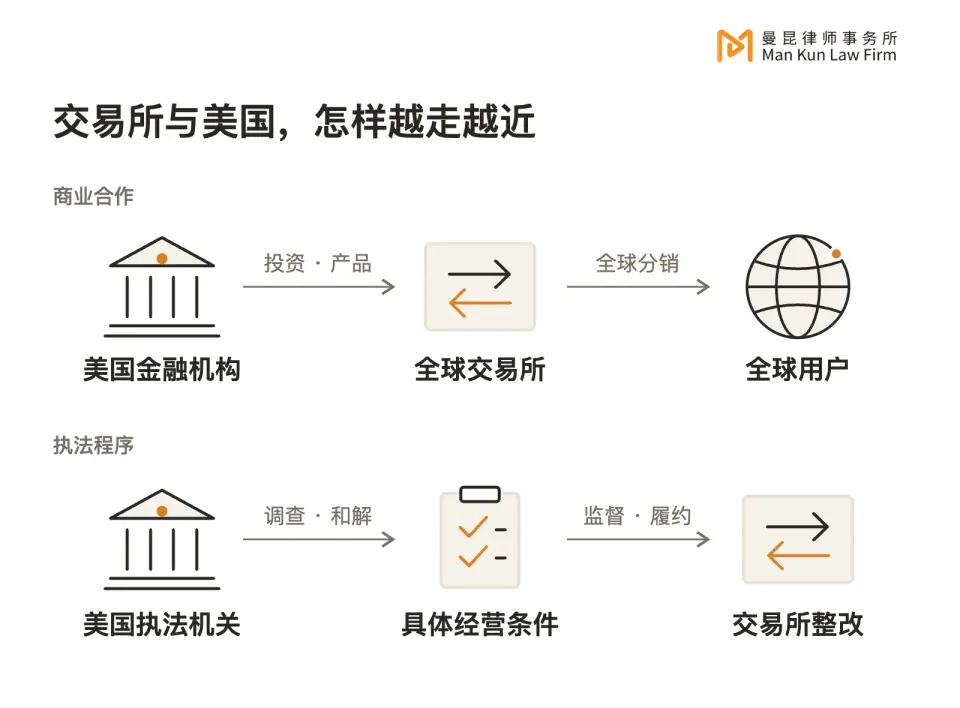
To some extent, the United States is bringing global crypto exchanges into its fold. Those willing to move closer can discuss investment, cooperation and entry into the U.S. market. Those unwilling or unable to accept the relevant conditions may face investigations, prosecutions and the consequences of having their financial channels cut off.
For exchanges that still want to serve mainstream global capital, the cost of remaining outside this system is becoming increasingly high.
The capitulation camp: first, look at how Binance got here
To understand today's Binance, one must start with November 2023.
That month, Binance reached a criminal and related enforcement resolution with the U.S. Department of Justice and other authorities, agreeing to pay more than USD 4.3 billion; Changpeng Zhao pleaded guilty and resigned as chief executive officer. A platform occupying an important position in the global crypto market ultimately still had to address its past business through U.S. legal proceedings.
The matters pursued by the United States were very specific. The platform had served U.S. users but failed to fulfill corresponding anti-money laundering obligations, and it was also involved in transactions that violated U.S. sanctions rules.
More noteworthy than the fine are the operating conditions attached to the settlement. Under the arrangement announced at the time by the U.S. Department of the Treasury, Binance was required to accept five years of compliance monitoring; the regulator could, through a monitor, access its books, records and systems, and verify implementation of commitments such as exiting the U.S. market.
For an exchange, this directly changes how money is made. If the platform wants to continue operating, it must require its growth team to accept that the compliance department has the authority to block certain revenue.
But Binance's subsequent moves also show that its bosses did not intend to remain forever on the page of paying fines.
In December 2024, Binance and Circle, the issuer of the US dollar stablecoin USDC, announced a strategic cooperation. Binance will expand the use of USDC in trading, payments and other products, and will incorporate USDC into the company's treasury management. Circle, for its part, will provide technical, liquidity and other support. A exchange serving global users and a US stablecoin company began working together to grow the on-chain US dollar business.
By 2025, Binance had also obtained a US$2 billion minority equity investment from the Abu Dhabi investment institution MGX. In May of the same year, a co-founder of World Liberty Financial announced at an event in Dubai that the investment had chosen to be settled in USD1, the US dollar stablecoin issued by that project. World Liberty Financial is connected to the Trump family, which linked a Middle Eastern capital investment in the exchange to a crypto business involving the family of a US political figure.
The money came from an Abu Dhabi institution, the settlement instrument came from a project involving the Trump family, the exchange obtained financing, and the stablecoin obtained a large-scale application scenario. Each of the participants had its own commercial interests, and they also bound one another's businesses more tightly together.
In October 2025, Zhao Changpeng received a pardon from Trump.
The pardon document addressed the corresponding federal crimes of Zhao Changpeng personally. We can already see that the relationship between the exchange's founder and the United States will be built both through law enforcement and will continue to develop through commercial interests and political contacts.
So-called "submission" is often accomplished through these specific arrangements. The company continues to operate, the founder continues to seek development opportunities, and US compliance requirements, commercial partners and US dollar products increasingly enter the exchange's day-to-day business.
OKX obtains a ticket to Wall Street
Binance chose to expand cooperation with a US stablecoin company; OKX went a step further and invited US financial institutions into its shareholders and board of directors.
On March 5, 2026, Intercontinental Exchange (ICE), the parent company of the New York Stock Exchange, announced an investment in OKX at a corresponding valuation of US$25 billion. The announcement did not disclose the specific investment amount, but it explicitly stated that ICE will obtain a board seat at OKX.
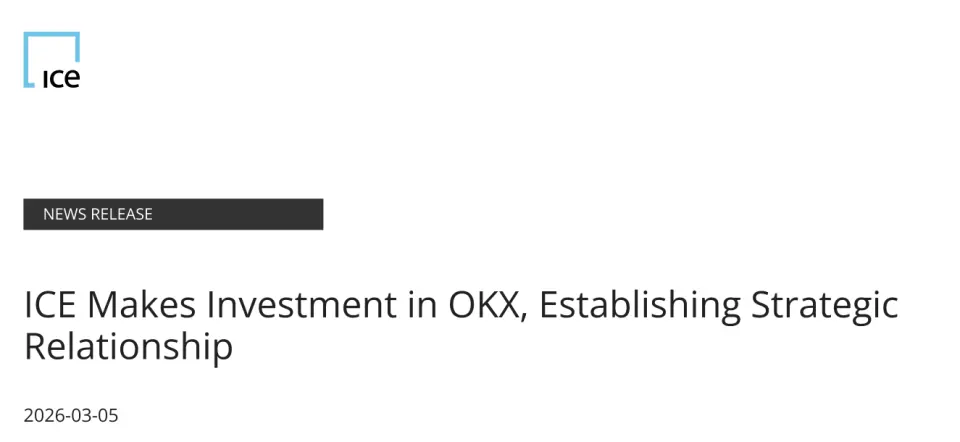
A board seat allows the cooperation to enter corporate governance and business discussions. For OKX, this new partner also possesses mature regulated markets, institutional clients and financial product resources. The platform's accumulated global users therefore also have the opportunity to access more traditional financial assets.
OKX has accumulated crypto users, wallets and trading infrastructure, while ICE possesses the product and institutional resources of the US financial market. After the cooperation, the former can expand its products, and the latter can reach investors it previously did not cover through a crypto platform. US financial institutions therefore have the opportunity, by means of a global exchange, to bring their market before users in more countries.
The plan announced by both parties is clear. ICE will obtain a license for OKX spot crypto price data to launch regulated futures products in the United States. After obtaining the relevant regulatory approvals, OKX plans to provide its users with access to ICE US futures and the NYSE tokenized equity market.
However, OKX also had to resolve its US enforcement issues before reaching this point.
US prosecutors disclosed that although the OKX platform restricted US users as a matter of policy, it still attracted and served US customers, and certain employees even instructed customers to provide false information to circumvent identity verification. In February 2025, Aux Cayes FinTech, the Seychelles entity operating OKX, pleaded guilty and agreed to pay more than USD 504 million in penalties and forfeiture. Under the plea agreement, its independent compliance consultant arrangement continues until at least February 2027.
Garantex rebrands, and the United States imposes further sanctions
Of course, there are always two paths in the woods, and someone will always take the one less traveled.
This pressure has persisted for several years with respect to the Russian exchange Garantex. In April 2022, the US Department of the Treasury's Office of Foreign Assets Control (OFAC) added Garantex to its sanctions list. This office is responsible for enforcing US economic sanctions. After being listed, Garantex continued to operate, and the platform and relevant personnel continued to be investigated.
Even without opening a storefront in the United States, a foreign exchange may still need connections to US banks, payment services or other regulated institutions. By controlling these institutions, the United States can influence the conditions under which an exchange conducts external fund flows. Overseas partners that still need to preserve their own US business will also consider whether to continue bearing the cost of cooperating with a designated platform.
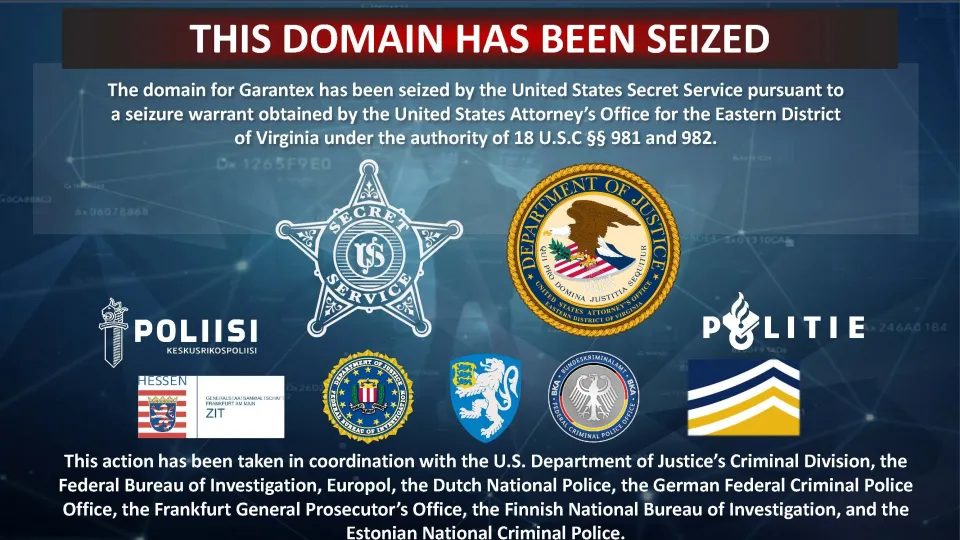
In March 2025, the United States, together with Germany and Finland, took action to seize the domain names and servers used by Garantex. The US Department of Justice simultaneously announced indictments against the relevant operators and disclosed the freezing of more than USD 26 million in related funds. The pressure faced by the exchange expanded from financial restrictions to website infrastructure, assets and the actual operators.
Garantex subsequently attempted to transfer customers and funds. According to an August 2025 announcement by the US Department of the Treasury, its successor platform Grinex took over part of the business, and the related arrangements also used the ruble-backed token A7A5. The United States continued to add Grinex and the relevant individuals and entities to the scope of sanctions.
This experience shows that after leaving the US-dominated financial network, an exchange may still find customers and even continue to process transactions of considerable scale. But it needs to constantly seek new infrastructure and cooperative relationships, and it must also withstand the next round of tracing and sanctions. The more a platform relies on such customers, the harder it becomes to obtain the funds and services that mainstream financial institutions are willing to provide, and the more its business options are constrained.
For exchange owners who still want to operate for the long term, these are costs that must be calculated.
Once the money is on-chain, can the United States still reach it?
Many people, upon reading this, will think of a question. Since banks can be cut off, then if one only conducts coin-to-coin trading and keeps all funds on-chain, would that reduce exposure to US influence?
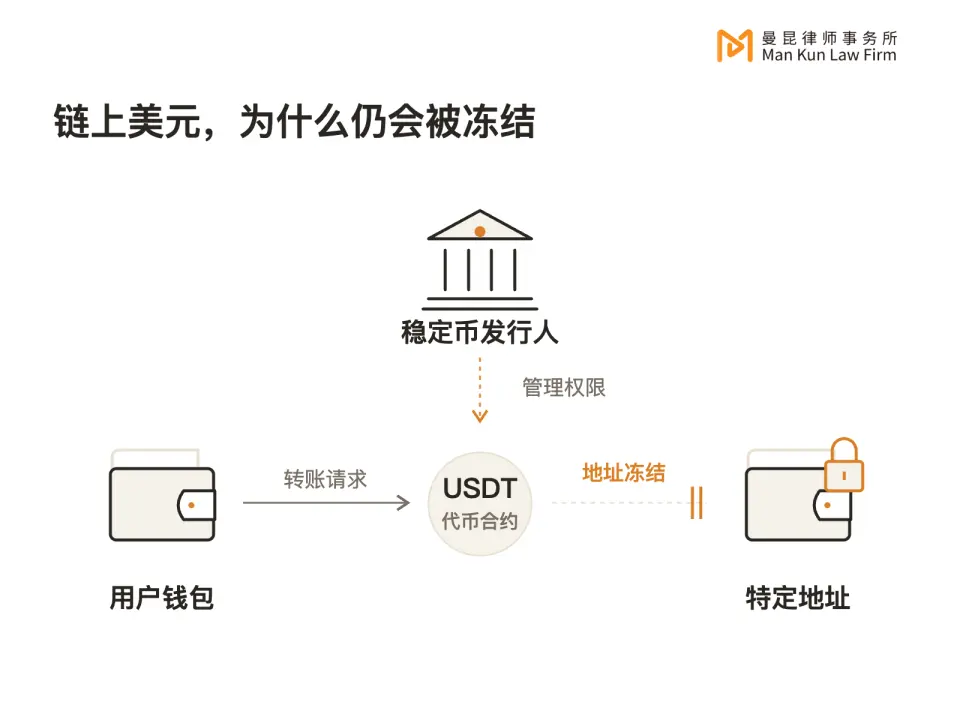
On March 7, 2025, Tether publicly stated that it had assisted the US Secret Service in freezing USD 23 million in funds related to transactions connected to Garantex. The USDT issued by Tether is a commonly used US dollar stablecoin in the crypto market. Users holding wallet private keys can initiate transactions themselves, but the token contract also retains administrative permissions for the issuer. Once a specific address is frozen by the issuer, the relevant USDT in that address will be subject to transfer restrictions.
As early as December 2023, Tether announced a voluntary wallet-freezing policy, taking measures against activity related to the OFAC Specially Designated Nationals and Blocked Persons List, including freezing wallets that have been included on the list.
What does this mean for exchanges?
A platform may place its headquarters outside the United States and may accept only crypto assets, but as long as its business makes extensive use of centrally issued US dollar stablecoins such as USDT, it still needs to consider the issuer's compliance policies and freezing capability.
Therefore, US influence on the crypto market already exists simultaneously in banking and on-chain. Banks determine which fund transfers can be processed, stablecoin issuers determine how the tokens they issue are subject to freezing, and trading platforms then restrict accounts or transactions based on lists and risk policies.
And the more an exchange hopes to obtain institutional clients and traditional financial products, the more it needs to demonstrate that it can identify these boundaries and implement these requirements. On-chain business has thus also been brought within the review scope of mainstream financial counterparties.
The United States reaps the benefits of exchanges' global customers
Looking at Binance, OKX, MEXC and Garantex together, I think the US attitude toward exchanges has become increasingly easy to understand.
For unlawful conduct, the United States can investigate, prosecute and penalize. For platforms that can accept conditions and also have commercial value, US financial institutions are willing to invest and cooperate. The departments responsible for enforcement, the president who makes pardon decisions, and private companies pursuing returns each have their own objectives, but when these actions are combined, they cause exchanges to attach increasing importance to US rules and relationships.
Policies will of course change. The operating entity of BitMEX was sentenced in January 2025 to a USD 100 million fine for violating the Bank Secrecy Act, and in March of the same year, that entity and several founders received a pardon from Trump. The United States that exchanges face also contains different enforcement judgments, political choices and commercial interests internally. The relationships that bosses need to manage will therefore extend to lawyers, regulators, financial partners and the political environment.
This also makes "pro-US" an increasingly realistic business choice.
In the past, many exchanges could rapidly acquire users through lenient account-opening requirements, a wide range of tokens and cross-border services. Once they reached scale and needed more stable banking services, more attractive assets and more institutional capital, the U.S.-led financial network would again appear in their plans for the next stage of development.
Global exchanges have already completed user education, built trading and wallet infrastructure, and accumulated cross-border distribution capabilities. By connecting to these platforms, U.S. financial institutions have an opportunity to enable more overseas users to trade their products and use assets denominated and settled in U.S. dollars.
For exchanges, this may be a business worth pursuing. But as revenue becomes increasingly dependent on these partnerships, platforms will proactively screen customers, manage assets and organize their business in ways acceptable to their partners. The influence of U.S. rules will also extend beyond the United States along with products and capital.
Therefore, when I say the United States is co-opting global cryptocurrency exchanges, this change is what deserves the most attention. Platforms willing to cooperate can share in the benefits of entering mainstream financial markets. Those that continue to operate businesses excluded by the U.S. sanctions regime must bear higher connectivity costs and enforcement pressure.
Crypto exchanges have spent more than a decade connecting users around the world. Today, U.S. financial institutions and U.S. dollar products are following these already-built connections into more people's accounts.