Artificial intelligence is rapidly moving from a technical concept to real commercial infrastructure. From large models and AI agents to smart hardware, AI companionship, and enterprise software, as more and more products actually enter the market, the question facing companies is no longer simply whether model capabilities are strong enough or financing costs are low enough, but an increasingly practical choice: operating the same AI product in different countries may require confronting entirely different legal environments.
China and the United States happen to provide two highly representative samples.
If one must summarize it in a single simple sentence, it can be said that the United States as a whole is closer to "running first," while China places greater emphasis on "regulating first." But such a summary can only serve as an entry point for understanding the two regimes, and cannot be directly treated as a legal conclusion. The United States does not mean that AI companies can build first without being subject to regulation, nor does China mean that all AI products must undergo approval before they can go online. The real difference between the two countries lies in the timing and manner of regulatory intervention in products, and the risk-bearing mechanisms.
For AI companies preparing to enter the Chinese and U.S. markets, this point is far more important than simply discussing "which country has stricter regulation."
The real difference is not that one regulates and the other does not, but who bears the risk first
As of August 2026, the United States still has not enacted a comprehensive federal AI law uniformly covering all AI products and application scenarios. In reality, U.S. AI governance is more like a network composed of existing laws, sectoral regulation, state-level legislation, administrative enforcement, and judicial litigation.
This means that for most general AI products, companies typically will not need to first apply to some unified federal AI regulator for a license merely because they "use artificial intelligence technology." Models can be developed, products can go online, and business models can first enter the market for validation, but once a product actually touches upon copyright, consumer protection, privacy, employment discrimination, child safety, false advertising, or the rules of regulated industries, existing laws will intervene quickly.
This is also why the phrase "the United States runs first" has some explanatory power. The more common logic of U.S. regulation is not to judge "whether you can do it" before a product appears, but to continuously delineate boundaries after companies have entered the market through regulatory enforcement, state-level rules, and specific cases.
But "running first" absolutely does not mean "deal with it after something happens." The real pressure AI companies face in the United States is that many risks will not appear before product launch in the form of a clear approval checklist, but will emerge after the product scales up in the form of copyright litigation, consumer claims, regulatory investigations, or enforcement by state attorneys general. Companies gain greater room for innovation in the early stage, but this also means they must bear more judgment costs themselves.
China's regulatory approach is markedly different.
In recent years, China has not waited for a complete "Artificial Intelligence Law" to be enacted before uniformly regulating AI. Instead, it has continuously established specialized rules around different scenarios such as algorithmic recommendation, deep synthesis, generative artificial intelligence, labeling of AI-generated content, and anthropomorphic interaction. Regulation therefore more easily appears in advance during product launch and operation. For some AI services, filing, security assessments, content governance, labeling of generated content, protection of minors, and data compliance are no longer matters handled only after a product has a problem, but have gradually become issues that must be considered before a product goes online.
Therefore, what is truly worth companies understanding about "China regulates first" is not that all AI projects need to wait for approval, but that regulatory requirements are more easily pushed forward into product design and operational processes.If this divergence is examined more closely, China and the United States have already taken relatively distinct paths in AI governance with respect to product launch, training data, AI content, protection of minors, cross-border data transfer and regulatory logic.
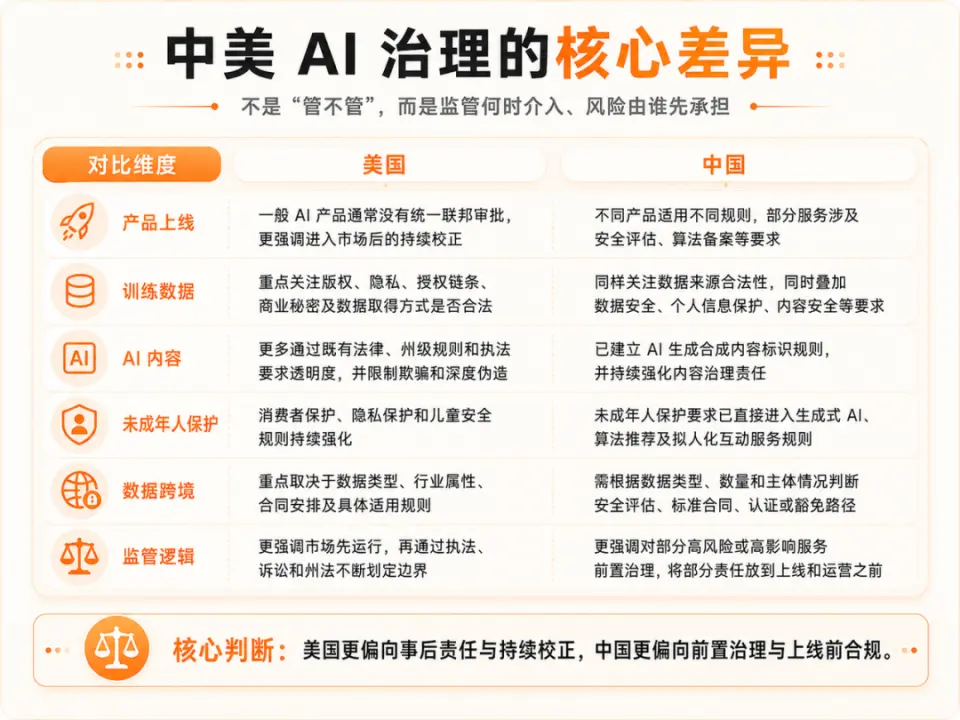
Chart by Mankun Law Firm | Core differences in China-U.S. AI governance
The United States draws "red lines for conduct," while China is increasingly reaching into "product mechanisms"
This divergence becomes more evident at the level of specific rules.
At the current stage, U.S. regulation of AI is still to a large extent carried out through existing laws. If a company exaggerates the capabilities, safety or benefits of an AI product, it may fall within consumer protection and false advertising regulation; if training data involves copyrighted works, it may enter copyright law disputes; and if algorithms are used in recruitment, credit or housing and produce discriminatory outcomes, they may be directly subject to existing anti-discrimination laws.
In other words, in many cases the United States does not focus on whether you have used AI, but on what you did after using AI and what legal consequences ultimately resulted.
This is also why U.S. AI legal practice relies heavily on specific cases. AI technology usually develops faster than dedicated legislation, so many new issues can ultimately only be answered by first returning to old laws, after which regulators and courts gradually draw new boundaries.
China's changes, by contrast, are moving to a deeper level.
Initial AI governance focused more on issues such as whether content is lawful, whether algorithms are filed, and whether data sources are lawful. However, as AI products increasingly take on interactive and anthropomorphic features, the rules have begun to reach directly into product functions themselves. The rules on anthropomorphic AI interactive services, which officially took effect on July 15, 2026, are a typical example. For products such as AI companions and anthropomorphic chat, regulators are no longer concerned only with whether a model will generate unlawful content; they have begun to focus further on whether the platform clearly informs users that they are interacting with artificial intelligence, whether it takes measures to prevent excessive dependence, whether it reminds users after continuous use for too long, and what types of anthropomorphic services minors can access.
These requirements have already begun to affect the UI, user flows, account systems, product interactions and risk management mechanisms.
From this perspective, a change in China's AI governance that merits close attention from companies is emerging: compliance is moving from "content review" into "product design."
For companies, this change means that if the legal department conducts only a final review when a product is about to launch, it is often already too late. Truly effective AI compliance needs to begin when product managers define functions, technical teams design model interactions, and operations departments formulate user mechanisms.
The biggest risk for both countries is also not simply "who imposes higher fines"
When discussing China-US AI governance, another common oversimplification is to understand the United States as "relying on litigation in the courts" and China as "relying on government administrative regulation."
This judgment has some basis, but it is still not accurate enough.
The United States of course has a large volume of private litigation, but the FTC, state attorneys general, and industry regulators in sectors such as finance and healthcare likewise enforce the law directly; China uses administrative regulation as an important means, but AI companies may likewise face civil litigation over copyright, personality rights, personal information, or consumer rights issues. What is truly worth comparing is not which country uses only which instrument, but which type of risk is more likely to become the most important constraint in the course of a company's operations.
Anthropic's copyright case is a very typical US sample. In July 2026, a US court approved a copyright litigation settlement of approximately USD 1.5 billion between Anthropic and a group of authors. If this case is summarized only as "an AI company used copyrighted works to train its model and therefore paid USD 1.5 billion," that would in fact overlook what is truly complex about the case.
The court had previously made a highly noteworthy determination on whether AI model training constitutes fair use, while another important dispute in the case concerned the manner in which the company obtained and retained copies of pirated books. The final USD 1.5 billion was also a settlement amount reached by the parties, not infringement damages directly awarded by the court.
The real reminder this case gives AI companies is not that "copyrighted content absolutely must not be used to train models," but rather that: data compliance in the AI era cannot be limited to checking how the final model uses data; it must also trace back to where the data was actually obtained and whether the company has the right to obtain, retain, and use that data.
This is precisely the kind of risk that many US AI companies truly need to worry about. A product may have been running for several years, gained a large number of users, or even completed multiple rounds of financing, and only afterward become entangled in prolonged litigation because of a single training data source, a single product design, or a single promotional method. Greater room for innovation does not mean lower legal costs; it only means the risk arises at a different point in time.
The pressure facing Chinese companies, by contrast, is often reflected more directly in "whether the product can continue to operate."
Failure to complete filing, a content governance mechanism that does not meet requirements, failure to implement AI content labeling, problems in designs concerning the protection of minors, or a conflict between a certain product function and regulatory requirements may all lead to rectification, functional adjustments, or even suspension of services.
For an internet company in rapid growth, this type of risk cannot necessarily be measured simply by the amount of a fine. A core function being forced offline, or a product needing to redesign its user flow, may bring commercial costs far higher than the administrative fine itself.
Therefore, from a company's perspective, the core risks in the United States and China can be understood as two different problems: US companies need to prevent "being held accountable after they have scaled up," while Chinese companies more need to prevent "being unable to scale up because upfront compliance was not done well."
What AI companies expanding overseas should really compare is not where regulation is more lenient
Precisely because the regulatory logic differs, the mistake AI companies most easily make when choosing a market is to directly compare whether "the United States is more lenient" or "China is stricter."
Such a question itself oversimplifies a complex business decision.
Even for the same AI company, the regulatory issues faced by foundation models, enterprise internal Agents, AI SaaS, education products, AI companionship, medical AI and smart hardware are entirely different. An enterprise-level efficiency tool that does not directly face consumers and an AI product that engages in continuous dialogue with millions of minors every day cannot possibly use the same set of legal judgments, even if the underlying model invoked is the same.
What a company should really look at first is its own risk structure.
If a product relies heavily on large-scale copyrighted data for training, then after entering the United States, data licensing, the boundaries of fair use and potential class action litigation risk must become core issues; if a product processes a large amount of personal information within China and needs to invoke overseas models, then cross-border data transfer pathways and personal information protection will become important matters; if it is an AI companionship product, then content safety, protection of minors, anthropomorphic design and user addiction mechanisms will directly enter the scope of product compliance.
Therefore, when an AI company decides where to establish operations, it is in fact not simply choosing a "lenient market" or a "strict market," but choosing which type of legal risk it is more capable of managing.
This is also where the comparison of China-US AI governance truly has value.
The United States gives companies greater room for innovation at the early stage, but requires companies to be capable of bearing complex and dispersed later-stage responsibilities; China imposes more ex ante requirements on certain products, but once the rules are clear, companies can more easily know which compliance matters must be resolved in advance.
Both systems regulate AI; they simply place risk in different positions.
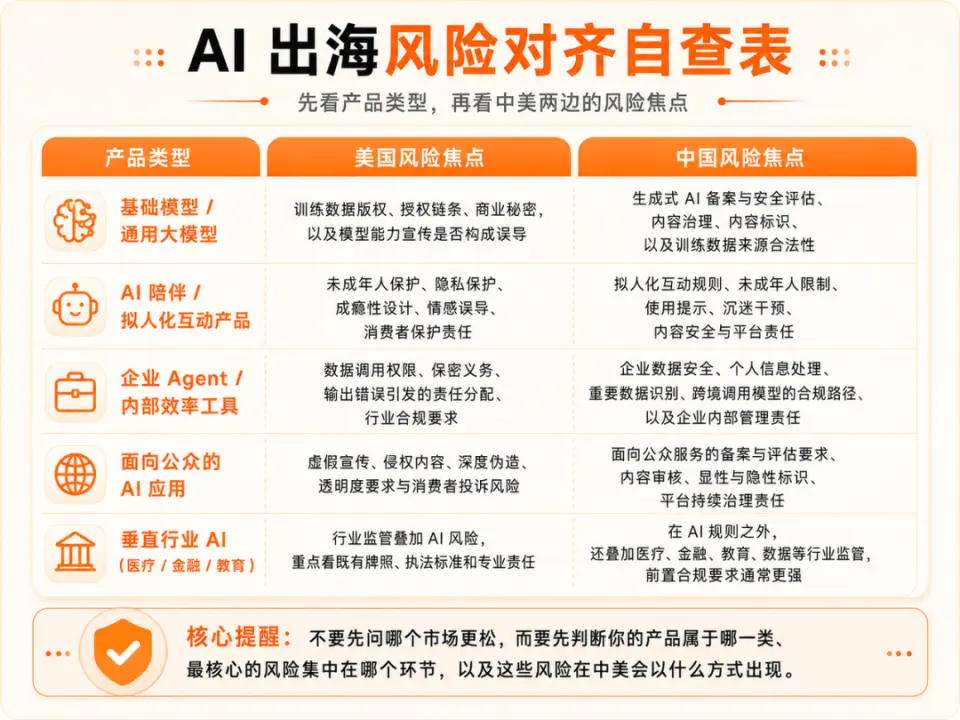
Mankun Infographic | AI Overseas Expansion Risk Alignment Self-Assessment Checklist
Going forward, neither China nor the United States will become increasingly "lenient"
Looking further back, although China and the United States have chosen different paths in AI regulation, one trend is in fact converging: as AI moves from being a tool into real social relationships, regulation in both jurisdictions is becoming more specific.
A very important variable for the United States going forward is how the federal government and the states will redraw the boundaries of AI regulation. At the federal level, the aim is to preserve the United States' technological competitiveness in the global AI industry, while states such as California and New York have continued to build their own regimes around issues such as frontier models, algorithmic transparency, deepfakes and child protection. For AI companies, what they will most likely face in the future is not the question of whether the United States regulates AI at all, but how to deal simultaneously with federal policy, state law, industry rules and existing law.
China, by contrast, continues to advance along another path. The rules on algorithms, generative AI, data, content labeling and specific application scenarios that have taken shape over the past few years already constitute a fairly specific regulatory system; the State Council's 2026 annual legislative work plan further proposes accelerating comprehensive legislation on the healthy development of artificial intelligence. Accordingly, China's future AI governance will most likely not simply tear up the existing rules and start over, but will instead gradually develop a more systematic higher-level legal framework on the basis of the existing regime.
For enterprises, this means a very practical conclusion: in doing AI in the future, it will be difficult to continue to understand legal compliance as auxiliary work performed after a product is completed.
Whether in the United States or China, a genuinely mature AI company will ultimately need to embed compliance capabilities throughout the entire process of research and development, product, data, marketing and operations; the difference is only that the issues each side most needs to resolve in advance are different.
Conclusion
"The United States runs first, China regulates first" remains an easily understood summary, but if one truly takes the perspective of an AI business operator, these words can explain only the first layer.
The United States does not allow enterprises to run first without constraints; rather, it continuously draws boundaries in the course of market operation, more through existing law, regulatory enforcement, state-level legislation and judicial litigation. Nor does China require all AI products to be approved in advance; rather, for certain high-impact services, services directed at the public or services involving specific risks, it further front-loads requirements such as filing, assessment, content governance, user protection and product mechanisms.
Therefore, the real difference between AI governance in China and the United States is not "one encourages innovation and the other restricts it," but that the two regimes have chosen different ways of allocating risk.
For AI companies preparing to expand overseas or to enter both the Chinese and U.S. markets at the same time, rather than first asking "where is regulation more lenient," it is better to first ask three more important questions: what scenario does one's product actually fall within, at what stage the law will intervene, and, if a judgment proves wrong, which risk is the one the enterprise can least afford to bear.
Once these questions are thought through, "where to do AI" ceases to be merely a market question and becomes a genuine commercial and legal decision.
*This article represents only the author's personal views and does not constitute legal advice on any specific project. Specific AI products and cross-border business should be assessed on a case-specific basis in light of product functions, business model, user location, data processing methods and specific application scenarios.
“Move Fast” in the U.S., “Govern First” in China? How AI Companies Should Understand Two Regulatory Approaches
Artificial intelligence is rapidly evolving from a technological concept into real commercial infrastructure. From foundation models and AI Agents to smart hardware, AI companions, and enterprise software, more and more AI products are entering real-world markets. For companies, the question is no longer simply whether their models are powerful enough or whether capital is sufficiently available. A more practical choice is emerging: the same AI product may face fundamentally different legal environments depending on where it is launched and operated.
The United States and China offer two particularly representative examples.
If we had to summarize the difference in one simple phrase, the U.S. is generally closer to a “move fast” model, while China places greater emphasis on “govern first.” But this is only a useful entry point for understanding the two systems, not a legal conclusion in itself. The U.S. does not allow AI companies to innovate without regulatory constraints, nor does China require every AI product to obtain approval before launch. The real distinction lies in when regulation intervenes, how it intervenes, and how legal risks are allocated.
For AI companies considering the U.S. and Chinese markets, understanding this distinction is far more important than simply asking which country has “stricter” AI regulation.
I. The Real Difference Is Not Whether AI Is Regulated, but When Risk Is Allocated
As of August 2026, the United States still does not have a single comprehensive federal AI law governing all AI products and use cases. In practice, U.S. AI governance resembles a network made up of existing laws, sector-specific regulation, state legislation, administrative enforcement, and litigation.
For most general-purpose AI products, this means that a company does not typically need to apply to a centralized federal AI regulator for permission simply because it is using artificial intelligence. Models can be developed, products can be launched, and business models can enter the market for validation. But once a product implicates copyright, consumer protection, privacy, employment discrimination, child safety, misleading advertising, or rules governing regulated industries, existing law can quickly come into play.
This is why describing the U.S. as allowing companies to “move fast” has some explanatory value. The more common regulatory logic is not necessarily to decide before launch whether a company is permitted to build a particular AI product, but rather to define and refine legal boundaries after products enter the market through regulatory enforcement, state-level rules, and specific cases.
But “move fast” should never be confused with “deal with the law only after something goes wrong.” The real pressure for AI companies in the U.S. is that many risks do not appear in the form of a clear pre-launch approval checklist. Instead, they may surface only after a product has scaled, in the form of copyright litigation, consumer claims, regulatory investigations, or enforcement actions by state attorneys general. Companies may enjoy greater room to innovate at an earlier stage, but they also bear more responsibility for making their own legal judgments before the boundaries are fully settled.
China follows a noticeably different regulatory approach.
In recent years, China has not waited for a single comprehensive Artificial Intelligence Law before regulating AI. Instead, it has continuously introduced rules targeting specific technologies and scenarios, including algorithmic recommendation, deep synthesis, generative AI, labeling of AI-generated content, and anthropomorphic interactive services. As a result, regulatory requirements are more likely to appear earlier in the product launch and operation cycle.
For certain AI services, filing requirements, security assessments, content governance, AI-generated content labeling, protection of minors, and data compliance are no longer issues to be addressed only after a problem occurs. They are increasingly becoming matters that companies must consider before launch.
What companies should therefore understand by China’s “govern first” approach is not that every AI project must wait for regulatory approval. Rather, compliance obligations are more likely to be embedded earlier into product design and operational processes.
When these differences are broken down further, the U.S. and China already show relatively distinct approaches across product launch, training data, AI-generated content, protection of minors, cross-border data transfers, and the overall logic of regulation.
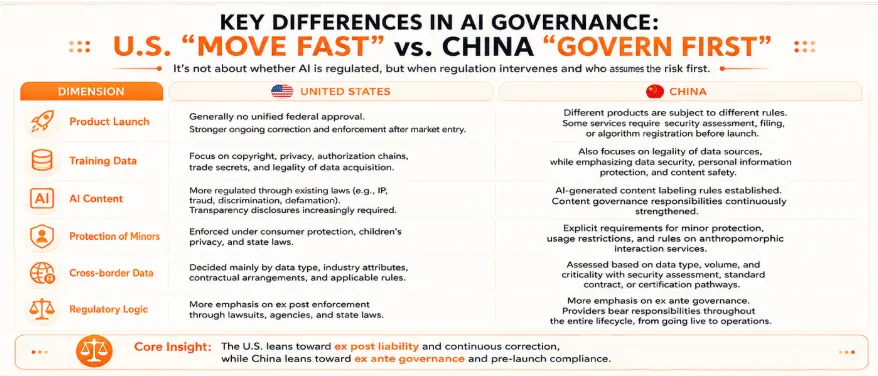
Mankun Graphic | Key Differences in AI Governance Between China and the U.S.
II. The U.S. Draws “Conduct Red Lines,” While China Is Moving Deeper into “Product Design”
These differences become even more apparent when we look at specific rules.
At present, much of U.S. AI regulation still operates through existing legal frameworks. If a company exaggerates the capabilities, safety, or expected benefits of an AI product, it may trigger consumer protection or deceptive advertising rules. If copyrighted works are involved in training data, copyright disputes may arise. If algorithms used in hiring, lending, or housing produce discriminatory outcomes, existing anti-discrimination laws may apply directly.
In other words, the U.S. often focuses less on the fact that a company is “using AI” and more on what the company does with AI and what legal consequences result from that use.
This is also why U.S. AI law is highly dependent on individual cases. AI technology typically develops faster than AI-specific legislation. New disputes therefore often have to be analyzed first under existing legal doctrines, with regulators and courts gradually defining new boundaries through enforcement and litigation.
China, meanwhile, is moving into a deeper stage of regulation.
Earlier AI governance focused heavily on questions such as whether content was lawful, whether algorithms had been properly filed, and whether data had been lawfully obtained. But as AI products become increasingly interactive and anthropomorphic, regulation is beginning to reach directly into product functionality itself.
The rules governing anthropomorphic AI interactive services that took effect on July 15, 2026 provide a useful example. For AI companions, anthropomorphic chatbots, and similar products, regulators are no longer concerned only with whether a model may generate unlawful content. They are also paying attention to whether platforms clearly inform users that they are interacting with AI rather than a human being, whether measures are in place to prevent excessive dependence, whether users receive reminders after extended periods of continuous use, and what types of anthropomorphic services may be provided to minors.
These requirements are already beginning to affect UI design, user journeys, account systems, product interactions, and risk-control mechanisms.
From this perspective, an important shift is emerging in China’s AI governance: compliance is moving from “content moderation” into “product design.”
For businesses, this means that if the legal team only conducts a final review when a product is nearly ready to launch, it may already be too late. Effective AI compliance increasingly requires legal considerations to enter the process when product managers define functionality, technical teams design model interactions, and operational teams establish user mechanisms.
III. The Biggest Difference Is Not Simply “Who Imposes Larger Fines”
Another common simplification in discussions of U.S. and Chinese AI governance is to say that the U.S. relies on litigation, while China relies on administrative regulation.
There is some truth to this distinction, but it is still incomplete.
The U.S. certainly has extensive private litigation, but the Federal Trade Commission, state attorneys general, and regulators in sectors such as finance and healthcare may also take direct enforcement action. China relies heavily on administrative regulation, but AI companies can likewise face civil litigation involving copyright, personality rights, personal information, or consumer rights.
What matters is therefore not which country relies exclusively on which enforcement mechanism, but which type of risk is most likely to become a meaningful constraint on a company’s business operations.
Anthropic’s copyright litigation provides a useful U.S. example. In July 2026, a U.S. court approved an approximately US$1.5 billion copyright settlement between Anthropic and a group of authors. Describing the case simply as “an AI company used copyrighted works to train its model and therefore paid US$1.5 billion” would overlook the complexity of the dispute.
The court had previously made an important determination regarding whether AI model training could constitute fair use. Another major issue in the case concerned the manner in which the company acquired and retained copies of pirated books. The US$1.5 billion ultimately represented a settlement between the parties, rather than a damages award directly imposed by the court.
The real lesson for AI companies is therefore not that “copyrighted materials can never be used for AI training.” It is that data compliance in the AI era cannot stop at examining how data is ultimately used by a model. Companies must also trace where the data came from, how it was obtained, and whether they have the legal right to acquire, retain, and use it.
This is precisely the kind of risk that many U.S. AI companies need to take seriously. A product may have operated for years, attracted a large user base, and completed several rounds of financing before a dispute over training data, product design, or marketing practices develops into prolonged litigation. More room to innovate does not necessarily mean lower legal costs. It may simply mean that the risks emerge at a different stage.
For Chinese companies, the pressure often appears more directly in the question of whether a product can continue operating.
Failure to complete required filings, inadequate content-governance mechanisms, failure to implement AI-content labeling, product designs that do not satisfy requirements for protecting minors, or functions that conflict with regulatory rules can all lead to rectification requirements, product modifications, or even suspension of services.
For a fast-growing technology company, these risks cannot be measured solely by the size of an administrative fine. If a core function must be taken offline or an entire user flow needs to be redesigned, the commercial impact may far exceed the financial penalty itself.
From a business perspective, the core risks in the U.S. and China can therefore be framed as two different problems: in the U.S., companies need to avoid being held liable after they have already scaled; in China, companies need to avoid being unable to scale because they failed to address compliance requirements early enough.
IV. For AI Companies Going Global, the Real Question Is Not Which Market Is More Relaxed
Because the two systems follow different regulatory logics, one of the easiest mistakes for AI companies to make when choosing a market is to compare whether “the U.S. is more relaxed” or “China is stricter.”
That framing oversimplifies a much more complex business decision.
A foundation model, an internal enterprise Agent, an AI SaaS product, an education application, an AI companion, a medical AI system, and an AI-enabled hardware product all face very different regulatory issues. An enterprise productivity tool that does not directly serve consumers cannot be evaluated under the same legal framework as an AI product that continuously interacts with millions of minors every day, even if both ultimately rely on the same underlying model.
What companies should examine first is their own risk profile.
If a product depends heavily on large-scale copyrighted training data, then data licensing, fair-use boundaries, and potential class-action litigation may become central issues in the U.S. If a product processes significant volumes of personal information in China while calling overseas models, cross-border data transfer mechanisms and personal information protection may become major concerns. If the product is an AI companion, content safety, protection of minors, anthropomorphic design, and mechanisms addressing user dependence may directly fall within the compliance framework.
Choosing where to launch an AI business is therefore not simply a choice between a “relaxed market” and a “strict market.” It is a choice about which type of legal risk the company is better equipped to manage.
That is where comparisons between U.S. and Chinese AI governance become genuinely useful.
The U.S. gives businesses more room for innovation at an earlier stage, but companies must be prepared to manage complex and fragmented downstream liability. China imposes more front-loaded requirements on certain types of products, but once the applicable rules are identified, companies may also have greater clarity about which compliance steps need to be completed before launch.
Both systems regulate AI. They simply place risk at different points in the product lifecycle.
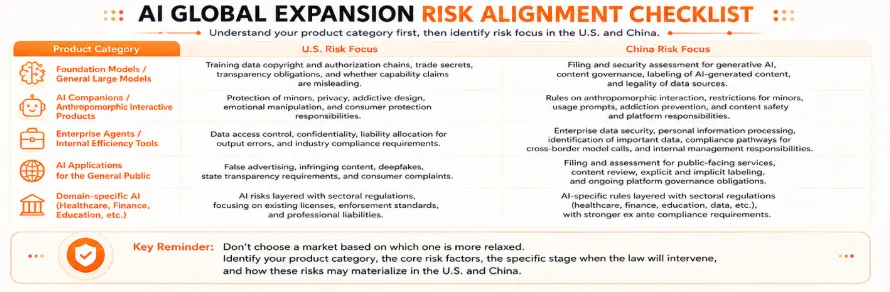
Mankun Graphic | AI Global Expansion Risk Alignment Checklist
V. Neither the U.S. nor China Is Likely to Become “More Relaxed”
Looking ahead, although the U.S. and China have chosen different regulatory paths, they are moving in one similar direction: as AI moves from being a tool into real social relationships and high-impact applications, regulation in both countries is becoming more specific.
One of the most important variables in the U.S. will be how the federal government and individual states ultimately divide authority over AI regulation. At the federal level, policymakers continue to emphasize maintaining U.S. technological leadership and competitiveness in AI, while states such as California and New York continue to develop their own rules around frontier models, algorithmic transparency, deepfakes, child safety, and related issues. For AI companies, the future challenge is therefore unlikely to be whether the U.S. “regulates AI at all.” It will be how to navigate the interaction between federal policy, state law, sector-specific regulation, and existing legal frameworks.
China is continuing down a different path. Rules developed over the past several years governing algorithms, generative AI, data, content labeling, and specific application scenarios have already formed a relatively detailed regulatory system. China’s 2026 State Council legislative agenda also calls for accelerating comprehensive legislation to promote the sound development and governance of artificial intelligence.
China’s future AI governance framework is therefore unlikely to discard the existing rules and start again. More likely, it will build a more systematic, higher-level legal framework on top of the regulatory architecture that already exists.
For businesses, the implication is increasingly clear: AI compliance can no longer be treated as an auxiliary legal review conducted only after a product has been completed.
Whether operating in the U.S. or China, mature AI companies will ultimately need to integrate compliance capabilities throughout research and development, product design, data governance, marketing, and operations. What differs is which risks need to be addressed first in each market.
Conclusion
“Move fast in the U.S., govern first in China” remains an easy way to understand the basic contrast between the two systems. But from the perspective of an AI business operator, those few words explain only the first layer.
The U.S. does not allow companies to move fast without constraints. Rather, it relies more heavily on existing law, regulatory enforcement, state legislation, and litigation to define legal boundaries as products operate in the market. China, likewise, does not require every AI product to obtain prior approval. Instead, for certain high-impact, public-facing, or risk-sensitive services, it places filing, assessment, content governance, user protection, and product-design requirements earlier in the product lifecycle.
The real difference between U.S. and Chinese AI governance is therefore not that one system “encourages innovation” while the other “restricts innovation.” The two systems allocate legal risk differently.
For AI companies preparing to expand internationally or operate simultaneously in both China and the U.S., the better questions are not simply “Which market is more relaxed?” Instead, companies should ask: What type of product are we building? At what stage will the law intervene? And if we make the wrong judgment, which risk would be the most difficult for the business to absorb?
Once those questions are clear, deciding “where to build AI” becomes more than a market-entry decision. It becomes a genuine business and legal strategy.
This article reflects the author’s personal views only and does not constitute legal advice regarding any specific matter. Compliance assessments for particular AI products and cross-border businesses should be conducted based on product functionality, business model, user location, data-processing practices, and specific application scenarios.
/ END.
*This article is an original work of Mankun Law Firm and represents only the personal views of the author. It does not constitute legal consultation or legal advice on any specific matter. For reprinting and legal consultation, please add our customer service: mankunlawyer.
About the Lawyer