
A 'robot girlfriend' priced at nearly one million yuan, advertised as able to recognize more than twenty of your emotions, can only keep you company for two to four hours on a full charge. This article seeks to work out clearly: where exactly does the money come from in UBTech's business, and is it earning from the product or from the valuation?
On June 30, UBTech held its 2026 annual global launch event in Shenzhen, unveiling the full-size ultra-bionic humanoid robot 'U-World U1' series. Three products: the half-body U1 Lite priced at 119,800 yuan, the full-body U1 Pro at 169,800 yuan, and the highly dynamic U1 Ultra capable of autonomous walking, at 990,000 yuan for the male version and 880,000 yuan for the female version. At the launch event it was announced that cumulative orders across all channels had exceeded 13,361 units.
For comparison: in the whole of 2025, UBTech sold a total of 1,079 full-size embodied intelligent humanoid robots. In other words, the pre-order volume of a product aimed at individual consumers, in less than one month, is more than twelve times its entire sales volume to enterprise clients last year.
At the same launch event, there was another, less conspicuous specification. Whichever model in this robot series, the continuous operating time on a single full charge is 2 to 4 hours. A product marketed around 'long-term companionship' accompanies you for a duration measured in hours. Placed side by side, these two figures show the most real current state of this business.
What actually sells in volume is not the 990,000-yuan model
First, let us look at what kind of business this is.
UBTech operates at the most downstream end of the humanoid robot industry chain: it assembles others' joint actuators, Nvidia's edge chips and others' lithium batteries, together with its self-developed bionic skin and emotional large model, into a complete machine, and sells it to health and elderly-care institutions, high-end reception scenarios and individuals who can afford it. The way it collects money is very traditional: one-off payment for hardware. As of now, it has not disclosed any subscription or value-added charges for the emotional large model. After the outright purchase, the machine will not charge you a second time.
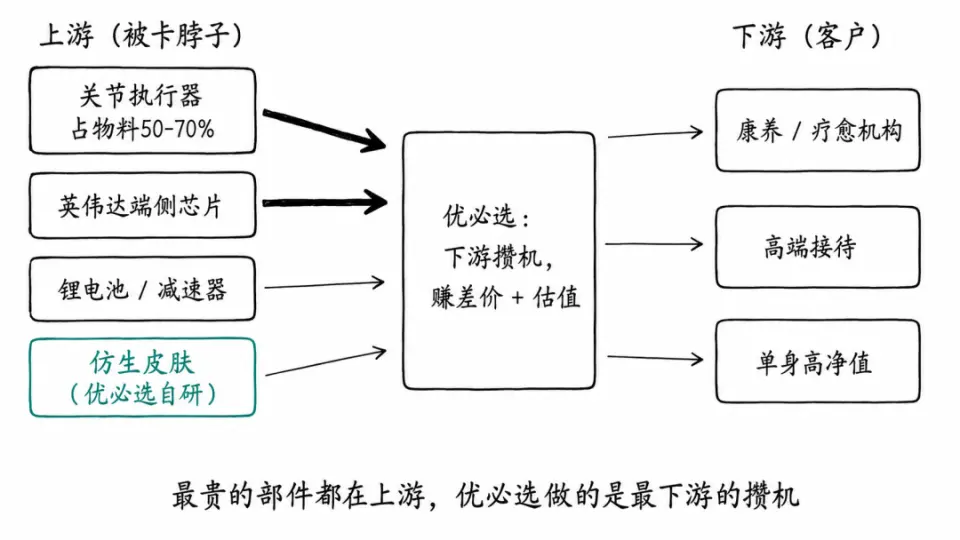
UBTech's position in the industry chain
The 990,000-yuan model is meant to make headlines, not to sell in volume. What actually sells are the 119,800-yuan Lite and the 169,800-yuan Pro.
Let us do the hardware math. UBTech has not disclosed the BOM cost, that is, the material cost of building one machine. Peers can serve as a reference: in March this year, China Post Securities teardown of the Unitree G1 showed a base-version whole-machine BOM of about 41,600 yuan, with core joints at 27,500 yuan and a base-version gross margin of 40.7%. But this structure cannot be directly applied to the U1. Unitree is an industrial biped, with money spent on leg joints; the U1 is ultra-bionic companionship, with money spent on the face. Jiao Jichao, dean of UBTech's Research Institute, has said that the head of the U1 contains as many as two to three thousand components, accounting for more than 60% of the whole machine's materials, and that miniaturization and heat dissipation must be achieved within a human-proportioned skull. The material cost here depends on bionic yield, not the economies of scale of standard parts, and the room for cost reduction is far smaller than for joints.
A rough calculation: taking a BOM midpoint of around 100,000 yuan and cutting across the three tiers makes the pricing structure clear. In the 119,800-yuan Lite, hardware cost accounts for the bulk, making it almost a traffic-driving model sold at cost; the 169,800-yuan Pro has a gross margin close to 40%; while the 990,000-yuan Ultra, against material costs in the 100,000-yuan range, has a book gross margin as high as nearly 90%. That figure is physically untenable, and it proves only one thing: this price is meant to serve as an anchor, not to close sales.
In UBTech's 2025 annual report, the overall gross margin was 37.7%, and that of the high-margin full-size humanoid robot category was 54.6%. The true gross margin of the U1 companion model most likely falls between these two figures. This is the gross margin of a normal hardware business, not some windfall profit.
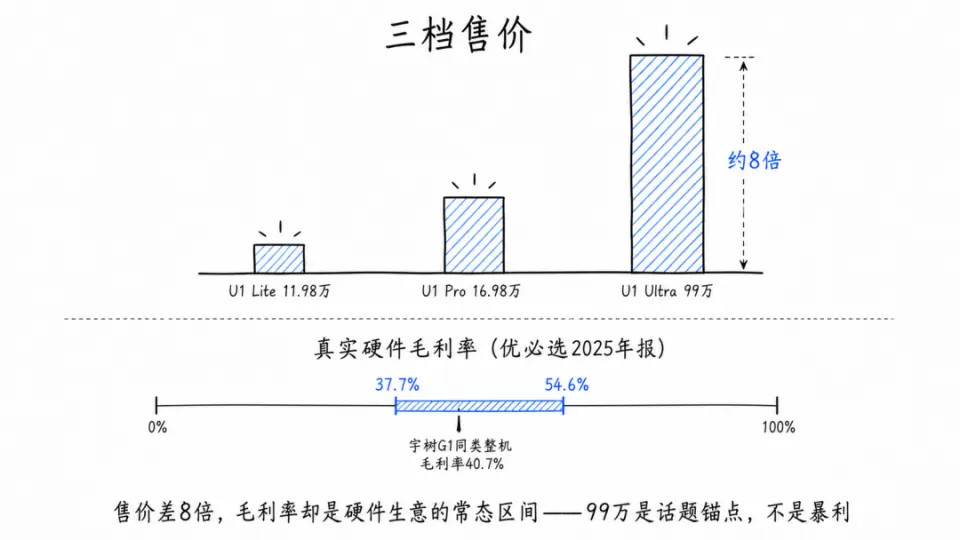
Three price tiers and the true gross margin
Two to four hours: companionship cut into fragments
Back to that battery-life figure.
The power consumption of a bipedal humanoid robot is determined by physics. There is a running joke in the industry: "impressive for no more than 2 hours." As long as the robot does not enter deep sleep, it is continuously drawing power just to stand and maintain balance, and once it starts moving, power consumption rises non-linearly. Some have disassembled a Tesla Optimus: the joint actuators across the body account for roughly 70% of the whole unit's power consumption, and a single knee joint can peak at 500 watts. The U1 has several times the degrees of freedom of Optimus, and must additionally power a layer of bionic silicone that maintains a warm, soft tactile feel and a 200 TOPS chip running inference at all times. The battery is only so large; the 2-to-4-hour battery life is a calculated result, not a failure of optimization.
A 2025 Bain & Company report offered a judgment: most humanoid robots today can run for about 2 hours under real loads, and achieving 8 hours of uninterrupted operation may take about 10 more years.
The problem is that the selling point of "companionship" is precisely what requires uninterrupted operation. UBTECH advertises that the U1 has cross-time memory and proactive care without a wake word, like an old friend you have known for a long time. But this old friend has to go back to the wall and plug in every two or three hours, and cannot connect while charging. Whether a companionship repeatedly interrupted by charging is still companionship is a hurdle the product cannot avoid.
Interestingly, UBTECH itself knows how to solve this. Its industrial Walker S2 takes the battery-swapping route: when the main battery runs out, the robot walks to a charging station by itself, and the entire swap takes less than 3 minutes. But this fallback is unavailable to the home companion model: you cannot have a "girlfriend" take out her own battery in the middle of the night. So the companion model can only plug into the wall, and battery life becomes a hard constraint.
The demand side also warrants a question mark. 13,361 units sounds intimidating, but it is less solid when broken down. These are orders locked in by consumers paying a 3,000 yuan deposit, and that deposit is refundable before the presale ends on July 15. More importantly, the composition: 36Kr found in early July that JD.com had 5,467 orders and Tmall 80, meaning about 5,500 units were actually ordered online, with nearly 8,000 units attributed to "offline all-channels" under an unclear methodology. After discounting refundable deposits by the conversion rate for high-priced durable goods, the volume that actually becomes completed sales may be only one or two thousand to three or four thousand units.
Zhou Di, an expert in the Ministry of Science and Technology's National Science and Technology Expert Database, put it bluntly to reporters: at this stage such hyper-realistic bionic robots are more like "advanced toys" than productive forces; the emotional companionship scenario has not undergone long-term market testing, battery life is limited, and chatting alone can hardly create sustained essential demand, so they are easily left idle once the novelty wears off.
Something that must go offline to charge several times a day and generates no service revenue after purchase is selling novelty, not essential demand. This business has not yet been able to sustain itself on its products.
A market-cap machine
If the product's numbers add up to an ordinary business, then on what basis is this company worth so much money?
The answer lies not in the product, but in the capital markets. UBTech is Hong Kong's "first humanoid robot stock." Over the past few years its market capitalization has ridden a roller coaster: on the day it was included in the Stock Connect in March 2024, it surged 88%, at one point reaching HK$328 and a market capitalization of over HK$130 billion; it then corrected all the way down, falling to a low of HK$40.8 in early 2025, with over HK$100 billion in market value evaporating; after releasing its annual report this April it rose 17% again, and its current market capitalization is about HK$49 billion, equivalent to RMB 42.6 billion, almost the same level as the offering valuation of Unitree, which is still queuing for an IPO.
This curve is essentially decoupled from whether the company has sold robots or made money. It tracks capital-market events such as inclusion in the Stock Connect, annual report releases, and Unitree benchmarking.
A look at the financial statements explains why. From 2023 to 2025, UBTech's net loss attributable to shareholders was RMB 1.234 billion, RMB 1.124 billion and RMB 703 million respectively, a cumulative loss of about RMB 3 billion over three years; operating cash flow showed a net outflow of nearly RMB 2.7 billion over the three years. Yet on paper it is not short of money, sitting on RMB 4.92 billion in cash at the end of 2025. This money was not earned; it was given by the capital markets—in 2025 alone, the company raised about HK$6.3 billion through three rounds of placements. On one side is a business that keeps bleeding; on the other, a steady transfusion of placement funding. What props up the market capitalization is the "first stock" identity and the "trillion-dollar track" story, not profit.
So the several groups actually promoting this business are all making money from the narrative. The company sells market capitalization, brokers sell research reports and underwriting relationships, robot ETFs sell management fees, and Unitree, currently in IPO, is seeking listing liquidity. None of these four groups makes money from the hardware gross margin of the U1; what they earn is "someone believes the trillion-dollar story." The only ones paying real money are the consumers who buy the machines and the buyers of last resort in the secondary market.
Some will say UBTech still has a moat: the yield rate of bionic skin, the miniaturization process of cramming two or three thousand parts into a human head—a wax museum factory only makes a few hundred heads a year, and the yield rate itself is a barrier. That is half right. But that is not how the accounts work. However difficult the process, it only shortens the time for competitors to catch up from a year to half a year; it cannot stop players such as Unitree and Kepler, who are also drawing from hyper-realistic bionics. What truly sets UBTech apart is not the skin, but that it listed first, raised money first, and first obtained that financing channel that can be used for repeated placements. Its moat protects the valuation, not the product.
This also means where this business will crack first. Not regulation, but the product. After deliveries began on September 16, if real-life footage starts appearing on Xiaohongshu and Black Cat complaining of "charging three times a day" and "bought it and it just gathers dust," and if actual activation numbers do not match the stated 13,000 units, a wave of order cancellations and the share price will arrive together; once the placement channel closes, the RMB 500 million a year in R&D cannot be sustained. Battery life of 2 to 4 hours will be the first link to fail.
Those who want to enter must first see clearly where they stand
If you are thinking of getting a share of the pie, first see clearly how many positions there are and how much the threshold differs for each.
Those who want to build complete machines. The threshold for this position is not technology, but the ability to raise capital continuously. UBTech has spent a cumulative RMB 1.9 billion on R&D over four years, maintains a team of nearly a thousand people, and has lost RMB 3 billion over three years, surviving entirely on placements. Without the "first stock" identity, you cannot leverage this kind of capital; entering means using your own money to fill a track where even a listed company is still losing money. Money at the complete-machine layer can only be earned by platforms that are already listed and can pin the attention of the entire internet on themselves.
Those with materials and production-line capabilities can look at supporting components, but only at one position. UBTech claims full-chain in-house development; what is truly left to external solution providers and is hardest to catch up on is the yield rate of bionic silicone skin. Do not compete in joint modules—those have Unitree's public teardowns and the threshold is rather soft; nor should you treat the ability to tune emotional large-model APIs as a threshold, as that is a capability available in abundance. Mass production ramp-up begins in September, which is precisely the window for yield-rate solution providers.
Those with health-and-wellness or high-end hospitality channels can take on distribution. Your channels happen to match U1's institutional clients, and what you earn is a handling fee from deposit to closing; you can start with funds in the tens of thousands of yuan, and no one's approval is needed. But if you are purely chasing the hype and have no channels in hand, do not rush to stock up; what you would be stocking is novelty.
As for ordinary consumers, if you are buying it as a product rather than as a collectible, you can wait a little longer at this stage. To spend from 119,800 yuan to buy a robot that has to return to its wall charger every two or three hours and, once bought outright, comes with no value-added services, a large part of what you are paying for is the prop that someone else's valuation story needs.
The last item on the ledger is regulatory
For those doing this business, the law is the last cost item on the ledger and must be factored in.
Right now things happen to be at a particular point in time. The Interim Measures for the Administration of Anthropomorphic Interactive Services Based on Artificial Intelligence were jointly published by five departments on April 10 and formally took effect on July 15, that is, half a month after the launch event. Article 2 expressly brings services that "simulate the personality traits of natural persons and provide sustained emotional companionship interaction" within regulation, and products such as U1 fall squarely within range. What follows is a series of costs that will definitely have to be incurred: algorithm filing, security assessment, science and technology ethics review, prominent labeling that "you are talking to an AI," dynamic reminders about over-reliance, and no provision of virtual companions to minors. For a company of UBTECH's size, these are fixed compliance expenditures, not a matter of life or death; those truly shut out by this threshold are small and medium-sized complete-machine manufacturers and solution providers that lack compliance capability and want to take shortcuts. On July 4, two industry associations jointly issued an initiative on preventing ethical risks; although it is only an initiative and there are not yet mandatory standards, the direction is clear, and formal technical standards will most likely land within one or two years, with privacy and physical safety being the first two areas addressed.
What deserves closer attention than compliance filing is the data line. This robot perceives you through cameras and microphones in the home, and what it collects is the most sensitive personal information, such as faces, voiceprints and living habits. Once the authorization chain for collecting, storing and using such data to train emotional large models is not properly set up, what is breached is the informed consent requirement of the Personal Information Protection Law. Disputes of this kind can be resolved by paying money and are risks that can be counted as operating costs, but they must be calculated accurately and reduced to a minimum: at the collection stage, make authorization an explicit user checkbox, store data locally without external transmission, and obtain separate consent for training purposes; if these steps are done solidly, this cost can basically be reduced to zero. The one line of text saved on the authorization page may one day become a fine or judgment of several hundred thousand yuan.
Whether this business can succeed ultimately does not depend on regulation. It depends on whether, after September 16, that robot that needs to return to its wall charger every two or three hours is truly a product that can keep people paying, or a model showroom that propped up a market value of 49 billion yuan but cannot last through one night.
