
A company whose book assets are so thin as to be almost negligible has raised several hundred million yuan in a single round. It does not build robots; what it sells is a 'memory system' installed in other people's robots. This article seeks to make one thing clear: on what basis is this memory system worth so much money, and is that value a purchase of profit, or a purchase of a ticket to entry.
On July 5, 36Kr's Hard Kr exclusively reported that TranscEngram, founded by HKU professor Ma Yi, completed a angel round of financing amounting to several hundred million yuan. The investor list spans industrial capital and state-owned platforms: Sino Biopharmaceutical under the Charoen Pokphand Group, Pudong Venture Capital, Zhangjiang Science & Technology Investment, Zhangjiang Hi-Tech, Hongxin Electronics, as well as several financial funds including Yunhui, Woken, and Jinduo.
TranscEngram was established in September 2023, with registered capital of only 601,200 yuan, and Ma Yi personally holding 53.44%. A company with almost no heavy assets on its books raising several hundred million yuan in a single angel round—this contrast is itself a piece of information.
More important is what it does not do. There is not a single complete machine or production line on this list. TranscEngram does not build robots; what it sells is the thing installed in other people's robots, which the team itself calls a 'memory system.'
This leads to the question this article aims to answer: on what basis is an invisible, intangible memory system worth several hundred million yuan.
What it sells is not robots, but robots' memory
First, let us pin this business down on the industrial chain.
Most embodied intelligence companies today sell the body—that is, the robot hardware itself. Zhiyuan, UBTech and Unitree all belong to this layer, earning money from complete machines and complete-machine orders. The bulk of the cost in this layer is hardware: for a high-precision humanoid robot, actuators and joint modules alone account for about 60% of the cost, and gross margin is dragged down all the way by material costs.
TranscEngram sits one layer above the hardware. What it does is the robot's 'cerebrum plus cerebellum': the cerebrum handles visual memory, understanding the geometry and object structure in space; the cerebellum handles muscle memory, recording the trajectory and timing of movements. In the words of co-founder Yang Yanchao, 'visual memory is memory about space, muscle memory is memory about time.'
Around this memory, TranscEngram has built four products: real-machine teleoperation collection, first-person wearable collection, motion memory control, and environmental memory navigation, plus a self-developed cross-embodiment translation engine, EngramMotorNeuron. Together, this suite does one thing: once a skill is learned, it can be transferred to robots with different structures and continue to be used, without having to teach it again from scratch.
Its envisioned endgame revenue model is called 'skill subscription.' Learned skills are turned into assets that can be repeatedly invoked by different robots, with fees charged by subscription. This statement is still only a vision, with no public pricing, but it reveals the role TranscEngram truly wants to play: not a seller of robots, nor a seller of a particular model, but a seller of the 'foundation.'
The position of foundation sounds like a foundation model, but is in fact more awkward. Above it, costs are constrained by hardware suppliers such as compute, dexterous hands and joint modules; below it, the customers are body manufacturers such as AgiBot, Fourier and Galbot, and these body manufacturers have all raised money and each has the motivation to build its own brain. TranscEngram has raised angel-round cash flow but is telling a foundation-model-layer story, and the distance in between is precisely the account this article's latter half will calculate.
The valuable thing is hidden behind a wall of data.
To understand why Yisheng is valuable, one must first see clearly where the entire industry is stuck. The answer is data.
For embodied intelligence models to become smarter, they rely on interaction data from the real world—data generated by "seeing once, moving once, learning once." Such data is currently extremely scarce. According to statistics from Jiaziguangnian and multiple institutions, the entire industry has accumulated only about 500,000 hours of high-quality real-machine interaction data, whereas training a model with general generalization capabilities is widely believed in the industry to require at least tens of millions to one hundred million hours—a gap of two to three orders of magnitude. For reference, this volume is less than one twenty-thousandth of the training data for large language models.
Data is not only scarce but also expensive. Data collected through real-machine teleoperation is priced at 500 to 1,000 yuan per hour on the market; the cost of a single valid data item is 3 to 8 yuan on an annualized basis, and this does not yet include the labor for subsequent cleaning, annotation, and alignment. A data collection facility often requires an investment of "more than 100 million yuan," and basically none of them are profitable.
More troublesome than the expense is a third issue: data follows the body. Robots of different brands and models have different sensor layouts and control methods, and a set of teleoperation data is highly bound to specific hardware; switching to another robot requires collecting the data all over again. An industry investigation by 36Kr described this dilemma bluntly: data assets cannot accumulate across bodies and cannot become a public asset of the industry. It is as if every company is repeatedly digging the same well in its own backyard.
What Yisheng is confronting are precisely these two walls. Its memory mechanism is claimed not to be strongly coupled with the body, and to be able to transfer skills from grippers to dexterous hands and to robotic arms of different spans; its collection system is positioned as "lightweight, with most data automatically generated, and less dependent on manual teleoperation and labeling." If both of these hold true, then what it is doing is transforming the industry's most expensive thing: turning data from a one-time cost into an asset that can be reused repeatedly.
This is the real reason the "memory system" is valuable. What it sells is not motors and shells, but the ability to amortize the sky-high cost of data and to compound a set of skills across different robots. Hardware is linear—one more unit means one more unit's worth of material cost; data compounding is nonlinear—when a second customer invokes the same set of skills, the marginal cost is close to a single computing fee. Capital is willing to give it hundreds of millions of yuan before it has any revenue, betting precisely on this nonlinear curve.
The problem is that this curve has not yet been proven by a single number.
One view is that Yisheng's experience in cross-body adaptation was honed machine by machine on real robots from AgiBot, Fourier, Galbot, and Crossdimension Intelligence, and that this kind of hands-on feel cannot be copied by others merely by reading papers. Another view is exactly the opposite: its core network CRATE has already been published at NeurIPS 2023, and the more "white-box and interpretable" it is, the easier it is to reproduce; moreover, its self-reported claims that "multi-task performance is three times stronger than traditional models, with a success rate above 95%" are the company's own statements, without third-party verification, and SOTA numbers will be refreshed every six months.
Both statements are currently correct. Because the number that determines victory or defeat—namely, how much data is actually saved after cross-body reuse and how much success rate can still be maintained—Yisheng has not disclosed a single one. Whether behind this wall lies a gold mine or a stage set, no one can prove at present.
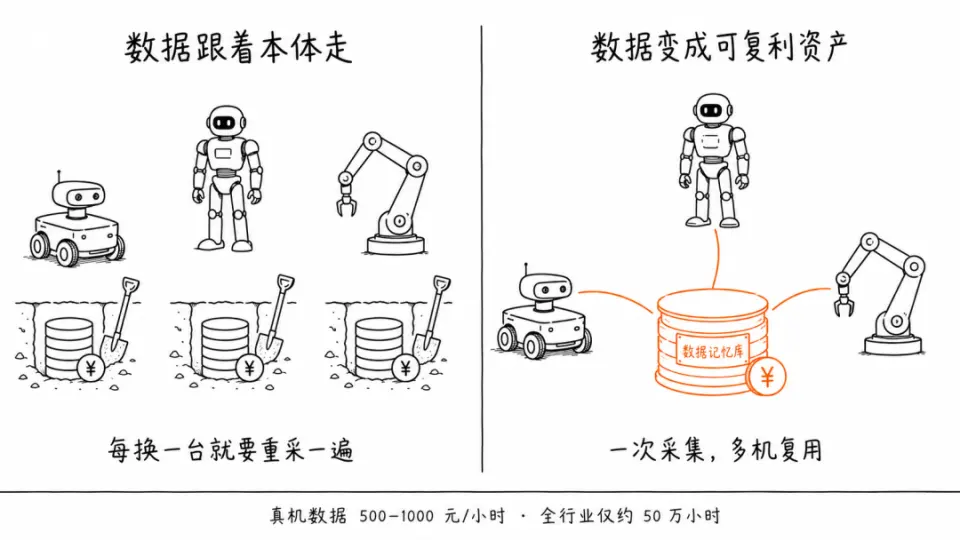
Data transforms from a one-time cost into a compoundable asset
Laying out the accounts, the revenue line is currently empty
Put it in the simplest three-line ledger: revenue minus cost equals gross profit.
On the revenue line, Yisheng's entry is essentially blank. Unit price per customer, ARR, and signed contract value: the company has disclosed none of them; skill subscriptions have not yet been priced; and the arrangements with hotels and with the aircraft-parts manufacturer backed by Airbus are still at the "exploring cooperation" stage.
The cost line, by contrast, is hard and frighteningly large. I ran the numbers for it at the lowest tier: training a general-purpose model requires tens of millions to 100 million hours of data, and even at a floor price of RMB 500 to 1,000 per hour, the data item alone comes to the order of RMB 5 billion to 100 billion. This angel round, meanwhile, is "several hundred million yuan," of which more than 60% goes to the data pipeline; at the very most, RMB 200 to 400 million is invested in data, which is not even a fraction of that lower bound, amounting to roughly 4% to 8%.
So one thing needs to be made clear: Yisheng has no intention of filling this hole through genuine on-device hard data collection, and physically it cannot be filled that way. It must bet that the path of "lightweight collection and automatic generation" can push down that astronomical denominator. In other words, the current valuation is not pricing its gross profit today, which is negative; it is pricing the bet itself that data costs will collapse in the future. This is more like buying an option than buying a business.
Even if the bet pays off, the ceiling is not as high as imagined. How big a business is it at its fullest extent? The annual whole-machine market for industrial humanoid robots in China is optimistically estimated at the order of tens of billions of yuan, and the share of whole-machine value that a software foundation can capture, by analogy to the share of whole-vehicle value taken by autonomous-driving software, is only 10% to 15%. By that calculation, the addressable foundation-software market is roughly RMB 4 billion to 6 billion per year, and that must be shared among Yisheng, Physical Intelligence (which has already open-sourced its flagship model π0), and the various in-house brains developed by individual companies. For any single company, the realistic revenue ceiling is in the billions, not the tens of billions that outsiders perceive.
This is not to say the business does not hold up, but that its nature must be accurately understood: this is a redistribution that carves software value out of the bowl of the hardware makers, capturing the wasted money others spend repeatedly collecting data, not a new cake that has grown out of thin air.
What state-owned and industrial capital are scrambling for is a ticket
Given that the numbers are negative and the ceiling is only in the billions, why are state-owned and industrial capital such as Charoen Pokphand, the Zhangjiang group, and Pudong Venture Capital still scrambling to get in?
Because what they are buying and what the entrepreneurs want to earn are not the same thing.
First, look at what each of the people promoting this business is earning. For the professor team, financing is itself a monetization event: Ma Yi holds more than half the shares, a valuation in the hundreds of millions is realized, and part of the paper wealth is immediately cashed in. What state-owned platforms value is planting a flag on the industrial map: Zhangjiang Science & Technology Investment, Zhangjiang Hi-Tech, and Pudong Venture Capital all entered at the same time, earning the political credit of a "Shanghai embodied-intelligence benchmark project" and the internal rate of return of industrial funds, not betting on the revenue of any single project. Industrial capital comes in to buy an entry point into the future supply chain. Financial funds are betting that the next round at a higher valuation will find a buyer. None of these ledgers is a bet that Yisheng will be profitable through skill subscriptions in 2028.
This is not Yisheng's story alone; it is how the entire track is priced. In the first half of 2026, 288 financings took place in China's embodied-intelligence sector, with more than RMB 46 billion disclosed, but the money is highly concentrated: the top five absorbed about RMB 17.1 billion, or 37%; the top 20 took more than 70%; and the remaining 200-plus companies split the remaining RMB 10 billion-plus, averaging only tens of millions each. Xu Huazhe of Tsinghua put this kind of bet plainly: "What everyone wants more than anything is to buy a ticket to the future." Another judgment circulating in the industry is even more direct: the high valuations of the 25 billion-yuan unicorns are essentially capital's bet on a "GPT moment for the physical world," not a pricing of existing revenue and orders.
There is a mismatch hidden here that everyone thinking of following along should see clearly. Capital can bet this way because it bets on a portfolio: of ten investments, nine may die, and as long as one Physical Intelligence pays off, it recovers its money. But the hardware makers that actually embed Yisheng's foundation into production lines, and the scenario owners that put robots into workshops and hotel rooms, are paying real project money and putting personal safety on the line; a single product accident, or a single instance of "the brain doesn't work well and we have to tear it out and build our own," is a real loss from which there is no exit. Capital's optimism has never meant that industrial customers should bet heavily on it as their only foundation.
For Yisheng itself, the greatest threat comes precisely from the very customers it wants to serve. There is a consensus in the embodied intelligence circle; in Han Fengtao's words, "the evolution of the brain will in turn define the hardware." The brain is the high-value ground, and every well-funded body manufacturer wants to hold it in its own hands rather than outsource it. Zhiyuan Square has already open-sourced its self-developed NeuroVLA, JD.com is building its own embodied foundation model, and Zhiyuan and Fourier, which Yisheng has already adapted to, are themselves top players with valuations in the tens of billions and fully capable of in-house development. This means that those truly willing to buy "someone else's brain" over the long term are more likely to be mid-tier body manufacturers that cannot afford in-house development and scenario parties that do not care whose brain it is; and this secondary market is precisely where open-source, free brains will first be submerged.
So what the outside world should really take away from this funding round is not "how impressive the memory system is," but a set of access logic: the professor's credibility, the backing of state-owned capital, and the order pool of local industrial bases—bound together, these are themselves the entry ticket to this business. This also explains why Yisheng has spread its R&D and data centers across Shanghai, Shenzhen Qianhai, Beijing, and Sichuan: the currently certain revenue in embodied intelligence lies almost entirely in the order pools of state-owned capital and major corporations—a single centralized procurement by State Grid amounted to RMB 6.8 billion for 8,500 units. Such orders are not won through free competition in the market.
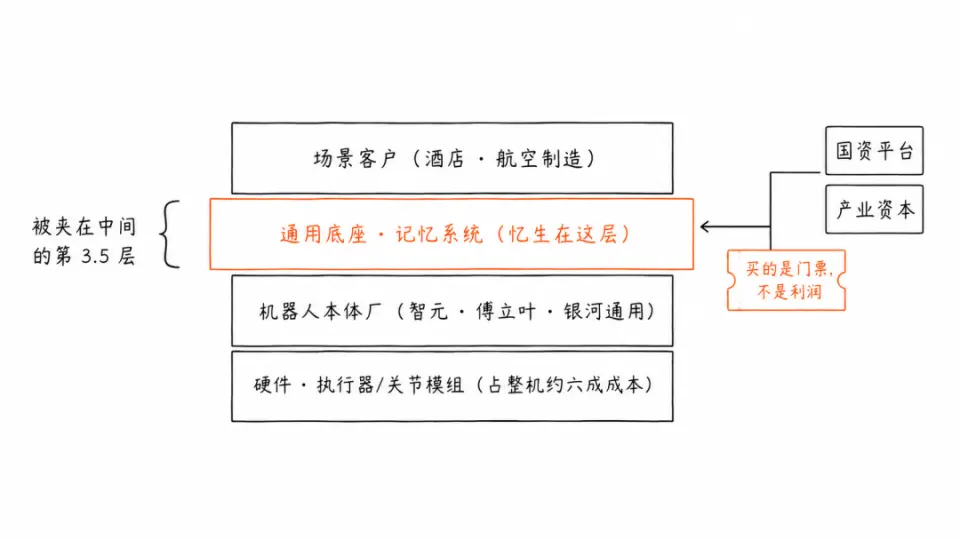
Yisheng is stuck at the foundation layer in the middle of the industrial chain; what state-owned capital and industrial capital are buying is the entry ticket
Who should bet, and who should steer clear
Once you understand this logic, different people should take different actions. The real threshold for this business is a Marr Prize-caliber team, hundreds of millions of yuan in funding, and a data gap on the order of tens of millions of hours—not on the same coordinate system as RMB 3,000, 30,000, or 300,000 in startup capital. So what is being discussed here is not "whether you should enter the field and build a memory system," but "once you understand this matter, how should you use this judgment."
If you are an early-stage investor, you can follow this type of professor-affiliated target, but you must be extremely selective. The track is winner-takes-all, with more than 200 companies splitting the meager leftovers; those that can make the top 20 rely precisely on characteristics like Yisheng's "top-tier team plus scarce positioning." But before betting, you must verify one thing: whether skill subscriptions have moved from a vision statement to a priced contract. If you cannot verify that, price it as an entry ticket, not as revenue.
If you are in business development at a body manufacturer or an industrial party, a foundation layer like Yisheng's can be used to reduce costs—after all, collecting tens of millions of hours of data from scratch yourself is unrealistic. But do not bind yourself exclusively, and even more so, do not outsource the entire brain. Once you are locked in, the compounding and pricing power of skill assets all belong to the foundation-layer provider, and you become the "hardware that is in turn defined." The smart approach is to treat it as an accelerator while keeping an in-house fallback.
If you are an entrepreneur upstream in components or data collection, this wave is instead the most certain opportunity. No matter which foundation-layer provider ultimately wins, dexterous hands, tactile sensors, torque sensors, and cross-body collection equipment are all water-selling businesses with guaranteed returns in drought or flood, with thresholds orders of magnitude lower than building a foundation layer. The fiercer the foundation-layer competition, the more one should buy data and hardware from upstream. This is one of the few "reachable" entry points in this wave of enthusiasm.
If you just want to understand this matter, one sentence is enough to remember: what this round of hundreds of millions of yuan is buying is not motors and shells, but a foundation layer of "data compounding plus cross-body reuse"; what is valuable is software assets, not hardware. With this ruler in hand, when you look at any piece of embodied intelligence funding news, you can distinguish which are heavy-asset also-rans selling hardware and which are potential winners positioned at the data-compounding spot.
The industry itself does not intend to gloss over this examination. Jensen Huang called 2026 the "first year of commercialization for humanoid robots," but some embodied intelligence founders counter that "this year is not the first year of commercialization, but the first year of elimination rounds." Most companies have cash flow sufficient to last only 18 to 24 months; 2027 to 2028 will be the collective life-or-death test for this batch of companies. Whether Yisheng's options can turn into cash—the answer lies in those two years.
Finally, let us discuss the legal costs along the data line
The core actions of this business are collecting data, training models, and selling the foundation layer; money can basically solve the problems, and for now it does not touch criminal red lines. But in the cost column, several items must be calculated separately.
The regulatory gap now lies in the opening that "embodied intelligence has no dedicated data rules yet." The Personal Information Protection Law and the Data Security Law can both reach Yisheng's actions, but both were written for apps, automobiles, and traditional industry; there is not yet a single provision specifically addressing "robots collecting motion data in real-world scenarios." There are two most concrete pitfalls. The first is its first-person wearable collection system: when operating in real-world scenarios such as hotels, it will collect images of guests and even biometric information, which falls directly under the informed-consent and sensitive personal information rules of the Personal Information Protection Law. In 2026, the Cyberspace Administration of China, the Ministry of Industry and Information Technology, and the Ministry of Public Security have already launched a special action on personal information protection, and within the industry there have already been real instances of "being forced to narrow the scope of collection due to privacy compliance." This type of risk falls into the category that can be resolved by paying money; judgments in similar personal information cases typically range from tens of thousands to several hundred thousand yuan, and not many are actually litigated, so it can be accounted for as an operating cost, but adding a clear authorization notice and checkbox at the collection end can essentially reduce this cost to zero.
What is genuinely harder, and what should be calculated in advance, is the aerospace line. The high-end manufacturing scenarios Yisheng aims to enter include flexible assembly of aircraft, rocket, and satellite components. Once assembly motion data is classified into the "important data" catalogue under the Data Security Law, or even touches on classified manufacturing, compliance is no longer as simple as adding a checkbox: it will stack several thresholds, including special and classified manufacturing qualifications, localized data storage, and cross-border security assessments. Moreover, Yisheng has a Hong Kong capital background and cooperates with Berkeley and DAMO Academy, so cross-border data transfer is unavoidable. In 2026 the state is accelerating the establishment of important data identification catalogues for key fields such as industry and aerospace; the qualification and cross-border costs along this line are very likely the first to rise.
Fortunately, all of these remain a soft landing in which compliance thresholds are raised and entry tickets can be bought back with money and licenses, rather than a hard constraint of being cleared out for crossing the line. For those looking at this business, what truly needs to be watched is not "whether it will break the law," but when these two costs will materialize and how heavy they will be. They do not change the judgment that "memory systems are valuable"; they only change the number that is ultimately deducted from gross profit in that account.
