

The legal risks associated with virtual currency trading are increasing.
Special Disclaimer: This article is an original work by Attorney Shao Shiwei. It represents only the personal views of the author and does not constitute legal consultation or legal advice on specific matters. For article reposting, legal consultation, or business exchanges, please add: sswls66
On August 19, 2024, the Supreme People’s Court and the Supreme People’s Procuratorate jointly held a press conference to release the Interpretation on Several Issues Concerning the Application of Law in Handling Criminal Cases of Money Laundering (hereinafter referred to as the “Interpretation”). The Interpretation came into effect on August 20, 2024.
The Interpretation lists trading in “virtual assets” as one of the methods of money laundering.This article provides an interpretation thereof—what is the magnitude of the impact of the new regulations on the legal risks faced by virtual currency exchanges?
Author | Attorney Shao Shiwei
01
Interpretation of Provisions
The crime of money laundering is stipulated in Article 191 of the Criminal Law of the People’s Republic of China. As can be seen from the legal provisions, there are seven categories of “predicate offenses” for the crime of money laundering, with statutory penalties divided into two tiers: imprisonment of less than five years, and imprisonment of five to ten years.
Article 191 [Crime of Money Laundering] Whoever, for the purpose of concealing or disguising the source and nature of the proceeds and generated benefits from drug crimes, crimes committed by organizations of a mafia nature, terrorist activity crimes, smuggling crimes, embezzlement and bribery crimes, crimes disrupting the order of financial management, or financial fraud crimes, commits any of the following acts, shall have the proceeds and generated benefits from the aforementioned crimes confiscated, and shall be sentenced to fixed-term imprisonment of not more than five years or criminal detention, and shall also or exclusively be fined; if the circumstances are serious, they shall be sentenced to fixed-term imprisonment of not less than five years but not more than ten years, and shall also be fined:
(1) Providing fund accounts;
(2) Converting property into cash, financial instruments, or securities;
(3) Transferring funds through bank transfers or other payment settlement methods;
(4) Transferring assets across borders;
(5) Concealing or disguising the source and nature of criminal proceeds and their benefits by other means.
In Article 5 of the Interpretation released today, trading in “virtual assets” is listed as one of the methods of money laundering used to conceal or disguise the seven categories of predicate offenses. Meanwhile, Article 6 clarifies the handling of concurrence of legal provisions: if an act constitutes both the crime of money laundering and the crime of concealing or disguising criminal proceeds, it shall be convicted and punished as the more serious crime of money laundering. (The statutory penalties for the crime of concealing or disguising criminal proceeds are divided into two tiers: imprisonment of less than three years, and imprisonment of three to seven years.)
Interpretation of the Supreme People’s Court and the Supreme People’s Procuratorate on Several Issues Concerning the Application of Law in Handling Criminal Cases of Money Laundering
Article 5: To conceal or disguise the source and nature of the proceeds and generated benefits from the predicate offenses stipulated in Article 191 of the Criminal Law, committing any of the following acts may be recognized as “concealing or disguising the source and nature of criminal proceeds and their benefits by other means” as stipulated in Item 5, Paragraph 1 of Article 191 of the Criminal Law: ... (6) Transferring or converting criminal proceeds and their benefits through trading in “virtual assets” or exchanging financial assets;
Article 6: Where concealing or disguising the criminal proceeds and generated benefits from the predicate offenses stipulated in Article 191 of the Criminal Law constitutes the crime of money laundering as stipulated in Article 191 of the Criminal Law, and simultaneously constitutes the crime of concealing or disguising criminal proceeds and benefits from criminal proceeds as stipulated in Article 312 of the Criminal Law, conviction and punishment shall be imposed in accordance with the provisions of Article 191 of the Criminal Law.
02
The release of the Interpretation increases the legal risks associated with trading in “virtual assets”
With the continuous multi-year implementation of the “Card Breaking Campaign” by public security organs, criminals, in an effort to evade crackdowns, have increasingly widely used virtual currencies characterized by decentralization and anonymity as tools for fund transfers.
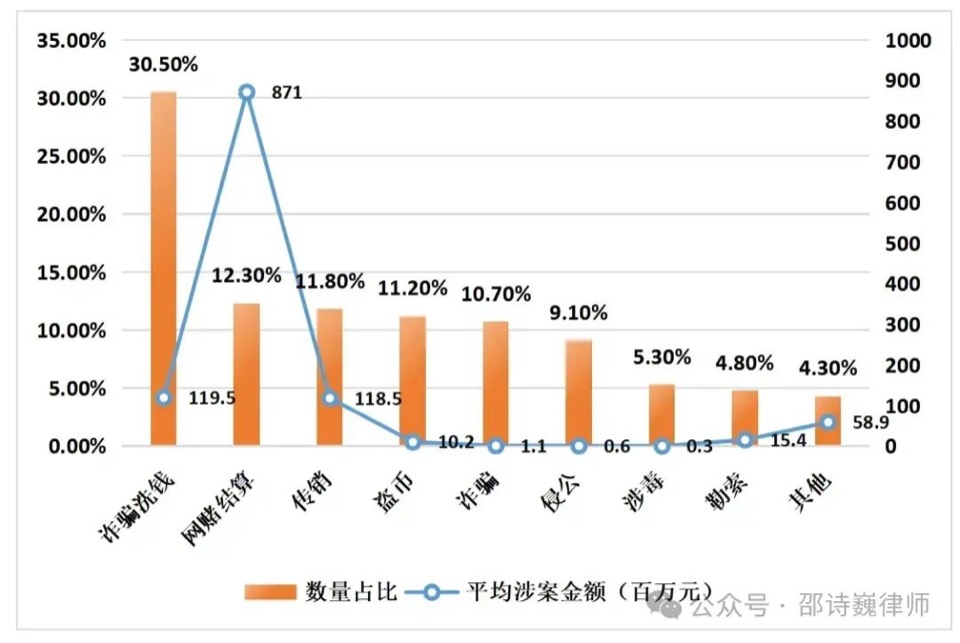
According to data from the “2022 Research Report on Trends in Blockchain and Virtual Currency Crimes” released by Zhifan Technology (see chart below), in terms of case numbers, cases in China in 2022 involving the use of virtual currencies for fraud and money laundering (referring to cases where the predicate offense was various types of online fraud) accounted for 30.5% of the total number of cases, ranking first. Other cases involved online gambling settlements, pyramid schemes, theft of crypto assets, fraud (direct fraud involving virtual currencies), infringement of citizens’ personal information, etc.
Going forward, it will become more difficult for USDT merchants (“U-shang”) to operate, and ordinary individuals who occasionally wish to sell crypto assets may also face significant legal risks.If illicit funds are received in the course of buying or selling virtual currencies, the nature of such illicit funds must be examined. If the source of the received funds falls within the seven categories of predicate offenses stipulated in the crime of money laundering, it constitutes the crime of money laundering. If the source of the received funds falls within other crimes outside the seven categories of predicate offenses stipulated in the crime of money laundering, it constitutes the crime of concealing or disguising criminal proceeds.
As can be seen from the interpretation of the provisions above, if illicit funds are received during the process of virtual currency trading, it may simultaneously involve suspicion of the crime of money laundering and the crime of concealing or disguising criminal proceeds. After the implementation of the Interpretation, the perpetrator will be convicted under the crime of money laundering, which carries heavier statutory penalties.
03
Two examples are provided to illustrate conviction scenarios
This brings to mind a previously observed case where a female master’s degree holder was convicted of the crime of concealing or disguising criminal proceeds for selling USDT. This was a case adjudicated by a court in Inner Mongolia in 2023 ((2023) Nei 0602 Xing Chu No. 203).
In 2022, Xu, a master’s graduate, sold Tether (USDT) worth RMB 200,000 (approximately 27,000 USDT) to others to earn the price difference. Upon receiving payment into her bank account, she immediately withdrew cash from the bank counter. Judicial investigations confirmed that over RMB 99,000 of the funds were proceeds from telecommunications fraud. Although she pleaded not guilty, the court ultimately found Xu guilty ofthe crime of concealing or disguising criminal proceeds, and sentenced her to one year of fixed-term imprisonment.
The above is a case where trading in virtual currencies constituted the crime of concealing or disguising criminal proceeds. Under what circumstances would selling USDT constitute the crime of money laundering?
Wang was the general manager of a state-owned enterprise. He utilized his position to provide assistance to XX Company in signing sales contracts and settling funds, and received RMB 2 million in cash from the legal representative of XX Company. To better conceal the assets, Wang arranged for someone to exchange the cash for USDT.
In this case, Wang’s act of utilizing his position to provide assistance to others and accepting money from them constituted the crime of bribery. Subsequently exchanging the illicit funds for virtual currencies constituted the crime of money laundering. Therefore, he should be punished for boththe crime of bribery and the crime of money laundering (self-money laundering). If the USDT merchant (“U-shang”) trading with Wang knew or should have known that the funds provided by Wang were proceeds from bribery, the USDT merchant would also constitutethe crime of money laundering (third-party money laundering)。
04
Concluding Remarks
According to introductions at the press conference held by the “Two Highs” on August 19, since the Supreme People’s Procuratorate deployed and advanced anti-money laundering work in 2020, nationwide procuratorial organs have implemented effective anti-money laundering measures with significant results. In 2023, a total of 2,971 individuals were prosecuted for the crime of money laundering,nearly 20 times the number of individuals prosecuted for the crime of money laundering in 2019. In the first half of 2024, 1,391 individuals were prosecuted for the crime of money laundering,a year-on-year increase of 28.4%, indicating a continued intensification of crackdowns on money laundering crimes[1]。
The release of the Interpretation signifies that China has adopted stricter measures in combating money laundering crimes and has included virtual currency trading within the scope of regulation and legal governance. The release of the Interpretation serves as a reminder to USDT merchants (“U-shang”) and ordinary individuals to exercise greater caution in virtual currency transactions, ensure the legality of transactions, and avoid unintentionally participating in illegal activities such as money laundering.

[1] The “Two Highs” Jointly Release the “Interpretation on Several Issues Concerning the Application of Law in Handling Criminal Cases of Money Laundering” https://mp.weixin.qq.com/s/sED93XLSObKCkacTQmpZ_g
Recommended Reading
Major Revision of the Anti-Money Laundering Law: How Should Web3 Entrepreneurs Respond?