
Suppose you are an enterprise doing overseas business. The product price has already been negotiated and the contract is ready to be signed, when the customer raises one final request: “Can this payment be made in USDT?”
The business staff think it is fine—the customer is willing to pay, and the order has a chance of closing. Finance, however, is somewhat troubled: the company ordinarily receives US dollars and euros, so where would stablecoins be received, how would they be booked, and how would suppliers be paid? The boss's concern is more direct: with the Chinese mainland's strict regulation of virtual currency, can this money be received at all?
Similar confusion also arises in cross-border e-commerce, software subscriptions, overseas game publishing and other service businesses targeting overseas customers.
The conclusion first: for an overseas operating entity that meets local legal and service-access requirements, stablecoin payment can be a collection option. However, a mainland company directly receiving coins, an overseas company receiving coins, and a customer paying in coins while the merchant receives fiat currency are three arrangements that must be analyzed separately.
There is also a fact that many enterprises have not yet learned: licensed institutions providing relevant services already exist overseas; they can process a customer's stablecoin payment and settle fiat currency to eligible merchants. An enterprise does not necessarily need to manage a wallet itself and then find someone to convert the coins into money.
Only by understanding these models can one determine which path suits one's own business.
I. First, clarify which company is actually receiving the payment
“We are a Chinese enterprise” is easy to understand in a business introduction, but it is not specific enough for legal analysis.
A company registered in Shenzhen signs an export contract in its own name and arranges for the customer to transfer USDT into a designated wallet; a Singapore company held by Chinese shareholders operates overseas business, signs contracts and receives payments in its own name. Although the boss may be the same person, the legal relationships of the two transactions are different.
In the former case, the seller and the creditor of the payment remain the mainland company. The fact that the customer is abroad, or that the wallet uses an overseas platform, does not automatically turn this collection into the business of an overseas company. Mainland virtual currency regulation, foreign exchange administration and tax and accounting treatment still need to be addressed directly.
In the latter case, it is necessary to consider the overseas company's place of operation, the customer's location, the actual business and the payment arrangements, in order to determine whether local law permits it, which steps must be completed by licensed institutions, and what requirements are triggered by the connection with the mainland. The identity of the Chinese shareholder alone is not sufficient to conclude that the overseas company cannot use lawful local payment services.
However, registering an overseas company also cannot simply give the original transaction a different name. Where the contract is signed by the mainland company and the payment belongs to the mainland company, while the overseas company merely provides an account for receiving coins, this is clearly different from the overseas company actually purchasing, selling and earning its own operating revenue.
The starting point for the assessment is the seller, the payee and the actual business arrangements in the specific transaction. Where the account is opened is only one factor.
II. The mainland regulatory boundary cannot be circumvented by relying on “genuine trade” or “US dollar stablecoins”
To discuss this issue, a legal background update is first required.
The Notice Yin Fa [2026] No. 42, issued on February 6, 2026, has replaced the 2021 “Notice 924.” The new Notice continues the regulatory position that virtual currency may not be circulated or used as currency, prohibits relevant domestic exchange and other business activities, and expressly provides that overseas entities and individuals may not unlawfully provide virtual-currency-related services to domestic entities.
Therefore, the statement “we sell genuine goods and do not speculate in coins” is not sufficient to answer whether receipt of payment is lawful. A genuine trade background must coexist with compliant payment methods. Based on the above rules, I do not recommend treating direct receipt of stablecoins by a mainland company and subsequent self-arranged exchange as a standard compliant foreign-trade payment solution.
Another misconception is to treat US dollar stablecoins directly as US dollars. USDT and USDC aim to maintain a value peg to the US dollar, but tokens in a company wallet and US dollar deposits in a bank account are not the same type of asset. Receiving stablecoins also cannot be directly equated with completing US dollar foreign exchange receipt.
A further distinction must be drawn between using payment tools and conducting financial business. The nature of the business differs between an overseas merchant receiving consideration for goods it sells itself and collecting, exchanging or transferring funds on behalf of other merchants. If an e-commerce platform further handles funds of merchants on its platform, the regulation of payment or other financial services must be analyzed separately, and the conclusions applicable to a self-operating merchant cannot be applied by rote.
The new Notice also imposes specific restrictions on domestic entities and overseas entities controlled by them issuing virtual currency overseas. Issuance and receipt of payment should be assessed separately: rules on issuance cannot be directly applied as a blanket prohibition on all overseas receipt of payment, nor can receipt-of-payment scenarios be expanded to mean that one may issue coins oneself.
For enterprises, an accurate understanding of the boundaryrequires avoiding both an underestimation of mainland restrictions and a rejection of all overseas payment options merely on the basis of the words “Chinese shareholder”。
III. Where customers pay in stablecoins, enterprises can receive fiat currency
When many enterprises consider receiving payment in stablecoins, only one path comes to mind: the company opens a wallet, the customer sends coins, and the finance team then finds a channel to sell them.
For overseas business permitted by local law, direct receipt of crypto assets is a model that requires assessment. It also means the enterprise must assume corresponding asset management responsibilities: how wallet permissions are allocated, whether the receiving network is correct, how the assets received are converted, and how to handle a stablecoin depeg or a frozen address. An enterprise cannot simply assign one employee to keep the wallet password and consider the payment collection process established.
Another model is closer to the payment services merchants are familiar with: the customer selects a stablecoin on the payment page, a third-party payment institution is responsible for receiving, processing and converting it, and the merchant receives fiat currency settlement funds as agreed.
Overseas customer pays in stablecoin → payment institution processes the payment and conversion → overseas merchant receives fiat currency settlement funds.
This model already has actual products. For example, the Singapore payment institution TripleA provides crypto payment services for e-commerce websites, applications and offline merchants, and also supports enterprises in initiating payment collection from customers through invoices. Customers pay using supported cryptocurrencies, and merchants may choose fiat currency settlement. For enterprises that wish to accept stablecoin payments but do not want to hold crypto assets themselves, such services offer an option for assessment. Whether a specific account can be opened still depends on the enterprise's location, business type and the institution's review results. TripleA official service description
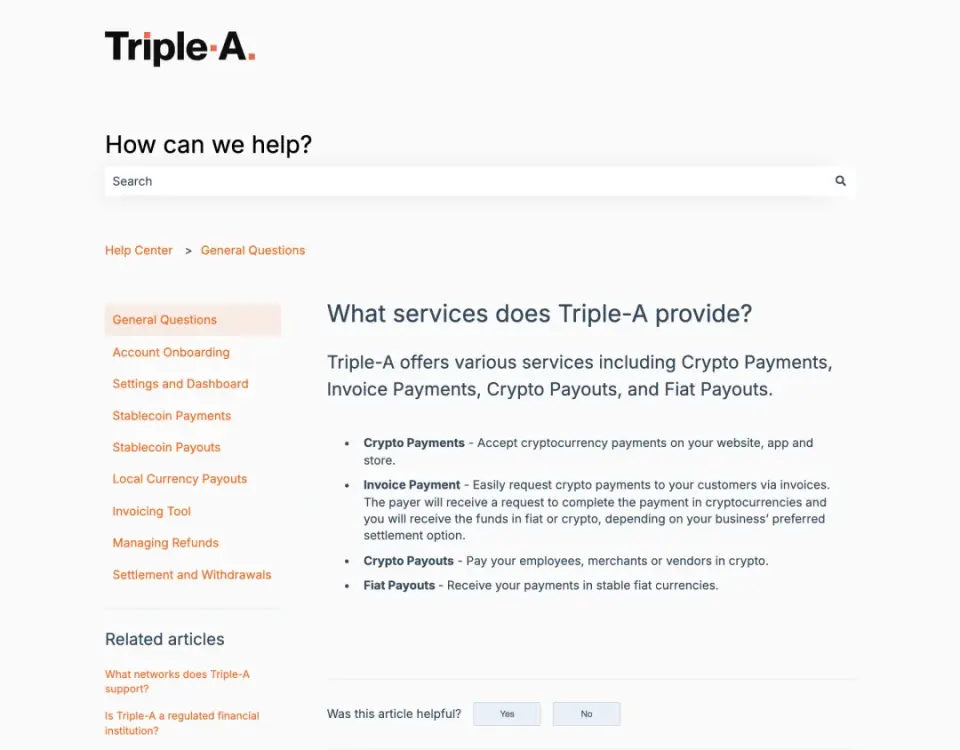
Figure: TripleA official service description. Merchants may choose fiat currency settlement according to the applicable services; specific eligibility conditions are subject to the institution's review and the service agreement.
For merchants, the value of such services is very concrete: it gives customers one more payment option while reducing the burden on the enterprise of safekeeping and converting crypto assets itself.
For enterprises, whether such services can be used can first be approached through a basic judgment:A company actually operating overseas business may use such services to collect payment for its own goods or services where the laws of the relevant region permit it, the payment institution's license and scope of services cover that business, and merchant review has been completed.
For example, a Singapore company established by a Chinese enterprise that sells goods or provides software services to overseas customers in its own name and wishes to have a payment institution process customers' stablecoin payments and settle fiat currency to the company may assess onboarding through this path. When opening the account, it should truthfully submit company, shareholder and business information, confirm that the customer region, the goods or services sold and the payment currency are within the supported scope, and agree on settlement to the company's account; during operations, it should continue to cooperate with transaction verification, retain order, delivery and settlement records, and handle accounting and tax matters in accordance with law. Approval by the institution is a condition for onboarding, and the enterprise must still continuously comply with applicable rules.
If the party signing the sales contract and receiving the payment is still a mainland company, the above model for overseas merchants cannot be directly applied.Borrowing an overseas account, or having an institution first receive crypto assets and then remit US dollars, does not automatically resolve mainland regulatory issues. Likewise, being permitted to collect payment for one's own business does not mean one may collect, convert or remit payment on behalf of other enterprises. Using the service for genuine business that has been reviewed is the basic boundary for using such payment tools.
For e-commerce and service enterprises, refund arrangements should likewise be clarified in advance. When goods are returned or services are cancelled, whether the refund is in fiat currency or stablecoin, and the point in time at which the amount is calculated, both affect actual costs. The difficulty of reversing on-chain transfers does not automatically eliminate the refund liability for the goods and services themselves.
IV. Licensed institutions do exist offshore, but it is necessary to examine what the licence covers
When selecting such services, enterprises should, in addition to confirming that the counterparty holds a licence, also verify whether the business activities it is authorised to conduct cover their own collection arrangements.
Taking TripleA, mentioned above, as an example, the institution directory of the Monetary Authority of Singapore (MAS) lists, under its major payment institution licence, merchant acquisition, digital payment token services, domestic money transfer and cross-border money transfer, among other business activities. The reason for examining these specific items is that "customers pay in stablecoins and the enterprise receives fiat currency" may involve different stages such as merchant collection, stablecoin conversion and fiat currency remittance.Merely seeing the licence name "major payment institution" is not sufficient to determine whether the entire set of services actually provided falls within the scope of the licence.
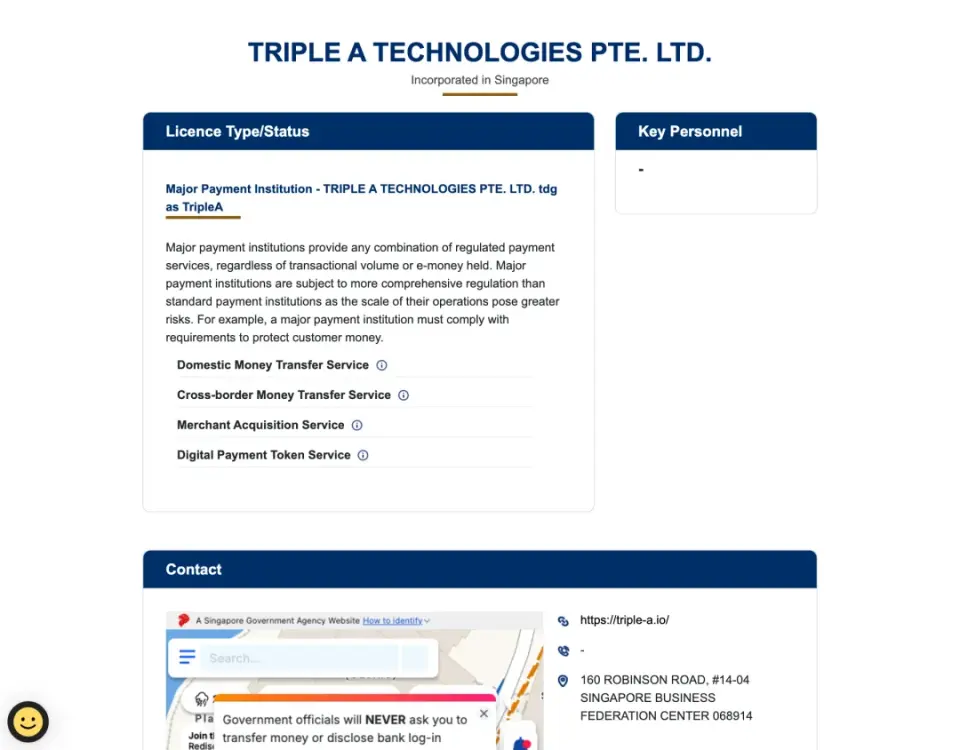
Figure: The licensed business activities of TripleA in the MAS directory of Singapore. Enterprises should verify the specific business items rather than looking only at the licence name.
When it comes to selecting a service provider, enterprises can verify from three aspects: the contracting entity, the specific services and the applicable regions.
First, the actual contracting entity must be verified. Some brands have multiple companies under them; the website may display the licence of Company A, while the contract is signed by Company B. Different entities may divide work and cooperate, but which segment of the service each company undertakes and on the basis of what qualifications it operates should be reflected in the contract and business arrangements.
Second, the actual services should be matched to the authorised business activities. Who receives the customers' stablecoins, who completes the conversion, and who remits the fiat currency into the enterprise's account should be clearly explained by the service provider. Where cooperating institutions are involved, the stages and qualifications each undertakes should also be specified; a single licence of one company cannot be used to cover the entire collection chain.
"Registration" and "licensing" must not be conflated either. FinCEN of the United States has specifically reminded that MSB registration is not equivalent to an operating licence, nor does it constitute a government endorsement of an institution's legitimacy or business. When enterprises see promotions such as "US MSB licence, globally compliant collection", they should further verify the actual scope of authority.
Finally, it is also necessary to confirm whether the service applies to one's own company, customer regions and industry. The lawful registration of an offshore company does not mean that all payment institutions will accept it; the fact that a certain region permits the relevant business does not mean that all stablecoins can be used for payment for local goods and services.
I would further recommend that, before signing, enterprises require the institution to specify the settlement currency, fees, conditions for receipt of funds and arrangements for handling freezes, and to confirm that payment and settlement records corresponding to orders can be obtained. A licensed institution can undertake the professional stages, but it will not eliminate all of the enterprise's responsibilities regarding commodity transactions, taxation or the source of funds.
V. Receiving funds offshore and remitting funds back into mainland China need to be handled separately
When the collection structure reaches this point, finance teams usually also care about the next step: can the funds received overseas be used to pay domestic suppliers, or be remitted back to China?
The analysis must begin with who owns the funds and why the payment is made.
Assume an offshore company actually operates an overseas sales business, receives fiat currency income through a payment institution that meets the applicable requirements, and then pays purchase price to a mainland factory. What must be examined here is the authenticity and legality of the overseas sales, the domestic procurement and the corresponding fund flow chain, as well as whether the bank can accept the corresponding settlement arrangement. The specific analysis cannot be omitted merely because upstream consumers have used stablecoins, nor can the front-end arrangement be treated as requiring no explanation merely because the final remittance is in US dollars.
If the offshore company distributes profits to domestic shareholders, the matter should be handled according to the legal relationship of dividend distribution, in light of the applicable company, tax and foreign exchange requirements. It has a different basis from payment of purchase price, and the payment label must not be arbitrarily changed simply to facilitate receipt of funds.
Conversely, if the income originally belongs to a mainland company and is merely collected through an offshore company or an individual's wallet, it cannot be directly recorded as the offshore company's own operating revenue. The collection tool cannot change the ownership of rights in the transaction itself.
The State foreign exchange administration rules require that foreign exchange receipts and payments for trade in goods have an authentic and lawful underlying transaction, and banks must also perform corresponding due diligence and anti-money laundering obligations. Therefore, contracts, orders, logistics or service delivery records, and settlement statements from the payment institution should together be able to explain the payment.
The fact that the actual remitter is a payment institution rather than the contractual buyer does not necessarily mean the transaction is problematic, but it needs to be supported by the corresponding collection-on-behalf and settlement relationship and records. Where stablecoin handling is involved, the relevant chain should also be truthfully explained, and the applicable requirements should be discussed with the handling bank in advance. A bank's willingness to accept the payment still cannot replace the assessment of the legality of the entire arrangement.
In particular, private currency exchange, domestic-foreign offsetting or fictitious trade should not be packaged as a collection structure.These arrangements may give rise to risks such as illegal foreign exchange and money laundering. The existence of genuine orders does not provide a lawful basis for all methods of handling funds.
Accounting should likewise keep pace with the business. Where an enterprise directly receives stablecoins and subsequently converts them into fiat currency, it needs to account for the corresponding assets and transactions under the applicable standards; where an enterprise receives fiat settlement funds, it also needs to reconcile sales revenue, fees and the net amount received. The fact that income is held in an offshore wallet or on a payment platform does not mean the accounting and tax treatment it should receive can be ignored.
VI. Lawyer's Summary
For Chinese enterprises conducting overseas business, receiving payments in stablecoins overseas requires a judgment based on the specific business. A mainland company directly receiving stablecoins, an offshore company established by a Chinese enterprise receiving payments, and a customer paying in stablecoins while the merchant receives fiat currency through a payment institution involve different legal relationships and cannot be summed up with a single "permitted" or "not permitted."
Many institutions providing stablecoin payment and fiat settlement services have already emerged in overseas markets. For overseas operating entities that meet local legal and institutional access requirements, these services offer new collection options and can also reduce the burden on enterprises of managing wallets themselves and holding and exchanging crypto assets. However, the scope of a payment institution's license, the actual service recipients, and the fund settlement arrangements still need to match the enterprise's business.
Enterprises can actively learn about these payment tools and incorporate them into the assessment of collection solutions for overseas business. When implementing specific arrangements, only by properly connecting the collection entity, payment chain, tax and financial treatment, and use of funds can the new payment methods truly serve order completion and day-to-day operations.
The rules and product information cited in this article were verified as of September 21, 2026. The third-party payment institution cases are used to illustrate business models and do not constitute a recommendation of any specific service.

