

Binance's stablecoin yield campaigns over the past two days are indeed eye-catching.
For flexible USDC, the maximum annualized yield is approximately 11.5%. Eligible high-tier VIP users who deposit 300,000 USDC can, based on the campaign's methodology, earn approximately 1,796 USDC in yield. At the same time, flexible USDT, RWUSD and BFUSD are also offering boosted rates, and several products can be participated in simultaneously.
USDC and USDT are both commonly used U.S. dollar stablecoins in the market; ordinarily, holding them is simply a matter of waiting to buy coins or preparing for transfers and settlement. Now, without having to guess whether Bitcoin will rise or fall, users can see double-digit annualized yields simply by depositing their coins on the exchange, so the appeal is easy to understand.
Seeing these figures, one cannot help but do the math: having paid out so much interest, where does it plan to earn this back from in the future?
Looking at Binance's products alongside those of other virtual currency exchanges, it becomes clear that everyone is already competing seriously for the funds users do not currently intend to trade.
With an 11.5% annualized yield, how much does the platform actually have to spend?
When people see high interest rates, their first reaction is often: how can the platform afford such high yields?
The answer lies first in the quotas that differ according to the treatment of different users.
In Binance's current USDC rate boost, the quota for ordinary users starts at 10,000 coins; once wealth-management holdings reach a certain threshold, the quota increases to 30,000 coins. Only at higher VIP tiers does the boosted-rate quota gradually expand to 200,000 or 300,000 coins. For USDT, which is also part of the campaign, the combined annualized yield is approximately 11%, yet the boosted-rate scope covers only the first 1,000 coins.
For 1,000 USDT, based on the campaign's displayed methodology, the yield during the campaign period is approximately 5.7 coins. The high annualized yield figures on the poster are striking, but in reality the cost the exchange actually bears for a small-amount user is quite limited.
At the 300,000 USDC tier, of the total annualized yield of approximately 11.5%, approximately 3% is the real-time yield at the time, while the other 8.5% is a limited-time rate boost. Calculated on the same basis, of the total yield of approximately 1,796 USDC, the additional rate boost contributes approximately 1,327 USDC.
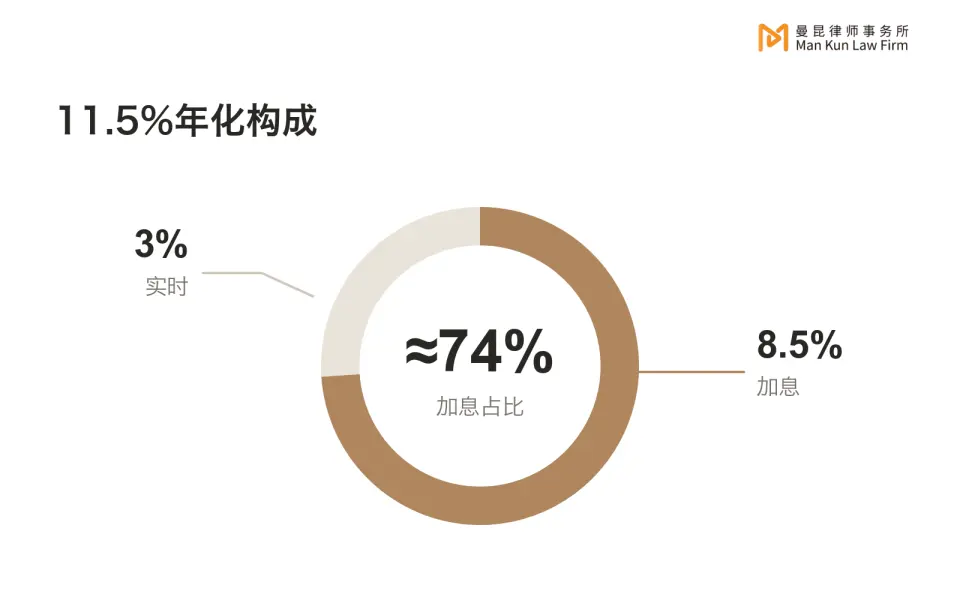
The platform is putting up this additional reward precisely in the hope that the 300,000 USDC will remain deposited there during the campaign period.
OKX, Binance's long-time rival, has adopted the same approach. Its Simple Earn page displays a 10% reward APR for USDT and USDC, but the corresponding individual quota for each is 500 tokens.
Term, quota, membership tier and total reward pool confine this promotional expenditure within the exchange's controllable marketing costs. Once the platform has calculated how many people to subsidize and how much each person receives, it can control its expenditure.
Small incentives encourage more people to try, while higher quotas are used to attract major clients.
Only when the money stays does the subsequent business have a chance to occur
Only by keeping the money on the exchange does the user's next trade have a chance of occurring there.
When a user sells Bitcoin and receives 100,000 USDT, they may subsequently withdraw the money or leave it on the platform awaiting the next trading opportunity. If this money never earns any return, the user has all the more reason to move to another platform. By offering a small return, the exchange gives the user no need to decide for the moment what to buy next, and the user is willing to keep the money there.
When market conditions change, the money is already in the account, making it convenient for the user to resume trading. The platform has an opportunity to collect trading fees; if the user further uses lending, margin and other services, new business will arise. In assessing whether this subsidy is worthwhile, the platform will also consider whether the user's future fees and lending income can cover the cost of attracting and retaining these funds.
For clients with substantial assets and frequent trading, the platform is naturally more willing to grant a somewhat higher interest-boost quota. Only by retaining this principal under wealth management does it have a better chance of continuing to do business with the client. As long as the subsequent income exceeds the subsidy and servicing costs, the expenditure is worthwhile.
Binance's interest-boost campaign also occurred during the days following a security incident, when withdrawals were being restored and users were reallocating their funds.
Binance began restoring withdrawals in stages on November 1. According to data subsequently disclosed by the platform, during the initial restoration period it processed withdrawals equivalent to USD 4.649 billion while receiving deposits equivalent to USD 1.01 billion, a net outflow of approximately USD 3.64 billion. Binance stated that withdrawal demand initially increased markedly and later gradually subsided, while deposits remained substantial. It also undertook to bear the losses arising from the stolen assets, but once withdrawals were restored, users could at last decide anew whether to keep their money there.
At the same time, peer exchanges were also receiving funds. The Block, citing a set of 24-hour statistics as of the early hours of November 2 Beijing time, reported that ten other relatively large exchanges tracked by DeFiLlama recorded aggregate net inflows of approximately USD 368 million. These inflows cannot all be attributed to funds transferred by Binance customers, but customers now had the opportunity to reselect platforms and reallocate their assets. To retain them, Binance had to give them a reason to stay.
During the same period, Binance also offered eligible users 30-day VIP tier protection, allowing them to retain their corresponding tier even if they temporarily failed to meet the usual asset or trading requirements. In my view, both arrangements were intended to stabilize existing customers so that, after services were restored, they would still be willing to continue using Binance.
Who actually pays the interest users receive?
The boosted yields in exchange promotional campaigns are time-limited. But the returns that exchanges routinely pay users must still be funded by ongoing revenue.
Some platforms pay returns from lending and other business lines, while others use their own revenue to reward users.
Take OKX's Simple Earn flexible product as an example. The official description states that users' assets are lent to users of flexible lending and leveraged trading. When someone wants to borrow stablecoins for trading and is willing to pay borrowing interest, those who lend the funds have a source of return, and the platform charges a service fee from it.
When more people borrow and demand for funds is strong, lending returns may rise; when fewer people borrow, returns may fall. What users see is a flexible product, but behind it people are actually borrowing, using collateral and bearing trading risk. The returns on this type of stablecoin wealth management product are directly tied to financing demand in the crypto market.
Another approach can be seen at Coinbase. It describes USDC rewards as a loyalty program funded by the platform, and expressly states that it will not use or lend users' USDC without user instructions. To understand this reward, one must look further to Circle, the issuer of USDC.
After Circle issues the stablecoin USDC, Circle holds the corresponding reserve assets, and the reserves generate income. To encourage exchanges, wallets and other partners to promote and use USDC, Circle in turn shares economic benefits with channels. Exchanges, as core channels, earn income from the use and distribution of stablecoins and then decide how much to allocate to reward users.
Circle disclosed in October this year that of approximately USD 1.4 billion in revenue in the first half of 2026, approximately USD 819 million was used for distribution partners and transaction costs.
A study published by the Bank for International Settlements in June this year also distinguishes exchanges providing returns to stablecoin holders into two models: reliance on market activity income and reliance on reserve asset income. In reality, the two can coexist.
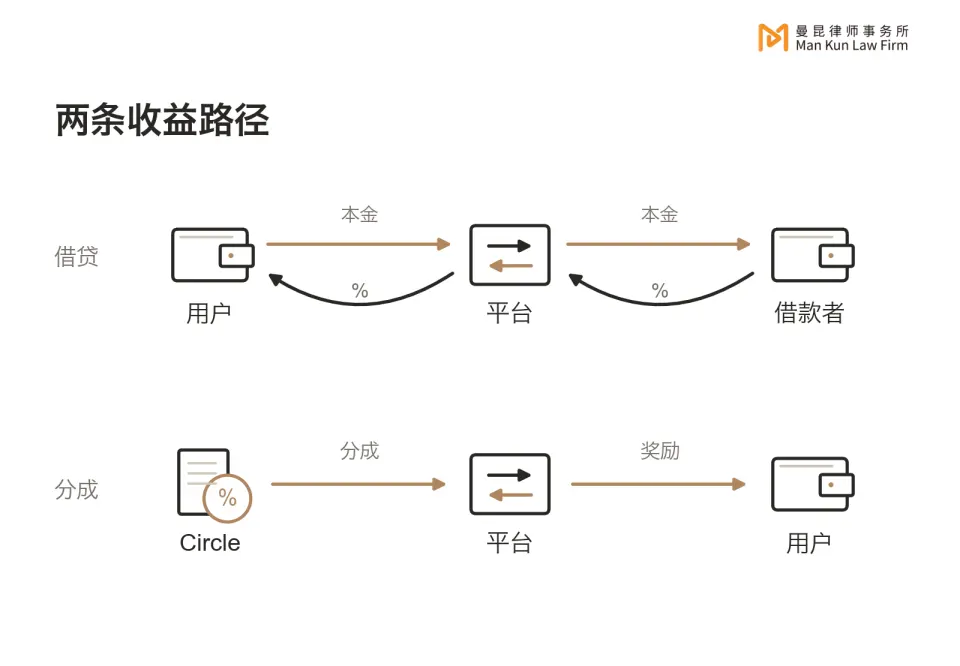
Returning to the Binance campaign mentioned at the beginning of the article, USDC can earn boosted interest of up to 300,000 units, while USDT only 1,000 units. To obtain more rewards, users naturally choose to convert their USDT into USDC. The exchange retains the funds, and the issuer gains more users holding and using its stablecoin, increasing the opportunities for it to be used in subsequent transactions.
Users may only click once to convert or subscribe, but behind it lie the separate commercial calculations of the platform and the issuer.
Both are wealth management returns, but the rights purchased are different
This campaign grouped together several products with annualized yields all around 10% and similar names. When users choose among them, they can easily focus first on which one pays more. However, the nature of the products and the legal relationships involved are not the same. What is held after subscription and how it can be recovered later both depend on the specific arrangements.
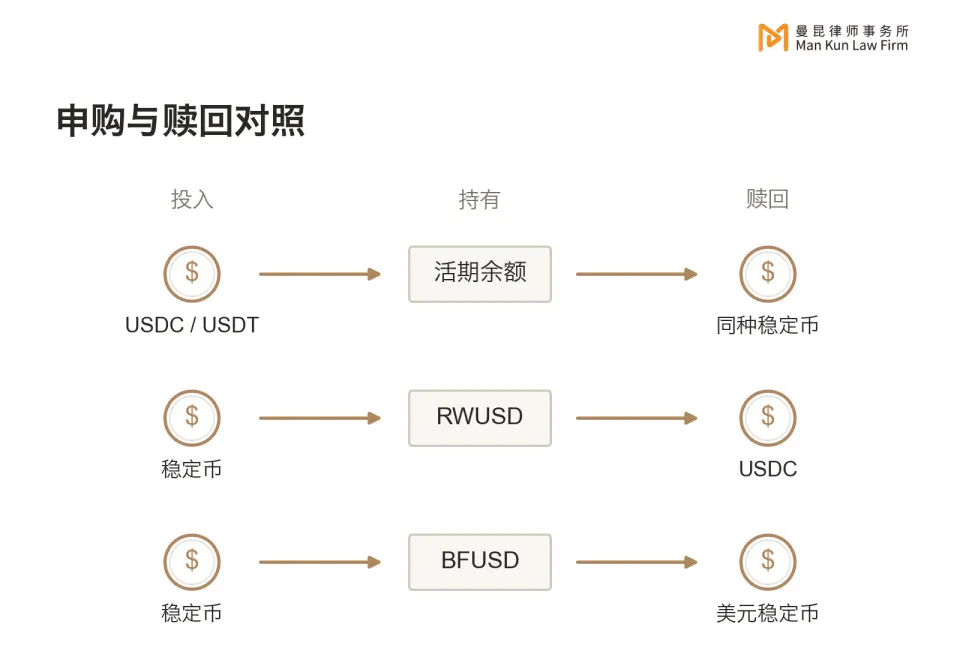
Take USDC and USDT demand products as an example. Users put existing stablecoins into the wealth management product, and the platform returns the same type and quantity of coins under the terms and pays the corresponding yield. Binance's Simple Earn terms expressly state that subscribed assets are not segregated separately, may be commingled with other customers' assets and the platform's assets, and may be used to lend to other users. This goes beyond a mere custody arrangement. Whether users can recover their assets on time depends on the platform performing the agreement.
RWUSD is a yield product offered by Binance. According to the official description, its yield may be supported by strategies such as tokenized U.S. Treasury bonds and platform ecosystem revenue, and upon successful redemption it is converted one-to-one into USDC. The official description also expressly states that RWUSD is not a stablecoin, and holders do not thereby acquire a claim against the relevant real-world assets, underlying securities or other financial instruments.
You subscribe through Binance, and when redeeming you also go to Binance. Even if Binance uses assets such as Treasury bonds to support the yield, you have not thereby purchased Treasury bonds. If redemption problems arise in the future, you must still seek resolution from Binance under the product terms and cannot directly demand payment from the U.S. Department of the Treasury or the underlying fund.
BFUSD, by contrast, is a yield-bearing asset offered by Binance and is also not an ordinary stablecoin. Upon redemption it is converted back into a supported U.S. dollar stablecoin under the platform's rules. Its yield mainly comes from spot and futures hedging and crypto asset staking. According to Binance's description, the platform holds spot assets on one side while holding opposite positions in the futures market, seeking to minimize the impact of price fluctuations, and then earns yield from the funding fees periodically paid by both long and short parties in the futures market.
Hedging reduces some price risk, but funding fees and yields will still change, and positions require ongoing management. Binance's BFUSD risk disclosure states that rewards may be zero and that in extreme circumstances redemption may be delayed; if the platform becomes insolvent or its operations fail, users may also be unable to redeem. Money originally intended for payments may not be transferred out on time if the platform suspends services or the product restricts redemption.
OKX's demand products have also warned that if all funds in a particular coin's pool are lent out, redemption may be temporarily restricted. The money has already been lent to others, and when many people seek redemption at the same time, the platform must arrange for funds to return. Even if the product is called demand, how quickly money can be obtained still depends on the specific terms and how much funds the platform can mobilize at the time.
This is especially important for those who genuinely use stablecoins for settlement. If money intended to pay suppliers or salaries still has to wait for redemption or for withdrawals to resume, the extra yield earned may not cover the loss from missing a payment. Before deciding how much to put in, thinking clearly about when the money must be used is more meaningful than comparing annualized yields to the decimal point.
Compliance points for promoting stablecoin wealth management
For well-known reasons, mainland China does not permit this type of virtual currency financial business. Binance's campaign also has regional restrictions, and users in Hong Kong, Singapore and other places cannot participate. After news of high interest spreads into Chinese-language communities, some people will still be interested and want to ask friends familiar with the crypto industry. If the person asked then starts recommending products and collecting commissions, they need to consider what responsibility they bear for doing so.
The Notice on Further Preventing and Addressing Risks Relating to Virtual Currencies and Other Matters issued in February 2026 continues to expressly prohibit domestic virtual currency exchange, trading in related financial products and other business, and also expressly provides that overseas entities and individuals may not unlawfully provide related services to domestic entities. The fact that an overseas platform can offer a product in certain places does not mean a mainland team can do the same or solicit customers on its behalf within mainland China.
A community leader saw the campaign and thought there was still a spread to earn, so he asked everyone to transfer USDT to him and then pooled it into the exchange, promising investors a return. Once the money entered his account, he had to arrange both subscription and redemption, and others could only wait for him to return principal and yield. If the platform did not pay rewards as expected, or the account was restricted, investors would still come to him, and he would have to explain how the promises he had made would be fulfilled.
If he continues to solicit strangers in public community groups, repeatedly promote fixed returns, pool the tokens he collects under unified management, and then repay principal and interest himself, he may be investigated on the basis of illegal fundraising. At that point, it is not enough to explain it away by saying, "I also just put them into exchange wealth-management products." Holding tokens oneself to take part in an activity and collecting money from the public without permission while promising returns are two different things.
Summary
When the mobile internet rose, ride-hailing and food delivery used subsidies to cultivate usage habits, and stablecoin wealth-management yield boosts have a similar plan: attract funds first, then pursue subsequent revenue. Stablecoins can move between platforms, and high interest alone makes it hard to retain customers. As payment and settlement uses increase, exchanges will also have to compete with wallets and payment companies. Large platforms have funds for subsidies, while small and medium-sized service providers can also participate by relying on local channels and merchant relationships. The outcome of this subsidy war will ultimately depend on who can turn the account balances attracted today into a business of continuous global fund flows tomorrow.
