
In mid-September 2025, just as gold prices were continuing to rise, news spread from the Shenzhen Shuibei International Jewelry Trading Center (hereinafter "Shuibei"), the country's largest gold and jewelry distribution hub, that several gold raw material suppliers (hereinafter "material suppliers") had absconded. This was the inevitable result of the gold industry's rapid expansion and the growing popularity of the "gold pre-pricing" trading model.
When upstream material suppliers, tempted by profit, turned the trading of physical gold into a financial game, everyone from physical gold merchants to ordinary consumers could end up losers in a high-stakes gamble.
Reporter | Wang Yiran
Editor | Xu Jingjing
The Vanished Gold
On September 10, Liu Lin, a gold merchant in Shuibei, Shenzhen, was somewhat busy. Domestic gold prices had seen a wave of increases, and that very day a client from Fujian wanted to send in more than 1,000 grams of gold jewelry for recycling. She contacted Rongtong Jin, a large material supplier with whom she often cooperated, but the other party's customer service did not reply in time. The client, worried that prices would fall, kept urging her to "lock in the price" quickly. She hurriedly turned to another cooperating material supplier, Yuebaoxin, locked in a price of 825 yuan per gram, and paid a deposit of 20,000 yuan.
Doing business in gold, one cannot avoid material suppliers.There are mainly two types of situations in which Liu Lin deals with material suppliers. In one, the material supplier is responsible for purchasing gold plates from the upstream Shanghai Gold Exchange (hereinafter "SGE"), and Liu Lin takes the material from them, finds a factory to process it, and then retails it to clients. The other is old gold recycling. The gold collected also needs to be sent through material suppliers to a refining plant in Shanghai for refining before it can be converted into money or new gold plates.
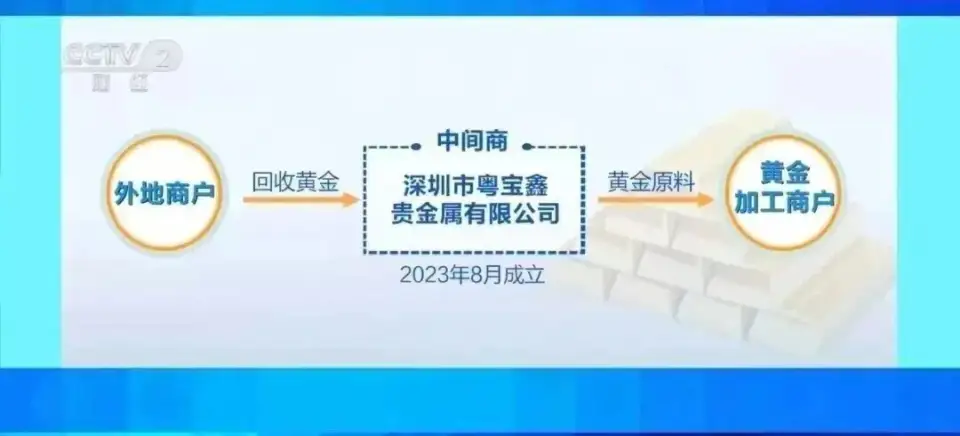
Image source: screenshot of a CCTV Finance report
Two days later, Liu Lin delivered the more than 1,000 grams of gold sent by the client to Yuebaoxin. In the past, after the material supplier tested the purity, payment would be made the same day, but that evening, the other party's customer service told Liu Lin that gold was now surging, too many people were coming to sell gold, and funds were temporarily unable to turn over, so they would transfer the money to her tomorrow. Liu Lin did not take it to heart; next-day payment was quite common in Shuibei, and moreover, at 12 noon that very day, she had just delivered a diamond-inlaid necklace weighing a dozen or so grams in gold to Yuebaoxin, and by just after 2 p.m. she had received more than 7,000 yuan in payment.
But by the next day, the payment still had not arrived. In the afternoon, Liu Lin felt a bit panicked and prepared to go to Yuebaoxin to ask about it; if the payment could not be recovered, she would take the material back first. Unexpectedly, as soon as she arrived at Yuebaoxin she saw police, the company's main door was closed, and the police were preparing to affix seals. Liu Lin was stunned.
Liu Lin had originally run a cake shop in her hometown in Fujian. After the COVID-19 pandemic, her shop could not stay open, so she went to Shenzhen to make a living. Once, she went to Shuibei to buy gold for her boyfriend and immediately saw an opportunity: people in her hometown were generally keen on buying gold, and the gold here was of high purity and also cheap. She started trying her hand at purchasing on behalf of others through her own social circle, and business grew more and more prosperous. In March last year, she took over her own counter in Shuibei.
The gold and jewelry business runs on credit, and the material suppliers Liu Lin worked with were all recommended by friends.Material suppliers come in different tiers. Well-capitalized suppliers handle large volumes and can register and open accounts directly with the Shanghai Gold Exchange to become member units. Some smaller suppliers survive by attaching themselves to larger ones, attracting gold merchants with lower deductions and better services (such as delivery included and faster settlement). A company like Yuebaoxin cannot be found in the Shanghai Gold Exchange's official member directory, and it has larger suppliers upstream.
Looking back on the whole course of events, Liu Lin only wished she had "kept one more thing in mind." She had always been careful and prudent in business. Some merchants who were bullish on the market would regularly stockpile gold to profit from price differences, but she worried about risk and never stockpiled; selling gold earned her only a 10 yuan per gram processing fee, and buying back gold earned her only a 5 yuan per gram price spread—she made her hard-earned money steadily.
But which material supplier to work with is sometimes not up to the merchant."We also know that the bigger the material supplier, the more reliable it surely is, and I would like to go to Rongtongjin too. But big enterprises have high thresholds—they say right away that transactions start at one jin, and even if you really scrape together one jin of gold, they may not necessarily sell to you," said gold merchant Sun Zhe, "because they have bigger customers they need to supply first."
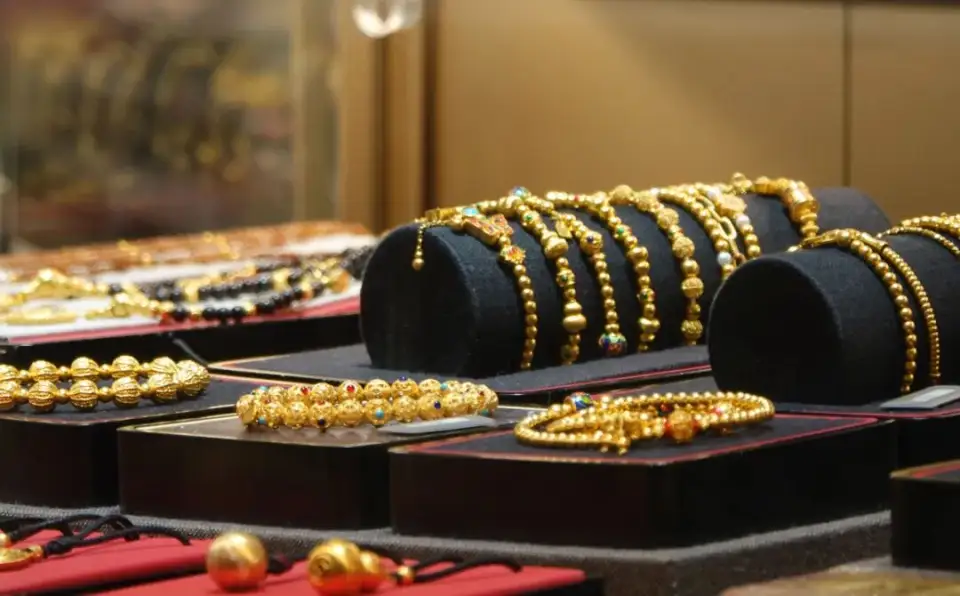
Image | Visual China
Liu Lin's shop was relatively small and likewise could not open an account with Rongtongjin.This meant that transactions with the material supplier had no one-on-one customer service group, and public customer service always replied very slowly. In the buyback business, gold prices fluctuate constantly and customers are often in a hurry to lock in a price, so it was always somewhat inconvenient.In the past two years, Liu Lin had also often heard news of small material suppliers absconding, but Yuebaoxin counted as a mid-sized material supplier in Shuibei, with a shop of one to two hundred square meters. Moreover, its customer service replied quickly, and its prices were more cost-effective than those of large material suppliers. So her cooperation with Yuebaoxin gradually increased.
In fact, several months earlier, Liu Lin had heard peers say that Yuebaoxin's payment speed had slowed, and she herself had been paid "overnight" several times, but the growing frequency instead put her off her guard. Only after the incident did she discover that the company had changed its legal representative on May 22. The order for this batch of more than 1,000 grams of gold would originally have yielded a profit of about 5,000 yuan, but the material supplier's absconding caused Liu Lin to lose more than 900,000 yuan in one blow. She could not run away; she compensated the customers, and this was almost her entire net worth.
Amid this round of gold price fluctuations, Yuebaoxin was not the only material supplier to "abscond."Sun Zhe only learned that his small material supplier, Huanqiu Jinye, had "absconded" when he was scrolling through Douyin. Fortunately, he was highly vigilant and had withdrawn the payment on his account early, leaving only a 20,000 yuan deposit. In the eyes of peers, this kind of loss "belongs to the negligible kind." When he went to report to the police, he saw that the amounts reported by other peers were almost all several hundred thousand or several million yuan.

Shenzhen, Shuibei International Jewelry Trading Center. (Photo | Visual China)
The affected merchants are not limited to those in Shuibei. Gao Long, a gold shop owner in the Daxing'anling region of Heilongjiang Province, began cooperating with Huanqiu Gold Industry three or four years ago on a friend's recommendation. Unlike the merchants in Shuibei, who generally source materials from multiple suppliers, Gao Long did not have many information channels, and after several rounds of cooperation, this materials supplier became his sole upstream source for purchasing gold sheet stock and recycling old gold.
Gao Long had never even been to Shuibei in Shenzhen, more than 3,800 kilometers away, nor had he heard the news that had gradually emerged over the years about materials suppliers absconding. What concerned him more were the immediate matters:In recent years, gold prices have fluctuated sharply, and after the initial honeymoon period, the gold business became increasingly difficult—gold prices were too high, fewer people bought gold, and nearly all the old gold that could be recycled in small counties had been collected.Shipping gold from distant Daxing'anling to Shenzhen meant that, during the mailing time lag, a drop in the gold price would result in a loss. Thus, to earn a little more profit, he began to "store materials" with the materials supplier: the recycled old gold he sent over was not settled immediately, and he would settle it gradually once the gold price rose.
When Huanqiu Gold Industry "absconded," it took with it 200 grams of gold that Gao Long had stored there. The loss of 170,000 yuan represented several years of his income. He joined a rights-protection group and found that there were seventy or eighty out-of-town merchants like him in it, with the largest losses reaching tens of millions of yuan.
A high-stakes gamble on "gold booking prices"
The exact reason for Yuebaoxin's "absconding" remains subject to investigation by the relevant authorities, but this kind of script is not unfamiliar to the people of Shuibei.Several gold industry practitioners in Shuibei recalled that over the years, materials suppliers large and small had "absconded" almost always at times when gold prices rose or fell sharply.In fact, however, gold price fluctuations themselves are not the direct cause of materials suppliers "absconding."
Zhou Qi is responsible for upstream gold risk management at a materials supplier company in Shuibei. She told this publication that under the traditional gold trading model, gold price fluctuations actually have nothing to do with either materials suppliers or gold merchants. The traditional materials supplier business is about "small profits but quick turnover," with profit coming from the price difference between selling materials and collecting and refining old gold. The company she works for is a relatively large state-owned enterprise, and its profit is only 0.8 to 1 yuan per gram of gold. To retain customers, many small materials suppliers may earn only 0.1 to 0.5 yuan per gram.
"It's getting harder and harder to make money in the materials business; too many people have come in to grab this share." Zhou Qi analyzed that as gold prices rose, more and more people came to believe that gold was a good business and began crowding into this track.As a result, there were more and more materials dealers, and operating pressure was increasing for everyone. But doing business properly by selling in volume and earning the price difference at most leads to losses or bankruptcy, whereas the 'flight wave' that has intensified in recent years is mostly related to the 'gold booking price'—a new 'way of playing' that has departed from traditional physical trading and has already become a semi-open secret in Shuibei.

Image | Visual China
The trading model of the gold booking price is essentially a futures business. Participants enter the market with a small amount of margin to trade on rises and falls in the gold price, and after paying the balance they may take delivery of physical gold or directly obtain economic profit.Gold futures are nothing new. The Shanghai Futures Exchange offers gold futures products, with two-way trading, allowing long or short positions, and physical delivery, but their entry threshold is high: capital verification is required, and participants are required to have futures trading test scores and trading experience. Their margin ratio is about 12%. Calculated at a real-time gold price of 850 yuan per gram, the margin for 1 lot (1,000 grams) of gold is about 100,000 yuan, and the round-trip fee is 20 yuan per lot. Calculated this way, the leverage (using a small amount of funds to control a large transaction) is usually around 10 times.
In Shuibei, however, the materials dealers act as market makers themselves and run 'private boards,' and the entry threshold is much lower. Sun Zhe explained that the 'market price' in Shuibei is a margin of 20,000 yuan per lot plus a management fee of 10 yuan per day, and leverage is pushed to more than 80 times. Many people, with 200,000 yuan in hand, dare to trade 10 kilograms of gold. Because leverage is so high, at current price levels, the gold price need only rise 2.3% for the 200,000 yuan principal to double, but likewise, the gold price need only fall 2.3% for the margin to be completely lost, with the entire 200,000 yuan wiped out, possibly in just a few hours.
Sun Zhe has seen too many cases of people 'playing until their families are ruined.' Many people, after losing money, do not stop but instead borrow money to continue investing. For the market makers, the private boards are unregulated and seem to offer 'profit without capital': 'You can figure it out—with such low margin, it is impossible for them to go to the formal futures market to hedge (note: for example, if a player buys long, they go to the market to buy an equivalent amount short to offset the risk). If you lose, you lose everything outright, and the money all goes to the materials dealer. If you win—Just like this time, when everyone was buying long and the gold price did indeed surge, the bullion dealers could not cover their losses and simply ran off with your principal, and you still lose everything.”
Lü Yinghui, a practicing lawyer at Mankun Law Firm (Shenzhen), has long handled criminal matters involving economic crimesand recently took on a dispute case involving gold booking prices in Shuibei. He told this publication that the concept of gold booking prices originated in Hong Kong and was initially a means used by gold merchants to hedge transaction risks arising from gold price fluctuations, rather than for "betting on gold." Shuibei adopted this model early on. The change occurred around 2022, when the "paper gold" wealth management products previously offered by major banks were successively suspended due to excessive risk.Some fervent lay investors set their sights on Shuibei's booking-price business, hoping to achieve dreams of sudden wealth through "speculating in gold," and booking prices gradually developed into today's ultra-high-leverage "betting pools."
"Shuibei's gold booking prices are now already at 'version 3.0.'" He Tingting's entire family is in the gold business. Over 20 years, she has frequently come to Shuibei and clearly seen how great the risks are.
He Tingting said that the earliest gold booking prices circulated only within a "small circle," and bullion dealers traded only with gold merchants inside Shuibei. Although there was then an element of "betting on rises and falls," the leverage was not as exaggerated as it is now. He Tingting's brother-in-law entered the market at that time; after making some money in the first year, he invested more and more, and ultimately lost RMB 10 million. By 2019, gold booking prices had expanded to gold retailers in various places. Bullion dealers would convene merchants for meetings under the guise of training in "modern sales" and "making videos," when in fact they were explaining how to "make money with money" through leverage on gold price rises and falls. Her ex-husband was called to several meetings in a row and was also "talked into" starting to play the booking-price game. In fact, even then, bullion dealers who "lost their bets" began "running off" one after another, but the scope of impact was not large.

Still from Romance in the Alley
In the second half of 2023, He Tingting discovered that the gold forward-pricing gambling operations that had gone quiet during the COVID-19 pandemic had become more brazen than ever. She observed that the number of gold material suppliers had surged since the previous year. In the Shuibei commercial district, there were suppliers on almost every floor, with four or five on the most densely packed floor. Many newly opened small suppliers took turns using the same office, and many did no physical business at all, specializing instead in "paper gold." Someone once came to her to complain after a certain supplier "ran off"; when she checked, that supplier's business license had been issued only 20 days earlier.
More and more people were drawn to this high-stakes gamble. "Many video accounts explain gold price movements convincingly, and when you contact them, they tell you how much they made buying this gold futures." This year, many clients around He Tingting came to consult her: "Do you deal in gold forward pricing? I want to buy from you." Even some friends outside the gold industry came to consult her. When she asked why they wanted to buy, they often replied: "You can buy a kilogram of gold for just 10,000 yuan." She could only "scold them and persuade as many as she could."
Long Yuanyuan, a lawyer at Rongfu Law Firm, has handled cases related to gold forward pricing since 2020. Since 2024, the number of clients coming to her for litigation has increased two- to threefold, and the client profile has shifted from being mainly gold industry practitioners to being mostly ordinary investors, who mostly buy and sell through online mini-programs or apps, with no physical trading throughout the process, and the recipients of transfers are usually neither company accounts nor the personal accounts of legal representatives, but unrelated private accounts.Most of the clients who came to her hoping to file lawsuits were those seeking to have contracts declared invalid after suffering losses, while another group consisted of those who had made profits but could not withdraw them because the bookmakers lacked the ability to pay.
In the high-stakes gamble of gold forward pricing, the cost for a supplier to "run off" is extremely low.Lü Yinghui explained that in criminal cases, the legal representative usually appears as a "scapegoat." Some companies install an unrelated person as the legal representative to preemptively avoid risk.In many cases, the legal representative's identity information is stolen, or the person has no idea what business the company is in, making it difficult to impose penalties on them. At the same time, gold, as a bearer precious metal, is more flexible than bank card funds; sometimes even if the supplier who "ran off" is found, there are no executable assets in their name, and it is difficult for victims to recover their money.
A Broken Trading Ecosystem
"In the past, contracts were replaced by personal recognition, introductions by acquaintances, and mutual trust among peers; suppliers were reliable and reputable. If a friend lacked material, material worth tens of thousands could be lent on the spot, and no one worried the other party would not repay it. But as the blow-ups occurred, all of that vanished into thin air," Sun Zhe lamented.
Sun Zhe witnessed firsthand how Shuibei transformed from a jewelry wholesale market into its current frenzied state. He came to Shuibei in 2016 to do silver jewelry. At that time, Shuibei did not yet have its current fame, and practitioners were a tight-knit group who knew each other well; without an acquaintance to bring you in, you could not enter the trade at all. When Sun Zhe first started doing gold business, no supplier was willing to supply him, all fearing that a stranger might use gold for money laundering; in the end, he only got into the trade through an introduction by a peer. Suppliers in those days were the real thing: they had physical gold reserves and gold spectrometers for testing purity.
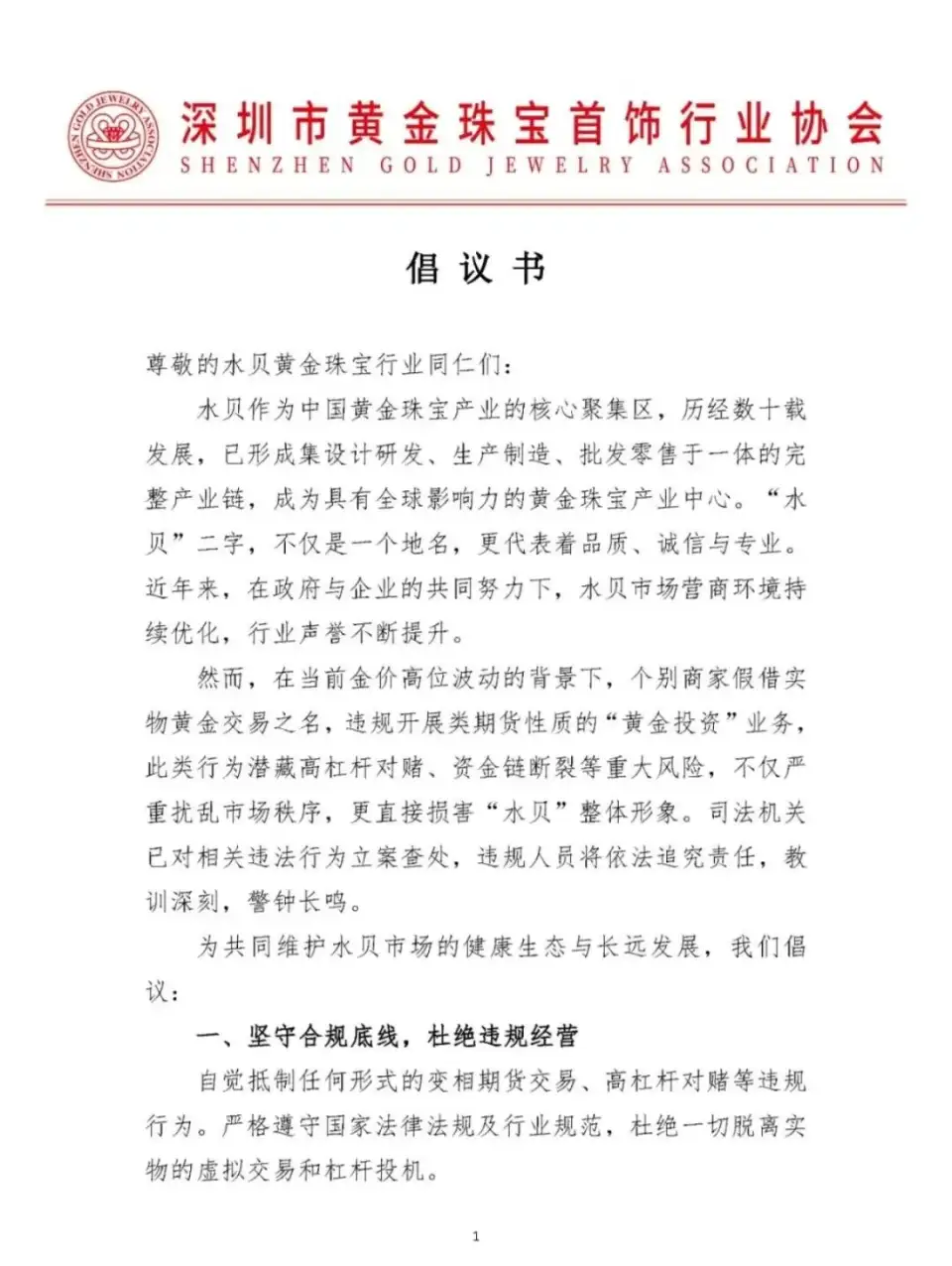
The Shenzhen Gold and Jewelry Industry Association issues a proposal
In 2021, an influencer's livestream put Shuibei on the map. Ordinary people flocked there to buy gold, and merchants who had previously dealt in silver and K-gold all switched over to the gold business, leaving the market a mix of good and bad operators. Now, Sun Zhe can be sitting at his counter when someone sends him an advertisement: "Hello boss, we are a materials dealer operating in ××, one kilogram costs only ×××, price locked for 24 hours, no management fee, just scan the QR code and submit your ID card to open an account." He once sat at his counter and casually opened two accounts in a single morning; in the past, that would have been unimaginable.
Sun Zhe remembers a merchant who looked like a legitimate materials dealer and won over many physical gold shop owners with ultra-low processing fees that appeared to be loss-making at a glance, thereby gaining their trust. After growing big and strong, that dealer suddenly told the merchants that it had launched an online recycling mini-program, where they could pay a deposit and set a price at any time, without having to wait for the materials market to open as before. This convenient method stirred the gambling instinct of some physical gold merchants, who began to speculate on gold price movements and, without realizing it, got involved in gold futures and started playing with leverage.
The allure of overnight riches is so hard to resist, whether for gold merchants or for materials dealers who had previously operated honestly.Long Yuanyuan found that some of the companies investors were suing were in fact newly registered by old materials dealers who had been in physical operations for many years, set up specifically to engage in gold advance-price trading. This left some gold merchants who did business honestly caught between a rock and a hard place.
Yao Meiyun is one of them. She came to Shuibei in 2013 right after graduating from university, and worked her way up from an employee at a gold company to starting her own gold shop. Over the years, she has only worked with materials dealers recommended by friends. For newly recommended dealers, she examines how many years the other party has been established, the company's scale, whether the legal representative or equity is directly connected to the owner himself (note: if there is a connection, it is harder for them to abscond), and whether they engage in gold advance-price business—"anyone who does advance pricing, I will not work with, without exception."
Still from the TV drama "Guo Se Fang Hua"
The dealer she worked with most was an old acquaintance she had known for over ten years, who had large physical stores in many places in Jiangxi and Jiangsu and was also related to her best friend. However, starting last year, this acquaintance had also begun doing gold advance-price business, and told her that a Ms. Liao wanted to become a materials dealer in Shuibei and that he was the boss behind the scenes, asking Yao Meiyun to support the business. Bolstered by more than ten years of trust, Yao Meiyun made an exception. Ms. Liao's prices were indeed a good deal, and several transactions went smoothly. But unexpectedly, at the end of June this year, this materials dealer collapsed, and Yao Meiyun lost 800,000 yuan. When she went to report the case, she found that Ms. Liao had also reported it to the police, saying that she had been defrauded by an upstream party. The upstream merchant also claimed that everything had nothing to do with them. Yao Meiyun could not figure out exactly what twists and causal links were involved; in any case, getting her money back was a distant prospect.
In the past two years, of the four long-term materials dealers Sun Zhe had accumulated since entering the industry, one after another collapsed, and three have now absconded. Buying materials has become his biggest headache: "Big dealers are out of reach, small dealers are unreliable. In this environment, I really can't guarantee when this last one will run off too. Actually, even if a materials dealer only kept the gold recycling business, they could still make a steady profit without loss, but the profits from advance pricing are too tempting—you just can't resist."
"The jewelry trade has always relied on trust, but the saying now circulating in Shuibei is that you can't trust anyone."Liu Lin said. As a physical merchant swept up in this turmoil, she does not know how much longer she can hold on in the gold industry. Now, she only trusts "cash on one hand, goods on the other."
After the news of Shuibei materials dealers "absconding" became a hot topic in mid-September, Lü Yinghui, in order to investigate, specifically opened a burner account on social media to see how people from all walks of life reacted.He found that many materials dealers were still trying to "recruit people," teaching him how to operate and enter the market, and specifically explaining that one could detach from physical transactions—if you did not want the gold, you could "breach the contract" and directly convert it into a cash payout, with no breach penalty charged.
He also found that in past cases involving gold pre-order pricing, evidence was relatively easy to obtain, as transactions could still be found in the apps or mini-programs used by the various merchants. However, the recent collapse was too large in scale, and transaction data in accounts is now quickly deleted. It is foreseeable that similar cases will become very difficult to litigate in court in the future.
(Liu Lin, Sun Zhe, Gao Long, Zhou Qi, Yao Meiyun and He Tingting are pseudonyms used in this article. Intern reporter Peng Tianmei also contributed.)

