

On November 28, 2025, the People’s Bank of China, jointly with the Ministry of Public Security, the Supreme People’s Court, the Supreme People’s Procuratorate, and other departments totaling thirteen, convened the “Coordination Mechanism Meeting to Crack Down on Virtual Currency Trading and Speculation,” reiterating that business activities related to virtual currencies constitute illegal financial activities and emphasizing that a high-pressure stance will be maintained in cracking down on various forms of virtual currency trading and speculation.
Coincidentally, the following day, theFirst “Criminal Law + Web3” Professional Forum in Zhengzhou, co-hosted by Mankun Law Firm and Beijing Dongwei (Zhengzhou) Law Firm, concluded successfully. At the forum, Attorney Shao Shiwei, Head of the Criminal Department at Mankun Law Firm, provided an in-depth sharing on the practice of virtual currency crimes and regulatory trends, which highly aligned with the policy signals released by this meeting.
This article will take Attorney Shao Shiwei’s forum presentation as the main thread to provide a professional interpretation of this coordination mechanism meeting, outline the changing trends of criminal risks in the Web3 field, and explore response strategies for criminal defense lawyers in their practice.
I. Author of This Article: Attorney Shao Shiwei
1
Regulatory Tone: Continuing the High-Pressure Stance, Unwavering Determination to Crack Down
The meeting explicitly pointed out that it will continue to implement the spirit of the 2021 “Notice on Further Preventing and Disposing of Risks Related to Virtual Currency Trading and Speculation,” resolutely crack down on virtual currency trading and speculation, and rectify market chaos. Notably, the participating departments in this meeting were broader than in the past. The deep involvement of judicial departments such as the Ministry of Public Security, the Supreme People’s Court, and the Supreme People’s Procuratorate marks that the crackdown on virtual currency crimes has comprehensively escalated from the level of financial regulation to the level of coordinated criminal justice.
From Governor Pan Gongsheng’s statements at the Financial Street Forum on October 27, 2025, to the convening of this coordination mechanism meeting, it is evident that the state’s determination to crack down on virtual currency crimes is consistent and continuously strengthening.
As Attorney Shao Shiwei pointed out at the Zhengzhou forum, since 2017, the regulatory attitude has undergone an evolution from “observation and exploration” to “drawing clear red lines,” and then to “comprehensive crackdown and deepened understanding.”
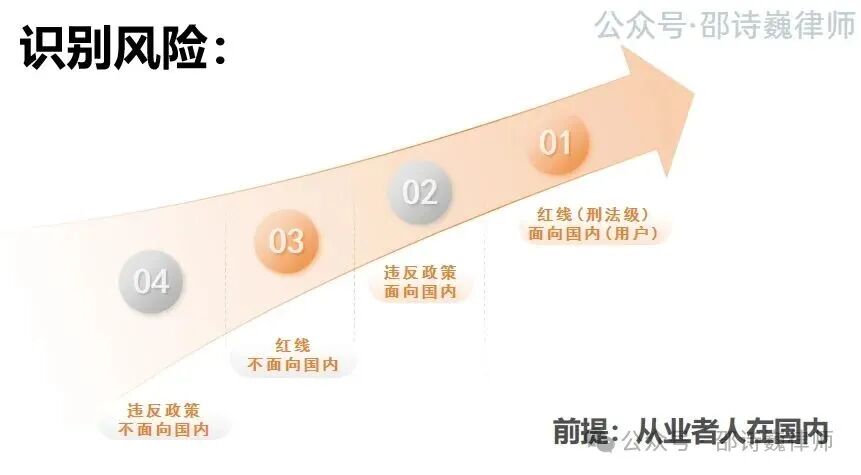
(The “Three-Stage Regulatory Evolution Theory” proposed by Attorney Shao at the forum)
Especially after 2021, with the issuance of the “September 24 Notice” and the in-depth promotion of the “Card Breaking Campaign,” black and gray market funds began to extensively use stablecoins such as USDT for money laundering and illegal cross-border settlements, further highlighting the harmfulness of virtual currency crimes.
Meanwhile, the accumulated historical risks of Web3 projects that grew wildly during the early “compliance gap period” have entered a period of concentrated outbreak. The accountability chain of law enforcement agencies has penetrated into domestic technical execution and business promotion links. A large number of technical teams, business development, and market operation personnel who previously served related projects have become the primary objects of current accountability.
2
New Situations and New Challenges: Iteration of Criminal Methods and Upgrading of Law Enforcement Capabilities
The meeting pointed out that “virtual currency speculative trading has shown signs of resurgence, related illegal and criminal activities occur from time to time, and risk prevention and control face new situations and new challenges.”
The so-called “new challenges” are reflected in practice as the continuous professionalization and concealment of criminal methods. Attorney Shao Shiwei focused on analyzing the typical business chain of using virtual currencies for illegal foreign exchange trading at the forum: using USDT as a medium and adopting the “domestic and foreign offsetting” model to achieve cross-border fund transfers without physical flow of actual funds. Such behaviors are highly concealed and involve large capital scales, having become one of the mainstream channels for underground banks and money laundering crimes.
(Cross-border offsetting foreign exchange transaction chain using USDT)
In addition, with the emergence of new concepts such as real-world assets (RWA) and PayFi in the Web3 field, criminal forms are also becoming more complex. This imposes higher requirements on law enforcement agencies’ on-chain tracing capabilities, electronic evidence fixation, and cross-border investigation cooperation mechanisms.
Currently, China’s law enforcement departments have been continuously accumulating experience in practice. Combining cases personally handled by him, Attorney Shao Shiwei pointed out that in major cases involving cross-border online gambling and cryptocurrency-related pyramid schemes, public security organs have gradually explored effective paths for collaborating with overseas exchanges, conducting on-chain fund tracking, and obtaining evidence.
3
Law Enforcement Focus: Information Flow and Fund Flow Become the Core of Penetrating Supervision
The meeting emphasized the need to “focus on key links such as information flow and fund flow, strengthen information sharing, and further enhance monitoring capabilities.”
Attorney Shao believes that this means judicial organs will further intensify crackdowns on the transfer of illicit funds and money laundering links, especially targeting the on-chain circulation paths of stablecoins such as USDT, implementing penetrating analysis with the aid of technologies such as KYT (Know Your Transaction) and address profiling.
Director Zhou Fang of the Wuzhi Office of Henan Yingyu Law Firm shared a case at the forum involving the crime of concealing or disguising the proceeds of crime due to buying and selling USDT, which is a microcosm of this trend: virtual currency activities in county-level areas are often closely intertwined with gray industry chains such as “money laundering” and “foreign exchange swapping.” By recounting a typical case where a young man from a small town was ultimately identified as a funding channel for a fraud chain because he exchanged USDT on behalf of others and collected a small handling fee, this case also reveals the widespread lack of legal awareness among grassroots participants and reflects that law enforcement agencies’ monitoring of “fund flows” has extended down to sporadic transactions at the county level.
4
Future Trends: Comprehensive Upgrade of Regulation, Web3 Criminal Defense Will Move Towards Refinement
From the 2013 “Notice on Preventing Bitcoin Risks” to the 2017 “September 4 Announcement,” and then to the 2021 “September 24 Notice” and this joint meeting of thirteen departments, it can be seen that China’s regulatory policies on virtual currencies are continuously upgrading, the scope of crackdowns is continuously expanding, and law enforcement methods are becoming increasingly rigorous.
Against this background, Attorney Shao Shiwei pointed out during the roundtable session of the forum that future Web3 criminal cases will present a development trend of “increasing quantity and diverse types.”
Attorney Shao stated that virtual currency theft and fraud cases, which previously failed to be filed due to difficulties in fixing evidence and controversies in characterization, are now seeing significantly enhanced enthusiasm for filing as public security organs improve their cognitive levels and tactical methods. In the future, in addition to the currently prevalent crimes of aiding information network criminal activities and concealing or disguising the proceeds of crime, cases involving virtual assets such as theft, fraud, and embezzlement by taking advantage of one’s position will also emerge endlessly, and criminal risks will further cover the entire chain of Web3 project development, operation, and trading.
5
Concluding Remarks
The Coordination Mechanism Meeting to Crack Down on Virtual Currency Trading and Speculation convened by the People’s Bank of China is another clear warning regarding criminal risks in the virtual currency and Web3 fields, and sets the tone for law enforcement actions in the next stage. However, correspondingly, the professionalization, cross-domain nature, and technological sophistication of criminal methods also impose higher requirements on lawyers’ professional qualities.
Attorney Shao believes that only by being familiar with industry operations, understanding technical logic, and deeply cultivating criminal law expertise can lawyers achieve effective communication and refined defense in increasingly complex cases involving virtual currencies, truly safeguarding the legitimate rights and interests of clients, and contributing the professional strength of legal professionals to the standardized development of Web3 in the Chinese context.

Recommended Reading