

Special Notice: This article is an original article by Attorney Shao Shiwei and represents only the personal views of the author. It does not constitute legal consultation or legal advice on any specific matter. To repost the article, seek legal consultation, or engage in peer exchange, please add: sswls66.
On February 6, 2026, the People's Bank of China, the China Securities Regulatory Commission and six other departments jointly issued the Notice on Further Preventing and Addressing Risks Relating to Virtual Currencies and Other Matters (hereinafter the "February 6 Notice"), which caused considerable reverberations in the industry and once again impressed upon many practitioners the sustained high-pressure posture at the policy level.
The issuance of this Notice also continues the longstanding regulatory rhythm: from the meeting convened by the People's Bank of China in November 2025 under the coordination mechanism for combating virtual currency trading and speculation, to the risk alert on preventing illegal activities involving virtual currencies jointly issued by seven industry associations on December 5, 2025. Within a short period, multiple departments have spoken in succession, which also means that the regulatory stance is being further refined and implemented.
Drawing on years of practical experience handling Web3 and coin-related criminal cases, Attorney Shao wishes to discuss in a more pragmatic manner: when these policies are applied in reality, what impact will they actually have on three categories of people in China—
1. Web3 practitioners working remotely within China, including employees providing technical, operational and marketing support to Web3 project teams, virtual currency exchanges, wallet projects and on-chain tools;
2. Crypto KOLs, self-media operators and community organizers, including those in roles such as trade calling, project promotion, publicity and distribution, and community promotion;
3. OTC merchants (U merchants), including practitioners engaged in off-exchange buying and selling of USDT, foreign exchange conversion channels, collection and payment on behalf of others, and acceptance and matching services.
I Author of this article: Attorney Shao Shiwei
1
Web3 practitioners working remotely within China
Among the Web3 practitioner community in China, those providing services to virtual currency exchanges in fact account for a considerable proportion. Although in recent years China's policies have continued to crack down on and phase out virtual currency exchanges, "where there is a policy, there is a workaround"; from the flourishing remote-work recruitment posts, job-seeking experience posts and even wealth-flaunting posts on various platforms such as Bilibili, Xiaohongshu, BOSS Zhipin and Maimai, one can deeply sense that the number of practitioners in China providing remote support to virtual currency exchanges and Web3 project teams remains very large.
Employees of virtual currency exchanges working remotely within China are usually distributed across several key positions:
-
BD/Business DevelopmentDirectly responsible for market expansion and user acquisition;
-
Marketing/BrandResponsible for advertising placement, commercial presentations and channel partnerships;
-
Community operationsResponsible for providingonline business premises, organizing community activities and maintaining user engagement;
-
Listing managerParticipates in token listings and project screening;
-
Product managerResponsible for trading product design and rule-making;
-
Technical, development, testing and operations personnelprovides underlying technical support for the platform's operation.
Although these roles differ in their division of labor, in terms of overall effect they all jointly serve the market expansion of offshore virtual currency exchanges, driving the growth of their domestic user base and the increase of their market share.
According to Circular 2.6, where a domestic individual, knowing that an offshore entity is illegally providing virtual currency-related services within the territory, still provides assistance, liability shall be pursued in accordance with law. Judicial practice concerning virtual currency exchanges in recent years shows that: when the actual controller or core decision-making level of an exchange is located offshore, those first subject to criminal case filing and investigation are often exchange employees still engaged in remote support within the territory.
Related reading:
2
Policy and Legal Risks of Monetization Models for Crypto KOLs
In addition to Web3 practitioners working remotely within the territory, crypto KOLs are also an important group participating in the domestic virtual currency ecosystem. These KOLs are usually active on platforms such as Xiaohongshu, Bilibili, Douyin, Twitter (X), and Telegram communities, and recommend virtual currency trading (bringing in orders) through video explanations, market analysis, live-stream interactions, and community call-outs.
From a business model perspective, the main monetization paths of crypto KOLs can be broadly summarized into the following categories:
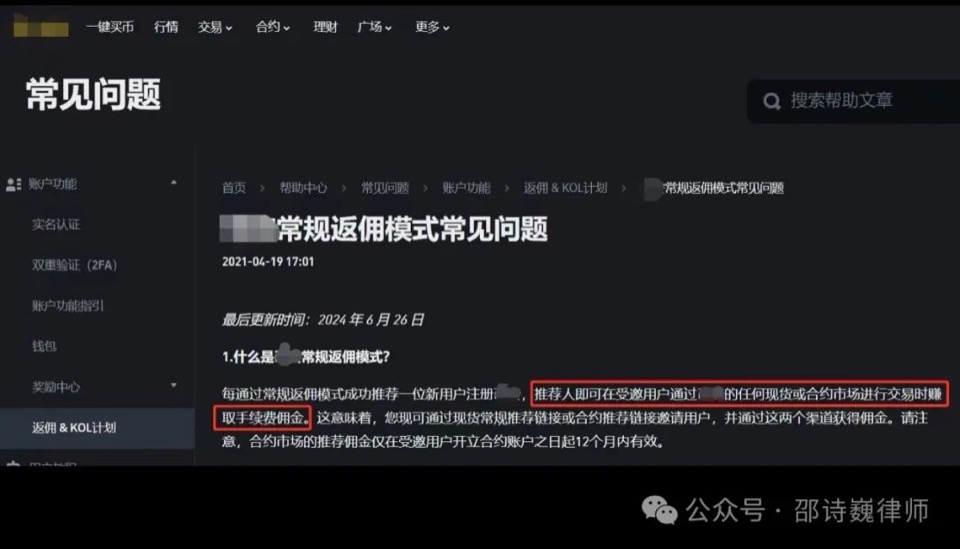
First, trading rebates (commission sharing). KOLs obtain commission income through invitation rebates, node programs, and other methods. Public reports show[i] that in the node program of a leading exchange, the trading fee rebate ratio for invited users can reach as high as 40%, and some teams' daily rebate income even exceeds RMB 100,000.
Second, referral rewards. Typical practices include: for each user invited who makes a deposit, one can obtain a USDT rebate card; after the invitee completes trading tasks, the inviter can obtain additional rewards; and upon reaching a certain number of invitees, one can be upgraded to a "node" and enjoy a higher rebate ratio.
Third, fixed promotion fees. KOLs produce promotional videos, AMA events, review content, or tweets for exchanges, priced according to follower count and influence, with a single collaboration fee ranging from several thousand yuan to several hundred thousand US dollars.
From the perspective of legal characterization, the above conduct will often be found to constitute providing information intermediation, pricing references, marketing and promotion, or paid traffic diversion for virtual currency transactions.
According to the Notice of 2.6 and other regulatory documents, domestic policy expressly prohibits providing information intermediation and pricing services for virtual currency transactions, and also requires internet platforms not to provide support such as marketing and promotion, paid traffic diversion, commercial display, or online business premises. This also means that the business and revenue models of the above-mentioned crypto KOLs inevitably carry policy and legal risks.
Article 18 of the Notice of 2.6 further clarifies that if a domestic individual, while knowing or ought to know that an overseas entity is unlawfully providing virtual currency-related services within the territory, still provides assistance, and the conduct constitutes a crime, that individual will bear criminal liability in accordance with law.
Related reading:
What are the legal risks when crypto KOLs promote projects for project teams?
Crypto influencers take orders and pay rebates — is this business lawful?
Crypto contract trading signal leaders promise to make you fly — are they angels or devils?
3
OTC merchants (U merchants): when stablecoins are characterized as foreign exchange
According to the Notice of 2.6, in addition to reiterating that virtual currency-related business activities constitute illegal financial activities and that virtual currency exchange, information intermediation, and pricing business may not be carried out, it also states that “stablecoins perform some functions of legal tender in a disguised manner”。
This inevitably brings to mind the earlier case in the Tai Po court (pictured below), in which the court found that the defendant bought Tether from retail investors and then sold itto earn the price differencethe court ultimately determined that the defendants, Chen and Li, used the buying and selling of virtual assets as a means of disguised foreign exchange trading,constituting the crime of illegal business operationsIn addition, this case was subsequently republished by the Guangdong High People's Court, which means that the case has been recognized as a reference precedent of typical significance within the view of a higher-level court and may be referred to and applied by other case-handling authorities in similar cases in the future.
(Image source:Has the crime of illegal business operations unexpectedly become a frequently charged offense for U traders in the crypto industry?)
If the judicial approach becomes stricter in the future, treating stablecoins (especially USDT) as equivalent to "foreign currency" in individual cases and characterizing OTC off-exchange trading as "disguised foreign exchange trading," then not only U traders but even some ordinary users' one-way purchase or sale transactions may be brought within the scope of criminal risk. In that case, cases such as the Dabu court case will become increasingly common.
Related reading:
4
Final remarks
The successive notices issued by the regulatory authorities have clearly conveyed a strict and tightening enforcement stance against virtual assets and related activities. Based on the latest policies, this article focuses on groups such as Web3 practitioners working remotely within China, crypto industry KOLs, and OTC merchants (U traders), analyzing the high-level criminal legal risks they may face under the current regulatory environment, and is intended solely as a risk alert.

[i] Phantom in the Crypto World: "Copy-Trading" One-on-One, Commissions of RMB 100,000 a Day_News Recommendations_Beijing Business Today_Financial Media Group https://www.bbtnews.com.cn/2022/0315/431540.shtml
This article is an original article by Lawyer Shao Shiwei and represents only the personal views of the author. It does not constitute legal consultation or legal advice on any specific matter. To repost the article, seek legal consultation, or communicate with peers, please add: sswls66.
Recommended Reading

