

Special Notice: This article is an original article by Attorney Shao Shiwei and represents only the author's personal views. It does not constitute legal consultation or legal advice on any specific matter. To repost the article, seek legal consultation, or engage in peer exchange, please add: sswls66.
In fact, I have previously written quite a few articles on the issue of criminal jurisdiction in China, but in my daily work, I still receive inquiries from parties and their family members who are motivated by criminal risk prevention or who have already had compulsory measures taken against them by judicial authorities.
This may be because, among the cases handled by our firm, criminal cases involving foreign exchange, cross-border online gambling, telecommunications fraud and other illegal and gray-market industries, and virtual assets account for a considerable proportion, and many involve foreign elements. As a result, the issue of jurisdiction in criminal cases—or, more specifically, whether China's judicial authorities actually have jurisdiction over a particular act or a particular case—has become one of the most frequently raised questions in consultations.
But having been asked this many times, I have gradually come to realize that, for ordinary people without a legal background, it is not enough for a lawyer merely to explain the legal provisions. They go on to ask: "I understand the law, but does this really happen in reality? Have people actually been arrested by domestic police because of these issues?" Depending on the role of the person asking, their thinking can be translated into different words:
For parties engaged in criminal risk prevention and control (mostly company owners or employees, such as many Web3 project teams), what they care about more is: I have never had any problems, so isn't this an extremely low-probability event? It probably won't happen to me, right?
For parties against whom compulsory measures have already been taken and their family members, they are more direct: If China's judicial authorities have no jurisdiction, does that mean the wrong person was arrested? Can we obtain release on bail pending trial, or even have the case withdrawn, by raising a jurisdictional objection?
So whenever this issue comes up, I often have to spend a great deal of time explaining the law and reasoning it through, and repeatedly explain, in conjunction with real cases, that going abroad, setting up servers overseas, changing nationality, or even holding multiple identities cannot automatically avoid the jurisdiction of China's criminal law. There is only one purpose—to enable the parties to truly understand the practical meaning of "jurisdiction," so that they can more clearly assess their own situation.
Ps. Many articles I have written recently have been censored, and I have been worn out by all the deletions. Yesterday's article, "Behind the Deportation of c: A Full Breakdown of a Cross-Border Group's Criminal Chain—Which Charges May Be Involved in Different Roles?" was also cut by half its length, with all the substantive content deleted, before it was finally published.
But I have to say that, apart from the facts of the case itself, the case in that article published yesterday is, in the eyes of legal professionals, also very interesting in terms of jurisdiction, and typical enough, so this article will still use that case as a sample for analysis.
In order to keep the article alive for as long as possible, and to avoid unnecessary misunderstanding, I can only make this special statement: the case content involved in this article is entirely fictional and is intended only for case discussion in the context of public legal education.
I Author of this article: Lawyer Shao Shiwei
1
Why do the judicial authorities of our country have jurisdiction over the series of cases involving cross-border criminal group c?
For background on the c case, please see "Behind c's repatriation: A full dismantling of a cross-border group's criminal chain—which charges may different positions involve?" to learn more; it will not be elaborated here.
I think the interesting point about jurisdiction in this case is that it is very much like playing billiards, and c himself is the final ball that goes into the pocket 🕳:
I suggest everyone read the analysis below first, then come back to understand the subtlety of this metaphor. Simply put, "man proposes, but Heaven disposes"—this is the reason c was caught.
1. Nationality-based jurisdiction
Before the analysis, let us first look at information disclosed in a set of public reports, starting with his nationality, because this directly concerns nationality-based jurisdiction.
- In 1987, c was born in Fujian Province, China, and was originally a Chinese citizen
- From 2014 to December 2025, he renounced Chinese nationality and became a citizen of jpz;
- On October 14, 2025, the Ministry of Justice of country m formally prosecuted c and disclosed extensive criminal evidence concerning c's group (in particular, the seizure of USD 15 billion in Bitcoin);
- In December 2025, individual C's nationality of Country J was revoked by that country in accordance with law;
- on January 7, 2026, according to domestic official reports, with the support and cooperation of the relevant authorities of JPZ, China successfully repatriated individual C (a Chinese national), the ringleader of a major cross-border gambling and fraud criminal group, from Phnom Penh, JPZ.
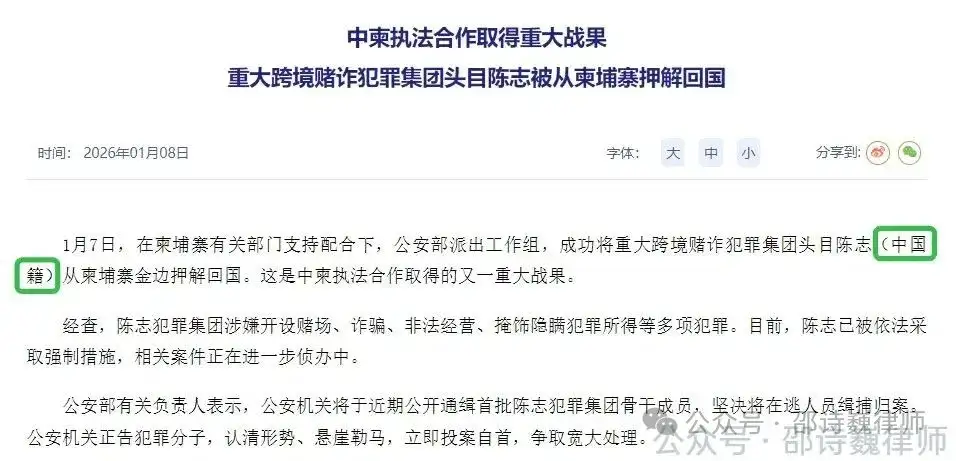
It should be emphasized, however, that according to the indictment of Country M, while individual C held the nationality of Country J, he also held the nationalities of three countries: Vanuatu, Saint Lucia and Cyprus. As to when these nationalities were acquired, there is currently no accurate public information; however, all three of these countries have previously operated citizenship-by-investment programs. Through such programs, applicants may obtain the citizenship of the relevant country after satisfying certain investment requirements (such as purchasing real property, making government donations, etc.). It may therefore be reasonably inferred that these nationalities were acquired after 2014.
As to the specific status of individual C's nationalities after his repatriation, because Vanuatu, Cyprus and other countries generally keep information on citizenship-by-investment applicants confidential, and the relevant countries may not yet have formally published their handling decisions, the specific timing is difficult to verify.
It can only be inferred that even if his nationality of Country J has been cancelled, he may still hold the status of Vanuatu, Saint Lucia, Cyprus and other countries; that is to say, at present, he is not necessarily a stateless person.
Interestingly, however, even though individual C's Chinese nationality was cancelled long ago,the official notices issued by both China and Country J expressly describe him as a person "of Chinese nationality"— so his earlier renunciation of Chinese nationality was a renunciation to no avail: in life he is a Z-country person, and in death he is a Z-country ghost.
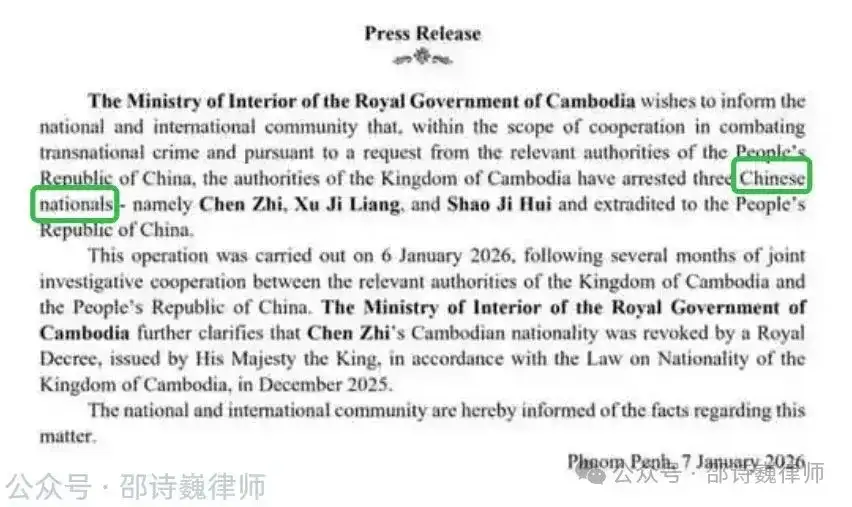
Therefore, although whenever a consulter asks me whether working abroad or changing nationality still entails criminal risk, I repeatedly stress that China's criminal law follows a "piercing enforcement" logic, this case has also given this lawyer a deeper understanding of personal jurisdiction — so long as you "once" were a Chinese citizen, personal jurisdiction may still apply.
To put it more profoundly, however, in the contest between states, "whether there is jurisdiction" and "whether jurisdiction can actually be exercised" are by no means fully equivalent concepts. In many cases, what is truly decisive is comprehensive national strength, diplomatic relations and real-world bargaining, which is also why Country M is frequently criticized for "long-arm jurisdiction." This is particularly evident in the present case.
After Country M formally indicted individual C in October 2025, the situation faced by Country J was as follows:
on the one hand, Country M was also demanding his transfer, and on the other hand, China was also demanding his transfer, which left JPZ, the little brother, deeply worried: should he be handed over at all, and if so, to whom? Offending anyone did not seem appropriate.
First question: will they hand him over?
Country M has already brought charges against individual C and his group. This not only characterizes him as a global public enemy, but more importantly, the practical measure has been to sever the connection between the Huione Group under his control and Country M's financial system.
This means that if the government of Country J continues to take no action, its domestic financial ecosystem (Huione Group) and even the entire country may face the risk of isolation from the international financial system, which would obstruct Country J's normal international trade and investment settlement. This is the direct economic and political pressure to which Country J must respond.
Country J's economy is highly dependent on exports (garments and agricultural products) and tourism. International sanctions and financial isolation would directly hit foreign investment and trade in these industries, making an economy already facing slowing growth (the IMF forecasts growth falling from 6% to 4.8% in 2025)[i] and a sharp rise in non-performing loans even worse.
At the same time, this case has become a global focus, and multiple countries have followed suit by freezing assets. If Country J shelters over the long term the head of a criminal group widely recognized by the international community, this would seriously damage its national reputation.
Therefore, our junior partner has no second answer to choose from and must hand him over.
Second question: hand him over to the senior partner or the second partner?
China and Cambodia have close relations, and China is one of Country J's most important partners. Satisfying China's important law enforcement request is consistent with Country J's national interests. There is no extradition treaty between China and the United States, and geopolitical competition exists, so handing individual C over to Country M is not a preferred political option for Country J.
China and Country J signed the Treaty between the People's Republic of China and the Kingdom of J on Extradition in 1999, which formally entered into force on December 13, 2000. This is the legal basis for extradition cooperation between the two countries.
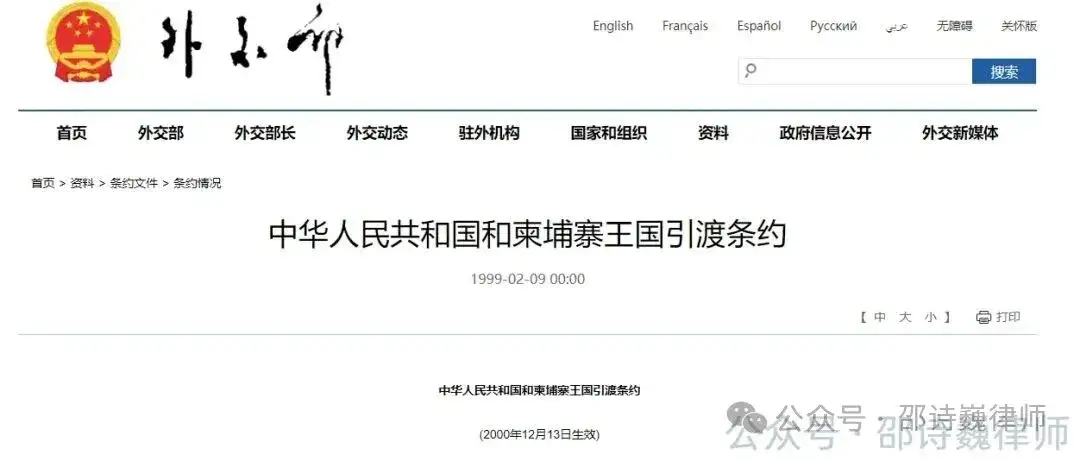
But one more issue must then be resolved, because under Article 5 of the aforementioned Extradition Treaty, "1. Either Contracting Party shall have the right to refuse to extradite its own nationals."
This also explains why the press notice issued by Country J's Ministry of Interior emphasized that, in accordance with the relevant provisions of Country J's Nationality Law, individual C's Country J nationality was formally revoked by royal decree in December 2025.
In summary, under the international financial and political pressure exerted by Country M, Country J chose the path most consistent with its own geopolitical interests and judicial efficiency—namely, by revoking nationality, it cooperated with China's law enforcement request to complete the repatriation (it should be noted that "repatriation" and "extradition" are not the same concept, and procedurally repatriation is more flexible and efficient than formal extradition).
Repatriating individual C to China can be described as a case of "one stone killing three birds" for Country J:
It responded to the international community's calls to combat crime.
It satisfied the core request of its most important partner—China.
It avoided the complex political and legal disputes that might have arisen from initiating extradition proceedings to the United States.
That such a decision, so full of wisdom and strategy, could be made truly gives one pause:
Yet, ironically enough, in July 2020, individual C was granted the title of Duke by then Prime Minister Hun Sen of Country J, and subsequently served for a time as an adviser to Hun Sen and Hun Manet[ii].

Finally, one cannot help but reflect: how good it is that our motherland has grown strong. Consider, if individual C had been a person from some nameless island nation, how would the government of Country J have decided?
Therefore, in many cases, a criminal case is in fact not merely a legal issue. At the international level, what lies behind "whether it can be handled" often depends on a nation's strength and its voice. May our motherland forever prosper and flourish.
2. Territorial jurisdiction
Having discussed personal jurisdiction, let us now turn to territorial jurisdiction, which is even easier to understand.
In fact, as early as 2020, China had already launched an investigation into this group. According to publicly available information from the China Judgments Online website:
In 2020, the Beijing Municipal Public Security Bureau established the "5·27" Special Task Force and opened a case investigation into the "XX Group" of Country J, a major cross-border online gambling criminal group. The investigation showed that a total of 458 individuals provided fund settlement services to the online casinos in the capacity of "customer service agents."
In 2023, the "2·02" special case handled by the People's Procuratorate of Wangcang County, Sichuan Province, further exposed the group's gambling network. The person involved, Yuan XX, together with stakeholders of a group in Country J, jointly established an online gambling company targeting mainland Chinese citizens, which later gradually developed into a transnational online gambling group headed by Yuan XX as the principal offender with multiple members, involving 180 persons and amounts as high as RMB 5 billion.
Therefore, because the main victims of the business activities and online gambling services of criminal group C were mainland Chinese citizens, the place where the consequences of its criminal acts occurred (that is, the place where the funds were lost and the gambling services were received) was broadly and continuously within China. At the same time, C himself, as the core founder and leader of the criminal group, originally held Chinese nationality. Accordingly, China's judicial authorities have clear and priority territorial jurisdiction and personal jurisdiction over the criminal group and its principal members.
2
Lessons from a certain casino-establishment case:
Some may say: C was pursued and the state took action only because the case was too large. Let us then look at the following genuine archived case in which ordinary workers were sentenced under the Criminal Law:
The case of Zhang XX, Pei XX and others for the crime of establishing a casino, handled in 2022 by the Intermediate People's Court of Weihai City, Shandong Province
Case No.: (2022) Lu 10 Xing Zhong No. 46
Basic facts:
A Korean national, HONG SEONGMIN (handled in a separate case), established a Korean gambling website named JOABET on the Internet, set up a studio in the Weihai area, and hired Chinese employees to solicit Korean nationals to engage in gambling activities through the website; that is, the website accepted bets only from Korean gamblers.
Although the server of the Korean gambling website was located overseas, its pages were displayed in Korean, and it did not accept Chinese gamblers, because the website's Korean actual controller recruited Chinese citizens to provide customer service management, collect bets and other services within China, China's court held that China had jurisdiction over the case and ultimately still convicted the relevant Chinese employees of the crime of establishing a casino.
3
Closing remarks
Let us return to the original billiards analogy.
On the surface, C exhausted his "wisdom": he renounced Chinese nationality, naturalized in JPZ, and, considering that there is no extradition clause between Country J and Country M, set up the Brooklyn network in Country M, carried out telecom and online fraud, and established multiple offshore companies for money laundering (I believe this was by no means his "wisdom" alone; it may reasonably be suspected that he hired quite a few legal professionals), trying every possible means to evade Chinese jurisdiction. But in the end, he still returned to the starting point.
Therefore, no one should harbor any false hope of avoiding the criminal jurisdiction of our country. These words may not be pleasant to hear for some, but honest advice is often unwelcome.
Although as defense lawyers our duty is to safeguard all lawful rights and interests of our clients, and that is beyond doubt, it is equally important that we truthfully inform our clients of clear, unambiguous and uncontested legal rules.
Otherwise, if a large amount of energy is consumed on 'jurisdiction' and our thinking becomes trapped in a dead end, while the room for defense on the facts of the case itself is neglected, this will instead be detrimental to the handling of the case.
In addition, I believe that the work of criminal lawyers, apart from defense and representation in cases, should in fact also include a duty of public legal education: through real cases and real judicial practice, lawyers can enable more people to understand the true operating logic of legal rules and help them more clearly recognize risks and avoid inadvertently violating the law. This is likewise a value that this profession should embody.

[i] IMF warns: weak growth threatens the economy of Country J - Khmer Times
[ii] Individual C arrested | Once granted the title of 'Duke' by Cambodia, former Prime Minister Hun Sen of Country J reportedly made statements to distance himself | Sing Tao Global Network https://www.stnn.cc/c/2026-01-08/4028813.shtml
Recommended Reading
Can fleeing abroad or changing nationality evade criminal sanctions?

