
Special Statement: This article is an original work by Attorney Shao Shiwei and represents only the author's personal views. It does not constitute legal consultation or legal advice on any specific matter. For article reprints | legal consultation | business exchanges, please contact: sswls66
Introduction:
As the saying goes, debts must be repaid, and that is only right and proper. However, based on a private lending case involving virtual assets that Attorney Shao's team recently handled, the court did not see it that way.
Using this case, Attorney Shao invites everyone to think through and review together:given that virtual asset transactions are currently not protected by PRC law, how can a plaintiff suing for coins or money improve their chances of winning, even slightly??
Of course, to protect the privacy of the parties involved, the description of the case facts in this article will be encrypted again and again, and redacted again and again!
Author of this article: Attorney Shao Shiwei
01
Case Description
Regarding this case, the image version of the description is as follows:
The text version of the description is as follows:
A and B are good friends. One day, B came to A's home and wanted to borrow 1 million RMB from A. Without a second thought, A readily transferred approximately 140 thousand USDT (Tether), equivalent to 1 million RMB, from A's account to the address designated by B. After B confirmed successful receipt of the coins, B issued a promissory note (IOU) to A, stating: Today, I borrowed 1 million RMB from A, to be repaid after half a year.
Coincidentally, D was also present and witnessed the entire course of the aforementioned facts.
Six months later, B stated: I acknowledge the debt, but I have no money to repay it. A then filed a lawsuit in court. We acted as A's authorized representative.
After the court hearing,Defendant B and the judgeregarding the facts of the case as submitted by our side through the IOU, the token transfer records, and witness statements,all acknowledged them。
(Reading this far, do you not think the prospects of winning the case are still quite good?)
In the end, the court ruled to dismiss the lawsuit filed by plaintiff A.
The court's view, as shown in the screenshot of the reasoning section of the judgment, is as follows (there is no intent here to quote out of context, because apart from this sentence, the rest consists of lengthy quotations of legal provisions, occupying about one A4 page):
Many people, possibly including plaintiff A himself, may not understand: A transferred out USDT in real money, defendant B wrote an IOU to plaintiff A after receiving it, and the two parties communicated steadily over a long period, with the defendant never denying that the money was owed—so how did it become an illegal debt?
02
Attorney Shao's Commentary
According to China's relevant policies, virtual currency, as a type of virtual commodity, has property attributes. Attorney Shao has mentioned this many times in previous articles; everyone can read them when they have time, to understand some basic legal common sense. This article will not repeat it.
However“Property attributes” do not equal “¥”. In other words, property attributes show that virtual currency has value, but having value does not mean it can occupy a legal status equal to that of currency and circulate in the market.
To give a possibly inapt example—since, as a criminal defense lawyer, I have handled quite a few casino-operation cases—why are certain game mechanics found to constitute gambling? To a large extent, it comes down to the presence of a cash-out step in the game. A lawful gaming scenario is this: game coins/items can only be consumed within the game. If game coins/items can
be freely exchanged with RMB without obstruction (equivalent to being able to circulate in the market like currency), then it is gambling!
Therefore, in this case, the court held that the parties had agreed on a loan, but A in fact delivered USDT to B; that act violated public order and good morals, was invalid, and the loss was to be borne by the party itself.
Let me translate that sentence again. That is to say, the court held that A was effectively using USDT as money and lending it to B, but policy provides that virtual currency does not have legal-tender status, so no one is permitted to do this. The consequence of finding the act invalid is that A's claim against B for the return of 1 million is not supported; and of course, the U worth 1 million RMB that A had already transferred to B
has also gone down the drain.
Friends who have not experienced this kind of thing may think this is a bizarre case, but in fact,this approach to adjudication is very common。
Past experience, if not forgotten, is a guide for the future; cases that are lost also have value. As long as one is willing to study them diligently, many valuable points can in fact be unearthed from every case.
The life of the law has not been logic; it has been experience.—This is a famous saying of Justice Holmes, a proponent of American pragmatist jurisprudence. I have always deeply agreed with it.
So let us consider: under the existing policy background, in cases of this type,what can the parties do to make the probability of winning somewhat higher??
03
Judicial practice
1. First, the current situation.
In judicial practice, some courts indeed refuse to accept crypto-related disputes on the ground that they fall outside the scope of civil cases accepted by the courts. Such situations will not be discussed here, since the battle is over before it begins. See the figure below:
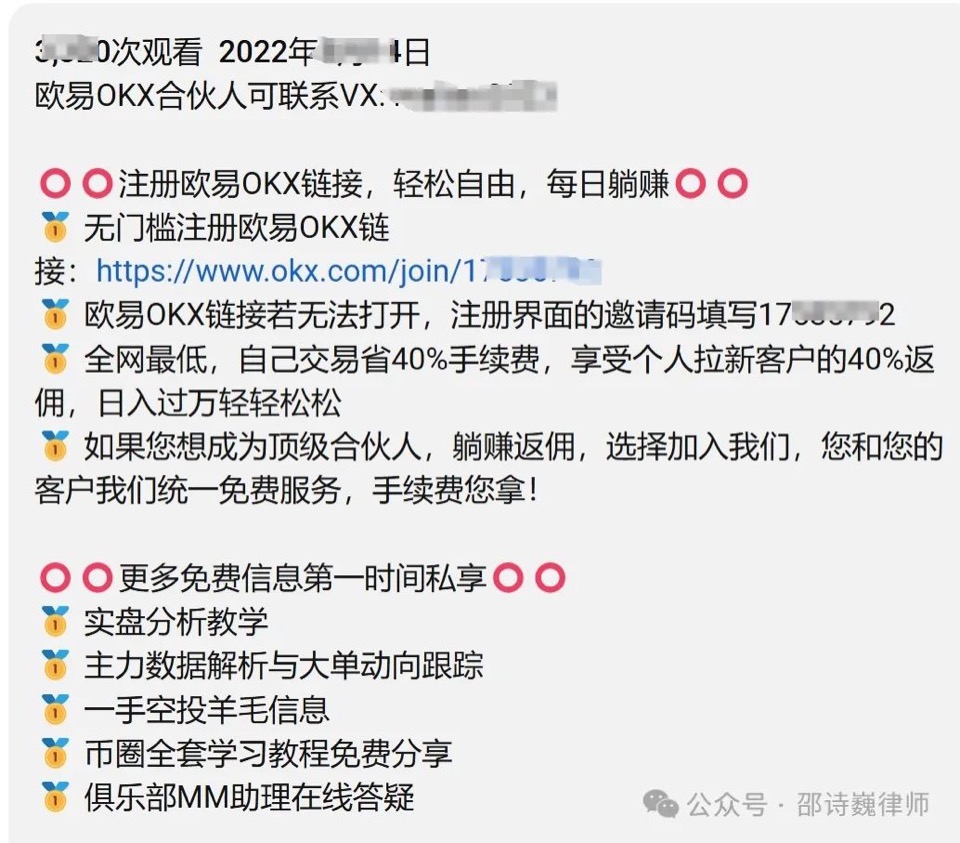
If you are concerned that the case-filing stage will encounter serious obstacles, it is advisable to retain a professional lawyer to handle the case,strive to have a full “battle” with the filing division judges, make thorough legal explanations and reasoning, and endeavor to get the case filed!
2. Big-data analysis of similar cases
A search of similar cases shows that judicial practice varies greatly across regions; even cases in the same province may result in entirely different judgments.
There are basically the following three types of judgments:
(1) Judgment ordering the return of virtual assets
(2) Judgment ordering the return of RMB
(3) The contract is held invalid, and the risk is borne by the parties themselves. For this type of case, two simple examples are given below (both are hard-learned lessons), so thatreaders will pay greater attention to the lawyer's recommendations in the remainder of this article (popularizing the law is a long and arduous task…)。
Case 1:
A case similar to the present one is a judgment of the Siming District People's Court of Xiamen Municipality, in which the parties agreed on a loan of 10 million, the plaintiff transferred the equivalent value in Ethereum as agreed, and the defendant acknowledged the transfer but did not repay it; the court held that the plaintiff must bear the risk itself.—The 10 million was lost for nothing
Case 2:
The defendant borrowed RMB from the plaintiff and later repaid it in virtual assets; the court held that the defendant's repayment was invalid and that the defendant should still repay the money to the plaintiff—The repayment amounted to nothing
04
Lawyer Shao's recommendations:
Based on the conclusions drawn from the numerous cases this lawyer has researched, and in light of the circumstances of the present case, the following conclusions may be drawn:
If you have not conducted in-depth research on the virtual-asset-related policies issued in China over the years, and cannot deeply grasp the evolving mindset of the legislators, then when lending virtual assets or money to others, you may find thatwriting nothing at all and having no evidence whatsoever gives you a greater chance of winning than properly writing an IOU。
Why do we say that?Because the IOU you wrote may be precisely the key to losing this case(and this is exactly an important reason why this case was lost)
If you are evidence-conscious and feel that you must have something like an IOU to feel at ease, then Lawyer Shao offers you a saying worth a fortune (far more than a fortune,with this saying, the money you may be able to recover could go from zero to all of it!):
Write what you lend; lend what you write.
Lend what you write; write what you lend.
How should this passage be understood? It means: if the IOU states that RMB is lent, then do not lend/return virtual currency to the other party; if the IOU states that virtual currency is lent, then do not lend/return RMB to the other party. This saying applies equally to both lenders and borrowers.
*However, Lawyer Shao must also give a risk warning: virtual-currency-related private lending cases are not as simple as everyone understands them to be. As to a specific region, a specific court, and a specific presiding judge's understanding of the nature of the case, as well as the circumstances and evidence of an individual case, in practice the adjudication of cases varies enormously. This saying may keep the lender/coin lender from dying
in such a miserable way, but it cannot guarantee a 100 percent certain win. After all, some courts may not even accept a case at filing, let alone hold a hearing.
In addition, from a technical perspective, many lawyers hold the view: Bringing such cases under a cause of action for return of the original property carries a higher probability of success than bringing them under a cause of action for private lending. However, based on this lawyer's extensive case-law research, that is not the case.。
The conclusions drawn from big data are as follows:
1. If the above principle of "write what you lend, and lend what you write" is not followed, the action will basically be dismissed, and judicial practice is relatively consistent on this point.
2. If the above principle is followed, and in addition, based on the IOU and other written agreements and relevant evidence between the parties, the agreement provides for repayment in tokens, then the cause of action is return of the original property; if the agreement provides for repayment in RMB, US dollars or other legal tender (even if what was lent was virtual currency), then the cause of action is private lending or contract dispute,and can be supported by the court.。
The above represents the mainstream view in the vast majority of court judgments; there are occasional divergences[1], but they are very rare and not typical.
05
In conclusion:
In virtual currency disputes, whether civil or criminal cases, judicial practice produces a wide variety of rulings. For Lawyer Shao, who handles coin-related cases every day, this surreal phenomenon is no longer surprising.
Of course, that is a matter for later. In the case our team handled, the client only found us shortly before the hearing.
Perhaps from the client's perspective, the case was simple: debts must be repaid, as a matter of natural justice, and with an IOU, transfer records and witnesses, how could he lose? So he had previously prepared the complaint and evidence himself and filed the case with the court. Butfinding a lawyer on the eve of the hearing was already too late. Because all the evidence and facts had already been submitted to the court by the client from what he believed to be a favorable
perspective.
When we accepted the engagement, we already anticipated, based on the evidentiary materials the plaintiff had provided, that the likelihood of losing the case was very high. But the client's view was that the hearing was imminent, so they would do their best and leave the rest to fate. While insisting on retaining us, they also regretted not having contacted us sooner.
Perhaps with a different litigation approach, or a different way of arranging and combining the evidence, the case could well have produced a different outcome.(In view of the parties' privacy, no further details are set out here; the legal relationships and the relationships among the persons involved in this case were in fact far more complex than described in this article.)
Unfortunately, there is no "if."。

[1] (2021) Hu 0151 Min Chu No. 2896, cause of action: contract dispute; the parties had no written agreement regarding the loan or the tokens. The plaintiff transferred EOS tokens; thereafter, the defendant signed a repayment agreement undertaking to return the virtual tokens. The court ruled that the virtual tokens be returned, and if they could not be returned, the corresponding RMB be paid.
Recommended Reading
Is over-the-counter (OTC) trading of digital currency a crime?
Defrauded in a USDT transfer: how can 40 million worth of USDT be recovered?

