

A DAT company is not a fixed template, but rather resembles a spectrum.
Each era creates new terms to accommodate phenomena that old frameworks cannot explain. Twenty years ago, the topic of widespread interest was 'internet companies'; ten years ago, it was 'unicorns'; and in recent years, a new term that has emerged in the capital markets isDAT company。
DAT, an acronym for Digital Asset Treasury Company, literally means 'Digital Asset Treasury company.' They differ from traditional internet or energy companies not because their business models are novel, but because they treatdigital currencies such as Bitcoin and Ethereum as treasury assets on their balance sheets.。
This trend has a macroeconomic backdrop. After 2020, the world experienced successive shocks from inflation and interest rate hikes. Corporate treasurers suddenly realized that cash on hand was being quietly eroded. While U.S. dollar deposits and short-term bonds are safe, they cannot withstand the long-term erosion caused by currency depreciation. Consequently, some companies began seeking new 'reserves.' Gold is too traditional, real estate is too cumbersome, and Bitcoin emerged as a lightweight outlier—it is scarce, transferable, and sovereign-free.Thus, the story of DAT companies unfolds.
The model of DAT companies compared to typical enterprises
In light of current market conditions, DAT companies can generally be categorized into three mainstream forms. The distinction lies not in how much Bitcoin they hold, but inthe relationship between their crypto asset holdings and their core business operations., and how these two curves jointly shape the enterprise's risk exposure.
1. Crypto Asset Treasury Model
-
Representative company: Strategy Inc. (formerly MicroStrategy, NASDAQ: MSTR)
Strategy’s positioning has completely diverged from the traditional software company path; the market label applied to it is virtually equivalent to an “enterprise-grade Bitcoin ETF.” As of September 21, 2025, the company held in aggregate639,835 BTC, with a weighted average purchase price of $73,971 per BTC.Its stock price elasticity far exceeds that of spot Bitcoin, making it a pure “amplifier.”
Key Investment Considerations:The value of such companies is highly dependent on the Bitcoin cycle. They provide frequent disclosures and strong transparency, so investors are clear that they are not buying into the core business but rather a compliant, auditable leveraged exposure to Bitcoin.
Risk Factors:Financing pace and dilution management. If market conditions deteriorate and the average purchase price of newly financed Bitcoin acquisitions deviates significantly, it may cause a structural discount within the valuation framework.
2. Hybrid Model: Core Business as a Floor + Strategic Bitcoin Holdings
-
Representative company: Boyaa Interactive (HKEX: 0434)
Boyaa Interactive is a card and board game company with relatively stable cash flow. Since 2023, the company has gradually introduced Bitcoin assets into its financial reports. As of September 18, 2025, it holds a total of4,091 BTC, with a total investment of approximatelyUSD 279 million,at an average price of USD 68,114 per BTCIn mid-September, it further acquired an additional411 BTCwithin three days, at a high average price of$115,420/BTC, of which90% of the funds raised through private placement were directly used to purchase Bitcoin。
Key Investment Points:The key for hybrid companies lies in "proportion management." The core business provides a cash flow window, while holding cryptocurrencies brings asset flexibility; the combination of the two constitutes a dual-track valuation.
Risk Factors:Entering new positions at high price levels may amplify financial statement volatility in the short term. If the proportion of cryptocurrency holdings continues to rise, the company’s overall valuation logic will gradually shift toward a “crypto-denominated” basis.
3. Crypto-Native Business-Driven Model
-
Representative Company: Coinbase (NASDAQ: COIN)
Coinbase’s core value is anchored in its platform businesses: trading fees, custody, subscriptions, and interest rate spreads. In the second quarter of 2025, the company held on its balance sheet11,776 BTC and 136,782 ETHwith a fair value of approximatelyUSD 1.84 billionHowever, the market does not treat it as a cryptocurrency-holding company, but rather views it as a global compliance gateway.
Investment Highlights:The valuation logic for business-driven Digital Asset Treasury (DAT) companies most closely resembles that of traditional fintech companies. While cryptocurrency price fluctuations affect trading volumes, non-trading revenue (subscriptions, custody) provides counter-cyclical support.
Risk Factors:Regulatory and Fee Pressure. Compliance attributes are a double-edged sword: on the one hand, they create a moat; on the other, they expose profitability to the direct impact of policy adjustments.
-
Representative Company: Riot Platforms (NASDAQ: RIOT)
Riot does not rely on purchasing coins; instead, it “self-produces” bitcoin through computing power and electricity. In August 2025, the company produced477 BTC, holding at period-end19,309 BTC (of which 3,300 were restricted), and disclosed that the all-in electricity cost for the month was approximatelyUSD 0.026/kWh。
Key Investment Points:A mining company’s profitability is equivalent to a three-variable equation: bitcoin price × network difficulty × electricity price. During bull markets, their operating leverage is extremely strong; during bear markets, cash flow pressures and the rigidity of capital expenditures are amplified simultaneously.
Risk Factors:The double-whammy effect of cyclical volatility. Companies must withstand both bitcoin price corrections and rising electricity costs; risk resilience depends on locked-in electricity pricing under contracts and inventory management.
In summary,The treasury model represents pure beta exposure, the hybrid model embodies a balancing act, the business-driven model constitutes a platform moat, and mining enterprises represent cyclical bets.When analyzing Digital Asset Treasury (DAT) companies, the key for investors is not merely to look at "how much crypto assets are held," but rather to price them by considering the resilience of their core business, the safety cushion provided by the average acquisition cost of their holdings, and the transparency of their governance and disclosures.
Controversies in the Investment Market
The emergence of the DAT model has not won unanimous acclaim from traditional capital markets. On the contrary, it has been accompanied by persistent skepticism and divergence among institutional investors, analysts, and accountants. The core issues are concentrated in several dimensions:
First, there are concerns regarding "shell companies."For some DAT enterprises, their core business operations have significantly weakened, with revenue and profit having almost no substantive impact on valuation. The market's understanding of these entities has gradually simplified to "buying the stock is equivalent to buying Bitcoin." In such circumstances, whether the company still possesses independent value as an operating entity, or merely serves as a "legal shell" providing a tradable alternative to direct Bitcoin exposure, remains a question in the minds of many investors.
Second, there is the issue of volatility.Bitcoin's annualized volatility has consistently remained between 60% and 80%, far exceeding that of gold and mainstream commodities. When a company allocates a substantial portion of its assets to Bitcoin, its financial statements are inevitably driven by fluctuations in the coin's price. For pension funds and sovereign wealth funds seeking stability, such volatility is difficult to incorporate into traditional portfolio models, which directly limits the weighting of such companies in institutional investment portfolios.
Third, there is confusion in valuation logic.DAT companies simultaneously exhibit two valuation curves: the discounted cash flow of their core business operations and the market value fluctuations of their digital assets. The problem lies in the fact that these two factors often do not move in the same cycle and may even diverge completely. This leads to mispricing in the market: when crypto asset prices rise, the valuation of the core business is ignored; when prices fall, the value of the asset reserves is discounted by the market. This dual-track valuation system makes it difficult for investors to find a stable anchor.
Fourth, there are questions regarding management motives.Large-scale acquisitions of Bitcoin can be interpreted as strategic asset allocation, or viewed as a tool for narrative-building and share price promotion. If disclosures are opaque, investors may suspect "arbitrage" rather than long-term corporate financial planning. Such uncertainty tends to amplify market sentiment.
Finally, there is uncertainty regarding regulatory and accounting treatment.Accounting standards vary across different markets; some require cost-based valuation, while others require recognizing changes in fair value. This not only undermines the comparability of financial statements for companies operating across markets, but also directly increases the risk of valuation discounts. Until a unified regulatory framework is established, DAT companies will inherently bear higher valuation uncertainty.
Overall, the controversies surrounding the DAT model essentially point to one core issue:Does it possess genuine corporate attributes, or is it merely a packaged asset vehicle? This is also why market valuations for similar companies vary so significantly.
Therefore, the key next step lies in determining:Which DAT companies are truly healthy and capable of weathering economic cycles, and which are merely pseudo-propositions leveraging concepts for arbitrage? —This is precisely the logical starting point for establishing criteria to identify "good DAT companies."
How to Evaluate a DAT Company?
Based on my current understanding,A good DAT company should possess at least four characteristics:
1. Stable Core Business Operations:The company must generate independent cash flows that provide a buffer during economic downturns.
2. Crypto Assets as Reserves, Not the Entirety:Holdings must be subject to proportional limits to avoid tying the company’s overall valuation entirely to cryptocurrency prices.
3. Transparent Disclosure:Position sizes, acquisition costs, and risk management measures must be clearly disclosed; otherwise, the company risks being labeled by the market as merely “storytelling.”
4. Strong Counter-Cyclical Resilience:The company must be able to sustain operations during bear markets without being forced into distressed sales; during bull markets, holding crypto assets will truly serve to amplify valuation.
Beyond these four criteria, there is another dimension that is often overlooked but is critical in investment research—Price FactorsThe weighted average purchase price of Bitcoin acquired by the company directly determines its risk exposure in future financial statements. A lower average price provides a thicker safety cushion; a higher average price increases the sensitivity of the financial statements to short-term volatility. For example, Boyaa Interactive’s newly acquired 411 BTC in September 2025 had an average price as high as$115,420, significantly higher than its historical average price of $68,114, which means it may face substantial volatility in future financial statements.
Using these dimensions, we conduct a horizontal comparison of several representative Digital Asset Treasury (DAT) companies.(Based on the latest data as of September 2025):
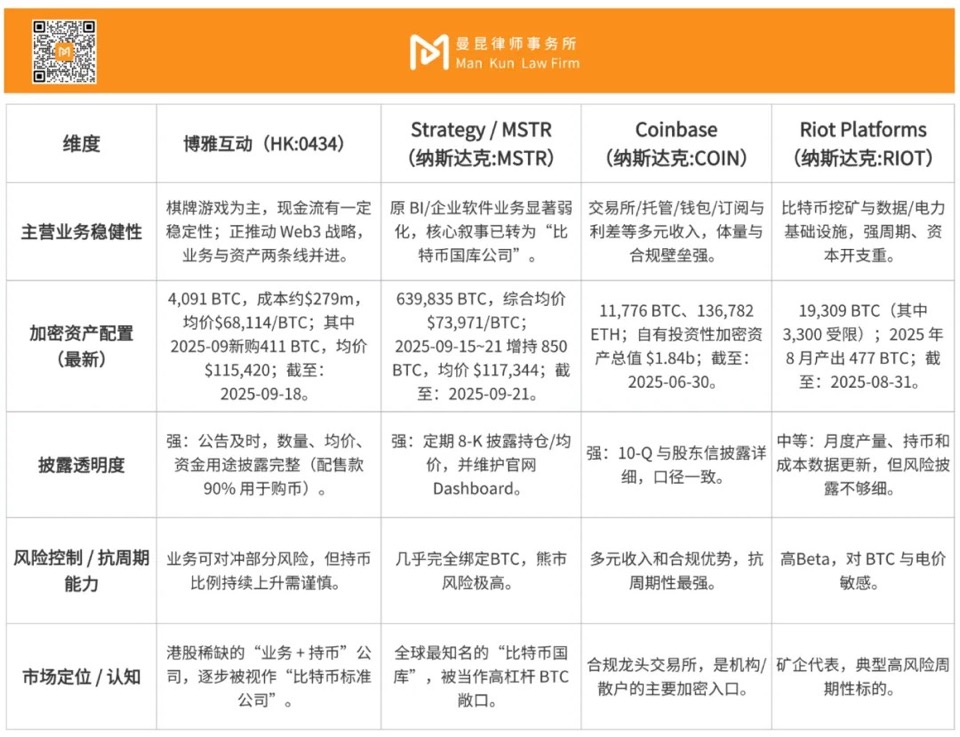
Summary
DAT companies do not conform to a fixed template; rather, they resemble a spectrum.At one extreme, Strategy has virtually abandoned its software business, choosing to position itself as a "corporate-grade Bitcoin treasury." At the other extreme, Coinbase’s value anchor remains its trading, custody, and compliance ecosystem, with crypto asset holdings merely constituting a financial footnote. Between these two poles, Riot provides a typical example of a high-beta mining company, with both profits and risks amplified; whereas Boyaa Interactive represents a rare hybrid case listed on the Hong Kong Stock Exchange, maintaining cash flow from its card and chess games while simultaneously using proceeds from share placements to acquire Bitcoin, thereby attempting to construct a dual-track logic of "operations plus reserves."
In the future, the capital market’s screening of DAT companies will not focus on the superficial metric of "how much crypto is held," but rather on whether a company truly possesses a sustainable operational foundation and transparent financial governance. Companies whose core businesses have become hollowed out and which rely solely on crypto price narratives may enjoy short-term favor during bull markets, but often lack viability when the cycle turns downward. Conversely, companies that can rely on their core operations as a backstop and treat crypto assets as long-term strategic reserves are more likely to establish stable valuation anchors amid volatility.
From a broader macroeconomic perspective, the emergence of DAT companies is essentially an intermediate step in the institutionalization of crypto assets. They have brought assets such as Bitcoin and Ethereum onto balance sheets, gradually acclimating the capital market to viewing digital assets as part of corporate reserves.This dual logic of "operations plus crypto holdings" is not only the core consideration for investor acceptance of DAT companies, but will also determine over the coming years which companies can truly navigate market cycles and which will prove to be fleeting phenomena.