
Seedance 2.0 earned ByteDance more than RMB 1 billion in a single month, yet nine out of ten teams using it to compete in AI short dramas are not making money. With the same model, why do some print money while others merely tag along? This article does three sets of calculations: whose pockets the money spent competing in short dramas ultimately ends up in, what other small businesses nobody is fighting over the same set of AI video capabilities can support, and what kind of people can make it pay off.
On July 7, a 36Kr in-depth article called ByteDance's Seedance "the world's second good business in AI." The numbers do look good: more than RMB 1 billion in monthly revenue, Volcano Engine's full-year MaaS target raised from RMB 10 billion at the start of the year all the way to RMB 15 billion, and multiple industry practitioners estimating this video model's gross margin at around 90%. For reference, Volcano's full-year 2025 MaaS revenue was only about RMB 1.5 billion.
In the same week, Securities Times offered another set of numbers. More than 1,300 AI short dramas go live across the internet every day; roughly 122,000 launched in the first quarter of 2026, accounting for 95% of the entire short-drama industry. Yet fewer than 150 have surpassed 100 million views, a hit rate of about 0.1%. DataEye's figures are even more direct: production-side costs fell 90%, traffic costs rose more than 100% year on year, and revenue fell by more than half. Only 3% to 5% of mid-tier companies are profitable, and no more than 2% of those below mid-tier.
On one side is a money-printing machine; on the other, nine out of ten are just tagging along. Both are using the same Seedance. The difference is not the tool; it is where the money flows.
Those competing in short dramas are working for ByteDance
First, let us see clearly how the money of short-drama teams disappears.
For an AI short-drama team, revenue comes from platform revenue sharing, and costs are traffic buying plus tokens plus labor. Traffic buying is the largest item, accounting for 70% of total gross billings. The entire industry burns RMB 150 million to 170 million a day on traffic buying alone. On the revenue-sharing side, earnings per thousand views have already fallen from RMB 60 in the second half of 2025 to RMB 15 to 30 this year, nearly halved. Mature traffic-buying teams see ROI stabilize in the thin-margin range of 1.03 to 1.07, while a large number of ordinary projects have ROI below 0.8, meaning they lose two dimes for every yuan invested.
Putting these two ends together, what a short-drama team does every day is: spend money buying traffic from Douyin (money goes to ByteDance), spend money buying tokens from Volcano to produce the film (money goes to ByteDance), and then gamble on that 0.1% hit rate. If the gamble wins, the platform takes its cut first; if it loses, the team bears the loss itself.
ByteDance, meanwhile, captures all three links. 36Kr disclosed its commercial flywheel: Hongguo and Douyin increase resource support for AI dramas, content companies buy Seedance from Volcano to produce films, and the surge in AI dramas in turn brings Hongguo and Douyin more advertising and traffic-buying revenue. Money from selling models upstream, money from selling traffic midstream, and money from IP copyright downstream—a positive cycle turns, and ByteDance is guaranteed a harvest regardless of drought or flood, with gross margins of 70% to 90%. Short-drama teams stand in the flywheel's worker position, contributing tokens, contributing traffic buying, and bearing the hit rate alone.
What is more fatal is that this leverage is not in their own hands. This year Douyin and Hongguo adjusted revenue-sharing coefficients and abolished the guaranteed-minimum mechanism, and top and mid-sized short-drama companies immediately experienced project contraction and layoffs; some companies cut nearly a third of their staff. The platform changes one line of rules, and your business loses a third. This is not doing business; it is maintaining the crowd for the house in someone else's casino.
Change how you sell, and the money from the same model goes into your own pocket
Using Seedance the same way but changing how you collect money immediately flips the accounts.
Instead of paying platforms for traffic promotion and gambling on revenue sharing, treat AI video capability as a service and sell it to people who need videos: create product-recommendation content for e-commerce sellers, produce promotional videos for small and medium-sized enterprises, and make short marketing videos for merchants expanding overseas. You charge a service fee, and clients pay you directly; there is no platform commission in between, and you do not need to buy traffic.
That is the difference. Service providers do not buy traffic, which means they do not give money to Douyin; they do not gamble on revenue sharing, so their income does not depend on whether a video becomes a hit; Token consumption is minimal, with the model cost of one video being only a few yuan to a few dozen yuan, while the quote is several hundred to several thousand yuan. At Seedance's pricing of about 1 yuan per second, the generation cost of a 15-second video is a dozen yuan or so, which is almost negligible against a quote of several hundred to over a thousand yuan. ByteDance only earns that dozen yuan or so in Token fees from this business, and the rest goes into your pocket.
This is also why model price cuts in the short-drama rat race cannot save short-drama teams, but are a net benefit to service providers. Short-drama teams have cut production costs by 90%, but the money saved goes back to traffic that has risen 100% in price; for service providers, the cheaper AI is, the lower the cost, and quotes can still be maintained for a while on information asymmetry, with the entire spread going to them.
In one sentence, short-drama teams treat AI as a bet, while service providers treat AI as a tool. Money on a bet is eaten at both ends; money on a tool is delivered with one hand and collected with the other.
Looking at the three sets of accounts side by side
Put the accounts of the three types of players side by side, and the gap is obvious at a glance.
The accounts of short-drama teams were calculated above: ROI hovers around 1, ninety percent of companies do not make money, and the ten percent that do still have to pass the two hurdles of platform revenue sharing and a 0.1% hit rate.
The accounts of individual order-takers come from a real record by a practitioner in Shenyang. He charges 80 to 150 yuan for a 15-second product display, 200 to 400 yuan for a 30-second social media ad, and 30 to 50 yuan for a logo animation. He takes about 45 orders a month on average, with monthly income of 6,000 to 9,000 yuan and tool costs of about 120 yuan a month. He claims a gross margin of 98%.
That 98% is a pretty false account. It counts the only real cost, namely human time, as zero. The same person also recorded another account: for a 600-yuan order, the client asked for five rounds of revisions, which took 8 hours, working out to 75 yuan per hour, worse than collecting bottles. So the truth of the individual tier is that tool costs do indeed approach zero, but the effective hourly rate is capped by manpower. One person can produce four or five videos a day at most, and the ceiling is monthly income in the ten-thousand-yuan range. This is a craftsman's livelihood business, not a money printer.
The accounts of small studios are where this business truly becomes viable. With three to five people, they raise the average order value: 500 to 1,500 yuan for a 30-second corporate promotional video, 1,500 to 5,000 yuan for a 60-second brand story, 2,000 to 6,000 yuan for a package of 10 e-commerce main-image videos, and a single government, enterprise, cultural or tourism order can reach tens of thousands or even over a hundred thousand yuan. For reference, a traditional production company charges 6,000 to 10,000 yuan per minute for the basic tier of a corporate promotional video, and quotes 30,000 to 80,000 yuan for a standard 3-minute film. AI service providers take on the work for a few thousand yuan, and after deducting manpower, the gross margin is estimated at 50% to 70%, raising the effective hourly rate through average order value and batch production.
With the same Seedance, short-drama teams have an ROI of less than 1.1, individual service providers make a living, and small studios have a gross margin of 50% to 70%. The tool has not changed; what changes is the business you mount it on.
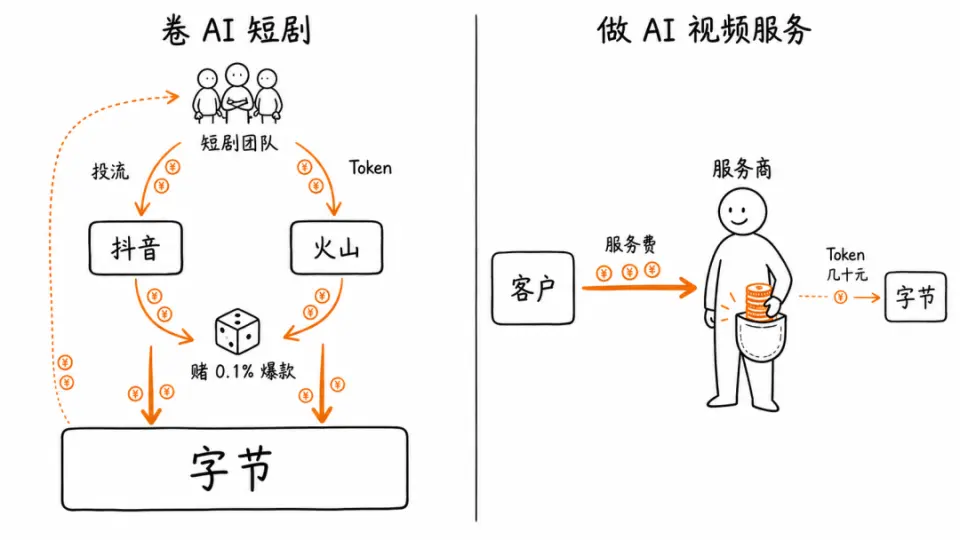
The short-drama rat race vs. providing services: two directions of money flow
Beyond short dramas, what other small businesses can this model serve?
This is the key point. The same set of AI video capabilities can serve a range of scenarios beyond short dramas that have not yet been crowded out, and these scenarios differ widely in the strength of demand and the intensity of competition, so each deserves to be examined separately.
The strongest demand is for e-commerce creative assets. Before the 618 shopping festival, a snack brand needs recommendation videos covering more than 20 SKUs; traditional filming takes 15 days and costs over RMB 100,000, whereas AI can produce more than 120 videos in three days at 60% lower cost. This is rigid, high-frequency demand: sellers need new assets every day to test ad placements, and a single client can provide ongoing business. This business is a mix of replacing existing demand and creating new demand: it takes work away from traditional filming while also creating new approaches that were previously unaffordable, such as splitting one product into four sales approaches—generic, unboxing, talking-head and hook—and testing them simultaneously to see which one performs. It suits teams with e-commerce operations experience, as creative asset services are a natural extension of their existing business.
Equally strong is creative asset production for cross-border sales. TikTok e-commerce sellers have an insatiable demand for short-video assets, and platforms already claim that more than 300,000 sellers use AI to generate sales videos. The logic is the same as domestic e-commerce, but the average order value and the market space are larger, and the barrier lies in English localization and familiarity with TikTok Shop rules. This segment is almost purely incremental demand, and whoever has strong language and channel capabilities will capture it.
Of medium strength is promotional videos for SMEs and local businesses. This is an incremental business that traditional pricing has kept out of reach. For local businesses such as restaurants, education and training providers, and medical aesthetics clinics, traditional promotional videos cost RMB 6,000 to 10,000 per minute, which they simply cannot afford; AI can produce them for a few thousand yuan, effectively turning people who previously could not afford videos into customers. Demand is not high-frequency—they may shoot only once or twice a year—but the sheer number of such businesses and the low price-comparison anchor work in your favor: clients have never seen AI quotations and will not bargain you down to cost. This suits local business service providers, who can win orders through chambers of commerce and field sales.
Township cultural tourism has imaginative potential but is hard to replicate. The case of Jiangdong Subdistrict in Fuling, Chongqing, is a striking one: a subdistrict publicity committee member and a friend working in new media, using eight AI software memberships plus purchased assets at a total cost of less than RMB 8,000, produced a 3-minute-12-second short film that received 316,000 views, after which many townships in Guizhou and Sichuan proactively approached them for production. Nationwide there are 38,000 townships and more than 2,800 districts and counties, and traditional promotional videos cost at least RMB 10,000 per minute, which the vast majority of grassroots entities simply cannot afford. It sounds like a blue ocean, but government and enterprise orders depend on resources, are non-standardized and slow to pay, so this is essentially a business for people with resources; those without local connections cannot get in.
What you should least touch is, ironically, the most respectable-sounding: brand advertising and TVCs. Looking closely at the cases posted on the Volcano Engine official website—a certain tea beverage brand saving 40% of manpower, a certain home appliance brand surpassing RMB 10 million in livestream GMV—you will find that the clients made these themselves using the tools, rather than outsourcing them to small studios. Major brands have 4A agencies and mature supply chains, and for them AI is merely an efficiency tool; there is no room for external service providers to take orders. For small studios to compete in this area is to use their weakest capabilities to fight for the most fiercely contested share of existing demand, with the highest customer acquisition costs.
Ranking the five scenarios: e-commerce assets and cross-border sales are the strongest and should be prioritized; SMEs and local businesses are a comfortable incremental zone with a low price-comparison anchor; township cultural tourism depends on whether you have resources; and brand TVCs are basically an illusion for small players. What they have in common is that these are all small blue oceans that big tech companies disdain and VCs do not enter; precisely because they are unsexy and cannot be replicated at scale, they have not been whipped by hot money into a red ocean of 1,300 episodes a day. You do not need a RMB 10 billion market; you need 50 clients who repurchase steadily.
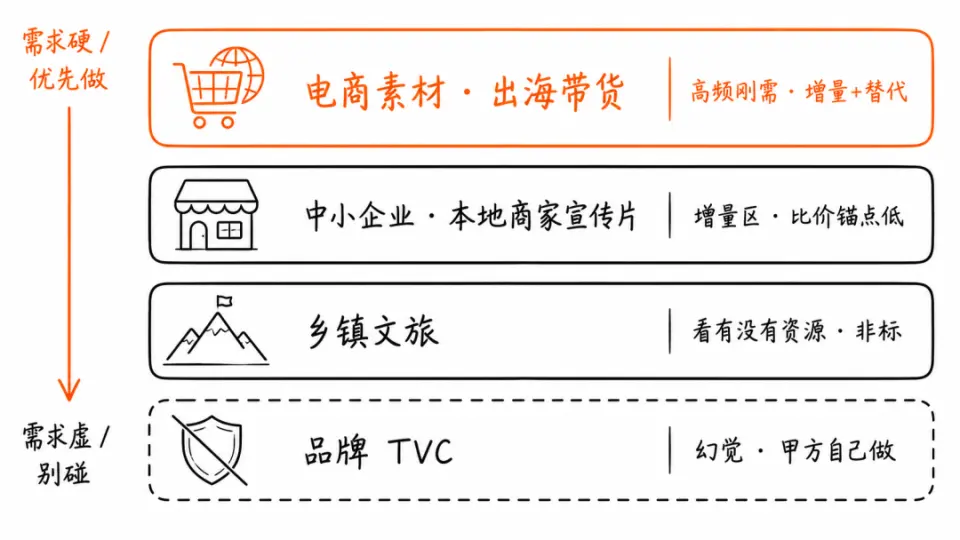
Five small businesses, ranked by strength of demand
Whether it is worth doing depends first on whether you have clients in hand
The barrier to entry for this business is frighteningly low, and precisely because it is low, the moat is what most needs careful examination.
Startup costs are almost negligible. For an individual taking orders, tool subscriptions at the RMB 120-per-month level plus a computer mean you can open for business with RMB 3,000. A small studio needs the RMB 30,000 level. Township cultural tourism starts at RMB 8,000 based on the Fuling case. The real barrier has never been money; it is whether you can continuously obtain orders.
Knowing how to operate Seedance is not a barrier. A training camp can teach it in seven days, which means that 'being able to use the tool' is available to everyone; it is someone else's commodity, not your moat. What truly cannot be copied is three things: client relationships and trust, namely the portfolio on Xiaohongshu, repeat purchases and referrals from existing clients; vertical industry understanding, meaning you have to know what the marketing department of a tea beverage brand and the operations team of a women's clothing e-commerce business actually want in terms of selling points; and the set of processes that turns AI's uncertainty into stable delivery.
This set of processes deserves separate discussion. The biggest pitfall in AI video is that clients think it can produce cinematic blockbusters with one click, when in reality it cannot even make precise modifications like 'move the character a little to the left.' The veteran approach is to send three sample videos before taking an order so the client can choose a style and lock expectations, with only two free revisions. This is not a minor trick; it is the core know-how that translates AI's gacha-like randomness into a deliverable service, and it is also where purely technical players are most likely to fail.
With such a thin moat, the biggest risk is model iteration. When platforms like Youxi AI and CreatOK turn production into 'drop in a product link and get four finished videos,' clients can produce videos themselves with one click, and the value of 'knowing how to operate tools' instantly drops to zero. Youxi AI drew 13,000 creators within five days of launch, which is exactly this signal. But viewed the other way, the stronger the tools, the more they expose what machines cannot handle: expectation management, creativity, and the patience to withstand clients' back-and-forth revisions. So the next generation of models will wipe out purely technical service providers while amplifying those who understand clients and can withstand delivery, because tools have raised the production capacity per unit of manpower.
You also need to see clearly who is hyping this business. Training camps shout 'say goodbye to zero orders in seven days, earn over 10,000 a month in 30 days'; they make money from tuition and sell the illusion that you will earn as soon as you enter, and whether you can get orders is none of their concern. SaaS platforms make money from subscription fees; they get paid whether or not you strike gold, and they may even hope to bypass you and sell directly to end clients. Volcano's official case studies make money from tokens and annual framework agreements; '60% cost reduction' is promotional rhetoric aimed at clients. None of these promoters lives by helping others take orders and earning service fees, so do not mistake their accounts for yours.
Ultimately, whether this business is a giveaway question or a trap depends on whether you have clients in hand. If you come from advertising, design, editing, or e-commerce agency operations and already have clients, AI is a lever to reduce costs and increase efficiency for your existing clients, and your channels precisely fill this business's only barrier; for you, this is a giveaway question. If you are a local merchant service provider, using AI to turn restaurants, education and training businesses, and medical aesthetics businesses that previously could not afford to shoot videos into clients is also worth doing. If you have an e-commerce operations background, material services are a handy extension.
Those who should wait and see are people who want to do this but do not yet have client resources. First build up a portfolio and your first batch of repeat clients on Xiaohongshu, and wait until you can steadily generate more than 20 inquiries a month before investing heavily; otherwise you are just paying tuition to training camps and SaaS platforms.
There are three types who should really steer clear: purely technical players who can only generate and cannot sell, whose skills are training-camp commodities and who will be the first to be eliminated by one-click platforms and price cutting; retail investors still competing over AI short drama ad traffic, who are working for ByteDance and still adding bets when ROI is below 1; and people who want to lie flat and earn by buying a course, because in this business the only ones who can lie flat and earn are the course sellers.
Finally, let us talk about policy as a cost. Unlike AI short dramas, which have been intensively tightened over the past six months, the window for commercial services is much wider. Regulatory firepower is concentrated on the content and platform side: AI comic dramas have been forcibly taken offline since April if not filed, classification and tiering standards were issued in June, and the draft Measures for the Administration of Micro Short Dramas require filing in three categories by investment amount and the issuance of licenses. All of these hit the short drama model that bets on revenue sharing. But helping clients make commercials, e-commerce materials, and corporate promotional videos currently requires no filing and no license and falls within ordinary business scope. There are really only two pitfalls to watch for, both of which can be solved by spending money: first, the obligation to prominently label AI-generated content; the Measures for Labeling AI-Generated Synthetic Content have already taken effect, enforcement in advertising scenarios will arrive sooner or later, and you simply need to add labels in accordance with the rules when producing videos; second, portrait rights and material authorization. This year, artists such as Jackson Yee have already defended their rights over AI face-swapping, and Hongguo took down the AI short drama The Peach Blossom Hairpin; using unauthorized real-person likenesses or materials is a compensable civil risk, so keep the authorization chain intact and do not touch celebrity faces, and this cost drops to zero. The profit in this business depends almost not on regulation lagging behind but on information asymmetry and delivery capability; even if the window closes, you can still do it, just with two additional compliance processes.
