
Samsung is preparing to let users transfer stablecoins directly within its phone wallet.On October 7, Samsung Electronics America announced plans to make USDC available to eligible U.S. Galaxy users during the last week of October 2026. USDC is a stablecoin pegged to the U.S. dollar; users can hold and transfer it out through Samsung Wallet, and can also remit funds to eligible bank accounts in more than 60 countries, allowing recipients to receive local currency.
This feature eliminates the need to install a separate crypto wallet and manage private keys oneself, bringing stablecoin transfers into the phone wallet users are familiar with. Phone manufacturers already have devices, account systems and user access points, and Samsung's approach offers them a way to add payment and collection services.
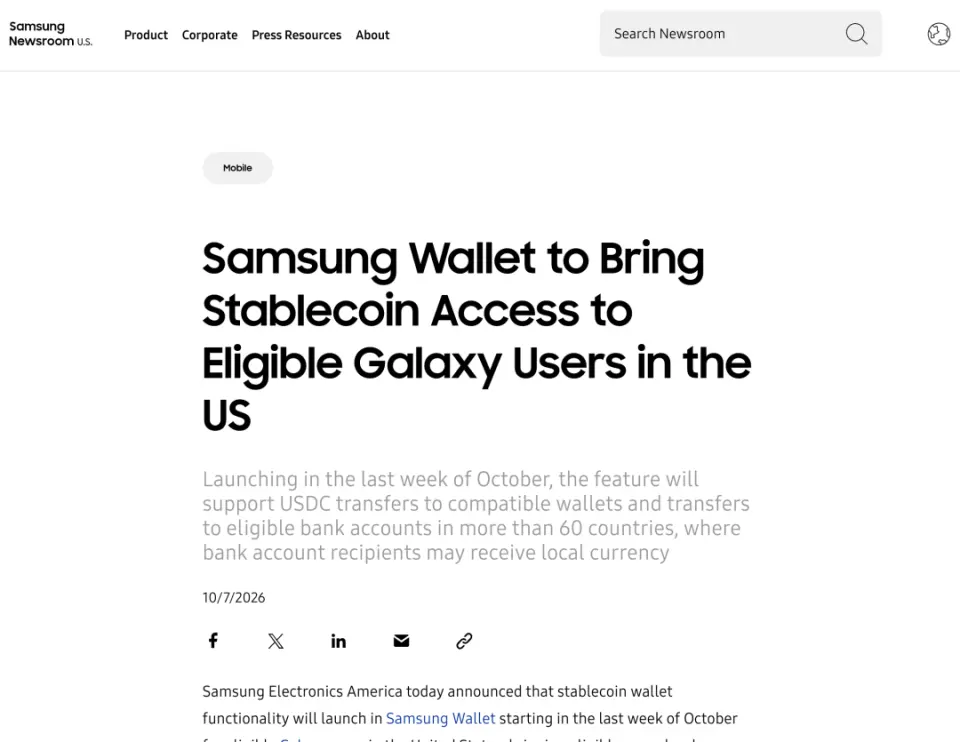
Samsung plans to make USDC available to eligible U.S. users. Source: Samsung Newsroom U.S., announcement dated October 7, 2026.
Behind the convenience of operation, accounts, custody and remittances still require professional institutions to provide. Samsung has chosen to connect these capabilities into its own wallet. When other phone manufacturers adopt similar cooperation models, which operations they prepare to participate in and which markets they open up to will directly affect their own liability.
I. In Samsung's wallet, who is handling users' money?
Samsung Wallet provides the operation entry point users are familiar with. Accounts, asset custody and fund transfers are provided by regulated partners. According to Samsung's announcement, Bastion supports the relevant payment framework, Coinbase acts as sub-custodian and holds USDC through Coinbase Prime Vault, and Sui, Solana and others provide blockchain network support. Samsung does not hold customer funds.
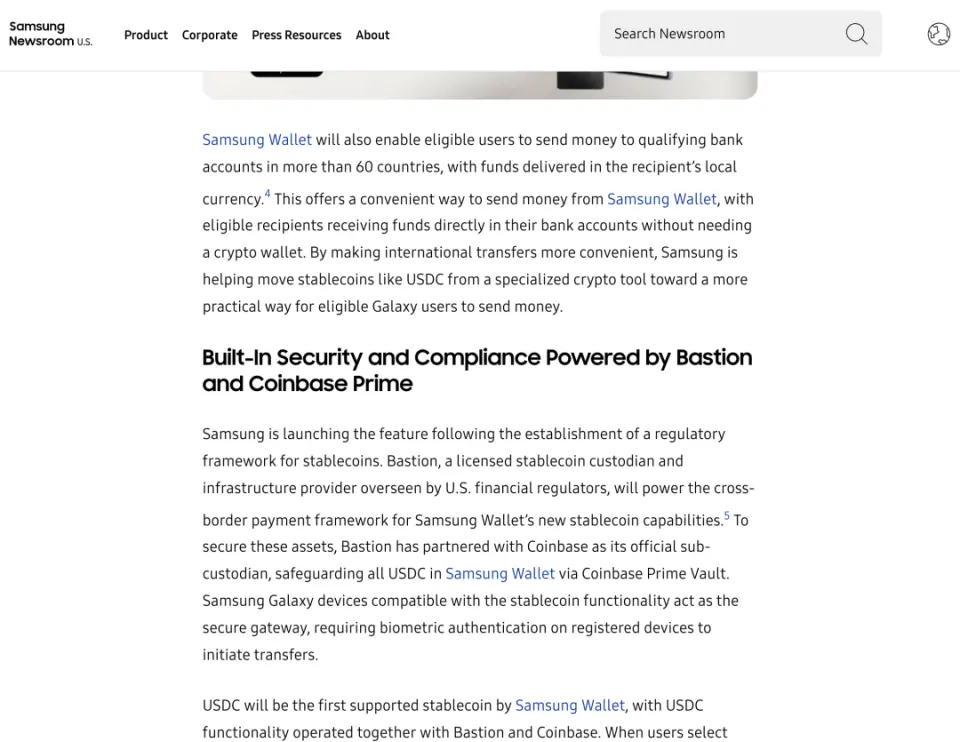
Bastion supports the payment framework, and Coinbase provides sub-custody. Source: Samsung Newsroom U.S., announcement dated October 7, 2026.
With these partners, users can use two transfer methods within the same wallet.If the recipient uses a digital asset wallet that supports the corresponding network, they can receive USDC directly; if the recipient uses a supported bank account, they can receive local currency. The latter method also requires currency conversion and bank payment, and the recipient does not need to open a separate crypto wallet.
Samsung does not charge a transfer fee for sending USDC to an external wallet, but the recipient's wallet or trading platform may charge fees. Remittances to bank accounts incur fees, which are displayed before the user confirms. The gas-free transfers supported by Sui eliminate on-chain network fees, while currency conversion and bank payment fees are still calculated separately.
The service is planned to be initially available to eligible U.S. adult residents, and users must complete account opening and identity verification and other steps. Bank accounts in more than 60 countries can receive funds, which refers to the scope of remittance destinations; senders must still meet the account opening requirements for U.S. users. Online shopping and offline tap-to-pay payments are follow-up plans mentioned by Samsung.
II. Integrating Stablecoins into Wallets: How Far Do Manufacturers Intend to Participate?
Samsung's collaboration offers other mobile phone manufacturers an approach to integration. However, the same transfer button may in some cases merely direct users to a third party, while in others the manufacturer is already arranging transactions on the user's behalf. What responsibilities a manufacturer itself bears depends on the actual operations behind the button.
If, after clicking the entry point, the user is directed to a partner's page, opens an account with the partner, and the partner provides quotes, collects funds and executes transfers, the manufacturer is primarily responsible for display and technical connectivity. In overseas markets that permit such collaboration, this arrangement generally makes it easier to delineate each party's role. However, if the manufacturer also collects transaction instructions on behalf of the partner, promises that funds will arrive, or charges commissions based on transactions, it must further consider local requirements regarding transaction services, promotion and solicitation.
To make operations more convenient, a manufacturer may also embed the partner's account within its own wallet, allowing users to open accounts and make transfers without leaving the page.Such an arrangement requires informing users of the identity of the service provider and having users accept the corresponding terms. Backend permissions must also be consistent with the division of responsibilities: even if assets are nominally held by a third party, if the manufacturer can transfer assets through account recovery or administrator permissions, it may still be exposed to responsibilities relating to custody and asset control. The label "non-custodial wallet" must be supported by the actual permission arrangements.
If several service providers are further integrated and the manufacturer compares quotes and selects channels on the user's behalf, an aggregation service is formed. Accepting orders, determining execution conditions, and automatically arranging exchanges and transfers may involve the corresponding qualifications for exchange, brokerage or payment services. Whether recommendation rankings are influenced by commissions should also be disclosed to users. Adding merchant payment collection functions will also involve collecting and settling funds on behalf of merchants, and the scope of the partner's services and the manufacturer's responsibilities must be adjusted accordingly.
III. Choosing Partners: Also Consider Which Market the Services Target
The integration approach must also correspond to the rules of the target market. Samsung first opened its services to users in the United States, while other manufacturers must determine, based on where their users are located, which company provides accounts, custody, exchange and transfers respectively, and whether each party possesses the corresponding qualifications.
Cross-border remittances also involve the receiving location: whether the sender can open an account and whether the receiving end can complete exchange and bank payment both affect whether the funds can be delivered.Samsung's support for remittances to multiple countries relies on the corresponding service arrangements. When selecting partners, manufacturers must also verify the remittance routes they intend to open, rather than merely looking at how many countries the partner supports.
Taking the United States as an example, enterprises must separately consider federal-level money services business registration, anti-money laundering obligations, and state-level money transmission and digital asset business requirements. The common MSB is a federal registration and must not be treated as a payment license covering business throughout the United States.
Singapore's rules, by contrast, remind aggregation platforms that they may be subject to regulation even without holding user funds. The relevant amendments effective since 2024 have brought certain activities that facilitate token transfers and exchanges within the scope of regulation. Therefore, whether a manufacturer directly holds assets is only part of the assessment of its business; it must also be examined whether it organizes or facilitates transactions.
Hong Kong also imposes requirements on stablecoin purchase channels and currencies.Under the Stablecoins Ordinance effective from August 2025, a party offering specified stablecoins to users must fall within a permitted category, and the currencies offered to retail customers must also meet the requirements for licensed issuance. The fact that a wallet can display the balance of a certain stablecoin does not establish that it may be offered for purchase to local retail users.
A single licence held by a partner may cover custody but may not necessarily cover exchange or remittance; the scope of authorisation of different companies within the same group may also differ. Manufacturers should map the contracting entity, the service market and the specific function, and confirm who lawfully provides each step in the product.
IV. Even where a partner sits behind the system, users will still turn to the mobile wallet when problems arise
Even if financial services are provided by a partner, what users see and operate every day is still the mobile manufacturer's wallet. If a balance is frozen or a transfer does not arrive, the first point of contact for users is very likely the wallet's customer service. Accordingly, manufacturers must not only enable transactions to be completed but also enable problems to be resolved.
This work begins on the account-opening page. Who provides the account, what asset the balance represents, how it can be converted back into fiat currency and what the fees are should be explained before users begin using the service. Users typically rely on the service provider to provide a sale or exchange channel, while direct redemption from the issuer is subject to eligibility and rule-based restrictions. Although stablecoins are pegged to the US dollar, price deviations, restricted addresses or suspension of services may still occur, and marketing must not describe them as bank deposits or promise unconditional redemption at any time.
Whether users can recover their assets also depends on the custody arrangements.Partners should segregate client assets from their own assets, clarify asset ownership and use, and agree on the withdrawal and migration methods to apply upon institutional insolvency or termination of the cooperation. Merely allocating a separate wallet address to a user is still insufficient to resolve the legal issues of asset ownership and return.
For mobile wallets, account recovery deserves particular attention. Recovering a mobile account may at the same time restore authority to conduct fund operations. If ordinary after-sales procedures are followed, opportunities may be left for account thieves. The recovery process should incorporate identity verification and security measures commensurate with asset risk, so that a design intended to make account recovery convenient does not instead make funds easier to transfer away.
When a transfer fails, customer service must also be able to explain where the money has stopped. For example, if USDC has already been sent out but the bank refuses payment, it is necessary to ascertain who holds the pending assets, how they will be returned, and who bears the exchange difference and fees. Only if manufacturers and partners agree in advance on handling procedures and time limits can users be spared from being sent back and forth among several companies without ever receiving an answer.
V. Anti-money laundering and data protection must also be integrated into the wallet
During transactions, service providers need to continuously identify customers, sources of funds and transaction risks in accordance with applicable rules, handle transactions involving sanctioned entities, regions or addresses, and transmit payer and payee information where required. The manufacturer is responsible for front-end operations and the partner for fund services, and the information held and measures taken by both parties need to be able to connect with each other.
This interface must be reflected in systems and day-to-day operations.Once a risk is flagged, there must be clear arrangements for who blocks, reviews and reports in accordance with the law, and how transaction status is synchronized to wallet customer service. Even after review work is delegated to partners for execution, each party must still perform the obligations it bears under the law.
To complete reviews and transactions, the parties will process materials such as identity documents, bank account information and on-chain addresses. Once such information is linked to mobile phone accounts, it may form a detailed personal financial record. Manufacturers and partners should, in accordance with applicable data protection rules, limit the scope of collection and sharing and properly handle notice, consent and cross-border data transfer requirements. Local fingerprint verification on the device must not become a reason to provide biometric data to partners by default.
Mankun Lawyers' Summary
Samsung's approach offers mobile phone manufacturers a cooperation pathway: leveraging existing wallets to connect accounts, custody and fund services so that users can use stablecoins more conveniently. Whether this pathway can be adopted depends on the specific transaction permissions, the service market, and whether the qualifications of partners cover the functions intended to be launched.
Before integration, manufacturers should walk through a single user payment in full, from account opening and deposit to final receipt of funds, and then examine how account theft, failed transfers and termination of cooperation would be handled. The front end can be made simple, but the responsibility behind it needs to be allocated to specific companies and actual processes. When users encounter problems, the wallet should be able to explain where the money is and provide actionable solutions.
This article discusses the product and compliance arrangements for mobile phone wallets integrating stablecoins, for industry research purposes, and does not constitute investment advice, product promotion or legal advice on any specific project.

