

An On-Chain Foreign Exchange Market
This week, an investment institution with global assets under management exceeding USD 10 billionYZi Labs announced that it would lead a USD 50 million financing round for Better Payment Network (BPN)to accelerate the construction of multi-stablecoin payment infrastructure. BPN is described as the “payment layer for the multi-stablecoin era,” connecting centralized finance (CeFi) and decentralized finance (DeFi) through a CeDeFi hybrid architecture, with the aim of establishing a unified network for stablecoin minting, redemption, and settlement.
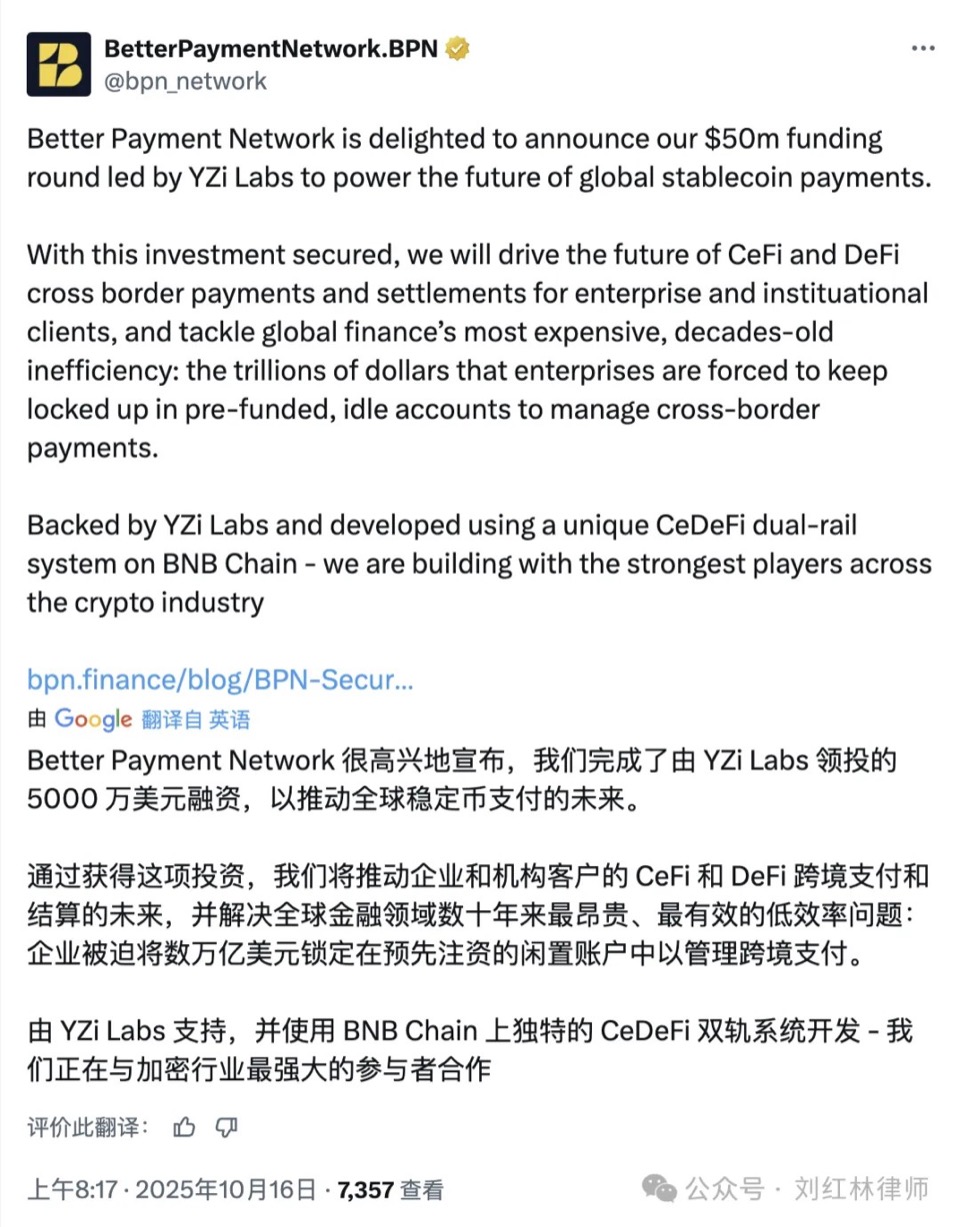
According to information released by YZi Labs, BPN is natively deployed onBNB Chainwith the goal of creating a “borderless, low-cost, and compliant” cross-border payment system. Traditional cross-border payments rely on pre-funded accounts to maintain liquidity, resulting in significant capital being idle for extended periods; whereas BPN achieves instant settlement through real-time stablecoin minting and burning, significantly improving capital efficiency. The current system supports multiple non-USD corridors, including the Brazilian Real (BBRL), Nigerian Naira (cNGN), Mexican Peso (MEXAS), and Euro (EURI), and plans to expand to 20 regional stablecoins across Latin America, Africa, and Asia by the end of this year.
A partner at YZi Labs stated in a press release: “BPN demonstrates genuine infrastructure potential in terms of performance, compliance, and architecture. It may be one of the first protocols to enable stablecoins to achieve universal global settlement in the real economy.”
The significance of this news lies not in the financing amount itself, but in the signal it sends: stablecoins are evolving from crypto assets into financial infrastructure.
The “Foreign Exchange Problem” Among Stablecoins
In financial history, only a few infrastructures have truly changed the flow of global capital. SWIFT moved cross-border payments from the fax era into the telegraph age, while Visa and Mastercard enabled retail payments to possess global credit acceptance capabilities for the first time. In the world of Web3, such foundational infrastructure remains absent. While DeFi provides liquidity and stablecoins provide a value anchor, the flow of funds across different blockchains and jurisdictions remains fragmented.
The solution proposed by BPN (Better Payment Network) attempts to find an institutionalized remedy for this fragmentation. It aims to become a new payment layer protocol, a unified underlying layer for value transmission, akin to TCP/IP for the information internet. Its objective is not to determine who transfers funds, but rather to address “how money can be moved in an orderly manner within the networked world.”
The fragmentation of the stablecoin ecosystem is forcing this issue to the forefront. By 2025, there will be more than fifty active stablecoins globally, with USD-pegged stablecoins still accounting for over 90% of the market. However, localized stablecoins such as the Brazilian Real, Nigerian Naira, and Hong Kong eHKD are emerging. This is a noteworthy signal: currencies are moving toward regionalization. The fragmentation among stablecoins is creating a new “foreign exchange problem,” while the traditional SWIFT network and correspondent banking systems are virtually ineffective in the blockchain context.
BPN’s approach more closely resembles the reconstruction of an on-chain foreign exchange market.Different stablecoins can be directly exchanged without the need for cross-chain bridges or reliance on intermediary banks. On-chain automated market-making and off-chain clearing jointly maintain order in this market, enabling fund conversions to be completed in a 24/7, permissionless environment. It does not seek to replace the financial system, but rather to establish a technological infrastructure capable of sustaining long-term value transfer.
Operational Logic and Commercial Applications of BPN
The underlying logic of BPN can be summarized in one sentence: treating stablecoins as “payment currencies” to enable them to complete real-world settlement cycles on-chain. While this may sound abstract, its operational mechanics are highly concrete when applied to actual use cases.
Within the BPN architecture, the flow of stablecoins is divided into two layers:
The permissioned layer handles interactions with fiat currencies (issuance, redemption, and custody), while the open layer facilitates purely on-chain exchanges, clearing, and market-making. Both layers share the same liquidity pool and achieve consistent settlement through atomic swaps. This “dual-layer model” allows BPN to combine the reliability of centralized systems with the liquidity of decentralized networks.
In the applications section of its white paper, BPN outlines several typical commercial scenarios.
1. Corporate Cross-Border Remittances
A multinational corporation headquartered in Hong Kong has a subsidiary in Brazil, with revenues denominated in Brazilian reais (BRL). The traditional approach requires currency exchange and settlement through correspondent banks or the SWIFT network, a process that takes 1–2 days and incurs costs as high as 1.5%–2%. By using BPN, the enterprise need only deposit BRL into a custodial account via a local partner institution to mint BRL-pegged stablecoins (BBRL), which can then be directly exchanged on-chain for USD- or HKD-pegged stablecoins (such as USDC or EHKD). Funds arrive within minutes at approximately one-twentieth the cost of traditional methods. The entire process remains compliant with local foreign exchange and payment regulations, but the movement of funds has shifted from bank messaging to on-chain settlement.
2. E-commerce Merchant Settlements
In Southeast Asia, an e-commerce platform typically needs to settle payments simultaneously with suppliers, logistics providers, and content service providers across multiple countries. BPN provides a stablecoin payment channel for such merchants: they receive payments in Indonesian rupiah-denominated stablecoins (IDR stablecoins) and automatically settle them into USDC or other target currencies for disbursement to global supplier accounts. This “multi-stablecoin intermediary layer” reduces foreign exchange losses and eliminates the complexity of maintaining clearing accounts in multiple jurisdictions. More importantly, it makes the settlement process programmable—payment logic, such as revenue sharing, settlement, or tax withholding, can be automatically executed via smart contracts.
3. Individual Cross-Border Payments
For freelancers, international students, and developers engaged in cross-border business, traditional cross-border payment collection processes remain cumbersome, costly, and slow. BPN enables personal wallets to connect directly to the on-chain settlement layer, allowing users to instantly convert between different stablecoins and receive payments. Test data presented in the white paper shows that a transfer from Nigerian cNGN to USDe (a USD-pegged stablecoin) takes an average of two minutes, with costs below 0.1%. This permissionless on-chain payment solution is highly attractive for the "digital labor economy."
4. Market Making and Liquidity Cycle
On the BPN DEX, market makers can arbitrage between different stablecoins (e.g., BRLcoin and USDe), profiting from price fluctuations and spreads against off-chain clearing rates. This mechanism not only facilitates price discovery but also creates a self-reinforcing liquidity flywheel: increased payment transactions bring greater liquidity depth, which in turn reduces conversion costs and attracts more users to the system.
These four cases demonstrate the "real-world relevance" of BPN: it is not a protocol operating in a vacuum, but rather an attempt to create a closed loop where stablecoins function across corporate settlements, merchant collections, individual payments, and liquidity markets. While the technology operates in the background, users experience faster, cheaper, and more transparent settlements.
Economic Model and Compliance Logic
In terms of its economic model, BPN does not rely on a single transaction fee to sustain operations.It functions as an integrated financial ecosystem, generating revenue from base transaction fees, value-added service fees (including yield generation, hedging, and bulk splitting), liquidity leasing, and arbitrage profits between stablecoins. The protocol redistributes eighty percent of its revenue to liquidity providers, validators, and ecosystem funds, creating a continuously cycling flywheel. This design is also more regulator-friendly, as it avoids direct dividends and instead distributes yields through on-chain traceable incentive mechanisms, thereby avoiding the regulatory red lines associated with securities offerings.
From a legal perspective, the key challenge for BPN lies not in the technical layer, but in how the monetary nature of stablecoins is defined.Direct conversion between different stablecoins does not automatically constitute foreign exchange activity. In the traditional sense, "foreign exchange" refers to means of payment and assets denominated in foreign currencies (such as cash, deposits, foreign exchange instruments, and marketable securities). Although stablecoins are pegged to fiat currencies, their essence is digital asset certificates referenced to fiat currency. In purely on-chain scenarios, conversions between stablecoins are closer to "transactions between virtual assets." It is only when such conversions are linked to fiat on-ramps/off-ramps or cross-border clearing that they may potentially trigger foreign exchange or payment regulatory boundaries in various jurisdictions.
Summary
If future cross-border payments no longer rely on inter-institutional messaging but are instead settled automatically based on on-chain protocols, the result will be not only improved efficiency but also a new financial order.
BPN's transition from a "bridge" to a "layer" also signifies a shift in institutional logic. A bridge implies permissioned endpoints, whereas a layer implies a foundational protocol. While this change appears technical, it fundamentally impacts the structure of the cross-border financial order. It weakens the monopoly position of traditional banks in the clearing process and shifts regulation from managing institutions to managing code. Rather than merely being a technological innovation, this represents a reconstruction of financial infrastructure. Challenges remain regarding reserve authenticity, cross-border regulatory coordination, anti-money laundering, and traceability. However, the trend is clear: payment protocols are becoming decentralized, clearing systems are becoming networked, and regulatory logic is becoming codified. This change,This may well mark the true beginning of the "Internet of Value."