
On the evening of September 16, Inovance Technology (SZ300124, share price RMB 83.49, market capitalization RMB 225200 million) announced that from September 8 to 15 of this year, the company's actual controller Zhu Xingming transferred 9602100 company shares to his daughter Zhu Hanyue through block trades as an internal transfer. Based on the average internal transfer price disclosed by the company, the shares transferred in this transaction were valued at approximately 770 million yuan.
The background to this equity transfer is as follows:
- In July 2021, Inovance Technology issued an announcement regarding the divorce of its actual controller, stating that Zhu Xingming and Zhong Jin had completed divorce procedures due to irreconcilable differences. Under the terms of their agreement, Zhu Xingming at that time allocated 70300300 Inovance Technology shares that he held directly to Zhong Jin. Calculated based on the closing price of RMB 76.67 per share on the date the parties completed the divorce procedures (July 8, 2021), the shares transferred by Zhu Xingming to Zhong Jin at that time were valued at approximately 5390 million yuan.
- In September 2021, the company announced that Zhu Xingming and Zhu Hanyue had entered into a Gift Agreement. To express his affection for his daughter, Zhu Xingming gifted 20602100 company shares held directly by him and a 21.7% equity interest in Huichuan Investment to Zhu Hanyue without consideration. Of this, the 21.70% equity interest in Huichuan Investment completed transfer registration in 2022. Zhu Hanyue undertook that the voting rights acquired through the gifted shares and the gifted equity interest would be unconditionally entrusted to Zhu Xingming for exercise.
- In December 2024, Zhu Xingming transferred 11 million company shares to Zhu Hanyue by way of block trades. In September 2025, the remaining 9602100 Inovance Technology shares agreed under the Gift Agreement completed the internal transfer process. However, the voting rights acquired by Zhu Hanyue through the gifted shares and the gifted equity interest will be unconditionally entrusted to Zhu Xingming for exercise. Accordingly, the gift will not result in a change in control of the company and will not affect the company's governance structure or its ability to continue as a going concern.
- As of September 17, 2025, Inovance Technology's share price had risen by more than 40% year to date.
This news came from Baidu's trending searches. It inevitably reminded me of the many divorce negotiations involving entrepreneurs that I have handled, where the ultimate solutions were truly remarkably similar in approach.
In the world of entrepreneurs, divorce is not only an emotional watershed but also a contest over property. Equity, as the "crown" in this contest, often becomes the focus of disputes. To avoid disputes affecting the company's normal operations, some entrepreneurs choose to place equity in their children's names while assuming the role of "custodian" themselves.
Today, let me discuss this seemingly clever yet actually complex arrangement from the perspective of a family lawyer.
First, placing equity in a child's name is usually a last-resort measure when spouses are contesting equity in a divorce. Once affection is gone, the optimal solution is of course to place the best assets in one's own name; real estate, vehicles and deposits are all relatively easy to handle, but company equity is often the most troublesome asset. For entrepreneurs, allocating equity to the other spouse creates operational risks—what if the other spouse one day acts unpredictably and demands to exercise shareholder rights? But if equity is not allocated to the other spouse, the other spouse will always assume the equity is highly valuable and demand a large amount of cash to buy it out, which is not cost-effective. This is a common conflict in practice.
Second, we therefore often propose a solution that sounds like it achieves both objectives: give the equity to the child, give custody of the child to the other spouse, and earmark the child support and the assets in the child's name exclusively for the child. This avoids direct property division disputes while ensuring the stability of the company's operations. However, at the legal level, is such an arrangement really so perfect? In fact, it must be arranged down to the smallest detail. I once revised a gift agreement six times before finally settling on the specific terms of the agreement (screenshots of some of the terms are below).
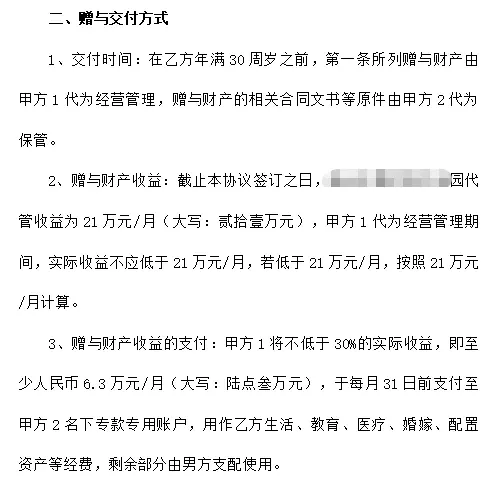
Third, on the one hand, the entrepreneur, as the equity "custodian," holds voting rights, and such an arrangement may give rise to new controversies and disputes—for example, if the other spouse still does not trust the entrepreneur after the divorce, may continue to create trouble, or even make the conflict public at the company, operational risks may still arise; on the other hand, the other spouse's "supervision" of equity returns may also become a mere formality due to the lack of an effective oversight mechanism. Both aspects also require strict contractual terms to constrain them (screenshots of some of the terms are below):
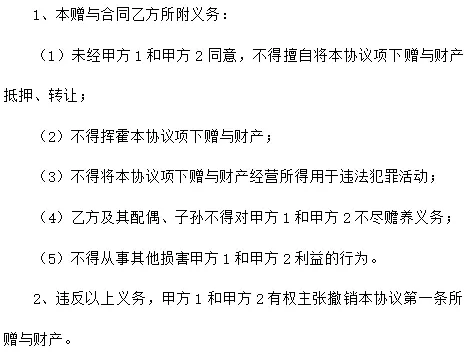
Finally, this approach is only suitable for companies operating in a compliant manner, such as listed companies, or companies with many shareholders and clear accounts. If you encounter an unscrupulous counterparty and a company that does not operate in a compliant manner, be careful that the counterparty may create debts for the shareholders, causing the children to be innocently held jointly liable for the shareholders' failure to make capital contributions or for contributions that are not genuine. The less compliant a company's operations, the more complex the terms that need to be set for equity arrangements, and the specific circumstances must be analyzed on a case-by-case basis.
This article is an occasional piece by Attorney Qu, written as casually as a street vendor hawking melons. Stay tuned for the next installment when a topic of interest comes up!

