
On September 19, a news report surged to the top of trending searches: Zhao Han (an alumnus of Renmin University of China), chairman and co-founder of the well-known restaurant chain brand Yunhaiyao, died at Kunming Tongren Hospital on September 18 after medical treatment proved ineffective following a sudden myocardial infarction. He was only 40 years old.
I was very shocked. I quite liked this brand, and the founder was still very young, one year younger than me. He was at the age for striving. In February this year he stepped down from the position of chairman of Yunhaiyao, and then passed away half a year later. It seems there were also some prior signs.

There are many expressions of regret and mourning online for Zhao Han himself:
"He was an indispensable figure in bringing Yunnan cuisine to the whole country. Too young, too much of a pity."
"Another young entrepreneur has left us. The mental health and physical health of entrepreneurs are truly not easy..."
At around 2 p.m. on September 19, Zhu Haiqin, co-founder and CEO of Yunhaiyao, also posted a tribute: "We are as grief-stricken as everyone else... I will carry forward the agreement I made with Zhao Han, work hard to run Yunhaiyao well, and realize our shared ideal."
From the news, he was young and the illness was sudden, so he probably did not leave a will.
This is all too common in practice. I once encountered two cases involving a struggle for control of a listed company after a father died of a sudden myocardial infarction. Before those cases were resolved, one of the sons also died of a sudden myocardial infarction on his way to a company meeting.
The father died in his seventies and left no will. The son died at around forty and still left no will.
When his wife came to me and told me about his death, she had already given up the right to operate the business and only asked for the value of the equity to be realized in cash according to the share price at that time.
The struggle for control of the company, which had lasted several years and even made CCTV2 news reports, thus came to an end.
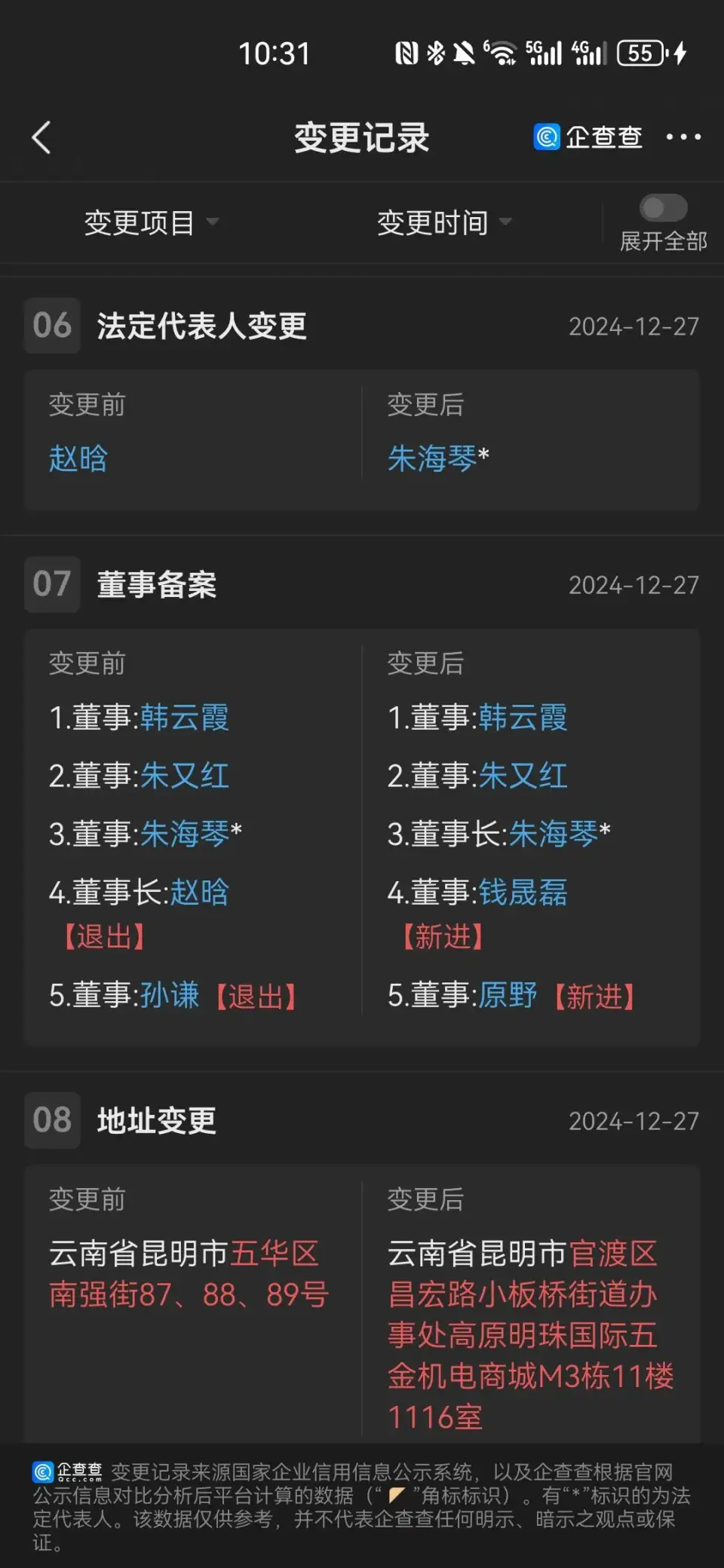
The changes in Yunhaiyao's company registration information also appear to show that a major change had just occurred: the business scope, legal representative, directors, and business address changed on the same day. The reason for the exit may have been that physical abnormalities had already appeared, so he chose to step back and rest, or it may have been a forced exit due to a penalty event (the penalty was announced two months after the exit). The company did not announce this, so it is not known.
Whatever the cause, the founder's physical health and the handling of posthumous matters deserve attention.
I also often think about this: I am a lawyer who handles many inheritance cases and have already entered my 41st year of life. Although the thought often arises that perhaps I should sort out my assets and give some instructions, I am immediately delayed by trivial matters.
Fundamentally, it is simply that I feel it is not yet necessary. On one rare occasion when I actually did it, I told my brother where my money is kept, and he immediately asked me what was wrong. Was I in a bad mood? Or was I feeling unwell? He would not let me continue.
Whether successful people or ordinary people like you and me, this may be the situation we all face.
Therefore, when it comes to posthumous matters, unless they are already imminent, it is very difficult to proceed with them carefully.
Being prepared is always something only those who can persevere will continue to prepare for.
The handling of Zhao Han's posthumous matters should be somewhat simpler than that of many entrepreneurs, because he had just separated from the company, the finances should have been settled, and no issues involving business operations and management are involved; it is more a matter of statutory inheritance of property.
More entrepreneurs who die suddenly face a situation beset by internal and external difficulties: internally, a battle among heirs; externally, shareholders and investors watching closely. Whether the widow and orphans left behind can preserve the family business, whether the spouse can live the rest of life without worry, and whether the children can have guaranteed support—these are all challenges faced in practice.
Therefore, when it comes to inheritance, if it is only the inheritance of assets, it is much simpler; when it involves the inheritance of equity, it becomes a hundred times more complex.
Follow me to learn more about marriage and family law consultations.

