
PART.01
The Incident: A Tragedy That Spiraled Out of Control in an Instant, the Collapse of Three Families
At 18:30 on October 2, 2024, during the evening peak of the National Day holiday, traffic and pedestrians were dense at the traffic-light intersection on Changjiang Avenue in Zhushan District, Jingdezhen City, Jiangxi Province.
Liao Mouyu, aged 20, was driving an electric vehicle with his girlfriend Sun Moumou as a passenger. When they reached this section of road and waited at the traffic light, he argued with his girlfriend over a trivial matter, which left him irritable.
After waiting through several rounds of traffic lights, Liao Mouyu, ignoring his girlfriend's attempts to dissuade him, accelerated through the intersection and continued to increase speed, driving the vehicle on this section, where the speed limit was 40 km/h, to an astonishing speed of 128.96 km/h.
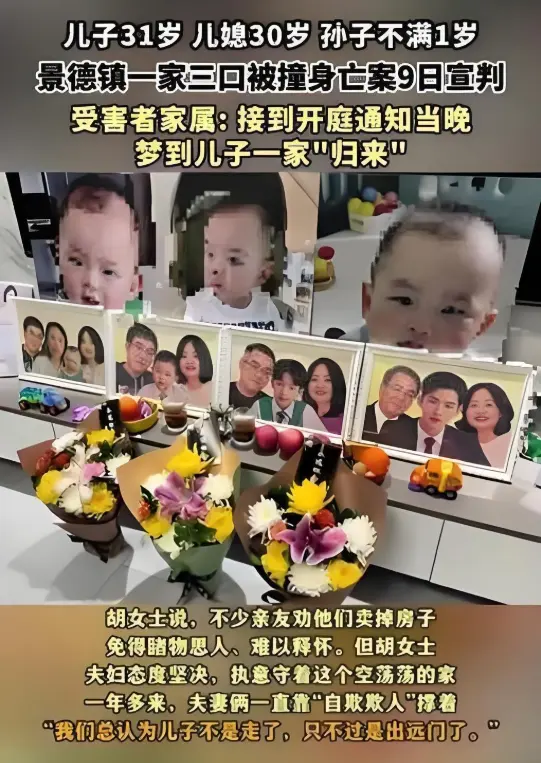
When the vehicle reached a certain intersection, Liao Mouyu spotted Hu Mou, Wang Moumou and their infant son Hu Moumou, who was under one year old and being carried in their arms, crossing the road from north to south. Although he immediately took evasive measures by applying the brakes and turning the steering wheel, the vehicle, because of its excessive speed, went out of control and struck the three of them.
The accident caused the immediate death of the infant son Hu Moumou; the mother, Wang Moumou, died after on-site rescue efforts proved ineffective; and the father, Hu Mou, also died despite being taken to hospital.
After the incident, Liao Mouyu called the emergency services and the police, and waited at the scene to be dealt with. This sudden tragedy plunged two families into everlasting grief — the victim's family members subsequently suffered for a year from depression and stress disorder, shut themselves indoors all day, and fervently hoped that the judiciary would deliver justice for their loved ones.
PART.02
Issues in Dispute and the Court's Judgment: A Precise Delineation of Legal Boundaries
(1) Core Issues in Dispute
Dispute over the characterization of the offense: The prosecution asserted that Liao Mouyu constituted the crime of "endangering public safety by dangerous methods," while the defense argued that it should be characterized as the crime of "traffic casualty." The core of this dispute lies in the characterization of subjective state of mind (intent vs. negligence) and the nature of the conduct (dangerous method vs. ordinary traffic violation).
Dispute over subjective state of mind: Was Liao Mouyu's conduct indirect intent or negligence? Do his subsequent evasive actions and call to the police affect the characterization of his subjective state of mind?
Dispute over the range of sentencing: The victim's family members firmly demanded the death penalty with immediate execution, while the court needed to determine the final penalty by comprehensively considering the circumstances of the crime, voluntary surrender and other factors.
(II) The Court's First-Instance Judgment and Its Legal Basis
On January 9, 2026, after more than two hundred days of trial, the Jingdezhen Intermediate People's Court issued its first-instance judgment: the defendant, Liao Mouyu, was convicted of endangering public safety by dangerous methods and sentenced to death with a two-year reprieve, with deprivation of political rights for life. The court's reasoning was clear and rigorous:
Basis for the conviction: Liao Mouyu had lived in Jingdezhen for many years and knew that Changjiang Avenue was a major urban arterial road with a speed limit; at the time of the incident, which occurred during the evening rush hour on a public holiday, he raised the vehicle's speed to more than three times the speed limit. He had previously shown friends the vehicle's acceleration performance and knew of its acceleration capability, and he continued to accelerate despite the dissuasion of passengers in the same vehicle. Subjectively, he held an indirect intent of "indifference" toward public safety rather than negligence. His conduct created a serious and uncontrollable danger to the unspecified public and was comparable to the statutory dangerous methods of arson and explosion, satisfying the constituent elements of "endangering public safety by dangerous methods."
Determination of subjective state of mind: Liao Mouyu had no prior conflict with the victims and had no direct motive to pursue the result of death; he took evasive measures before the collision and voluntarily called the police after the incident. Accordingly, the court found indirect intent, which is distinct from the direct intent of deliberately endangering public safety.
Sentencing considerations: Although the case caused the especially serious consequence of three deaths, in view of his voluntary surrender (he voluntarily turned himself in and truthfully confessed the main facts of the crime) and the fact that the offense was one of indirect intent, with subjective culpability lower than that of a direct-intent offense, the court did not impose an immediate death sentence but instead applied a death sentence with a reprieve.
It is noteworthy that, after the judgment was pronounced, the victims' family members expressly stated that they would apply to the procuratorate for a protest, and the case may subsequently proceed to second-instance proceedings.
PART.03
Warnings and Reflections: Practical Implications from a Lawyer's Perspective
As a lawyer specializing in traffic accident disputes, I see this case not only as a tragic case but also as one that reflects the core issues and risk-prevention priorities in handling such cases. There has already been ample online analysis of the criminal aspects, so I would like to add a few points on the civil aspects:
(I) Legal Examination of the 800 thousand "buyout compensation": Is the amount sufficient?
In this case, the defendant's family proposed a "buyout of civil compensation" of 800 thousand. In light of Jiangxi Province's 2025 personal injury compensation standards and the serious consequence of three deaths, that amount is clearly insufficient to meet the total compensation calculated under the personal injury standards applicable to traffic accidents. The specific calculation is as follows:
(1) Calculation of core compensation items (based on urban standards and the latest 2025 data for Jiangxi Province):
① Death compensation: all three persons are calculated under the standard for persons under 60 years of age (the youngest child was under 1 year old, and the parents should have been in their prime years). For each person: 47,514 yuan/year × 20 years = 950,280 yuan; for the three persons combined: 2,850,840 yuan;
② Funeral expenses: 47,370 yuan per person × 3 persons = 142,110 yuan in total (calculated based on the average annual wage of employed staff and workers in urban non-private units);
③ Compensation for mental distress: This case is an especially serious criminal case. In accordance with Jiangxi judicial practice, compensation for mental distress for the three deaths is determined at 50 thousand yuan per person, totaling 150,000 yuan;
④ Expenses for handling funeral matters: including lost-work losses, transportation expenses, accommodation expenses, etc., calculated on the basis of 3 persons for 10 days, determined at 30,000 yuan;
⑤ Living expenses of dependents: If the victims have parents who require support or other relatives whom they supported, an additional calculation is required (assuming there are no other dependents, only the expenses for the young child up to age 18 are calculated: 29,070 yuan per year × 17 years = 494,190 yuan).
(2) Estimated total amount of statutory compensation:
The core items alone (excluding living expenses of dependents) already amount to 2,850,840 + 142,110 + 150,000 + 30,000 = 3,172,950 yuan; if living expenses of dependents are included, the total will exceed 3600 thousand yuan.
(II) Reasons why public opinion was ignited after the judgment in this case
800 thousand yuan is tantamount to a drop in the bucket for three living lives and three shattered families.
It should be noted that
this amount is only equivalent to 21.6%–23.5% of the total personal injury compensation, and does not even come close to the bottom line of basic personal injury compensation. The fact that this specific amount emerged suggests that the parties most likely did negotiate the amount of criminal settlement, but the gap was too large.
For family members who have lost their closest relatives, the departure of their loved ones has long plunged them into an abyss of irreparable grief, and their inner world has completely collapsed, and
this insignificant 800 thousand yuan cannot make up for the eternal pain they endure, let alone achieve even the slightest psychological balance.
Therefore, the statement "we would rather not have this compensation" is by no means an impulsive thought, but rather the most instinctive and genuine emotional resonance of the vast majority of people when they empathize with the family's circumstances—
when the amount of compensation is severely disproportionate to the degree of suffering, money loses its compensatory meaning, and upholding justice and pursuing accountability instead become the family's only spiritual support.
What is incomprehensible is that the defendant and their family dared to brazenly propose "800 thousand to buy out three lives." Looking into the reasons behind this, it is not that they disregard the value of life, but rather that they harbor a hidden scheme to exploit legal rules—their claim in fact rests on the special compensation rules for incidental civil actions in criminal cases.
Under the current laws of our country,
in criminal cases, the scope of compensation in incidental civil actions is strictly limited: apart from three special situations—traffic accident cases, state compensation cases, and cases where the parties reach a criminal settlement or mediation—whether an incidental civil action is brought or a separate civil action is brought after the criminal judgment takes effect, the victim's family cannot claim the two core compensation items of death compensation and compensation for mental distress.
This means that once a settlement cannot be reached in the case, even if the court ultimately supports the family's civil compensation claims, the compensation obtainable would consist only of a few items such as medical expenses, funeral expenses, and lost work income for handling funeral matters, and the total amount would inevitably shrink substantially.
Returning to this case in Jingdezhen, this rule became the "confidence" of the defendant's side.
The victim's family consistently and firmly demanded that the defendant be held criminally liable for the crime of endangering public safety by dangerous methods, and the severity of this charge determines that it is difficult for the family, both emotionally and morally, to accept reaching a criminal settlement with the defendant and issuing a letter of forgiveness—after all, forgiveness means a certain degree of absolution for the defendant's conduct, which is an almost impossible psychological leap for a family that has lost three close relatives.
And once settlement is refused, the family can only be placed in the ordinary situation of being "unable to claim death compensation and compensation for mental distress," so the compensation they can obtain is naturally very little.
It is precisely because the defendant's side saw through this that they dared to put forward the "buyout" proposal of 800 thousand, essentially attempting to avoid harsher criminal punishment at an extremely low cost and distorting legal rules into a tool for oppressing the family into compromise.
But the defendant's side clearly underestimated the family's determination to defend justice. Where the compensation amount is severely insufficient and the defendant shows no sincere remorse, the family's choice is almost inevitable: since money cannot heal the pain, they will absolutely not accept this insulting "cheap compensation," and will instead pursue the fullest possible criminal accountability even more resolutely.
After all, for them, making the defendant pay the legal price they deserve for their evil deeds and bringing just consolation to the deceased loved ones is far more important than that insignificant compensation.
If the defendant continues to insist on this extremely low compensation amount and is unwilling to proactively increase the compensation amount or express remorse, this will only further intensify the conflict and make the family members more determined on the path of pursuing criminal liability, with no possibility of concession. Behind this lies not only the family members' defense of the dignity of life, but also their steadfast commitment to fairness and justice, and even more so their strong resistance to the defendant's disregard for life and exploitation of legal procedures.
(III) The Balancing Principles and Risk Prevention in Lawyers' Handling of Cases
In this case, the victim's family members, due to emotional pain, firmly demanded the immediate execution of the death penalty, while the defendant's side, based on circumstances such as voluntary surrender, advocated lenient treatment. The opposing emotions of both sides are acute, which also makes subsequent protest procedures and second-instance proceedings in the case unavoidable.
This situation provides important warnings for lawyers handling cases:
When we handle similar cases, we must not one-sidedly pursue the maximization of the interests of only the party we represent, but must also take into account the reasonable demands and emotional balance of both parties in the case.
When handling such cases involving serious casualties, if lawyers merely intensify conflicts—for example, by exerting excessive pressure on the victim's side, rendering aggressive remarks against the defendant's side, or ignoring the other side's lawful rights and emotional demands—this may trigger strong resistance from the other side: the victim's side may take extreme rights-protection actions, and the defendant's side may refuse to cooperate with mediation, abandon any willingness to compensate, or even push the defendant into a vortex of public opinion, increasing the risk in the second instance of a heavier sentence being imposed on appeal, ultimately causing the case to reach a deadlock. This is not only detrimental to the realization of the parties' rights and interests (for example, it may be difficult for the victim's side to obtain full compensation, and the defendant's side may be unable to seek lenient treatment),
but may also give rise to new disputes or even conflicts.
Professional lawyers should uphold the principle of "rational rights protection and balanced interests": on the one hand, firmly safeguard the parties' lawful rights and interests and clearly explain the legal basis and the reasonableness of the claims; on the other hand, fully understand the other side's emotions and demands and build a bridge to settlement through communication and negotiation—for example, encouraging the defendant's side to actively compensate and sincerely apologize in order to obtain forgiveness, and assisting the victim's side in rationally expressing demands rather than being dominated by emotion. Only in this way can the case be resolved efficiently and fairly while safeguarding the parties' rights and interests, achieving unity of legal effect and social effect.
PART.04
Conclusion
This tragedy in Jingdezhen is the shattering of three families, a painful warning to all traffic participants, and also profound practical guidance for legal practitioners. Traffic safety involves no small matters, and legal boundaries must not be crossed. Moreover, the professionalism and warmth of lawyers are important forces for resolving conflicts and safeguarding justice.
May the souls of the deceased be comforted, and may the living take good care of themselves!
If this article has given you a clearer understanding of the legal characterization of this trending news and of compensation and rights protection, you are welcome to follow, like, and share it, so that more people can understand legal risks and value traffic safety. If you have any questions about the subsequent progress of the case or related legal issues, you may also leave a comment in the comment section, and I will provide you with professional answers!

