
This is my 14th/100th legal commentary article of 2026.
In the rain-soaked cemetery,
all alone,
Koo Jun-yup went to Barbie Hsu's grave regardless of wind and rain; in the footage, he appears filled with longing and a reluctant farewell.
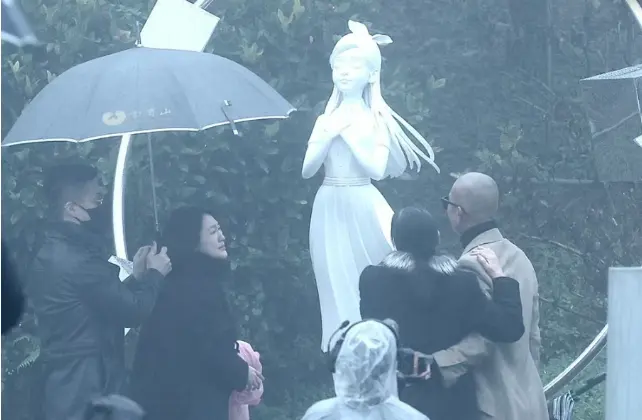
On February 2, as the statue was unveiled to mark the first anniversary of Barbie Hsu's death, netizens only then learned that the moving process described above had been turned into a reality show.
When death becomes a selling point for a reality show, and when the deceased, after passing, is still edited into variety-show clips, is this a heartfelt farewell or naked exploitation? Koo Jun-yup's plan to bring the process of Barbie Hsu's death onto a reality show has sparked discussion among netizens.
As a devoted fan who once never missed any variety show featuring Barbie Hsu, I still want to look at this matter from my professional perspective.

01
When farewell becomes performance: who has the right to decide?

Under Article 994 of the Civil Code, there is a clear order of subjects for protecting the personality interests of the deceased: spouse, children, and parents. All three categories of close relatives have an independent right to request that the actor bear civil liability, but none of them may unilaterally authorize another person to use the deceased's private information, portrait, or other personal information for commercial operations.
As a preliminary guess, Barbie Hsu's mother attended the statue unveiling and likely consented to the filming of this variety show, but Barbie Hsu's children did not attend and, judging from the news, were not even informed.
Imagine this scene: when Barbie Hsu's children are shedding tears alone late at night, they suddenly see footage of their mother's final moments edited into variety-show clips on television, accompanied by exaggerated captions and sound effects. Such a "heartfelt memorial" is, to family members still in mourning, no different from rubbing salt into a wound.
Key legal principle:
- Personality rights are the dignity inherent in every person and must not be casually exploited as life fades. Given Big S's low-key personality during her lifetime, we may infer that she would not have wanted to be discussed in this manner.
- Close relatives (parents, spouse, children) have only the right to seek remedies for infringement; they have no right to authorize recording—this is the final protection for the deceased. Even if Big S's mother and husband consented to the recording, Big S's children would still have the right to seek remedies.
- The deceased's wishes during their lifetime should be the most important consideration. Big S did not expressly state during her lifetime that she did not permit variety shows to be recorded after her death, which leaves room for different interpretations by different people.

02
The children's world: who will protect their childhood?

Even as ordinary people, we can imagine: two young children who have just lost their mother may now have to see their mother's death discussed on television. What impact would this have on their minds?
As minors, Big S's children would need to seek remedies through legal representatives if they wish to do so, but this is not merely a matter of legal procedure.
What the children need is a warm and safe environment in which to grow up, not a family tragedy pursued by the media and discussed by the public.
In psychological research, repeated exposure to traumatic images of a relative's death may cause children to develop post-traumatic stress disorder, anxiety, depression and various other psychological problems.
True deep affection should be gently stroking a child's forehead late at night, not turning their pain into television ratings.

03 The path to seeking remedies: more than a lawsuit—a defense of dignity

(I) Civil litigation remedies
Personality rights infringement litigation
This is not merely a pleading, but a solemn declaration of the dignity of the deceased; every court hearing tells the world: death is not material for entertainment.
Injunction against acts infringing personality rights
An urgent application filed before the program is broadcast is like pulling a runaway carriage back from the edge of a cliff; sometimes, timely legal intervention can avert a lifetime of pain.
(2) Evidence collection—recording the traces of harm
Evidence of infringement: those filming plans and promotional materials record the entire process of exploiting the deceased.
Evidence of damage: media reports and public comments bear witness to how the family's pain was amplified.
Evidence of identity: the names on the household register prove the rights and responsibilities that flow from blood ties.
If Wang Xiaofei were to defend the children's rights, he would likely be discussed, and even criticized, around the time the program is broadcast; all of this constitutes evidence.

04 Voices of history: when the law safeguards dignity

The case of the "Lotus Girl" whose life was written into a novel
A woman who passed away many years ago had her dignity protected by the power of the law; justice may arrive late, but it is never absent.
The case of Lu Xun "endorsing" milk tea
Even a literary giant's image should not become a commercial pawn; dignity should not carry a price tag.
The controversy over "AI resurrection" of celebrities
When technology attempts to "resurrect" the deceased, what we need to consider is: is this remembrance, or is it offense? In The Queen of News 2, after the character "George" played by Ma Kwok Ming dies, he is used as a digital anchor, and the plot prompts exactly this kind of discussion.

05 The intersection of ethics and law: a test of humanity

I hope Koo Jun-yup, and Big S's mother and sister, can ask themselves in the quiet of the night: is this truly a commemoration of Big S? If Big S could still speak, what do you think she would say?
The boundaries of the deceased's dignity
The privacy of the dying process: should not those final moments belong to the deceased and the person she loved most in this world? I think if Big S could still speak, she would say that what she loved most in this world were her two children.
The limits of commercial exploitation: when grief is given a price tag, is remembrance still pure? Personally, I do not like Koo Jun-yup—I very much do not like him, and I have disliked him since Big S announced her remarriage. Although Wang Xiaofei also betrayed her and became one of the causal forces behind her early death, Koo Jun-yup must bear the greatest responsibility for Big S not receiving timely emergency treatment.
Maintaining family relationships
What the children need is quiet comfort, not to be marginalized or made into supporting characters.
Coordination of opinions within the family: everyone grieves in a different way, but respect must be uniform. If the children do not agree, it must not be filmed!

06 If you truly love her, commemorate her this way

Advice for family members who wish to commemorate the deceased publicly:
- Adjust the format: choose a private memorial album rather than a noisy reality show
- Limit the content: treasure the warm moments that only you know about, rather than publicly exposing the final moments of vulnerability
- Obtain everyone's consent: genuinely respect family members' feelings, not merely the constraints of the law
- Psychological assessment: ask the child's psychologist what protection is truly best for them
Advice on safeguarding rights for family members who do not agree to publicly commemorate the deceased:
- Act promptly: before harm occurs, build a protective wall with the law.
- Preserve evidence: what is recorded is not only evidence, but also dignity that must not be trampled upon.
- Choose a strategy: the bottom line must not be violated; you must take up legal weapons, otherwise you will be exploited again and again!

07 Conclusion: Deep affection should not be exploited, and grief should not be put on display

When the camera is aimed at death and grief is turned into a show, what we lose is not only respect for the deceased, but also the basic warmth of being human. True deep affection is silent remembrance; true commemoration is treasuring someone forever in the heart.
The story of Koo Jun-yup and Barbie Hsu could have been a private memory about love and farewell. But once it becomes a reality show, it may become an entertainment product for public consumption. Death should not be edited, and grief should not be rated.
In this era of information explosion, let us together safeguard the emotions that should not be consumed and protect the pain that should not be displayed.
If your family members need legal protection, and if you too face a similar choice, remember: there are many ways to love, but respect is always the first bottom line. Choose the path that lets the deceased rest in peace and the living live in tranquility—that is true deep affection.

