
This is my 32nd legal commentary article of 2026. Today I will share, through the marital conflict between Sun Yang and Zhang Doudou in the recently premiered *Viva La Romance*, a lawyer's take on the dominant party and the person who "gives in to keep the peace" in a marriage. Should they all just get divorced?
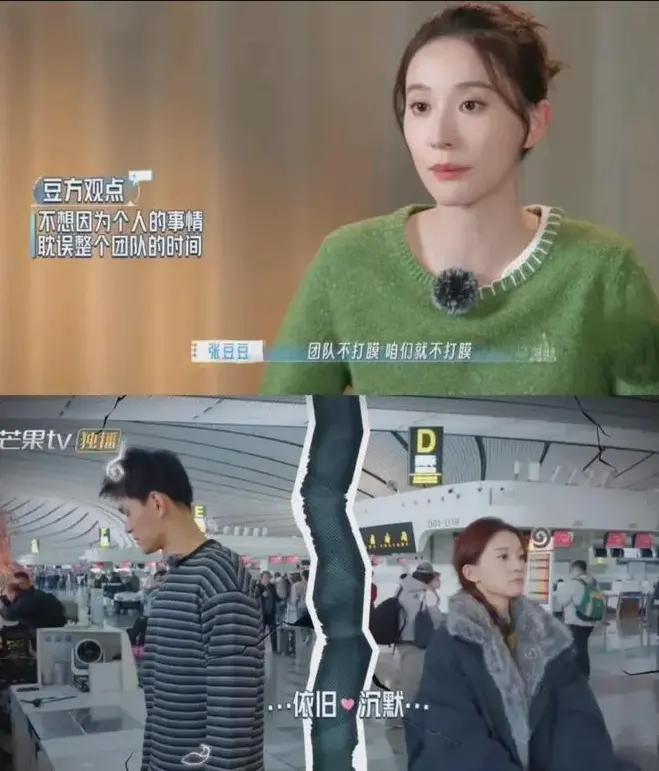
In my years of legal practice, I have observed a thought-provoking phenomenon:
In many marriage consultations, the confusion most frequently raised by female visitors is "why can't he understand me a little more" and "why can't he change for me," yet rarely does anyone ask "how can I improve myself to improve this relationship."
When Zhang Doudou was described by netizens in *Viva La Romance* as "dating down" to accommodate Sun Yang, this discussion reached an interesting point—we seem more accustomed to praising the "lucky ones" who are accommodated, yet rarely consider: is becoming the person capable of "dating down" to accommodate not also a deeper form of marital wisdom?
I. Zhang Doudou's "Dating Down" to Accommodate: Weakness or Wisdom?
In the program, the tolerance Zhang Doudou showed in the face of Sun Yang's stubbornness was interpreted by many as "giving in to keep the peace." But I see another possibility:This accommodation is not passive compromise, but a clear-headed, active choice.
Zhang Doudou was once a member of the national rhythmic gymnastics team and underwent equally rigorous competitive training. When she chose to accommodate Sun Yang, it was not because she did not understand the concept of "equality," but because she understood better than onlookers that the personality formation of a top athlete follows a special trajectory, and that the traits that helped them succeed in competition (persistence, competitiveness, unquestioning self-assurance) can appear out of place in daily life.
Her tolerance is built on a deeper understanding:If someone in the marriage must be the first to "see" and "understand" the other's limitations, she chooses to be that person.
This reminds me of the words of a female client: "I know my husband's need to control stems from his broken childhood. I can choose to argue about it every day, or I can choose to gradually guide him on the basis of understanding. I chose the latter, not because I am weak, but because I know what I want is the growth of the marriage, not just who is right or wrong in the moment."
II. Why Are We Afraid of "Dating Down" to Accommodate?
In our cultural context, "downward compatibility" is often given a negative connotation—as if it implies "marrying down," "suffering indignity," or "lowering one's standards." But when we look at it from a different perspective, this concept has a completely different value in marriage:
Healthy downward compatibility is not self-deprecation, but an "emotional container" within the relationshipJust as an aircraft has an automatic balancing system when it encounters turbulence, a marriage also needs someone who can provide a stabilizing force when the relationship is in turmoil. Ask yourself: can you be downwardly compatible with your parents, siblings, close friends, and colleagues? If you can, then why can't this person be your other half?
The calmness Zhang Doudou showed when Sun Yang lost control over a "face" issue was not because she had no emotions, but because shechose not to let herself be swept away by the other person's emotional vortex.
Many women worry: "If I am always accommodating, aren't I indulging the other person's bad habits?" The key distinction here is:Clear-headed accommodation is not the same as bottomless tolerance.
Observing Zhang Doudou's approach, she gave Sun Yang ample face in public, but clearly expressed her own feelings in subsequent interviews and communicated gently at the appropriate time. This is a kind of "timing wisdom"—knowing when to insist, when to hold back, and when to retreat in order to advance.
III. Women's Growth: From "Demanding to Be Accommodated" to "Becoming the Stabilizer"
I often say this to my female clients:"You can expect your partner to understand you, but you cannot count on him to always understand you. What you can do is cultivate your own ability to maintain inner balance regardless of whether the other person understands you."
This is not blaming women for "having to accommodate everything," but conveying a more fundamental truth about marriage:True security does not come from the other person's flawless behavior, but from your own emotional regulation capacity and your ability to repair the relationship.
\1. From "emotional demander" to "emotional manager"
The essence of many marital conflicts is that both parties are waiting for the other to take responsibility for their own bad emotions. In the program, Sun Yang attributed his negative emotions to Zhang Doudou "not giving him face," which is a typical case of externalizing emotions. A person capable of "accommodating downward," however, first possesses the ability to manage their own emotions—although I am affected by you, my emotional state is ultimately my own responsibility. This is an excellent scenario for separation of tasks.
\2. From "rule enforcer" to "relationship builder"
A domineering personality often establishes "hard rules" in a relationship ("you must listen to me," "you cannot contradict me"), which easily triggers power struggles (athletes, startup founders and others in high-pressure work commonly conflate work and personal life). The ability to "accommodate downward" is reflected in the capacity to establish "soft rules"—influencing the direction of the relationship subtly through one's own behavioral example. Zhang Doudou did not confront Sun Yang head-on arguing over "who is right and who is wrong," but instead demonstrated through action what a more effective way of communicating looks like.
\3. From "changing the other person" to "influencing the relationship"
A cruel truth about marriage is that you can hardly change an adult directly, especially a successful and stubborn adult. But you can change your relationship system by changing the way you interact with the other person. When Zhang Doudou chose to respond to Sun Yang's stubbornness with calm rather than confrontation, she in effect changed the "script" of their interaction.
IV. Five dimensions of growth for becoming a "stabilizer"
I do not advocate rushing to divorce at the slightest marital conflict; on the contrary, I have always held that maintaining a marriage requires wisdom, and that women's self-growth within it is especially crucial—hence the old saying: a good woman benefits three generations.
This is not to make women bear all the responsibility, but to hope that women recognize:No matter where the marriage goes, your growth will always be your most reliable support.
\1. Cognitive growth: distinguishing "his problem" from "my task"
Sun Yang's stubbornness is a matter of his personality, but "how to get along with a stubborn person" is Zhang Doudou's own task. A mature mindset for marriage is this: do not fixate on solving all of "his problems," but focus on handling well "my own tasks."
\2. Emotional growth: raising the threshold of emotional tolerance
Friction is inevitable in marriage, just as Zhang Doudou faced embarrassment when Sun Yang demanded an apology in public. Emotional growth does not mean never getting angry; it means being able to withstand a certain degree of discomfort and not letting oneself be hijacked by momentary emotions into destructive reactions.
\3. Communication growth: from "arguing over who is right" to "building connection"
When Sun Yang insisted on his own view, Zhang Doudou did not argue on the spot; instead, afterward she communicated in a way that said, "I know you care a lot about this, but..." This technique of delayed communication avoided a power struggle and strengthened the emotional connection.
\4. Perspective growth: seeing the vulnerability behind behavior
Behind Sun Yang's "obsession with face" is a longing to be recognized; behind his control over Zhang Doudou's friendships is a fear of having once been betrayed. If one can see through surface behavior to deeper needs, it is not easy to fall into superficial opposition.
\5. Bottom-line growth: compatibility does not mean having no boundaries
True compatibility means "I have the capacity to be accommodating, but I also have clear boundaries." Although Zhang Doudou is accommodating, on matters of principle (such as basic respect and marital loyalty) she inevitably has bottom lines. One of the keys to women's growth is to establish and hold healthy boundaries.
V. The truth of marriage: there is no absolute equality, only dynamic balance
In my years of legal work, the healthiest marriages I have observed are often not relationships that are completely "equal" on the surface, but combinations in which the two parties complement each other in different dimensions and take turns "accommodating" each other at different moments.
Sometimes the wife is the emotional stabilizer, accommodating the husband's impatience; at other times the husband is the rational navigator, accommodating the wife's anxiety.“Downward compatibility” is not a fixed role assignment but a fluid relational capacity.—Today I hold you through your emotional low; tomorrow you support me in my moment of vulnerability.
I recall a prenuptial agreement discussion with the head of a business unit at a leading domestic technology company. When it came to dividing personal property in advance, the woman, who clearly held far less property, said, “I understand this, and I agree to divide the property clearly first.” But when the conversation turned to solutions for problems in the marriage, the man, who held the greater property interest in the marriage, repeatedly patted the woman gently on the arm, then looked firmly at the lawyer and said, “I agree to include some provisions protecting the woman's interests.”
Throughout the process, I observed the shift from initial sensitivity to growing ease as the two interacted with each other. I believe that if their marriage continues in this mode, they will surely pass through the adjustment period quickly and move onto a stable track.
When netizens described Zhang Doudou as “downward compatible,” they may have overlooked one fact: in the long run of a marriage, everyone has moments when they need to be accommodated. Sun Yang's extreme self-discipline in competition is itself a kind of “downward compatibility” with his profession—accommodating training drudgery and physical limits that ordinary people cannot endure. And Zhang Doudou's capacity for accommodation is precisely her distinctive value in this relationship.
Finally, I want to say: you are not an appendage of the marriage; you are your own lifeboat.
As a family lawyer, I have seen too many women waiting to be “rescued” in marital difficulties—waiting for their husbands to change, waiting for their in-laws to understand, waiting for their children to grow up.
I want to say to every woman:Your most reliable lifeboat is not marriage, not a partner, not a child, but your continuously growing self.
Zhang Doudou's “downward compatibility” is not “virtuous forbearance” in the traditional sense, but a modern marital wisdom:I choose tolerance not because I must, but because I am capable of it; I choose understanding not because I am weak, but because I see more comprehensively; I choose to take a step back at certain moments not because I concede defeat, but because I care about this relationship more than about being right in the moment.
This “capacity for compatibility” is not innate; it can be cultivated. It comes from practicing emotional management, from expanding one's cognitive framework, and from countless small choices—choosing to listen first when you want to retort, choosing to stay calm first when you feel wronged, and choosing to understand first when you feel something is unfair.
The significance of women's growth lies precisely here:When the marriage is calm, you are a warm harbor; when the marriage is stormy, you are your own ark. You do not need to become a perfect wife, but you can become a resilient self—able to enjoy the sweetness of the relationship, and also able to avoid sinking when the relationship encounters difficulties.
Of course, I must say: not every man is worth your accommodation.
Your time, energy, and tolerance are all limited and precious resources. To spend them on someone who only knows how to take and never reflects, who takes your tolerance for granted, and who treats your concessions as leverage for further encroachment—that is not wisdom, but self-depletion.
There is also the question of whether a relationship is "worth it."
You have to learn to tell the difference. Behind some people's stubbornness is a sense of responsibility; behind some people's assertiveness is vulnerability; beneath some people's dominance is accountability—while the underlying color of everything some people do is simply selfishness.
How do you identify whether it is worth it?
Let me state the conclusion first: I believe Sun Yang is worth it. He is a person whose actions match his words. His assertiveness, stubbornness, and concern for face were displayed to the fullest in the program, but this is completely consistent with his identity as a world champion and with his upbringing.
He is not two-faced; he does not put on a show outside and change his face at home. Moreover, from the details in the program, he proactively carries luggage, plans for the family, and is willing to listen to Zhang Doudou's opinions on key matters. For such a person, his "problems" are on the table, and his "good qualities" are also real and tangible.
There will certainly be reversals later in the program, which will let us see a more complete picture of this relationship.
Tomorrow I want to analyze specifically: what kind of man is worth your "downward accommodation"? Stay tuned.
After all, the best state of a marriage is never about who accommodates whom, but about two people who keep growing, lifting each other up and moving forward together along the long river of time. And before that, please first become the person who, come wind or rain, can steadily hold themselves up—Then, save your tolerance for the person who deserves it.

