
This is my 57th legal education article of 2026. Today I want to discuss the situation of those who treat the practice of law as a business.
When the news of the LV v. Jasmine Milk Tea case first came out, a friend who regularly reads my WeChat public account sent me a private message saying that I should write about this case too.
I said I am not an intellectual property lawyer (although I have handled one similar case, I do not ordinarily take intellectual property cases), and I had not seen the original first-instance judgment, so I did not know the evidence presented by either side or the court's reasoning, and I did not dare to comment on such a specialized case at will, lest an expert say I was showing off my limited skill before an expert.
Until yesterday, I saw that the Beijing De[masked] law firm representing LV in the case had issued a rumor-refutation statement: the lawyer handling the case does not belong to its firm and has nothing to do with its firm.
However, netizens' anger did not stop. Comments said, isn't there also a Beijing Ying[masked] law firm?
Today, I happened to turn on the television and saw CCTV12's "Legal Lecture Hall," such a long-established and well-known program, sponsored by the Beijing Guan[masked] law firm.
As people within the legal profession, we all know that Beijing Ying[masked] law firm and Beijing De[masked] law firm have a much better reputation than Beijing Guan[masked] law firm. Seeing the sponsorship of "Legal Lecture Hall," I wondered whether this program is also about to be dragged into it?
All of this is attributable to those who treat the legal profession as a business and increasingly hold the discourse power of this industry, while the public does not know this reality. Therefore, these people who treat the legal profession as a business, when facing a group of responsible lawyers whose risk awareness is always switched on, have become ever bolder in order to make money!
I began studying law in 2003, and after graduating from graduate school in 2010, I entered the legal profession.
When I first entered the legal profession, it still operated under an apprenticeship model. I worked solidly on cases under my master for six years. What my master often told me was that a lawyer must at all times feel as if on the edge of an abyss and walking on thin ice. Risk awareness must always come first.
Why do it this way? Because we are craftsmen. We must answer to our clients, cherish our own reputation, and take responsibility for the lawyer's license we worked so hard to obtain after studying law for so many years. This is a lifelong livelihood and also a profession that helps others; do not let people point at your nose and curse you.
My master said he likes being a lawyer because he likes helping others and likes the sense of accomplishment that comes from solving problems. A lawyer should be an expert at solving problems.
I have heard these remarks repeatedly over the past six years (seven years ago I wrote a detailed article on this; those interested can read:Recollections of My Legal Work). So much so that to this day I have come to regard them as my professional habits.
Why do I say the past decade? Because in 2016, I felt the impact of the internet industry on lawyers' work and began working at internet companies in Shanghai; I should count as a lawyer who engaged deeply with the internet industry relatively early.
It was after 2016 that I began to notice more and more specialized marketing talent, operations talent and management talent entering the legal profession, with a very clear goal—to transform the legal profession.
Because they felt the legal profession was too traditional and needed outstanding outsiders to come in and transform it.
It cannot be denied that the entry of these outstanding outsiders genuinely promoted efficiency gains and expansion of the industry's scale in the legal profession (this way of putting it is very much that of a businessperson).
However, far too many corporate personnel have entered the legal profession without having gone through legal study, without having personally helped clients and enjoyed the sense of achievement that comes from it, and therefore without a commitment to fairness and justice, and without bearing responsibility for the law firm and therefore without red-line thinking.
If you open social media, you can see how much advertising and content marketing creates anxiety, packages brands, attracts traffic and visits, and stops at nothing to secure engagements.
There are even engagement arrangements that offer a share of proceeds in order to obtain more engagements. According to leads provided by netizens, Lawyer Li of DeMou Shenzhen Law Firm in Beijing is the general agent for all of LV's litigation cases in China. Netizens say Lawyer Li should be taking a commission from the compensation received.
In a similar case I once handled, my client was a two-person company founded by a husband and wife team, which was sued by an established Danish company. According to the attorney fee payment receipts provided by the opposing lawyer in the evidence of that case, the lawyer charged in advance based on hours worked, not a post-hoc commission as the netizens said.
Of course, there is also a possibility that, in order to have fixed evidence of attorney fee losses at the litigation stage, the lawyer together with his client provided a false engagement contract and attorney fee payment receipts, while actually charging in another manner. This involves criminal liability for providing false evidence to the court; a lawyer with even a slight awareness of risk would not dare to do it, and if a lawyer did dare to do so, he would truly deserve punishment and online backlash.
In a similar case I handled, the defendant was a very small Sichuan enterprise, and the claim amount was 5300 thousand. That figure genuinely frightened my client; he said that even if he were sold, he would not be worth that much money.
I advanced many arguments, and I considered them well founded. There were many grounds, including that the opposing party had no sales records in Sichuan at all and had provided no evidence in that regard—so how could it sue us on the basis of unfair competition by a small Sichuan enterprise?
Below is a screenshot of part of the statement of defense I drafted:
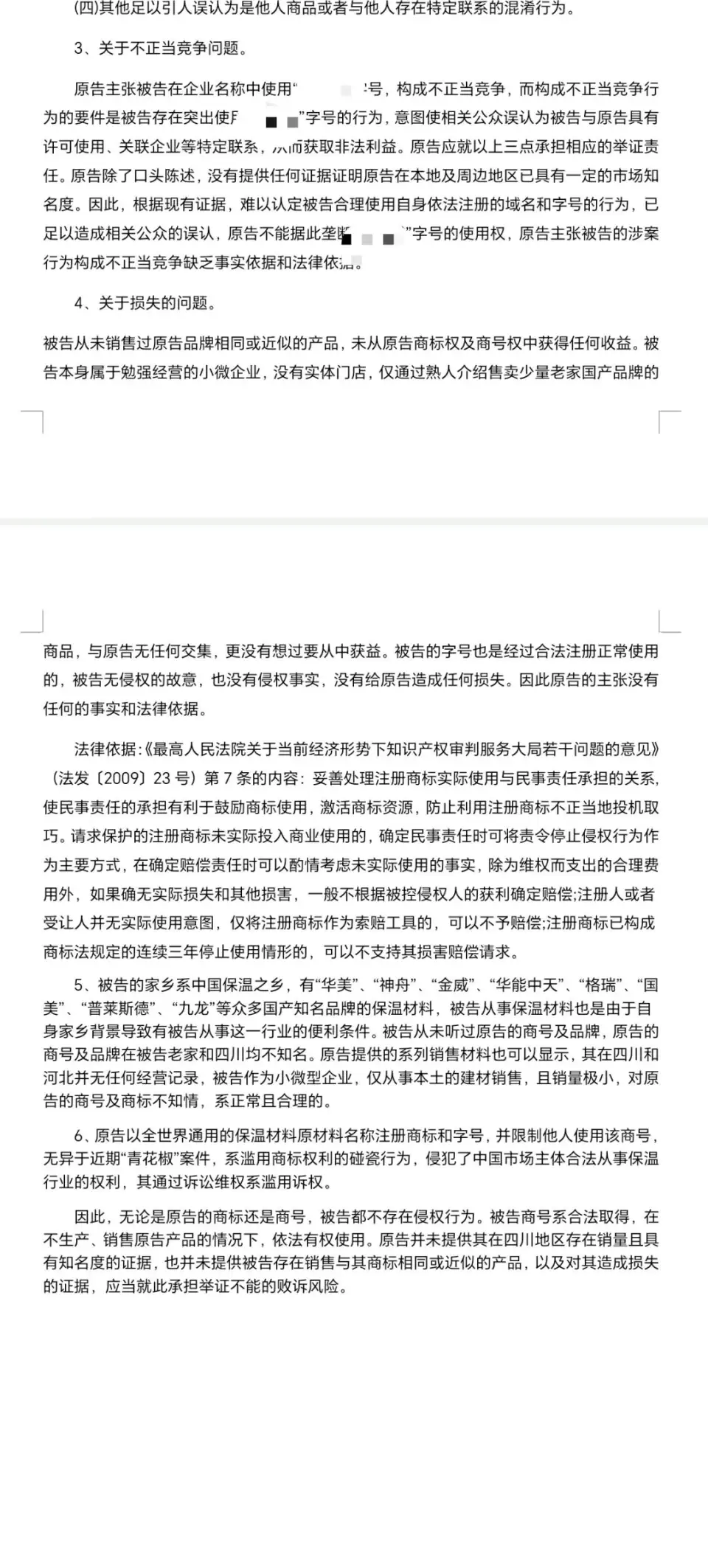
At that time, the intellectual property case concerning green Sichuan peppercorn fish was unfolding vigorously. The court nevertheless replied that no matter how eloquently I argued, I could not change the fact that the opposing party had come to sue on the basis of a prior precedent; unless that prior precedent was changed, the court could only rule against us.
In the end, after weighing the matter, the court awarded 100 thousand in damages. Compared with the claimed amount of 5300 thousand, that was relatively small, but it still left one feeling disappointment and helplessness.
Ultimately, after the judgment, the client chose to waive the right to appeal.
I then alleviated the client's payment pressure by negotiating installment payments with the opposing party, thereby resolving the adverse impact that case had on my client.

From the response of the opposing lawyer's assistant in that case, I could already sense that he did not approve of his own team's approach; even his client had begun to doubt his position.
Indeed, if you are someone who has received years of legal education, you will most likely have your own judgment and will not simply accept your supervisor's work arrangements blindly. Such a person is a lawyer who does not treat himself as a businessperson.
Let us look again at the lawyers or law firms that frequently collapse in scandal: in all likelihood, they are people who switched to law midway from other industries, and so they view this work through a business mindset—as merely a means of making a living.
As an aside, in recent years the green Sichuan peppercorn fish and Chongqing xiaomian cases (see the news for details, which I will not repeat here) have aroused such strong public resentment—should the courts not also reflect on their own adjudicative problems? My guess is that this is largely caused by the insensitivity that comes from outsiders managing insiders.
Returning to the point: when I saw the sponsorship naming of "Legal Lecture Room" this morning, I had the idea that I must write this article.
Regardless of how many people may see it, please choose fellow lawyers who have faith in the law and a clear awareness of red lines.
Those who treat legal practice as a business are very likely, when they encounter obstacles, to abandon you because the business is no longer worthwhile!
Or they may focus only on winning the case and fail to give you risk warnings; they may not even be aware of reputational risks such as those associated with LV!
This is an article teaching you how to identify and screen lawyers, and nothing more.

