
This is my 64th legal education article of 2026. Today I will share my thoughts on the recently much-discussed Shanghai "extramarital embryo case": where exactly does its complexity lie?
Ms. Zhu (Zhu) of Shanghai, the wife who has cancer and has a daughter from the marriage, discovered that her husband and a third party useda forged marriage certificateto complete assisted reproduction registration at Zhongshan Hospital, affiliated with Fudan University, and to cultivate frozen fertilized eggs (which were not transferred). Ms. Zhu, holding the genuine marriage certificate, asked the hospital to destroy the embryos but was refused, and therefore sued her husband, the third party and the hospital on a personality rights dispute; before the hearing, she also received a summons showing that her husband had filed for divorce in Wuxi. At present, the Xuhui District People's Court of Shanghai has held a hearing but has not yet ruled, and the embryos are sealed and kept in custody by the hospital.
Many netizens ask: why does the wife not divorce? Why does she not directly pursue the husband's criminal liability for bigamy?
Why? Because in a divorce, the property has not yet been clarified, and the husband is uncooperative. She knows that her time is limited and that she may not live long enough for the property to be clarified slowly; the matter would then become inheritance, and the child is still a minor, so how could the inheritance be clarified? Even if it were clarified, once the wife dies, the husband would become the child's sole guardian; would he then misappropriate the property the child inherits?
These questions are complicated even to think about; even without illness, one might not be able to sort them out clearly. How much more so when her life may be nearing its end?
I once handled a similar case: the child's mother was seriously ill and the father paid no attention. The child's mother instructed me to file for divorce. In order to obtain a faster property division result, and with the husband unwilling to divorce, we conducted a mediation for division of marital property during the marriage.
After obtaining the mediation statement, the child's mother told me that she had notarized her will and appointed her close friend as executor, so she could go for her last surgery with peace of mind; whether the outcome was good or bad, she could enter the hospital with peace of mind.
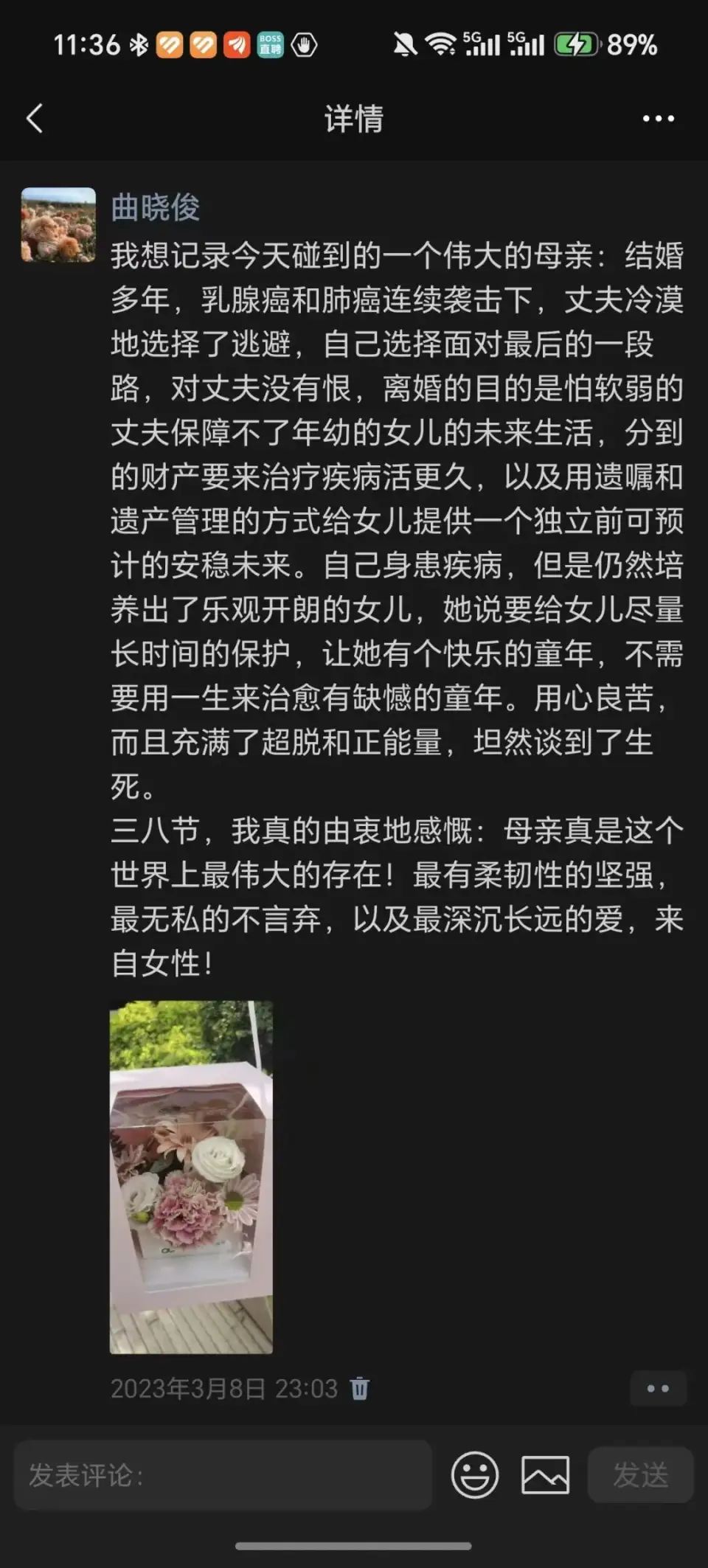
The above case is solved, but how is the Shanghai "extramarital embryo case" to be solved?
Next, I would like to use my experience and knowledge to break down for readers the complexity of this case and the solution I see.
I. The cause of action chosen is a personality rights dispute, and the claim to destroy the frozen embryos simply cannot be achieved!
Choosing a cause of action in personality-rights dispute, for the wife, serves no purpose other than to make things difficult for the hospital.
The hospital need only defend itself; it has no ability to verify marriage certificates, so its past conduct involved no intent or gross negligence, and it will not continue embryo transfer before a future judgment is determined, so the hospital has committed no tortious act.
A personality-rights dispute requires a tortious act, resulting damage, and causation between the two; in this case, it cannot even get past the threshold element of a tortious act and will be dismissed.
The proper path is instead:
Regarding the disposition of frozen embryos, the claim must be based on the medical services contract; the husband plus the third party versus the hospital are the two sides of the assisted reproductive medical services contract.
The wife neither signed nor provided gametes, so formally she is not a party to the contract.
But she is not a bystander—she proceeds on the basis ofa victim of spousal rights in the marriage relationship,a party whose personality interests (the tranquility of family ethical identity) have been harmedand, as plaintiff, asserts that the medical contract should be void because the underlying facts were falsified and its purpose is contrary to ethics.
Legal basis for asserting invalidity:
- Article 153 of the Civil Code: A civil juristic act that offends public order and good morals is void; an act that violates mandatory provisions is likewise void. During a marriage, obtaining assisted reproductive services by forging a marriage certificate not only undermines the mandatory order of the Administrative Measures for Human Assisted Reproductive Technology concerning admission of "married couples," but also breaches the ethical bottom line of marriage and family.
- Article 8 of the Civil Code: Civil activities must not offend public order and good morals.
Legal consequences after a contract is void:
Under Article 157 of the Civil Code, after a contract is void, "property acquired under the contract shall be returned; where return is impossible, compensation shall be made at the property's value." However, frozen embryos are not ordinary objects; the mainstream judicial view classifies them as"special ethical objects,"and they cannot be ordered "returned to the original spouse"; they can only enter the disposal stage:
The contract is void from the outset → the man and the third party's "legitimate right of disposal" over the embryos based on that contract loses its foundation.
Since the hospital no longer has a contractual obligation, it has the right to stop services, continue cryopreservation, and, under explicit judicial instructions and in accordance with assisted reproductive technology norms,destroy or permanently discardthe embryos, rather than automatically "waiting until divorce and then laundering the arrangement for transfer."
If the man and the third party claim that "the embryos were created from our sperm and eggs, so ownership belongs to us," the court will examine: recognition of ownership does not equal recognition of the contract's validity, and embryos obtained unlawfully do not automatically acquire lawful eligibility for transfer merely because of their biological source. Therefore, the man and the third party cannot prevail in litigation concerning the already-frozen embryos.
The wife's winning point is not 'I have the right to destroy the embryo,' but rather 'this embryo was an illegal product from the very channel of birth, and the law should not give it a second chance at legalization.'
II. The Risk of 'Re-marriage Whitewashing' in the Divorce Timing Gap
In the news report, the wife said that when she walked into the courtroom, she had just received notice of the husband's divorce filing. She said, 'I will not divorce before the embryo is destroyed.' This was not out of spite; she had done the calculations.
Netizens who casually talk about divorce should take a look at how many factors a real divorce requires consideration of:
1. The assets in this case have not yet been clarified, and there is a high probability that the husband has already transferred most of the assets; clarifying this will take time.
2. Investigating transferred assets is very complicated, and assets already transferred into another person's name cannot, in practice, be adjudicated in divorce proceedings; a separate action is required. A separate action in turn requires leads on the assets, and obtaining evidence is extremely difficult.
3. In this case, the wife's illness is severe, and whether she can endure until the outcome of the lengthy process of clarifying the marital property is highly doubtful.
4. If the wife passes away before judgment while the marital property has not yet been clarified, the matter becomes an inheritance dispute. The other disputing party—the husband—becomes the child's sole legal guardian. Would he investigate himself for the child's benefit?
5. If the wife endures until the marital property is clarified, obtains a favorable judgment on all claims, can enforce it into her own name, and smoothly transfers it to the child, then one can only pray that her illness reverses and that she lives a long life—at least until the child reaches adulthood and can dispose of the property himself or herself. Otherwise, as long as the child remains a minor, there is a risk that the property will be misappropriated by the sole legal guardian.
6. If the wife passes away, the husband obtains the right to remarry and can lawfully conceive embryos anew with the third party and have new children. The invalidity brought about by the fake certificate is thoroughly washed away by the timing gap of 'divorce/widowhood + remarriage.'
7. This is the chain the wife fears most: fake-certificate embryo (invalid and sealed) → prolonged divorce/widowhood → remarriage with a genuine certificate → embryo revived or new embryo created → extramarital child becomes a marital child.
8. A child born after the husband's remarriage through embryo transfer (or through new conception) is, as regards the father—the husband—children born within the marriage, enjoy the same statutory inheritance status as Ms. Zhu's biological daughter.
9. After Ms. Zhu's death, the portion of the estate in her name inherited by her biological daughter will in the future face the following: if the man's remarried spouse (the former third party) infiltrates the asset pool corresponding to the original wife's estate through inheritance, gifts, joint loan repayment, or other means, the original wife's daughter's share may be diluted or even directly deprived. In remarried families, it is all too common for a stepmother to move assets out piece by piece like ants moving house!
10. The "power overload" of the father, who is also the legal guardian: the original wife dies → the man is thesole legal guardianof the minor daughter or the adult daughter who is unable to care for herself + administrator of the estate. At this point: the mother's estate (which should protect the daughter in a trust-like manner) becomes property at the father's disposal; if the father is partial to his remarried family, there is a risk of transfer, misappropriation, or disposal at a low price; relying solely on the principle of "the best interests of the ward" under Article 35 of the Civil Code, post-hoc accountability is costly and proof is difficult.
III. How can the original wife lock down the property?
Use voluntary guardianship as a "separation-of-powers lock."
The standard course of action for a family lawyer should be:During the original wife's lifetime, establish voluntary guardianship + a will + a family trust/insurance trustEven without a trust, a dedicated account can be opened for the child.
- Voluntary guardianship: the original wife designates a trusted third party (relative or friend/lawyer/trust institution) to take over personal affairs if she becomes incapacitated, separating powers from the father;
- Will: expressly provide that the mother's estate is inherited by the daughter personally, excluding any involvement of the husband through spousal agency in ordinary family affairs;
- Trust or dedicated account: place the property income and cash into a trust or dedicated account, under which the father may only receive a supervisory remuneration and may not dispose of the principal. If the father infringes upon the child's interests, the designated guardian may deprive the father of guardianship.
- In this way, even if the father remarries or even encounters problems in a future political review, the daughter's property will not be siphoned off by the remarried family.
IV. The Other Side of the Bigamy Charge: The Child's Involvement in Political Review
Some argue that the man forged a marriage certificate and underwent IVF with a third party in the name of husband and wife, which is suspected ofbigamy(living together in the name of husband and wife while having a spouse). But the wife has practical concerns:
- If the man is criminally convicted, it will indeed affect certain political review scenarios for him and the children living with him;
- But if the man's criminal record is established, for the wife's biological daughter, the father's prior criminal record may likewise be regarded as a "criminal record of a family member" in specific political reviews;
- Therefore, the wife may not necessarily want to "send him to prison," but rather to "destroy the embryos, preserve the property, and keep the child from being dragged down."
In a marriage case, the wife's rationality is not revenge, but isolating the innocent child from the father's mistakes.
Looking at this case as a whole, the solution is to use a set of institutions to check and balance one another and protect the interests of the innocent child:
- The validity of the medical contract is at issue, and it is holding the fate of the embryos hostage;
- The pace of the divorce proceedings is holding hostage whether the husband can remarry;
- The right to remarry is holding hostage whether the child born outside the marriage can be legitimized;
- Inheritance law plus guardianship law are holding hostage whether the original wife's daughter's money will be devoured by the father's remarried family;
- The criminal-law threshold for bigamy also leaves the original wife wavering between "punishing the husband" and "protecting the daughter."
Each link has a legal basis, and each link is counteracted by another link.
Once it is clearthat each party has its own calculations, the task is to design a system to untangle the knot—locking in the interests of the most innocent parties (the original wife's daughter, and even the child born outside the marriage who may in the future be instrumentalized) through a combination of measures: voluntary guardianship, trusts, wills, challenges to contract validity, and divorce defenses.
A marriage can break, and blood ties can be schemed against, but a child's interests must not become the small change in adults' power games.
The content of this article is for case analysis only and does not constitute advice on any individual case. If you wish to discuss an individual case, you may communicate via comments or direct messages (WeChat and mobile phone share the same number: 18721502447).

