

“The purpose of handling cases is to extract money.”—So said the director of a local police station in a certain case.
This article is an original work by Attorney Shao Shiwei. It reflects only the author’s personal views and does not constitute legal advice or a legal opinion on any specific matter. For article reprints, legal consultations, or professional exchanges, please add: sswls66
On August 6, 2024, the Supreme People’s Procuratorate released to the public the key case-handling data of procuratorial organs nationwide from January to June of this year. Regarding the “Procuratorial Protection of Enterprises” special campaign, the head of the Case Management Office of the Supreme People’s Procuratorate stated thatprocuratorial organs are closely monitoring and addressing profit-driven law enforcement and judicial practices, and are strengthening oversight over the use of criminal measures to intervene in civil and economic disputes.According to reports, in the first half of this year, procuratorial organs supervised the initiation or withdrawal of nearly 500 case filings in enterprise-related criminal matters. The People’s Procuratorate of Qingdao City, Shandong Province, in accordance with the law,supervised the public security organs to withdrawa cross-provincialcriminal case filing for contract fraud, unfroze more than RMB 110 million in corporate account funds, and six police officers were disciplined.
In April 2021, the Party Committee (Expanded Meeting) of the Ministry of Public Security also emphasized the need to carry out in-depth special rectification of persistent and entrenched problems within the public security system,and include prominent issues such as irregular cross-jurisdictional law enforcement and case handling, and profit-driven law enforcementwithin the scope of rectification.
In judicial practice, in crypto-related cases, or more broadly, in economic crime cases, judicial authorities in certain regions do indeed engage in profit-driven law enforcement. Because crypto-related cases typically involve substantial amounts of funds, they represent a typical category.
Why do we reflect on and study this topic? In the course of handling criminal cases over many years, I have observed that in some cases, from a jurisprudential perspective, no matter how one analyzes the conduct for which the client is charged, it clearly does not constitute a crime; nevertheless, the case is initiated under a charge that appears tenuous. Moreover, such cases often share many similarities, for example:
The company or project sponsor involved demonstrates sound economic performance and operates smoothly;
The individual has consistently believed that their operations were compliant and never contemplated that their conduct might involve suspected illegal or criminal activity;
The so-called victims are unknown to the staff of the company involved, and the amounts reported by the victims are not high;
A significant proportion of these cases are filed and investigated by public security organs in other jurisdictions, with cross-provincial arrests;
Although the company has a large user base, only one victim has filed a report, and the victim’s place of residence coincides with the location of the public security organ that filed and is investigating the case.
Authors: Shao Shiwei and Bao Jie, Attorneys at Law
01
Related Cases
1. The Liang Liang Case in Wuxi
According to publicly available information[i], the case involves the CoinXP trading public chain and the Hubdex community-based decentralized exchange. The case initially came to light on February 26, 2021, when the Wuxi public security authorities sourced leads online and initiated an investigation under the charge of illegally using information networks. The charges were changed multiple times during the proceedings. Ultimately, on March 22, 2023, the prosecuting authority amended the indictment to charge the offense of organizing and leading pyramid-selling activities. The indictment alleges that the case involved “more than 50,000 users, forming over 100 pyramid-selling communities distributed across 32 provinces, municipalities, and autonomous regions nationwide, with more than 100 levels, and the digital currencies involved amounted to a total equivalent to RMB239 millionOn December 27, 2023, the Xishan District People’s Court issued its judgment in the Liang Liang case. Because Liang Liang refused to plead guilty and accept punishment, the court imposed a severe sentence of ten years’ imprisonment, a fine of RMB 20 million, and confiscation of all user assets on the platform. Case information disclosed by the attorneys representing Liang Liang and by his family members is publicly accessible.


Their lawyers previously issued"Liang Liang's Family Offers Reward for 'Xishan Witness' Wang Fengtao", indicating that both the family members of the defendant and their lawyers harbor significant doubts as to whether the public security organ that initiated the case filing and investigation had proper jurisdiction.

2. The Fil Miner "Interstellar Alliance" Case
According to disclosures by the attorneys representing the parties in this case[ii], the Investigation Report attached to the Indictment Opinion issued by the Public Security Bureau of Feng County, Xuzhou City, Jiangsu Province, found that: Since June 2019, three suspects, seeking illegal profits and after repeated premeditation, registered and established Xingchi Company. Under the pretext of "implementing blockchain technology and IPFS distributed storage to mine FIL," they employed deceptive means such as false advertising and promises of high returns to attract numerous individuals to purchase mining machines as a cover, while requiring members to pay entry fees... The organization involved six levels and 24 tiers, with the total amount involved in the case exceedingRMB 2.3 billion.
Their lawyers believe that the figure of RMB 2.3 billion may be the most attractive aspect for the handling authorities. Before the case was filed in Feng County, reports were made to the Shanghai Public Security Bureau. After investigation, the Shanghai Public Security Bureau concluded that the business model did not constitute the crime of organizing or leading a pyramid scheme (the company had also repeatedly sought expert opinions internally, confirming that its business model did not involve pyramid selling). After the incident occurred, four of China's most renowned legal scholars also unanimously concluded that the conduct did not constitute the crime of organizing or leading a pyramid scheme.
3. Gambling-Related Case Involving a Voice Chat Platform
On April 21, 2024, Banban, a voice chat platform, published on its official WeChat account aNotice of Suspension of Operations.
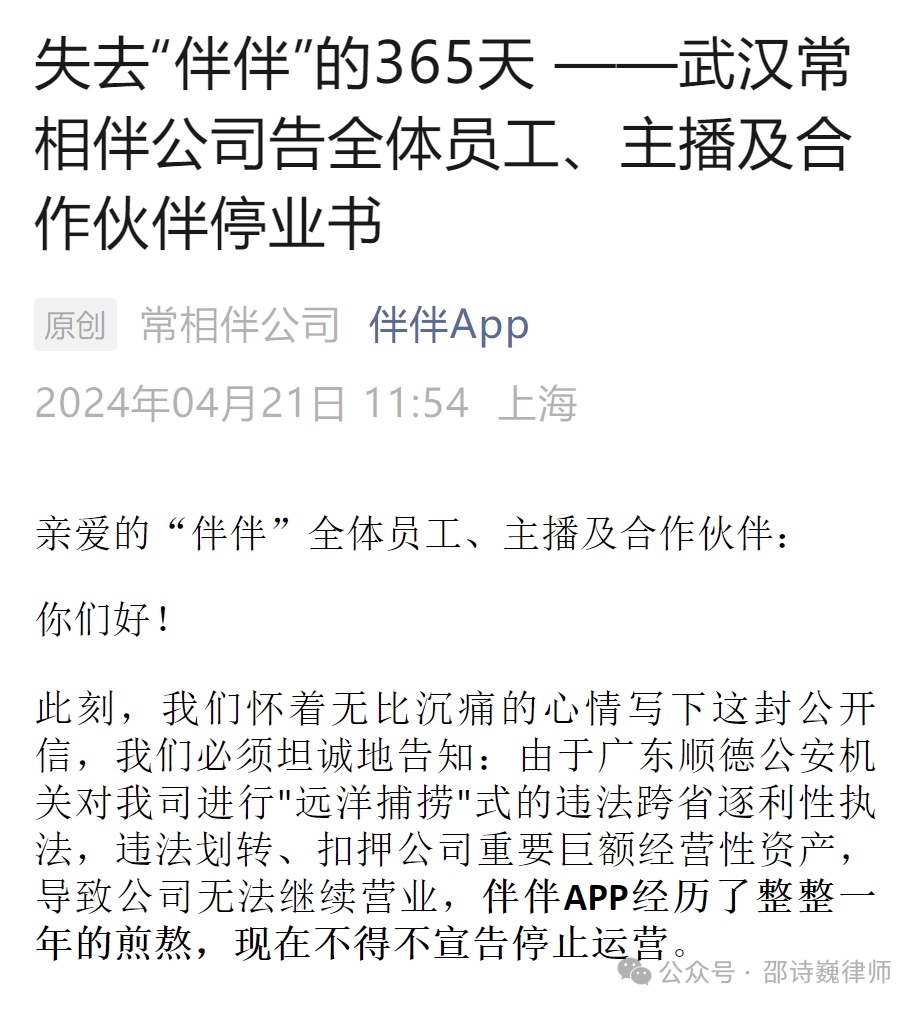
The statement read: "The Public Security Bureau of Shunde District, Guangdong Province, engaged in unlawful cross-jurisdictional, profit-driven law enforcement akin to 'open-sea fishing.' On April 17, 2023, the Shunde Public Security Bureau, alleging that the 'Banban' App was suspected of the crime of operating a casino, forcibly detained 25 company employees. In addition to the forced transfer of RMB 300 million, RMB 20 million in personal funds belonging to company shareholders was also forcibly transferred. As a result, the wages of all 1,600 employees, as well as the lawful earnings of hundreds of thousands of platform streamers and partners, could not be paid, leaving hundreds of thousands of individuals who depend on the platform for their livelihood in a state of destitution."
02
Why does "profit-driven law enforcement" occur?
"Profit-driven law enforcement" generally manifests as [iii], including arbitrary charges and fines by judicial organs, disputes among different public security organs over jurisdiction, fabrication of jurisdiction, cross-regional arrests, unauthorized deduction of funds in violation of regulations, and embezzlement of property.
The root cause of this phenomenon is insufficient funding for judicial organs.
Lv Dewen, an associate professor at the Center for Rural Governance Studies of Huazhong University of Science and Technology, conducted more than half a month of field research at a county-level public security bureau in central China to study this issue, providing an authentic record and analysis of the background underlying the logic of "profit-driven law enforcement."

(Image source [iv])
In the article, Professor Lv stated: "It was beyond our imagination that the Public Security Bureau had become so financially strained that it had to generate revenue through law enforcement to cover its operational costs." "The director of a local police station said that his most important task was to 'find resources to keep the operation running.'"
ThereforeUltimately, this is an economic calculation.
The article notes that, in addition to the salaries and allowances of formal police officers, other expenses (such as wages for temporary staff, kitchen costs, office expenses, housing provident fund contributions for police officers, medical insurance, and overtime pay) must be self-funded. After the implementation of the new fiscal policy, only 50% of the self-raised funds submitted to the treasury are returned to the Public Security Bureau. Thus, if a police station requires RMB 1 million annually to maintain operations, it must generate RMB 2 million in fiscal revenue each year. This so-called fiscal revenue consists of fines and confiscations.
Where does the revenue from fines and confiscations come from? It can only come from cases that generate economic benefits.
In 2022, media reports [v] indicated that, in a ranking of the year-on-year growth in fine and confiscation revenue for 2021 compared to 2020 among prefecture-level cities nationwide, six of the top 14 prefecture-level cities were located in Jiangsu Province. Relevant personnel stated that "the primary reason for the significant increase in fine and confiscation revenue was the rise in revenue from major and serious cases."
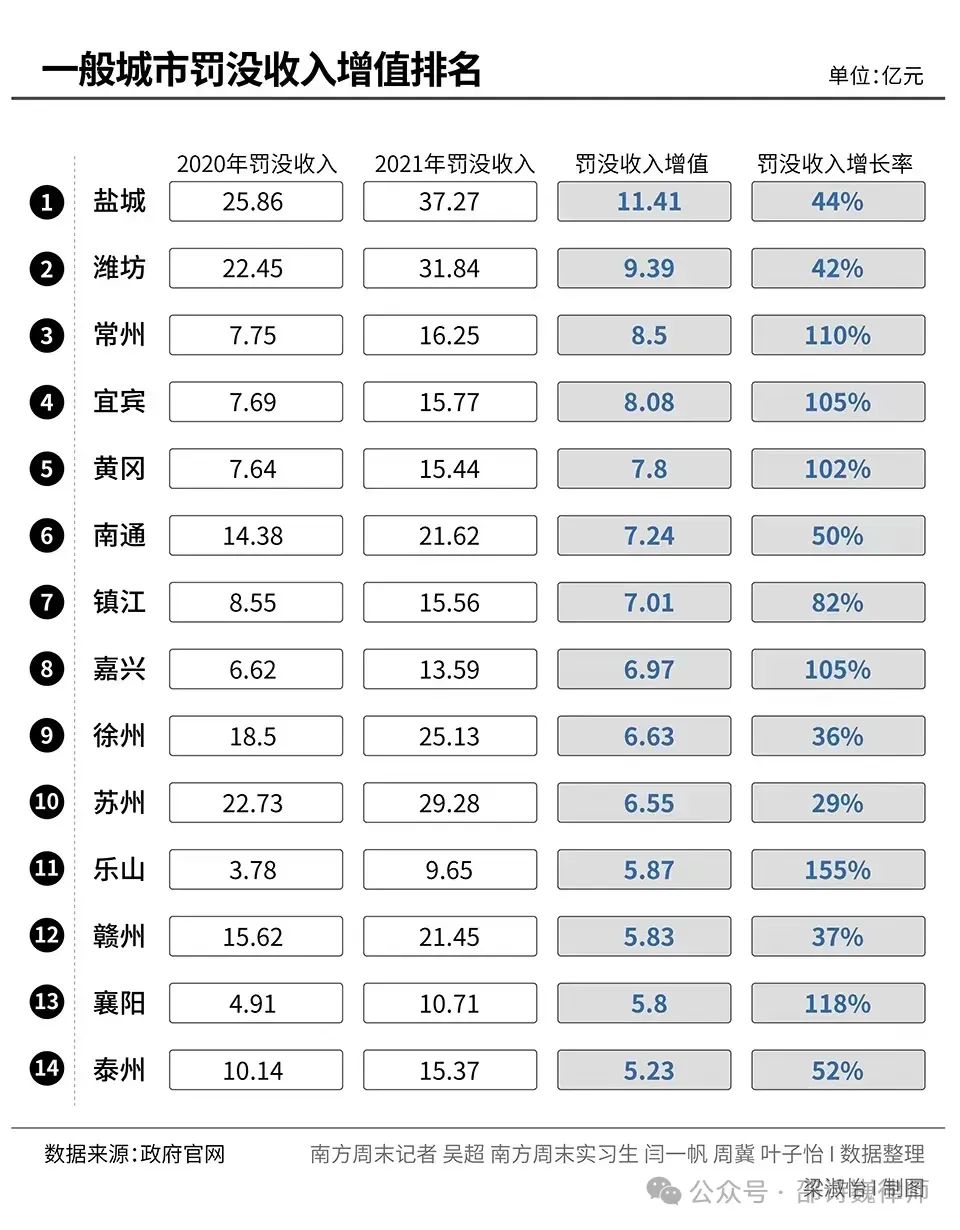
(Image source: Southern Weekly)
03
Necessity and Countermeasures for Addressing Profit-Driven Law Enforcement
Under fiscal pressure, case-handling authorities are compelled in practice to prioritize cases from an economic-efficiency perspective. Taking public-order cases handled by grassroots law-enforcement units as an example, the vast majority of such cases do not generate economic benefits—such as neighborhood disputes, brawls, and petty theft—yet these matters are closely tied to the daily lives of ordinary citizens. By contrast, cases involving prostitution and whoring, and crowd gambling can generate economic benefits, leading grassroots units to demonstrate greater enthusiasm in handling vice- and gambling-related cases. Where case-handling authorities face pressure to “generate revenue,” ordinary cases within their jurisdiction inevitably receive inadequate attention and remain unresolved for prolonged periods, while public-security organs devote more resources and focus to proactively identifying effective leads from other regions and conducting cross-regional arrests and case handling.
For private enterprises whose executives and actual controllers are arrested by public-security organs from other provinces in cross-provincial operations, the company may face a rupture in its funding chain, inability to continue operations, forced shutdown, and large-scale employee unemployment.
Although the State has issued multiple regulations to protect private enterprises, including the Seven Provisions Prohibiting Profit-Driven Law Enforcement by Public Security Organs, the Six Strict Prohibitions on Cross-Regional Case-Handling Cooperation, the Notice on Further Strictly Regulating Case-Handling Cooperation in Accordance with the Law, and the Work Plan for the Special Campaign on Judicial Protection of Private Enterprises, the current state of judicial practice indicates thatprofit-driven cross-regional law enforcement has not diminished despite the promulgation of these regulations.
How should the problem of profit-driven law enforcement be addressed?An honorary advisor to the China Criminal Law Research Association proposed four recommendations:
First, at thelegislative level, strengthen remedial measuresRemedial provisions must be improved at the legislative level, and practical measures must be established to address this phenomenon; prohibitions are only feasible when accompanied by penalty provisions.
Second, it is essential to ensure thatall property involved in cases is remitted to the central treasuryBecause, although regulations prohibit retaining proceeds for the case-handling authority, once funds are returned to local treasuries, local governments may still link case proceeds to law-enforcement budgets to varying degrees and through various means, merely introducing a degree of flexibility compared with the previous one-to-one allocation. Remitting all proceeds to the provincial-level treasury would increase control, but failure to remit them to the central treasury would still make it difficult to avoid localist tendencies.
Third,funds for case handling shall be uniformly allocated by the central fiscal authorities.If the case-handling funds of judicial organs are tied to local governments, the problem of local protectionism will never be resolved. Such funding must be decoupled from local control and placed under unified central management.
Fourth,appropriately increase resources for judicial fundingto meet demands, which is the fundamental issue. Appropriately increasing the amount of funds for case handling in the national fiscal budget is the basis for ensuring that judicial organs effectively perform their functions.
04
Conclusion
The issue of profit-driven law enforcement is not only a pain point in the construction of the rule of law; it undermines the authority of the law, erodes public trust in judicial fairness, distorts the normal operation of the market economy, and has a negative impact on social ethos. Therefore, addressing the issue of profit-driven law enforcement is not only necessary but also urgent.
On April 19, 2024, Yao Jinbo, a deputy to the National People’s Congress and Chairman and CEO of 58.com, shared a letter of appreciation issued by the Supreme People’s Court. The letter stated that during deliberations, Mr. Yao proposed: strictly standardize the approval procedures for cross-regional law enforcement and judicial activities; remit fines and confiscated funds to the central fiscal authorities, thereby fundamentally resolving profit-driven law enforcement and judicial practices by local political and legal organs, and better protecting the legitimate rights and interests of private entrepreneurs; and strictly standardize measures such as detention and border controls, so as to enhance the security of entrepreneurs and reduce interference with the normal business operations of enterprises. The Supreme People’s Court indicated that these suggestions were instructive and targeted, holding significant importance for the work of the people’s courts, and that they would be carefully studied and actively improved upon in future work.
We also look forward to a rule-of-law environment free from profit-driven law enforcement, and a society in which everyone can develop freely under the protection of fairness and justice. This is not only respect for the law, but also responsibility to the people and a commitment to the future.

Recommended Reading