Essential knowledge for crypto projects expanding overseas!
Generally, some small-scale blockchain projects may, in the early stages,register only one technology company, primarily used for developing and maintaining blockchain technology, as well as for paying developer salaries, renting office space, paying for software subscriptions, and accumulatingintellectual property rightsand other operational tasks. This technology company is usually registered in the country or region where the founders are located,,as this facilitates team management, salary payments, and enjoyment of tax incentives.
For larger-scale blockchain projects, especially those involving multiple business lines, it is advisable to establish separate technology companies for different business activities. If the project involves commercial operations, marketing, and revenue models, consider registering an independent commercial company to handle commercial affairs.
If the project conducts business globally, it may be necessary to register companies or branches in different countries to comply with local regulations and meet operational needs.
Once a project decides to issue tokens, the project party needs to establish a separate token issuance entity,primarily for the following four reasons:
-
Facilitating fundraising. It allows investors to clearly identify which company will be designated in the investment documents;
-
Preparing legal opinions for token listings. Since most token listing platforms require a legal opinion on the token, and in most cases, such a legal opinion cannot be prepared without a registered legal entity;
-
Mitigating regulatory risks. Some countries and regions impose strict restrictions or bans on the issuance and trading of tokens. Jurisdictions that welcome blockchain technology do not necessarily welcome token issuance, such as mainland China;
-
Tax planning. Since token issuance may involve substantial profits, selecting jurisdictions with favorable tax rates to separately establish a token issuance entity will reduce the tax burden.
When establishing multiple companies, the natural question arises regarding how to structure the architecture to facilitate the management of these entities. A common and mature framework is illustrated in the diagram below for the OK Group:
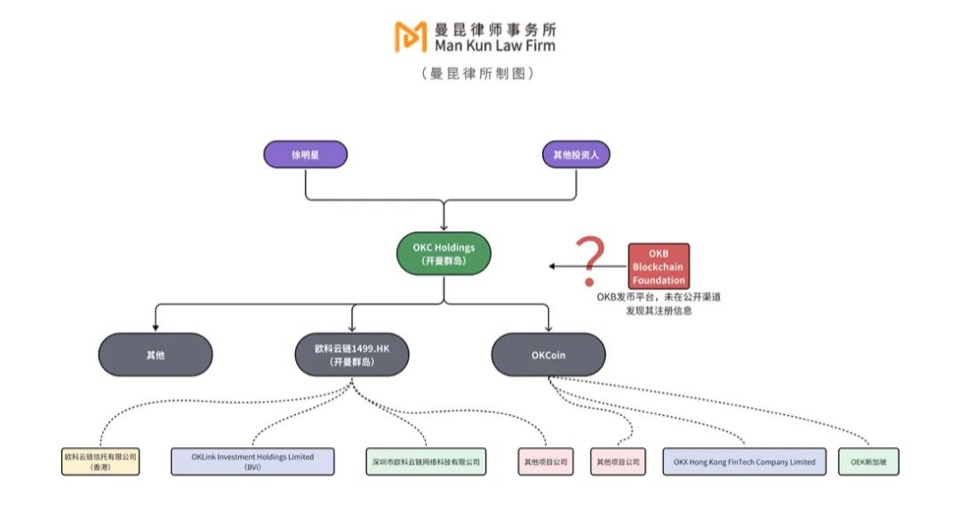
This structure has been simplified by Attorney Jin from Mankun Law Firm
Based on publicly available information,OKLinkOKC Holdings, the parent company of OKLink (formerly OKEx Chain) and OKCoin, is registered in the Cayman Islands. Xu Mingxing became the largest shareholder and actual controller of OKC Holdings through multiple offshore companies registered in the BVI. Subsidiaries of OKLink, i.e., specific project companies, include OKLink Trust Limited (Hong Kong), OKLink Investment Holdings Limited (BVI), Shenzhen OKLink Network Technology Co., Ltd., etc. Subsidiaries of OKCoin include OKX Singapore, OKX Hong Kong, OKX Brazil, etc., established according to actual business needs.
Additionally, the OK Group established a foundation specifically for its token issuance. However, Attorney Jin from Mankun Law Firm did not find information regarding the partnership structure of this foundation through public channels, but speculates that the partners likely include certain offshore companies within the OK Group's equity structure as well as some individual investors.
Other project parties can fully refer to the OK Group's structure and combine it with their own needs to build their multi-layered architecture.
Although the aforementioned structures are centralized corporate architectures and legal measures adopted to achieve centralized management, in some blockchain projects, founders still adopt the form of a Decentralized Autonomous Organization (DAO) for community governance and other issues to achieve 'decentralized autonomy.'
However, if the DAO form relies solely onsmart contractswithout any legal appearance,DAO members face the legal risk of being considered a general partnership, whereby DAO members would bear unlimited liability for its activities.For instance, in the case of the U.S. Commodity Futures Trading Commission (CFTC) v. Ooki DAO, since Ooki DAO had not formed any legal entity, the judge held that OOKI Token holders, by voting with governance tokens to influence the outcome of Ooki DAO governance proposals, could be deemed to have voluntarily participated in Ooki DAO governance and thus bear personal liability for the DAO's actions.
Therefore, incorporating a company for the DAO protects DAO members from potentially endless judicial, tax, financial, and other liabilities. Simultaneously, the establishment of a company standardizes the DAO's financial management procedures, such as ensuring Anti-Money Laundering (AML) and Know Your Customer (KYC) procedures for grants distributed from the DAO Treasury.
Whether a blockchain project should establish one or multiple companies is a highly practical compliance issue that requires consideration of multiple factors, particularly requiring careful attention to legal regulation and fiscal/tax matters. With the next crypto bull market approaching, if you are also preparing to expand overseas and navigate the challenges, it is advisable to consult professional compliance experts for tailored advice.
Recommended Reading
Web3.0 Going Global: Introduction to Japan's Blockchain Industry Regulatory Policies
Web3 Project Compliance: Why Choose a Cayman Foundation for Token Issuance?
How to Handle Compliance for Web3.0 Project Entrepreneurship in China?

{loadmoduleid 245}

To submit articles or request reprint permissions, please add WeChat ID: MankunLawFirm