Programmer’s Business Income Confiscated for “Circumventing the Great Firewall”: Is Scientific Internet Access Truly Safe?
By Mankun Law Firm
AI summary
Preface: This article provides legal argumentation and analysis only. The author’s conclusions do not constitute encouragement or support for any actions by readers. Readers must independently assess actual legal risks and bear responsibility for their own conduct.…
Contents
Preface:This article provides legal argumentation and analysis only. The author’s conclusions do not constitute encouragement or support for any actions by readers. Readers must independently assess actual legal risks and bear responsibility for their own conduct.
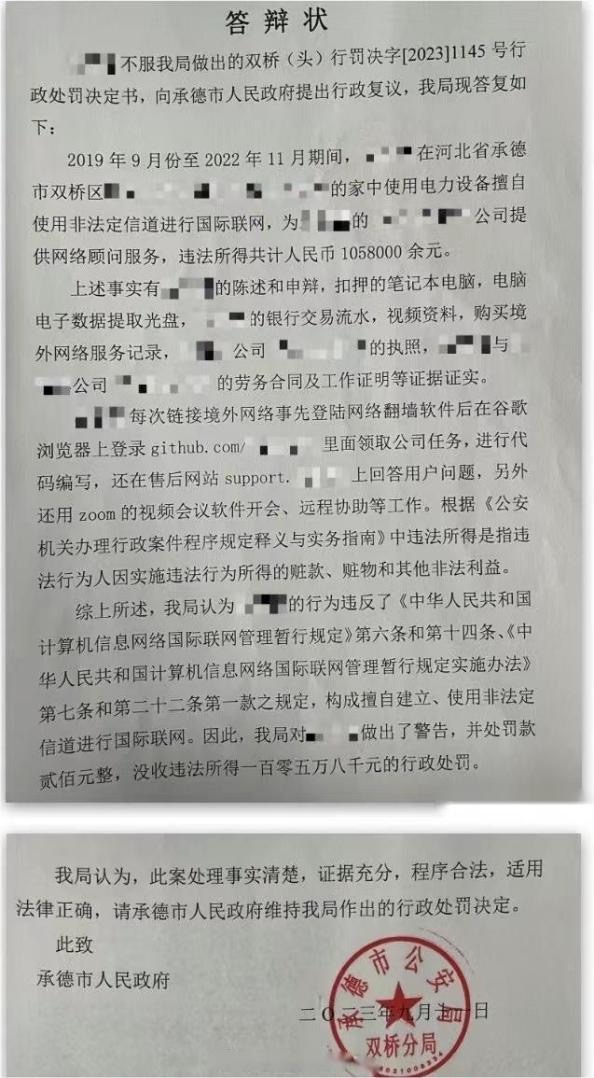
In September of this year, a post on Weibo claimed that a programmer was deemed to have committed illegal acts by public security authorities in Chengde because he wrote code for overseas companies on the overseas internet platform GitHub and used overseas software such as Zoom for work by “circumventing the Great Firewall.” His “illegal gains” of more than RMB 1 million were confiscated.(Image source: Internet)This incident attracted significant attention, particularly within the technology sector and among tech entrepreneurs. As a legal practitioner, Attorney Liu wrote an article about “circumventing the Great Firewall” (scientific internet access) a year ago (“Using VPNs and Other Tools to Circumvent the Great Firewall: Are There Legal Risks?”). Interested readers are welcome to offer criticism and corrections.This article provides a brief analysis of the administrative penalty imposed by the Chengde public security authorities, focusing primarily on two issues: First, is scientific internet access safe? Or is it illegal? Second, do income from lawful labor or business operations obtained after engaging in scientific internet access constitute “illegal gains”?
01Is Scientific Internet Access Illegal?Attorney Liu believes that scientific internet access isnot illegal.。The basis for public security authorities’ penalties for circumventing the Great Firewall is Article 6 and Article 14 of the Interim Provisions on the Administration of International Networking of Computer Information Networks (hereinafter referred to as the “Interim Provisions”), which came into effect on May 20, 1997, and Article 7 and Article 22 of the Implementation Measures for the Interim Provisions on the Administration of International Networking of Computer Information Networks (hereinafter referred to as the “Implementation Measures”), which came into effect on February 13, 1998. The substance of these two regulations is consistent:When conducting international networking in China, one must use the international gateway channels provided by the state public telecommunications network.Violations may result in fines of up to RMB 15,000 and confiscation of illegal gains.However, the aforementioned two provisions are not laws. Even if violated, the conduct constitutes at most a regulatory violation, not illegality. While this may seem like an irresponsible sophistry, if analyzed rigorously, Attorney Liu believes that the primary bases for concluding that circumventing the Great Firewall is not illegal are as follows:
(1) No laws, administrative regulations, or departmental rules prohibit circumventing the Great Firewall
Terms such as “circumventing the Great Firewall” and “scientific internet access” are not legal concepts, nor are they technical concepts within the internet industry. They are more akin to colloquial internet terms spontaneously adopted by netizens. A somewhat reliable explanation is that the Great Firewall of China (GFW) blocks certain overseas websites, and mainland citizens wishing to access them must bypass the barriers set by the GFW, analogous to climbing over a wall in the physical world.A thorough review of Chinese laws, administrative regulations, and departmental rules reveals no provision explicitly prohibiting circumventing the Great Firewall. Even the Interim Provisions and the Implementation Measures merelyprohibit citizens fromusing channels other thanthe international gateway channels provided by the statefor international networking. In other words, if citizens access overseas websites through the state’s official international channels, such conduct is entirely permissible.Clarification is needed here:Accessing the foreign internet from within China is entirely lawful.The fact that some websites are blocked and inaccessible does not mean that successfully accessing them is illegal. For example, individuals may freely access the official website of the U.S. government, but cannot normally access websites such as Google, Twitter, or YouTube. However, if by chance you inadvertently land on the pages of Google, Twitter, or YouTube, rest assured that you have not broken the law (after all, former editor-in-chief Hu Xijin and former Foreign Ministry spokesperson Hua Chunying both have their own Twitter accounts).Of course, our premise is that the accessed foreign web pages containno content involving violence, terrorism, pornography, political reactionism, etc.If domestic websites contain such content,accessing those domestic websites is also illegal.。
(2) The Interim Provisions penalize the unauthorized establishment of physicalcommunicationchannels
The Interim Provisions were first implemented in February 1996 and revised in May 1997. The GFW project began as early as 1998, and the term “firewall” did not appear until 2002.The “international gateway channels” stipulated in the Interim Provisions could not encompass future methods of bypassing GFW censorship, such as VPNs. Furthermore, the international gateway channels specified in the Interim Provisions can only bephysical channels.This is confirmed in the Implementation Measures:Article 3 of the Implementation Measures states: “International gateway channels refer to the physical channels used for international networking.”What is a physical channel? By definition, it must be at least tangible and corporeal. Common examples include international cables (land or submarine), international optical fibers, and international satellite communications.Only if you bypass the state-designated international networking channels and privately establish the aforementioned physical channels for international networking do you violate Article 6 of the Interim Provisions and Article 7 of the Implementation Measures, thereby incurring corresponding administrative penalty consequences.
(3) Current circumvention activities still conduct international networking through lawful channels
Some legal professionals argue that even if the “international gateway channels” in the Interim Provisions are limited to physical channels, this does not circumvent the requirement of Article 10 of the Interim Provisions: “Those requiring international networking must conduct such networking through access networks... Those requiring access to access networks must obtain consent from the access provider and complete registration procedures.”Consequently, they still consider circumventing the Great Firewall to be illegal.However, Attorney Liu believes that as long as the individual does not privately establish physical channels for international networking, but instead accesses the network through existing lawful internet service providers (such as China Telecom, China Unicom, China Mobile, etc.), subsequent lawful internet access—even to foreign websites (excluding content involving pornography, violence, terrorism, political reactionism, etc.)—constitutes lawful conduct.Because even if a user enables a VPN or other proxy tools, global mode may still allow unrestricted access to the entire internet. At this point, if someone claims that accessing Baidu is lawful while accessing Google is illegal, that would indeed be somewhat absurd. In such cases, even if the user bypasses the GFW’s censorship mechanisms to access Google, the connectionis still made through the international gateway channels provided by the three major telecom operators,meaning thatit is conducted through lawful channels.Unless you privately lay a submarine cable or launch a communications satellite for international networking, which would be expressly prohibited by the Interim Provisions and the Implementation Measures.At this point, astute readers may have realized that the core issue is not the method used to access the foreign internet, but rather the specific content accessed on the foreign internet. If you circumvent the Great Firewall to watch Ultraman, Pleasant Goat and Big Big Wolf, Boonie Bears, or SpongeBob SquarePants because you are tired of endless advertisements on domestic video sites, there is no problem. However, even without circumventing the Great Firewall, viewing content involving pornography, violence, terrorism, or political reactionism on domestic websites is illegal.02Does Overseas Income from Lawful Labor or Business Operations Obtained After Scientific Internet Access Constitute “Illegal Gains”?The reason the case of the programmer in Chengde attracted public attention was not merely that he was penalized for circumventing the Great Firewall, but that the public security authorities classified his entire labor income of over RMB 1 million as illegal gains and confiscated it. Is this reasonable?We have seen the defense statement submitted by the public security authorities during administrative reconsideration, circulated online, which stated the rationale for classifying the programmer’s labor income as illegal gains: “Illegal gains refer to illicit money, illicit goods, and other illegal benefits obtained by perpetrators through the commission of illegal acts.” From a lawyer’s perspective, this defense statement is quite rudimentary:
(Image source: Internet)
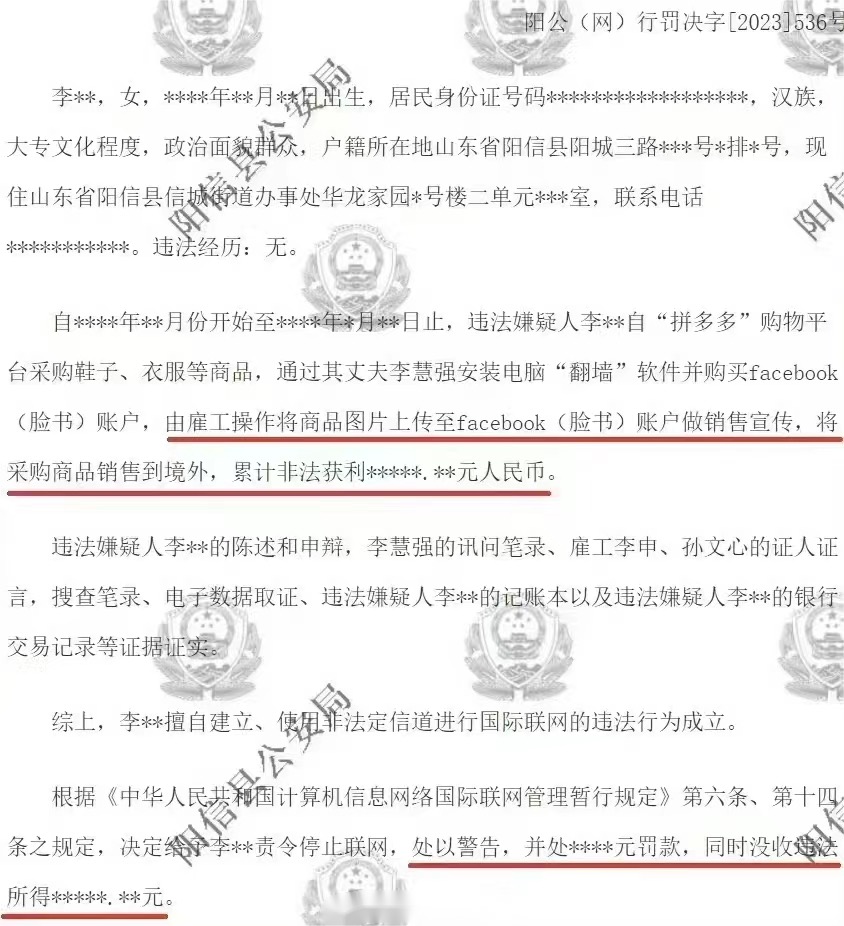
First, the Interpretation and Practical Guide to the Procedural Provisions for Public Security Organs Handling Administrative Cases is merely a book on legal practice; it does not constitute a law, administrative regulation, or departmental rule, and thus cannot serve as a statutory basis for law enforcement;Second, the content cited by the public security authorities merely explains what constitutes illegal gains; it does not demonstrate that this programmer’s income qualifies as illegal gains;Finally, even interpreting illegal gains according to the public security authorities’ citation as illicit money obtained through the commission of illegal acts, this programmer’s income of over RMB 1 million was not derived from the act of circumventing the Great Firewall, but rather from remuneration received for coding and providing after-sales support services for overseas companies.Following the logic of the Chengde public security authorities, income earned by physically traveling abroad to work—whether washing dishes, running a restaurant, or writing code—should be subject to confiscation. Or consider this example: Zhang San evades train fares to travel from Location A to Location B to sell grilled gluten. Because Zhang San arrived in Location B through illegal means, should all income he earned in Location B be confiscated?Attorney Liu believes that as long as the work is lawful, the income is lawful, and taxes are paid in accordance with Chinese law, such income constitutes private property protected by Chinese law and cannot be expropriated by anyone under any pretext.03Theoretical Dilemmas and Reality of Law EnforcementAlthough the foregoing analysis appears extensive, is it practically useful in real life? Regrettably, most public security authorities currently still classify the act of circumventing the Great Firewall via virtual channels (such as using VPNs) as illegal. They may also classify income earned from business activities conducted while circumventing the Great Firewall as illegal gains. The image below shows an administrative penalty decision from Yangxin County, Shandong Province, in which Ms. Li was administratively penalized by public security authorities for selling goods on Facebook by circumventing the Great Firewall, and her illegal gains were confiscated.(Image source: Internet)However, the current reality of law enforcement does not mean that such enforcement standards are correct. Individuals who disagree with penalty decisions may seek judicial relief through statutory avenues, such as filing for administrative reconsideration or initiating administrative litigation. For law enforcement agencies, it is essential to accurately understand the meaning of the relevant provisions of the Interim Provisions and the Implementation Measures.1997TheInterim Provisionswere enacted26years ago. Whether they can still adapt to current social realities, and whether further interpretation, amendment, or abolition is necessary, are matters that relevant departments must consider and actively advance.The essence of the internet is connectivity, sharing, and freedom; it is a tool that benefits humanity. Due to practical considerations such as national security and political stability, some countries restrict internet use, which often receives understanding or support from the majority of their citizens. However, such restrictions must be implemented within a lawful and compliant framework. If certain regulations have been substantially obsolete due to the passage of time, or if the regulations themselves are unlawful (so-called “bad laws are not laws”), then just as citizen Sun Zhigang sacrificed his life to bring about the abolition of the Measures for the Custody and Repatriation of Urban Vagrants and Beggars, we hope that the numerous practical disputes in current cases will prompt the authorities to clarify the meaning of Article6of the Interim Provisions and Article7of the Implementation Measures at an early stage, or simply abolish clauses and regulations that have long become outdated.


(Image source: Internet)