

Prepare for the worst to ensure the best cooperation
Special Disclaimer:
This article is an original work of Mankun Law Firm. It represents only the personal views of the author and does not constitute legal consultation or legal advice on specific matters. For permission to reprint this article, please contact Mankun Law Firm staff at: MankunLawFirm
Posing the Question
In previous legal awareness initiatives by Mankun lawyers, it has been established that arbitration offers greater advantages than litigation in resolving disputes involving virtual currencies. Under the New York Convention, arbitral awards enjoy recognition and enforcement in more than 150 countries and regions, offering strong confidentiality benefits that help preserve commercial relationships. Given the current domestic environment in mainland China, where investment and trading in virtual currencies are prohibited or receive limited or no protection, domestic arbitration is neither considered nor recommended, bringing international arbitration into focus.
In international arbitration, the rule-of-law cultures of Singapore and Hong Kong, which blend Eastern and Western traditions, are particularly favored. Should one choose arbitration in Hong Kong or Singapore? This article compares the Hong Kong International Arbitration Centre (HKIAC) with the Singapore International Arbitration Centre (SIAC) to provide reference for participants in the cryptocurrency industry when selecting an international arbitration institution.
What Are the Benefits of Arbitration?
The Hong Kong International Arbitration Centre defines arbitration as follows:Arbitration is a dispute resolution method based on the agreement of the parties.Specifically, the parties agree to submit their dispute to an arbitral tribunal composed of one or three neutral arbitrators appointed by or on behalf of the parties.
So, what are the benefits of international arbitration? The main advantages include:Neutrality, flexibility, time and cost efficiency, strong confidentiality, enforceability,enforceability, and finality of the award.
-
Neutrality。When drafting arbitration clauses, parties may freely choose a neutral seat of arbitration.
-
Flexibility.Parties may participate in selecting arbitrators and agree on applicable procedures, language, and governing law.
-
Time and Cost Efficiency.Due to the flexibility of arbitral procedures and the finality of awards, resolving disputes through arbitration is often faster than court litigation or other dispute resolution methods, and typically incurs lower costs than court proceedings.
-
Confidentiality.Arbitral hearings are conducted privately, and awards are generally not made public. Therefore, disputes do not become public knowledge, helping to maintain commercial relationships.
-
EnforceabilityEnforceability。Without appropriate bilateral treaties, enforcing foreign court judgments can be difficult. In contrast, under the New York Convention, to which more than 150 countries and regions are party, each member state undertakes to recognize and enforce arbitral awards made in other member states.
-
Finality of the Award.Arbitral awards are generally final and not subject to review on the merits, thereby avoiding lengthy court appeal processes.
Where Should Arbitration Be Held?
Queen Mary University of London, in collaboration with White & Case LLP, conducted a survey from October 2020 to March 2021 and published the "2021 International Arbitration Survey: Adapting Arbitration to a Changing World." The 2021 Arbitration Survey shows that the top five most preferred seats of arbitration are London, Singapore, Hong Kong, Paris, and Geneva. The five most preferred arbitration institutions are the International Chamber of Commerce (ICC), the Singapore International Arbitration Centre (SIAC), the Hong Kong International Arbitration Centre (HKIAC), the London Court of International Arbitration (LCIA), and the China International Economic and Trade Arbitration Commission (CIETAC).
Accordingly, we select two typical international arbitration institutions for comparison—the Hong Kong International Arbitration Centre and the Singapore International Arbitration Centre—to serve as a reference for choosing an international arbitration institution.
1. Characteristics and Advantages of the Hong Kong International Arbitration Centre (HKIAC)
First,Regarding reputation, location, facilities, and secretariat experience:The Hong Kong International Arbitration Centre is an arbitration institution highly regarded in Hong Kong in the field of international arbitration. It maintains a prominent status in international arbitration due to its favorable arbitration experience. Located in the prosperous, open, and international metropolis of Hong Kong, it boasts modern arbitration facilities and, most importantly, an international and experienced secretariat.
Second, the Hong Kong International Arbitration Centre has leading arbitration rules that are efficient and cost-effective. The HKIAC Administered Arbitration Rules 2018 (hereinafter referred to as the "2018 HKIAC Rules") are currently the most modern and comprehensive arbitration rules on the market. Their main features include:
-
Optional methods for payment of arbitrators' fees.Parties may choose between two methods: charging based on hourly rates, or charging based on the amount in dispute. The second method, based on the amount in dispute, accommodates the payment habits of parties from mainland China, making the Hong Kong International Arbitration Centre more attractive to parties from mainland China and enhancing its competitiveness.
-
Greater flexibility in handling complex cases.Hong Kong's legal system is derived from the common law tradition. The 2018 HKIAC Rules grant maximum flexibility to the parties. The HKIAC adopts a "light-touch" management model, meaning it intervenes minimally in the conduct of arbitral proceedings unless necessary.
-
Greater efficiency in handling complex cases.Comprehensive provisions regarding the joinder of additional parties, consolidation of arbitral proceedings, and the initiation of single proceedings under multiple contracts enhance efficiency. The application of the 2018 HKIAC Rules improves flexibility in handling complex cases, allowing disputes arising under multiple contracts to be heard in a single arbitration.
-
Provision for emergency arbitrator procedures.The HKIAC Rules provide for emergency arbitrator procedures to allow applications for enforceable urgent interim relief during arbitral proceedings. Although mainland China does not recognize emergency arbitrator procedures due to differences in judicial systems, the emergency arbitrator procedure offered by the Hong Kong International Arbitration Centre holds significant advantages in jurisdictions that recognize such procedures.
Third,The Hong Kong International Arbitration Centre possesses unique advantages in handling disputes involving China.
-
Ability to obtain preservation measures in mainland China. As HKIAC arbitrations are international arbitrations, the Arrangement Concerning Mutual Assistance in Court-Ordered Interim Measures in Aid of Arbitral Proceedings by the Courts of the Mainland and of the Hong Kong Special Administrative Region, signed between mainland China and Hong Kong and effective from October 1, 2019, gives the Hong Kong International Arbitration Centre an advantage over other international arbitration institutions in preserving assets in mainland China during arbitration.
-
Extensive experience in handling cases involving mainland China. Data shows that the Hong Kong International Arbitration Centre is the international arbitration institution that handles the highest number of cases involving parties from mainland China.
-
Leading record in recognition and enforcement in mainland China. The track record for enforcement of HKIAC awards in mainland China is excellent; Chinese courts have refused to enforce only three HKIAC awards to date. Hong Kong is a party to the New York Convention, meaning Hong Kong arbitral awards can be enforced in more than 150 contracting states. However, separate provisions govern the recognition and enforcement of arbitral awards between Hong Kong and mainland China, namely the Arrangement of the Supreme People's Court on Mutual Enforcement of Arbitral Awards between the Mainland and the Hong Kong Special Administrative Region effective February 1, 2000, and the Supplemental Arrangement concerning Mutual Enforcement of Arbitral Awards between the Mainland and the Hong Kong Special Administrative Region (hereinafter referred to as the "Supplemental Arrangement"), signed by the Supreme People's Court of China and the Hong Kong Department of Justice on November 27, 2020, among other bilateral judicial assistance agreements.
In summary, the Hong Kong International Arbitration Centre not only possesses advantages in arbitration enforcement, preservation measures, and case experience in mainland China that other international arbitration centers lack, but it has also made a series of positive and beneficial attempts in providing legal protection for virtual currencies. While building on legal recognition, efforts continue to explore and experiment with how virtual currencies can develop in an orderly and beneficial manner. Thus, the Hong Kong International Arbitration Centre is a favorable choice.
2. Characteristics and Advantages of the Singapore International Arbitration Centre (SIAC)
According to the 2021 Arbitration Survey, Singapore ranks as the second most preferred seat of arbitration globally and the most popular seat outside Europe.
First, regarding reputation, location, facilities, and secretariat experience: The Singapore International Arbitration Centre has a strong track record in providing neutral services to the global business community. Located in Singapore, which blends Eastern and Western traditions with a strict rule of law, SIAC's panel of international arbitrators comprises more than 600 expert arbitrators from 40 jurisdictions, supported by an international team of case managers.
Second, Singapore's arbitration legislation adopts a "dual-track" system, distinguishing between domestic and international arbitration under the Arbitration Act and the International Arbitration Act. The Arbitration Act applies to domestic arbitration, while the International Arbitration Act applies to international arbitration.
The Singapore International Arbitration Centre Rules 2018 (hereinafter referred to as the "2018 SIAC Rules") are the currently applicable arbitration rules. Their main features include:
-
Arbitration Costs.Under the 2018 SIAC Rules, case costs include case administration fees and arbitrators' fees. Arbitrators' fees are calculated based on the amount in dispute, though parties may also agree otherwise before or after submitting to arbitration. Case administration fees are linked to the amount in dispute and are subject to minimum fee standards.
-
Provision for Emergency Arbitrator Procedures.The 2018 SIAC Rules require the appointment of an emergency arbitrator within one day of receiving the party's application and payment of the administration fee and security deposit, providing timely and flexible emergency arbitrator services to the parties.
-
Singapore Is Not the Default Seat of Arbitration.Under the 2018 SIAC Rules, if the parties have not agreed on the seat of arbitration, the arbitral tribunal shall determine the seat after considering all circumstances of the case. The provision designating Singapore as the default seat when parties fail to agree has been removed. This reflects SIAC's responsiveness to international commercial needs by offering convenient and flexible arbitration features.
-
Recognition and Enforcement of Arbitral Awards.Singapore is a party to the 1958 New York Convention, meaning arbitral awards issued by the Singapore International Arbitration Centre can be enforced in more than 150 contracting states. There are no special arrangements between mainland China and Singapore specifically concerning the recognition and enforcement of arbitral awards.
Have virtual currencies become officially recognized legal tender in Hong Kong or Singapore? The answer is no. Singapore and Hong Kong recognize virtual currencies as "special" virtual commodities that can serve as underlying assets in trust structures. Here, the interpretation of "special" is particularly important. The "special" nature lies in the fact that virtual currencies have no intrinsic utility value but can directly substitute tangible property (e.g., vehicles), intangible property (e.g., trademark rights), or legal tender (e.g., Hong Kong dollars, Singapore dollars) as underlying assets in trusts.
Thus, in both Hong Kong and Singapore, virtual currencies are not protected as legal tender but as virtual property. Nevertheless, this represents a significant step forward compared to mainland China.
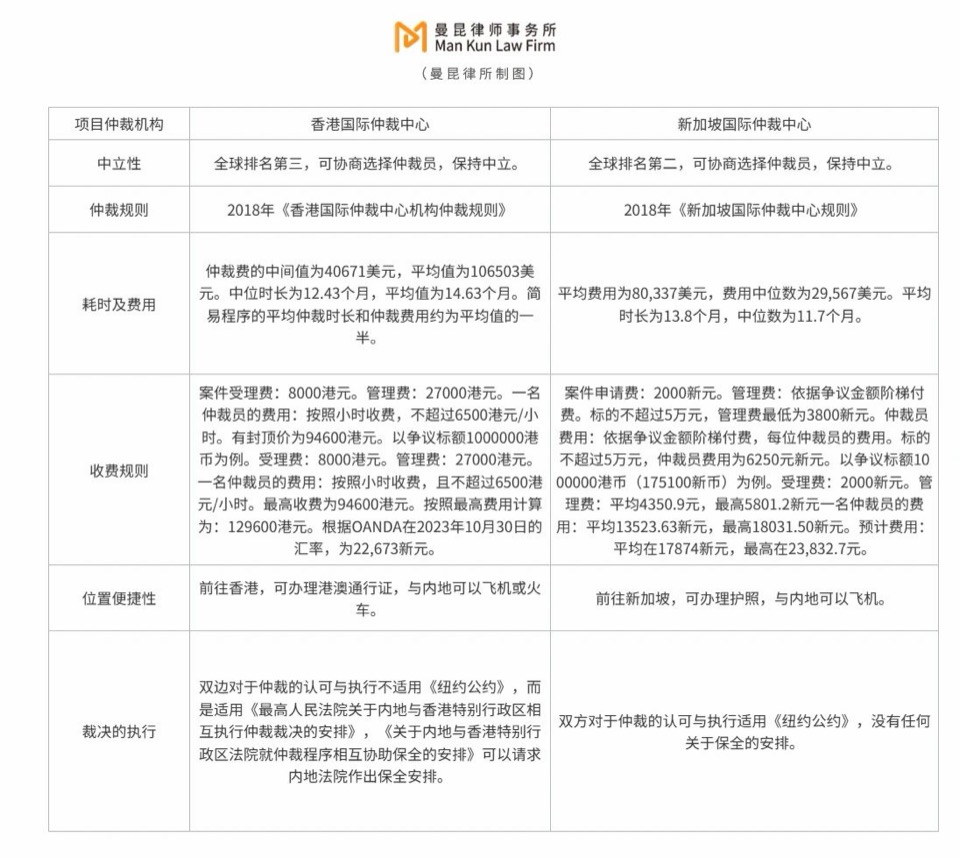
3. Comparison Between the Hong Kong International Arbitration Centre and the Singapore International Arbitration Centre
Recommendations from Mankun Lawyers
When agreeing on international arbitration for disputes involving virtual currencies, Mankun lawyers offer the following recommendations:
-
From a cost perspective, the estimated maximum costs at the Singapore International Arbitration Centre are slightly higher than those at the Hong Kong International Arbitration Centre;
-
In terms of familiarity with the mainland judicial environment, although both locations blend Chinese and foreign cultures, the Hong Kong International Arbitration Centre is more familiar with the judicial environment of mainland China;
-
Regarding applicability and enforcement in mainland China, prioritizing the Hong Kong International Arbitration Centre is relatively more advantageous. Of course, if both corporate entities are established in Singapore, or if the assets are located in Singapore, the Singapore International Arbitration Centre would be the preferred choice based on the principle of arbitral convenience.
Choosing between Hong Kong and Singapore for international arbitration—what else would you like to know? Feel free to leave comments or add Mankun lawyers on WeChat for further discussion.

{loadmoduleid 245}

To submit articles or request permission to reprint, please add WeChat ID: MankunLawFirm