
It is acceptable to cater to fans, but do not spoil them.
Special Disclaimer: This article is an original work by Attorney Shao Shiwei. It represents only the personal views of the author and does not constitute legal consultation or legal advice on specific matters. For article reprints, legal consultations, or professional exchanges, please add: sswls66.
Have you ever considered that you yourself could become an NFT??The recently popular Friend.tech and Time Store exemplify this model. Key Opinion Leaders (KOLs) issue their own NFTs on these platforms, and fans who purchase them can engage in interactive communication with the KOLs. Is such a model truly permissible in China? This article provides an introduction and analysis.
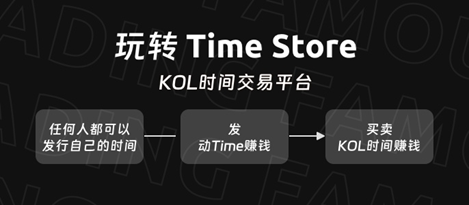
(Image source: Time Store official website)
01
Friend.tech Platform Mechanics
Friend.tech is a decentralized social platform built on Base, a Layer 2 network launched by Coinbase. It leverages strong integration with Twitter to obtain users’ Web2 identities, thereby creating opportunities for monetization based on such identities[1].
The more popular a user is, the higher the price of their NFT. Friend.tech has clearly mastered the mechanics of the fan economy.
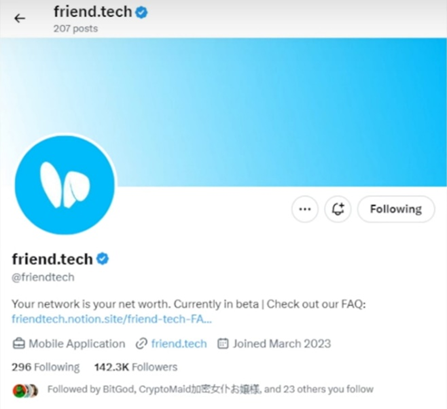
(Friend.tech Twitter account)
The specific mechanism involves linking the platform with users’ Twitter accounts. For instance, when a KOL (Key Opinion Leader, i.e., an internet celebrity or influential figure) joins as a new participant, they activate their account by entering another user’s invitation code and paying 0.01 ETH. Upon registration, the KOL’s account generates tradable “keys” (tokens representing ownership and access rights on the platform). If other users subsequently purchase these keys, the price of the KOL’s keys increases; if they are sold by other users, the price decreases. KOLs are priced by the market according to their influence, with their value tokenized in the form of NFTs.
Real-time prices for relevant accounts can be viewed on the official website:
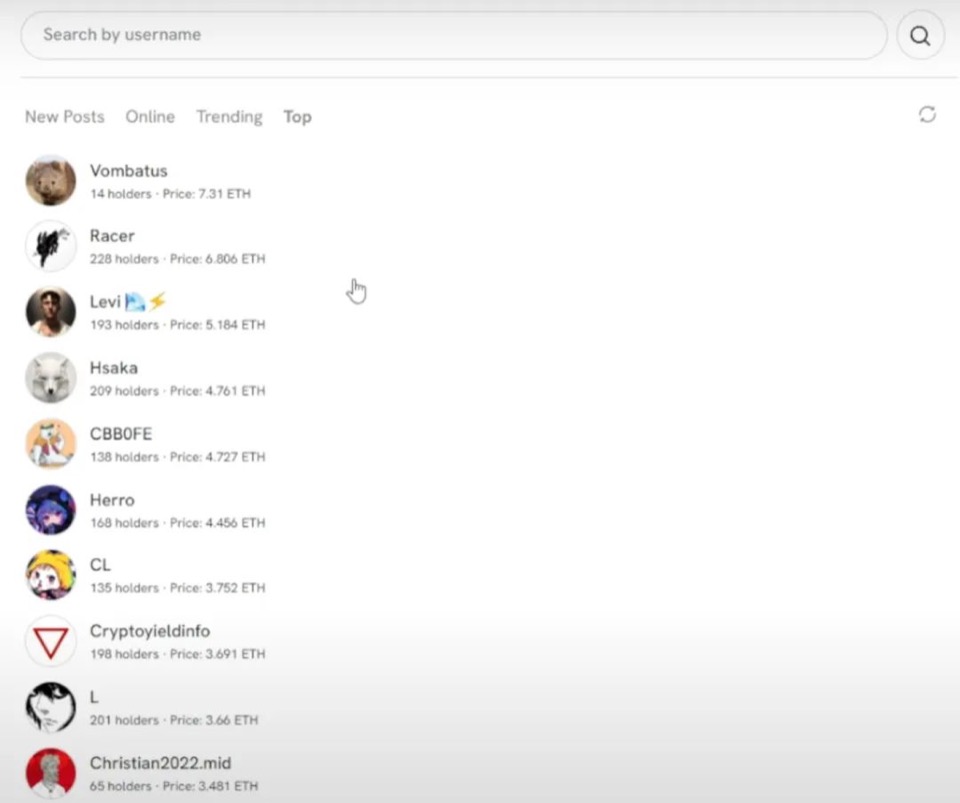
According to data on Keys holdings, as of August 25, the latest rankings for Friend.tech “Keys” prices show that the founder, Racer, temporarily holds the top position at 2.91 ETH, with earnings estimated at approximately 90 ETH[2].

02
How Friend.tech Generates Revenue
As a decentralized social platform with financial attributes, Friend.tech’s core mechanism converts Twitter connections into tradable “keys.” After purchasing a KOL’s keys, users gain access to the KOL’s friend list and can chat directly with the group owner in group chats. This provides ordinary users with a convenient way to communicate directly with industry leaders. For example, those seeking better job opportunities can post resumes directly in the group; those interested in the latest industry developments can follow the viewpoints and ideas shared by KOLs in the group chats; or, simply based on optimism about a particular KOL and the expectation of future buyers, users may purchase the group’s keys to join.
After payment, users can enter the group chat to converse with the KOL. Each user can only see the chat content between themselves and the KOL, and cannot view other participants’ dialogues within the group:
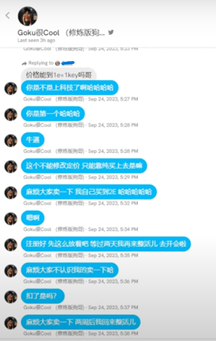
As a KOL, one can earn transaction fees from the buying and selling of their keys by others while operating their chat room. As an ordinary user, one can profit from price differentials by identifying potential opportunities and engaging in low-buy, high-sell strategies.
03
Time Store: A KOL Time Trading Platform
Similar to Friend.tech is the recently launched Time Store (whose predecessor was “Miao Ah” in 2017—the platform claims to be the first time-trading platform in China). Users purchase tokens issued by KOLs to buy their time, thereby enabling interactive communication with the KOLs.
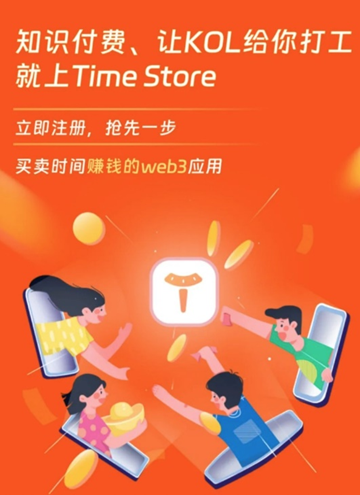
(Image source: Time Store official website)
After users purchase a KOL’s time, both parties have opportunities for online and offline interactive communication:
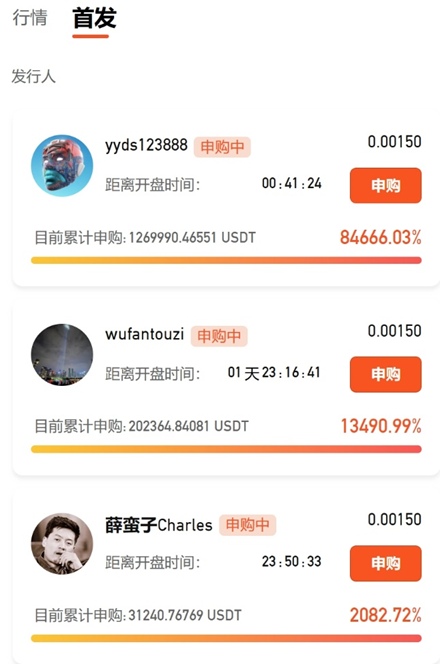
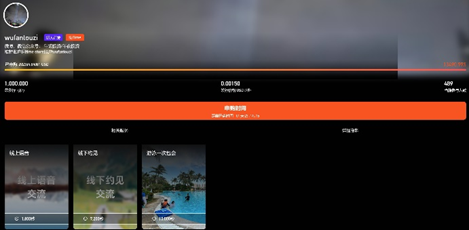
(Image source: Time Store official website)
04
Is It Legal for Individuals to Issue Tokens?
First, we need to clarify several concepts. NFT (Non-Fungible Token) refers to non-fungible tokens built on blockchain technology. Its counterpart is fungible tokens, such as Bitcoin, Ethereum, and other virtual currencies. The characteristic of fungible tokens is that each unit has equal utility and value and is interchangeable. In contrast, only one NFT can be generated per contract address; they are not interchangeable. NFTs can serve as carriers for storing real-world assets such as artworks, or function as virtual currencies.
According to the 2017 “Announcement on Preventing Risks of Token Issuance and Financing,” anyorganization or individualis prohibited from illegally engaging in token issuance and financing activities. The April 2022 “Initiative on Preventing Financial Risks Related to NFTs” also stated, “Resolutely curb the tendencies toward financialization and securitization of NFTs, and strictly prevent risks of illegal financial activities.
The business models of Friend.tech and Time Store are common in the Web2 world, such as paid Q&A communities like Liu Run’s “Evolution Island,” where paying membership fees grants access to community circles to observe discussions by industry leaders. However, in the Web3 domain, these two platforms tokenize social value by allowing users/KOLs to issue tokens for fans to purchase. Nevertheless, China’s relevant policies do not permit any organization or individual to issue tokens. Digital collectibles, as the localized product of NFTs in China, primarily emphasize their collection value as digital artworks and seek to prevent their financial attributes.
During platform operations, if false statements emerge in the market to manipulate public opinion and cause panic among users, the prices of certain KOLs may drop rapidly, leading to a collapse. Users who purchased earlier may seize the opportunity to sell at peak values, whereas later participants may become trapped, resulting in significant financial losses.
If certain KOLs guide large numbers of users to purchase their NFTs through hype, deception, or price manipulation, but fail to provide sustained, stable, and high-quality services, and then dump their NFTs to secure high profits after inflating prices, it will also lead to substantial financial losses for many users.
Under such trading models, if numerous user complaints arise, both the KOLs and the platform mayface criminal risks involving illegal fundraising, pyramid schemes, and fraud。
05
Is It Safe for Development Teams Based Abroad?
It is understood that Time Store claims its entire team has moved overseas. This raises the question: if the project and personnel are located abroad but primarily target Chinese users for registration and use, can they evade jurisdiction under China’s Criminal Law? The answer is no.
China’s Criminal Law stipulates territorial jurisdiction and personal jurisdiction. Territorial jurisdiction means that China has jurisdiction if either the criminal act or its consequences occur within Chinese territory. Personal jurisdiction means that China also has jurisdiction over Chinese citizens who commit crimes outside Chinese territory.
Therefore,China has jurisdiction whenever a Chinese citizen commits a crime, or when the criminal act or its consequences occur within China.。
06
Mankun Law Firm’s Reminder
The Web3 world allows for extensive content innovation, which is why increasing attention is being paid to blockchain, the metaverse, and related fields. Policies such as the 2021 “Guiding Opinions on Accelerating the Application and Industrial Development of Blockchain Technology,” jointly issued by the Ministry of Industry and Information Technology and the Cyberspace Administration of China, indicate that China adopts an encouraging and supportive stance. However, since the 2013 “Notice on Preventing Bitcoin Risks,” regulatory authorities have continuously issued documents expressing negative attitudes toward the issuance and trading of virtual currencies, mining, and related activities. Therefore, while Web3 entrepreneurs pursue various forms of content innovation, they must strictly avoid crossing regulatory red lines; otherwise, they may face imprisonment.

https://ld-capital.medium.com/friend-tech-%E6%B5%85%E6%9E%90socialfi%E8%B5%9B%E9%81%93%E6%96%B0%E8%B4%B5-203d43b61acb