

Special Declaration: This article is an original work by Lawyer Shao Shiwei. It represents only the personal views of the author and does not constitute legal consultation or legal advice on specific matters. For article reprints, legal consultations, or professional exchanges, please add WeChat contact: sswls66.
Preface:
Under China’s current policy and regulatory environment, entrepreneurs in the blockchain gaming sector must, from a compliance perspective, take care to avoid risks related to gambling.
At a press conference held by the Supreme People’s Procuratorate on November 29, 2021, it was explicitly stated that “a significant characteristic of application software suspected of involving gambling is the presence of relevant cash-out functions。”
The basic model of blockchain games, “play to earn” (playing while earning), refers to a mechanism where players can obtain in-game tokens by playing games. These tokens can be exchanged for virtual currencies such as Tether (USDT). Moreover, most blockchain game users do not play primarily for entertainment; their actual purpose is to buy low and sell high the tokens within the blockchain games to realize profits.
Therefore, based on the aforementioned description by the Supreme People’s Procuratorate, does the “play-to-earn” model of blockchain games inherently possess characteristics of gambling? This article explores this question.
01
Cases of Blockchain Games Involving Gambling
Fomo3D, which raised RMB 70 million in just 16 days after its launch, is a game built on the Ethereum network. Its core gameplay is “auctioning,” where each bid by a player resets the game countdown timer. The last bidder wins 48% of the Ether in the prize pool. This “big fish eat small fish” style game reportedly generated a monthly transaction volume of RMB 170 million.
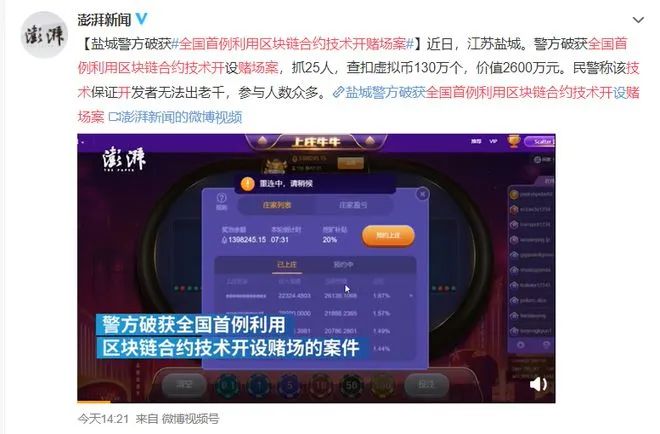
Biggame – The first case in China involving the operation of a casino using blockchain contract technology. Developed by individuals within China, this app required users to install an EOS wallet, convert Renminbi (RMB) into EOS tokens, and then provided various gambling games for users to place bets.
02
What Constitutes Gambling in Games?
Chinese law does not explicitly stipulate which online games constitute gambling crimes. However, we can summarize and analyze this issue through relevant regulations and policies.
According to the Notice issued by the General Office of the Ministry of Culture in 2020, titled “Guidelines for Supervision and Law Enforcement Points on Virtual Currencies in Online Games,” the main distinctions between ordinary guess-based online games, online games containing content promoting gambling, and online gambling games are as follows:
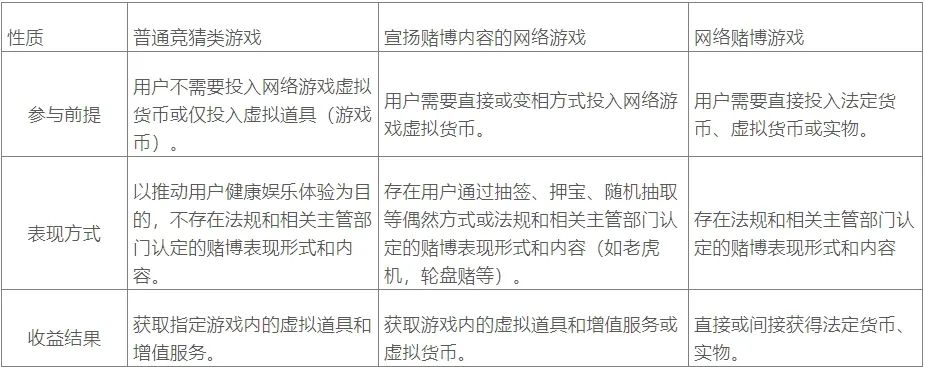
From this table, we can summarize that if anonline game involves gambling, it must simultaneously meet three key criteria:
1. Prerequisite for Participation: Users need to pay to purchase in-platform props or game currency.
2. Mode of Expression: The gameplay involves chance, allowing users to participate in a “betting small to win big” manner, with the possibility of incurring losses.
3. Outcome of Returns: Users cash out, directly or indirectly, to obtain fiat currency.
03
How to Determine Whether Blockchain Games Involve Gambling?
Combining the above three criteria, we analyze them in light of the characteristics of blockchain games.
1. Paying to Purchase In-Platform Props or Game Currency.
The vast majority of blockchain game platforms require users to purchase in-platform props or tokens through payment. The specific process typically involves: first, purchasing virtual currency with fiat currency through exchanges (such as Binance, OKEX, etc.); second, downloading a wallet (such as TokenPocket, MetaMask, etc.) and transferring the purchased virtual currency into the wallet; and third, connecting the wallet to the blockchain game to purchase props or tokens within the platform via the wallet.
Even if a small portion of blockchain games initially claim to be free-to-play, this is often a promotional strategy to attract users. Subsequently, to achieve a better gaming experience, users are still required to spend money.
2. Direct or Indirect Cash-Out to Obtain Fiat Currency.
For overseas blockchain game projects, users can cash out their NFTs or game tokens within the platform into virtual currencies on exchanges. In China, due to national regulations on virtual currencies, virtual currencies do not have legal tender status and are considered virtual commodities. Furthermore, according to relevant laws and regulations on games [1]: “Services shall not be provided for the trading or exchange of game points, or for the disguised exchange of cash or property through ‘virtual currencies’ or other means.”
Therefore, for blockchain games operated within China, if the tokens issued within the game support conversion into virtual currencies (known as “cashing out” or “xiafen”), then combined with Criterion 1 above (“loading funds” or “shangfen”), the game possesses the “loading and cashing out” characteristics typical of gambling crimes.
3. Gameplay: Chance, Betting Small to Win Big, and Possibility of Loss.
Currently, blockchain games can be mainly categorized into: nurturing, simulation management, sandbox, card-based, mining, competitive, and other types. The category alone cannot determine whether a game involves gambling; the specific determination depends on the platform’s particular gameplay mechanics.
For example, in gameplay mechanisms such as blind boxes or lucky draws, the outcome of winning or losing is highly contingent on chance. If the value of the game props obtained by users through paid draws varies significantly, creating a possibility of loss, the risk of involving gambling is high.
04
Recommendations from Mankun Law Firm
Given that domestic laws and regulations regarding blockchain and the metaverse are not yet fully developed, and that relevant policies maintain a negative stance toward virtual currencies and mining, if project planners intend to launch blockchain game products in China,they must ensure strict control over legal procedural risks both before and after the product launch。
Before launch, a rigorous risk assessment of the game mechanics must be conducted to prevent gambling-related risks;
After launch, product data must be regularly monitored to prevent users from exploiting platform vulnerabilities for gambling purposes;
Additionally, user complaints and reports should be taken seriously. Once any gambling-related behavior is identified, timely optimizations and improvements to the product must be implemented.
[1] Notice of the Ministry of Public Security, the Ministry of Information Industry, the Ministry of Culture, and the General Administration of Press and Publication on Regulating the Operational Order of Online Games and Prohibiting Gambling Through Online Games [Document No.: Gong Tong Zi [2007] No. 3]