AI summaryEssential knowledge for participants in the crypto community.This article is an original work by Mankun Law Firm. It represents only the personal views of the author and does not constitute legal consultation or legal advice on specific matters.…
Essential knowledge for participants in the crypto community.
Special Disclaimer:
This article is an original work by Mankun Law Firm. It represents only the personal views of the author and does not constitute legal consultation or legal advice on specific matters. For permission to reprint this article, please contact Mankun Law Firm staff at: MankunLawFirm
As the saying goes, misfortunes never come singly, and novice investors are often the first to suffer losses.For friends in the crypto community, in addition to the risk of having bank cards frozen when receiving payments from the sale of virtual currencies, many are now encountering an even more distressing issue: the freezing of their accounts on virtual currency exchanges.
Previously, a friend in the crypto community forwarded an article to me. The gist was that the account of a U.S.-based virtual currency encryption fund had been frozen on a well-known Chinese exchange because the account had received virtual currency assets involved in a case. After contacting public security authorities in mainland China, the fund provided materials such as proof of employment and account transaction records, but the public security authorities still did not apply to unfreeze its exchange account. The author of the article stated that he was unaware of the gambling website involved in the case and that his transactions were merely routine operations conducted on other virtual currency exchanges. He provided proof to the public security authorities, but they did not unfreeze his account, believing that he might be suspected of illegal activities.
Many people are puzzled. They reason: "I can understand if my Chinese bank card is frozen, since everything is within mainland China. But the virtual currency exchange I use is registered overseas; how can Chinese public security authorities have jurisdiction?" This article will discuss this topic.
Can Chinese Public Security Authorities Freeze Accounts on Overseas Exchanges?
Here is a concise summary:Not only is it possible, but virtual exchanges are generally very cooperative.。
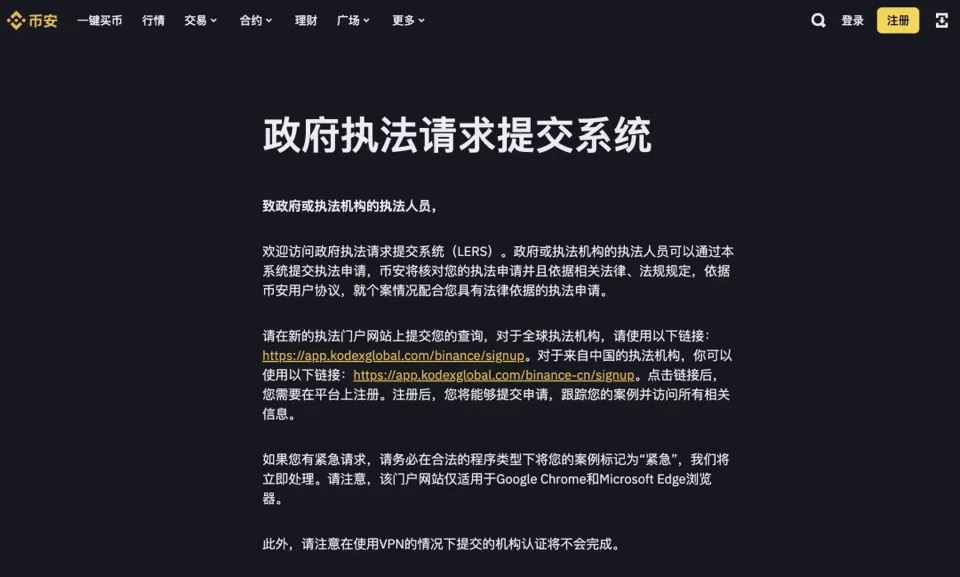
Taking Binance, a leading player in the industry, as an example, its official website even features adedicated linkfor Chinese law enforcement agencies, fully assisting in the smooth conduct of law enforcement work in mainland China. Moreover, it is rumored that certain virtual currency exchanges have established specialized channels for liaison with public security authorities in various regions of China to share information—a prospect that is quite intriguing (this is hearsay, and its veracity is unconfirmed).
According to Article 144, Paragraph 1 of the Criminal Procedure Law, public security organs may, as required for the investigation of crimes, inquire into and freeze the deposits, remittances, bonds, stocks, fund shares, and other property of criminal suspects in accordance with regulations. Relevant entities and individuals shall cooperate. Therefore, during the handling of cases, public security organs will seal and freeze accounts involved in the case. These accounts often serve as channels for new types of telecommunications and internet-based illegal crimes, frequently involving charges such as aiding information network criminal activities, money laundering, and concealing or disguising the proceeds of crime.
So, do user accounts on virtual currency exchanges constitute property or property rights involved in a case? If public security organs have evidence proving that a user's virtual currency account is related to criminal activities, such as suspected money laundering, fraud, gambling, or pyramid schemes, they have the authority to take compulsory measures against it to facilitate fact-finding and evidence collection. If a user's virtual currency account is unrelated to criminal activities, public security organs have no authority to take compulsory measures against it; otherwise, it would constitute an abuse of power and an infringement of property rights. Of course, in such circumstances, users also have an obligation to cooperate with the investigation by public security organs and provide relevant supporting documentation.
Can Public Security Authorities Directly Transfer Away Assets Involved in a Case?
(1) Traditional Property Involved in Cases
Under Chinese law, for property involved in criminal cases, public security organs may take measures such as sealing, seizing, and freezing. However, in principle, property involved in criminal cases cannot be directly deducted or transferred by public security organs. Disposal of such property is typically carried out by the court after judgment, either directly by the court or by public security organs entrusted by the court.
However, there are exceptions in practice. For telecommunications and internet-based crime cases, under specific conditions, public security organs may directly deduct and return funds belonging to victims from the property involved in the case. For instance, according to the Ministry of Public Security's "Provisions on Several Issues Concerning the Return of Frozen Funds in Cases of New Types of Telecommunications and Internet-Based Illegal Crimes," public security organs may directly deduct and return funds involved in the case if three conditions are met: first, the suspected crime is a telecommunications or internet-based crime, i.e., cases where offenders defraud or steal others' lawful funds through telecommunications and internet technologies; second, upon review by public security organs, the frozen funds are confirmed to be the victim's lawful funds; and third, public security organs must return the funds in the prescribed manner, such as direct full return based on direct tracing or timestamp tracing, or proportional return based on the victim's loss amount and the total amount involved in the case when tracing is not possible.
(2) Virtual Property Involved in Cases
The methods used by judicial organs to return virtual currencies as property involved in a case to victims are not entirely uniform. Although China has issued certain regulations and notices regarding the supervision of virtual currencies, such as the "Notice on Preventing Bitcoin Risks" and the "Announcement on Preventing Risks Associated with Token Issuance and Financing" by the People's Bank of China and other departments, as well as the recent "Notice on Further Preventing and Disposing of Risks Associated with Virtual Currency Trading and Speculation" issued by ten ministries and commissions including the Supreme People's Court, the Supreme People's Procuratorate, and the Ministry of Public Security, these documents do not specifically prescribe the procedures for public security organs to seal, seize, or freeze virtual currencies, nor do they specify the methods for judicial disposal. Consequently, controversies and disputes inevitably arise in practice.
Apart from regulatory provisions, there are also technical difficulties for public security organs in sealing, seizing, freezing, or deducting virtual currencies involved in cases. Because virtual currencies have no physical form and exist only on blockchain networks, controlled by strings of passwords and keys, public security organs must first obtain the user's account information and password from the exchange and require the exchange to cooperate by providing relevant evidence and assistance in execution. However, exchanges may refuse or resist such requests from public security organs, as they also need to protect user privacy and interests.
In current practice, criminal suspects subject to compulsory measures (such as criminal detention or residential surveillance at a designated location), after receiving legal education from public security organs (the specific methods vary by locality), often voluntarily cooperate with public security organs in handling virtual property involved in the case. For example, they may transfer the virtual currencies in their possession to a virtual currency account address created by public security organs. For cases with simple facts, such as where A steals one bitcoin from B in the context of cybercrime, after B reports the case and public security organs apprehend A, they may instruct A to transfer the stolen bitcoin to a wallet address created by public security organs. Upon confirming that B is the victim, public security organs may directly transfer the one bitcoin involved in the case to B.
Of course, criminal cases in reality are often complex, involving a large number of victims and even a large number of criminal suspects. In such scenarios, direct deduction and transfer of virtual currencies is difficult. However, sealing and freezing remain possible. Seizure operations generally involve transferring the virtual currencies involved in the case from the criminal suspect's account to a virtual currency wallet account held by public security organs.
How Can Citizens Protect Their Interests?
According to Article 145 of the Criminal Procedure Law, if property such as sealed or seized items, documents, mail, telegrams, or frozen deposits, remittances, bonds, stocks, or fund shares is confirmed to be unrelated to the case, the sealing, seizure, or freezing shall be lifted within three days, and the property shall be returned.
If a citizen's exchange account is frozen, they may proactively submit corresponding proof of assets and legal documents to demonstrate that the investment activity was personal and that the source of funds was lawful, thereby applying to public security organs for the release of compulsory measures. If public security organs refuse to lift the measures or fail to respond, the citizen may file a complaint with the People's Procuratorate. If the People's Procuratorate also does not support the complaint or fails to respond, the citizen may file an administrative lawsuit with the People's Court. Of course, during this process, one may also choose to engage a lawyer for assistance.
Based on the need to combat illegal and criminal activities, Chinese public security organs have the authority to freeze citizens' bank accounts or exchange accounts in accordance with the law. When faced with formal documents from public security organs, exchanges are highly likely to cooperate. In addition to passively waiting for public security organs to handle the matter, investors may proactively contact public security organs and provide relevant supporting materials to strive for the early unfreezing of their accounts.
Of course, the above suggestions are remedial measures. As the saying goes, "The best physicians treat disease before it arises." For friends in the crypto community, if you hold substantial lawful digital assets, storing them in truly decentralized wallets may be a more recommended option.
Recommended Reading
[Infographic] The Risks of Selling USDT Virtual Currency
Mankun Case | Bank Card Frozen with Millions Due to USDT Sales, Mankun Lawyers Successfully Unfreeze Account
Mastercard U-Card and UnionPay U-Card: Can They Guarantee Safe USDT Cash-Out Without Card Freezing?

To submit articles or request permission for reprinting, please add WeChat ID: MankunLawFirm