

The cryptocurrency circle is small; do not engage in misconduct.
Special Disclaimer:
This article is an original work by Mankun Law Firm. It represents only the personal views of the author and does not constitute legal consultation or legal advice on specific matters. For reprint permissions, please contact Mankun Law Firm staff at: MankunLawFirm
Recently, I observed some individuals experimenting with an intriguing method for getting rich quick—algorithmic collision with private keys.As a lawyer, I immediately recognize this as highly criminal.
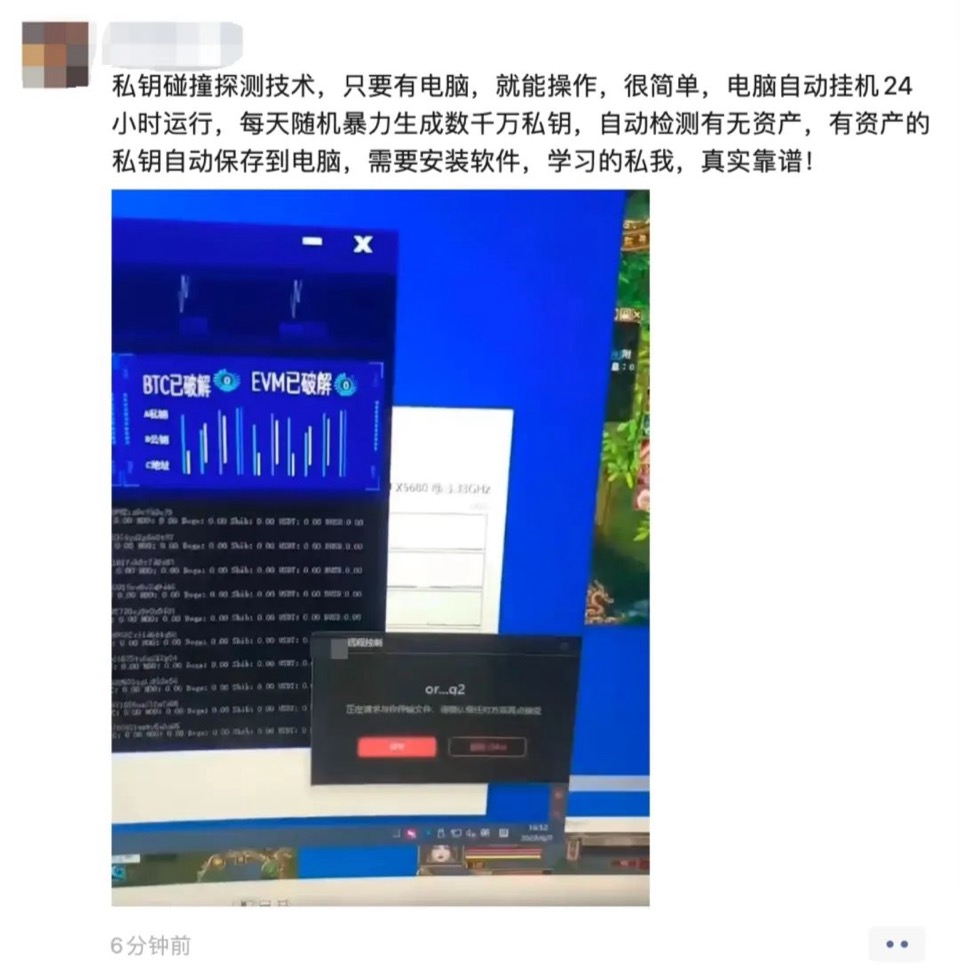
Since the cryptocurrency sector gained prominence, there have been continuous incidents of virtual assets theft involving individuals and institutions: Binance hacks, TP Wallet breaches, and thefts from major holders. News of such thefts is rampant daily, often involving flows amounting to hundreds of millions or even billions of US dollars, which is staggering. Opportunists have begun to fantasize that if they could access these vast funds, they would reach the pinnacle of success. Consequently, various tools and software claiming to enable algorithmic collision, private key cracking, and private key probing have emerged. Without exception, they claim to allow users to obtain others' private keys, transfer their coins, and then disappear into obscurity, enjoying a life of luxury with sunshine, beaches, yachts, fine wine, and beauty.
This is truly criminal, and therefore impermissible!
Consider a simple logical point: if these tools and methods could successfully acquire others' coins, why would the developers sell them to you instead of using them themselves? One successful use would suffice for a lifetime of wealth. Why would they need to painstakingly promote these tools on platforms like Zhihu, Toutiao, and WeChat Moments? Are they genuinely aiming to benefit the public?
The reality is that nearly all thefts (excluding insider theft, which, as you may understand, relates more to acting skills than technology) stem from:
1. Hacker intrusions;
2. Private key leaks.
These two causes can essentially be consolidated into one: hackers employ various means (including but not limited to phishing websites and backdoors in programs) to obtain your private keys and subsequently steal your coins. Currently, regarding the so-called 'brute-force collision' tools sold in obscure corners of domestic websites, I have yet to see any professional authority confirm their actual efficacy.
Therefore, in my opinion,such businesses are scams.If you purchase such tools and find them ineffective, you cannot reasonably demand a refund. The seller will likely claim that you used the tool incorrectly or that the data volume was too large, requiring patience. By then, the seller will have absconded. Having spent only a few days writing a script and earning tens of thousands, wouldn't they flee rather than wait to be caught? If you discover the ineffectiveness, you cannot report it to the police, as law enforcement might be uncertain whether to arrest you or the seller first. Consequently, you are left to swallow this loss in silence.
Another simple logical point is that even if you truly acquired such unparalleled 'martial arts secrets' akin to the 'Sunflower Manual' or 'Evil-Resisting Sword Spectrum,' would you have the fortune to spend the money? Your remaining life might be spent in prison.
This is not a threat, but a stark anti-fraud warning.
Let us hypothesize different scenarios:
1. The software is effective.If the buyer steals coins by merely obtaining private keys rather than intruding into computer systems, it may not constitute the crime of illegally obtaining data from computer information systems. Instead, it would be classified as theft. The maximum penalty for theft can be life imprisonment, implying prolonged incarceration. As for the seller, do not relax. You may be considered an accomplice to theft (with sentencing measured against the principal offender based on your specific role in the crime; given the high volume of sales, penalties accumulate). Alternatively, you may be charged with the crime of providing or imparting methods for committing crimes (since the software requires instructions for use, providing them constitutes a crime, typically resulting in several years of imprisonment; the more you sell, the longer the sentence. To qualify for probation, you must first disgorge illegal gains, rendering the effort futile). Or, you may face charges for providing programs or tools for intruding into or illegally controlling computer information systems (this charge is slightly lighter, with a maximum sentence of less than seven years. You can only hope your defense lawyer effectively argues for this lesser charge to mitigate punishment). With such risks, do you still intend to spend the money? Exit controls could be imposed instantly, and ultimately, all crimes will be brought to justice.
2. Of course, in my view, such products are likely a 'tax on intelligence', meaning purchases that leave buyers regretful and forced to enhance their discernment. Sellers exploit buyers' FOMO (if this can even be considered FOMO), with the intent of illegal possession (i.e., taking the money and fleeing). They employ methods of fabricating facts (deceiving buyers that they can achieve instant success) and concealing the truth (the product is essentially low-quality, likely developed in a few days by a junior-year computer science student, and possibly available at a lower price with bargaining). Thus, they defraud aspiring speculators of significant sums. This undoubtedly constitutes fraud; the higher the selling price, the longer the sentence. In this scenario, the buyer loses only money and dignity, without direct involvement in crime. After all, how can one commit murder with a toy gun?
3. There is a third scenario. The buyer has arranged everything in advance,liquidated assets, and fled abroad. Everything is ready, leaving only the act of launching the software. Then, they discover the software is fake... Too tragic. Let us not continue this hypothesis.
Therefore, do not believe in algorithmic collisions or private key cracking. From any perspective, this is not, nor should it be, a legitimate business. With the current market showing signs of a potential bull run ('little calf'), it is better to earn money honestly and accumulate capital, or at least avoid losses, to prepare for the imminent major bull market. Then, rely on your genuine skills to achieve success.

{loadmoduleid 245}

For submissions or reprint requests, please add WeChat ID: MankunLawFirm